Category Archives: Mindfulness

Subject Clearing (old-2)

Math

Please see The Book of Subject Clearing

When studying a subject one should be able to detect the hidden assumptions and distortions present in it. This is especially necessary when one is studying the fundamentals of a subject. Such distortions can be very pervasive. They may even enter the definitions of words provided in dictionaries.

The following procedure may help one detect and clear assumptions and distortions present in a subject being studied.

  1. Make a list of key words that describe the concepts in that subject.

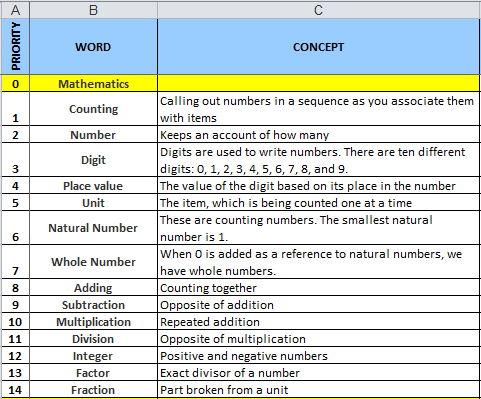
    Skim through the chapter that you are going to study, and make a list of key words that introduce new concepts in that chapter. Put that list on an Excel worksheet, so you can rearrange their order as necessary. You may add key words from previous chapters, or from other books, that you have studied. This list may grow as your studies get deeper into the subject.

  2. Write down the basic concept associated with the word.

    In a dictionary you may find the broad concept listed under ‘history’, ‘origin’, or ‘derivation’ of the word. This may appear either before, or after the definitions. For example, when you look up ARITHMETIC, you may find the underlying concept expressed as “skill with numbers.”

    Look for broad concept only. Sometimes you may have to piece together the concept from the derivations given. Ignore most other details. Once you have grasped the broad concept note it down next to the word on your Excel worksheet.

  3. Gradually build upon each concept for that subject.

    Study the materials in the chapter one paragraph at a time. Summarize and reduce each paragraph to its main thought before proceeding to the next. This may provide you with additional conceptual understanding. If so, then note it down next to the appropriate word on your Excel worksheet.

    If the paragraph is difficult to reduce to its main thought then look for words in that paragraph that may not have been understood fully. If the difficulty with a paragraph still persists then note down the confusion on your worksheet with the location. It may get clarified by something you read later.

    Since the required information may easily be accessed these days, the purpose of study is not to memorize but to sort out relevant data.

    The true purpose of study is to resolve inconsistencies (things that do not make sense) as you come across them. This develops a clarity of mind and the ability to think fast on your feet.

  4. Arrange the key words with their concepts in proper sequence.

    The key words should be listed starting with those that express the fundamental concepts. These are followed by those key words, which express derived concepts.

    Start by arranging the key words in the sequence they appear in the chapter. As you gain familiarity, rearrange the key words in the sequence that concepts seem to have evolved. Move the words expressing more fundamental concepts toward the top. Move the words expressing derived concepts toward the bottom.

    A “Priority” column may be added to your Excel worksheet. You may place numbers in that column to readjust the sequence, and then simply sort the list by that column.

  5. Note any inconsistencies among the concepts and clarify them.

    As the study of the subject progresses and better understanding comes about, the list of key words may be continually rearranged to achieve consistency among the concepts.

    If you notice any inconsistencies then this motivates research deeper into the subject. First review your materials to clarify any inconsistency. If it does not clarify easily then note it down on the worksheet and research through other materials in the library or on Internet.

  6. Clarify the fundamentals of the subject as a priority.

    The fundamentals concepts of a subject must be consistent. Any inconsistency at the fundamental level must be handled as a priority, since on this depends the consistency of later concepts in that subject.

    Look closely at the inconsistencies starting from the top. If an inconsistency does not resolve then look for underlying assumptions. Arbitrary assumptions may reveal gaps in the subject itself.

    There are likely to be many contributors to a subject. For example, many different cultures have contributed to the broad subject of religious knowledge. You may find similar concepts referred to by different words in different languages. Note down all those words and differences among the concepts. Seek consistency among these concepts and develop your own understanding.

  7. Make the subject as complete as possible.

    There are many examples in the subject of religion where gaps in knowledge are hidden under assumptions and dubious explanations. This may be the case with any subject where inconsistencies abound.

    When such assumptions and dubious explanations are ferreted out, then the gaps in knowledge become obvious.Real progress becomes possible now.

    Fill gaps in the subject with wider research. Make the subject as complete and consistent as possible through experimentation and direct experience.

.
Thus, subject clearing may occur.
.

Recognizing Objects

object2

Reference: Mindfulness Therapy

It is much easier to recognize physical objects than the subjective thoughts and ideas. So the person should gradually be brought up to a point that he can recognize physical objects in his present environment. The person’s memory is very fragile so no demands should be made to recall things from the past. All conversation must be limited to simple things in the present.

Get the person to recognize large, simple physical objects first by looking, touching and feeling them. Then give him smaller and more complex objects. Do not ask him to recall or recognize things out of his memory.

.

EXERCISE

Purpose: To get the person to recognize physical objects in his present environment.

  1. If it is difficult to get into communication with the person, imitate his actions. This might get you his attention.

  2. Get the person look at various items in his environment with the following command.  

    “Look at that ______.”

    Acknowledge when he looks as directed by saying, “Good, excellent, wonderful, etc.” Do this action gently, calmly and repeatedly for as long as it is comfortable.

  3. If it is difficult to get the person to look at objects in the environment, then bring items to him that he is familiar with. These could be his favorite toys, or possessions. Have him look at them, touch them and feel them until he can recognize them comfortably. 

  4. If it is still difficult to do step 2, take him to locations that he is familiar with, especially those, which were his favorite. Have him look at things there, touch them and feel them until he can recognize them comfortably.

  5. Once you are able to direct his attention go back to step 2. Get the person to look at items in his environment until he can do so comfortably without resistance. He does not have to identify the items to you. Let him also touch and feel them if he wants to.

  6. Next, get the person to identify items by pointing and asking, “What is this?” If he recognizes the item correctly then reinforce it by saying, “Yes. This is _______.” If he is unable to recognize the item then tell him with mindfulness, “This is _______,” and have him examine it by touching and feeling it.

  7. Get him to recognize large and simple objects first, such as, wall, door, chair, table, etc., and then, gradually, smaller and more complex objects.

  8. Encourage him to use all his physical perceptions. Do not ask anything that may require memory and recalling things from the past.

  9. Continue with this exercise until the person can comfortably recognize correctly the various items in his environment. This exercise may take as many sessions as necessary.

  10. After the person can recognize physical objects, ask him to recognize simple characteristics of those things, such as, number, shape and color. Make sure that the characteristics are obvious, that is, numbers are small, shapes are simple, and the colors are bright. 

  11. Next, get the person to visualize and draw simple objects, such as, ball, table, chair, etc. Never exceed his capability to visualize. If ideas get too complex for him to visualize, then make them simpler until he can visualize them comfortably.

  12. Gradually, get him to visualize subjective but simple ideas and describe them, such as, what it is like to get a haircut. Build up his ability to be mindful slowly and carefully. This itself will prove to be a wonderful therapy.

  13. The above exercise may require many sessions. Use your own judgment as to when to start and end a session.

.

Mindfulness N3: Physical Sickness and Basic Care

care

Whatever the sickness is, the first step is always to examine the body and treat it with rest, calm environment, and nutritious diet. The chemistry of the body needs to be corrected and restored back to its natural state. Many times we have acute situations due to injuries and illnesses. We have a well-developed medical system that uses proper operations and drugs to address those situations.

Once the acute situation is under control, the body is allowed to heal and strengthen with nutrition and physical exercise. The nutritious diet helps gradually replace the drugs that were used. It is important to exercise the senses of smell and taste with mindfulness, because the body uses them to find out what is good and nutritious.

Exercising the senses of smell and taste with mindfulness helps recover from physical sickness.

There are artificial imitations of smell and taste out there. One must guard against them.

.

MINDFULNESS N3: Physical Sickness and Basic Care

  1. Move the person to an area where he can rest and recuperate.

  2. Get the person medically examined by a doctor.

  3. Get proper diagnosis and treatment.

  4. Administer necessary drugs to help the person recover from acute illness and injury.

  5. Provide nutritious diet and physical therapy to help the person get off drugs.

  6. Exercise the person’s sense of smell and taste to recognize nutritious foods.

  7. Eliminate those things from diet that are not nutritious.

  8. Help build up the person’s immune system with proper foods.

  9. Let the environment of the person be calm, pleasant and secure.

  10. As the person regains health get him to exercise through walking.

  11. The person is fully recovered from physical sickness when his attention is no longer introverted into his body.

.

Being Objective

Book3

Reference: Mindfulness Therapy

After a person is able to recognize physical objects for what they are, he needs to separate them from his expectations, assumptions, biases, etc. This is being objective. A person who is trying to figure things out is not being completely objective. Objectivity involves looking at things more closely until it starts to make sense. To be mindful requires objectivity.

.

Exercise

  1. Place two objects, such as, a heavy book and large bottle about 10 feet apart so you can walk between them. Place them on stools or small tables such that you can pick them up easily.

  2. Walk over to the book. Pick it up. Look at it closely. Examine its color. Feel its weight. Sense its temperature. Then put it back exactly in the same place.

  3. Walk over to the bottle. Pick it up. Look at it closely. Examine its color. Feel its weight. Sense its temperature. Then put it back exactly in the same place.

  4. Execute steps 2 and 3 repetitively until you feel very comfortable with perceiving the book and the bottle objectively.

  5. Place two instruments, or objects that make different sounds, about 10 feet apart. Examine their sounds alternately. Do this repetitively until you feel very comfortable about perceiving the sounds objectively.

  6. Place two different flowers, or two objects with different aroma, about 10 feet apart. Examine their aroma alternately. Do this repetitively until you feel very comfortable with perceiving the aromas objectively.

  7. Place two different fruits, or two different edible objects, about 10 feet apart. Examine their taste alternately. Do this repetitively until you feel very comfortable with perceiving the tastes objectively.

  8. Place two different cloths, or two objects with different textures, about 10 feet apart. Examine their texture alternately. Do this repetitively, until you feel very comfortable with perceiving the textures objectively.

  9. You may do this exercise as often as needed until you have started to perceive the physical objects around you objectively.

  10. Take cue from this exercise, and start to examine mental objects (ideas, emotions, feelings, etc.) more objectively on your own, as often and for as long as you feel comfortable.

.

The 12 Aspects of Mindfulness

Reference: The Book of Subject Clearing

Mindfulness provides the discipline for looking and contemplation. The core of mindfulness may be described as follows:

1.     Observe without getting influenced by your expectations and desires.

Desires make one want certain outcomes. This leads to speculations that have no basis other than one’s expectations. But it is only when you know what is there can you predict future in a reasonable and consistent manner.

2.     Observe things as they are, without assuming anything.

Familiarity makes one assume certain things to be there. Such assumptions can take the form of beliefs, convictions, biases, fixed ideas, etc. The visualization is already there in the mind, and it gets superimposed over what is actually there. However familiar something may be, it is never permanent, and it may not actually be there.

3.     If something is missing do not imagine something else in its place. 

If something is missing, then recognize that it is missing. Do not imagine something in its place. If someone asks you a question and no answer come up in your mind, then do not feel obliged to make up an answer. Accept that you do not have an answer.

4.     If something does not make sense, then do not explain it away.

If something does not make sense, then recognize that it does not make sense. Do not try to justify it. Justification simply puts the blame somewhere without resolving the inconsistency. When you are faced with an inconsistency, and you feel an impulse to explain it away, then be alert to what you might be taking for granted. At times it may take some out-of-the-box thinking to realize what is going on.

5.     Use physical senses as well as the mental sense to observe.

We associate the idea of sense organs with eye, ear, nose, tongue, and body. We use them to observe physical objects, such as, chair, car, house, etc. However, the mind is also a sense organ, which senses ideas, thoughts, feelings, emotions, etc. These are mental objects. When being mindful, recognize both physical and mental objects for what they are.

6.     Let the mind un-stack itself. 

Let the mind un-stack itself naturally through patient contemplation on whatever comes up. Observe the issue uppermost in the mind, and then the next, and the next. Let the mind deal with issues in the order it wants to.  There should be no effort to recall, to dig for answers, or to interfere with the mind in any way.  Simply look at what is right there in front of the mind’s eye at any moment. The mind will never present anything overwhelming when allowed to un-stack itself.

7.     Experience fully what is there.

Experiencing is the deepest form of mindfulness. A person is deeply mindful of his feelings, emotions and impulses when he is experiencing them. So, dive into the very heart of whatever arises in the mind without resisting. If the mind is racing, then experience it racing without contributing to it.

8.     Do not suppress anything from yourself.

Not suppressing anything from yourself is being totally honest with yourself. Follow your attention wherever it goes and do not suppress. Do not avoid something just because it seems shameful or painful. It is the suppression of perceptions, memories, knowledge, visualizations, thinking, etc., that causes all difficulties in life. By not suppressing you establish complete integrity of your perceptions.

9.     Associate data freely.

In order to practice mindfulness, you will have to let your mind associate data freely. Mindfulness is being comfortable with the very activity of thinking itself. So, let the mind associate data freely on its own.

10.  Do not get hung up on name and form.

Name acts as a broad reference point to something. Form is one of the many ways that a thing may be represented. The knowing of a thing goes beyond its name and form. Fixation on name and form may act as built-in judgment of what is there. To know something, one must go beyond name and form and look at it more closely including all its associations.

11.  Contemplate thoughtfully.

When mindfulness is practiced, thinking becomes contemplation. Problems are solved by looking at them non-judgmentally and recognizing the relationships. One looks around to get the missing information instead of trying to “figure it out”.

12.  Let it all be effortless.

When you let it be, it becomes effortless. Effort comes into play only when there is resistance to letting it be. It is completely safe when you let the body and mind unwind gradually on their own. Trouble occurs only when you become anxious and start to dig for answers.

The examples for these 12 aspects are provided in the following exercises. Practice these exercises until they become a natural part of your attention:

  1. Observe without Desires
  2. Observe without Assuming
  3. Observe what is Missing
  4. Observe the Incomprehensible
  5. Observe all Senses
  6. Let the Mind Un-stack
  7. Experience Fully
  8. Do not suppress
  9. Associate Data freely
  10. Observe beyond Name and Form
  11. Contemplate thoughtfully
  12. Let it be effortless

The above exercises should then be followed by the following exercises.

13. Handling Introversion
14. Powerful Mindfulness Exercise 1
15. Powerful Mindfulness Exercise 2

Mindfulness seems to be fundamental to all scientific observation, meditation, prayer, and other forms of spiritual practice. Incorporate mindfulness in your life as much as possible.

The following is an excellent lecture: Meditative Mind

.