The Amazing AI Super Tutor for Students and Teachers, Sal Khan, TED
This seems to be a great advance in education. I am impressed.
.
 Vinaire's Blog
The Amazing AI Super Tutor for Students and Teachers, Sal Khan, TED
This seems to be a great advance in education. I am impressed.
.
Reference: Beginning Physics II
.
Displacement Current, Maxwell’s Equations, Gauss’ Law, Magnetic Fields, Faraday’s Law, Ampere’s Law, Electromagnetic Waves, Electromagnetic Spectrum, Electromagnetic Wave Equation, Energy And Momentum Flux, Poynting Vector, Radiation Pressure
.
For details on the following concepts, please consult Chapter 12.
DISPLACEMENT CURRENT
We know that the field within a parallel plate capacitor is uniform and is equal to E = q/ε0A, where q is the charge on the capacitor and A is the area of the capacitor. If the capacitor is being charged, then both q and E are changing, and we can write that ∆E/∆t = (∆q/∆t)/ε0A = ID/ε0A, where ID is the displacement current between the capacitor plates (compared to the conductor current in the wire).

Thus,
ID = ε0A(∆E/∆t) = ε0 (∆E A/∆t) = ε0 (∆ψ/∆t)
where ψ is the electric flux through the area.
MAXWELL’S EQUATIONS
These four equations are relationships between the electric and magnetic fields and their sources, charges and currents. The electric and magnetic fluxes are determined directly from the electric and magnetic fields and are not separate variables. Thus, these equations tell us how to calculate the electric and magnetic fields that are produced by charges, both at rest and moving. The particular form that we have used for these equations is not the most useful for actual calculations but is the easiest to understand conceptually. For purposes of calculations, these equations are expressed more formally in the language of the integral and differential calculus, which can then be solved for specific cases.
(1) GAUSS’ LAW
The electric fields can be established by free charges. All electric field lines start at positive charges and end on negative charges (lines can also go to infinity, such as those of an isolated point charge, where they are presumed to land on opposite charges at that distance). By convention the number of electric field lines per unit area, the electric flux density, at a given point is chosen equal to the magnitude of the electric field at that point. It then equals the electric field at every other point as well. Gauss’ law then relates the total charge within a closed surface to the net number of electric field lines that pass through the surface.

(2) MAGNETIC FIELDS
There are no magnetic monopoles that act as sources for a magnetic field. Therefore, magnetic fields do not have poles where they begin or end. All magnetic field lines must therefore close on themselves. This means that any magnetic field line that passes through a closed surface must necessarily pass through the surface again in the opposite direction, in order to close on itself. This means that the net total magnetic flux which passes through a surface is zero.

(3) FARADAY’S LAW
An electric field can also be produced by a changing magnetic flux.

(4) AMPERE’S LAW
The magnetic fields are created by currents, either conduction current or displacement current.

These four equations constitute Maxwell’s equations, which are the fundamental laws governing the existence of electric and magnetic fields, which are jointly called electromagnetic fields. Electric fields exert forces on any electrical charges, while magnetic fields exert forces on moving charges.
ELECTROMAGNETIC WAVES
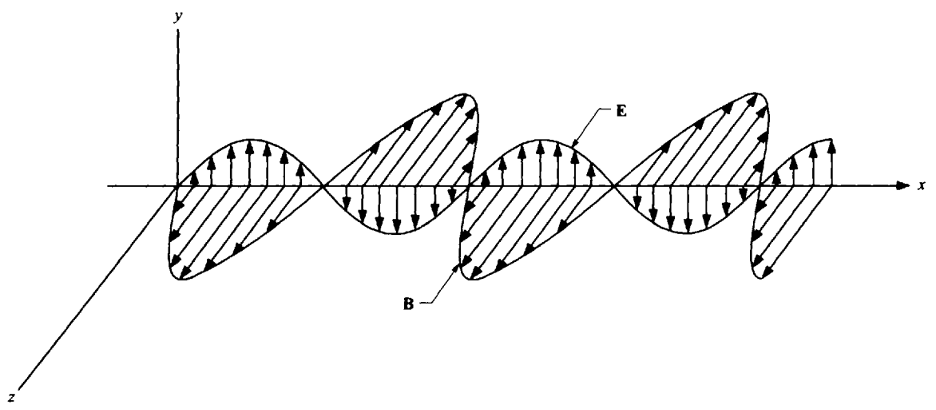
Maxwell was able to show that there were solutions to these equations that corresponded to waves propagating in free space, i.e., in regions where there are no charges or currents. These waves, which he called electromagnetic waves (EM) had special properties, which could be derived from these equations.
In the case of electromagnetic waves the time varying quantity is not the displacement but rather the electric and magnetic fields at a point in space.
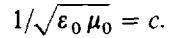
These waves are transverse, and their speed, in free space is equal to
For a wave traveling in the x direction, the electric and magnetic fields associated with this wave are in the y-z plane. These fields are also perpendicular to each other, and that their magnitudes are given by:
E = cB
It is useful to consider electromagnetic waves that are sinusoidal. This means that if we take a picture of the wave at any time, the disturbance will vary sinusoidally in space along the direction of propagation. Furthermore, at any position is space, the disturbance will vary sinusoidally in time.
The disturbance associated with an electromagnetic wave is the electric and magnetic field along the wave. Light consists of electromagnetic waves in a certain frequency range to which the eye is sensitive and can “see”.
ELECTROMAGNETIC SPECTRUM
Electromagnetic waves exist with wavelengths ranging from very small to very large (and corresponding frequencies from very large to very small). The various possible wavelength (and frequency) ranges constitute the electromagnetic spectrum. For small frequencies the wave is usually denoted by its frequency, and for short wavelength it is denoted by its wavelength.

All of these waves travel with a speed of c, all are transverse, and all carry perpendicular electric and magnetic fields with them.
ELECTROMAGNETIC WAVE EQUATION
The equation for the disturbance of an electromagnetic sinusoidal plane wave, traveling in the + x direction, is given in terms of its disturbance (an electric field in the y direction) by

Here ω is the angular frequency of the wave, and k is the “wavenumber” of the wave and has units of m-1. E0 is the maximum value of the electric field and is thus the amplitude of the wave.
For spherical waves, since the area of a spherical surface is 4πr2, the intensity falls off as l/r2. The amplitude of the wave, A, is related to the intensity by I α A2, and therefore A falls off as l/r. The formula for the magnitude of E is given by

ENERGY AND MOMENTUM FLUX
The electric and magnetic fields contain energy (substance). The energy density is uE = ε0E2/2 for electric fields and uB = B2/2μ0 for magnetic fields. The electromagnetic energy of an electromagnetic wave is just the sum of the energies of its electric and magnetic fields. The maximum energy is located at those points where the fields are at their maxima, which occurs at the crests of these waves. But these crests move with time at a speed of c, and therefore the energy is transported in the direction that the wave travels at this speed. An electromagnetic wave, therefore, carries energy and momentum with it.
The average energy transported per unit area and time as the wave travels with speed c in the x direction is defined as the intensity:

POYNTING VECTOR
The Poynting vector S depicts the direction and rate of transfer of energy, that is power,due to electromagnetic fields in a region of space. Its magnitude is EB/μ0, and its direction is perpendicular to E and B, and obeying the right-hand rule.
Whenever energy moves in a certain direction, there is also a certain amount of momentum in that direction. This is because energy is substance.
RADIATION PRESSURE
One can use sunlight in space to not only supply power but to exert a force on a spacecraft. The force that is exerted on the surface can best be characterized by the force exerted per unit area, or pressure, P = F/A.
.

Reference: A Course on the Factors
Buddha said, “All that we are is the result of what we have thought: it is founded on our thoughts, it is made up of our thoughts.”
A person sees only what he considers, and not the totality of that reality. His reality is made up of what he has thought—good or bad. We cannot say that all that is good is the result of our thoughts, and all that is bad is the result of some other person’s thought.
.
Compare the above to the following factor in Scientology.
Scientology Factor # 17. And the opinion of the viewpoint regulates the consideration of the forms, their stillness or their motion, and these considerations consist of assignment of beauty or ugliness to the forms and these considerations alone are art.
According to Hubbard, “One’s own universe is amenable to instantaneous creation and destruction, by himself and without argument.” This is not so. A person is bound by his own postulates that determine his individuality.
.
We are trying to approximate the reality with our postulates and reasoning. When we assign our thoughts to somebody else, we think we are no longer responsible for those thoughts. That is the source of all that is bad.
.

Reference: Exploring the Words of the Buddha
We all go through birth, aging, sickness, death, sorrow, and defilement. That is part of life. But why get fixated on these things. You just want to get on with the purpose of seeing with wisdom and keep evolving. What then is spiritual progress?
.
This account is primarily from MN 4 and MN 36:
Prior to Buddha, the general belief in the society was that the path to spiritual enlightenment was only through self-mortification. Buddha’s earlier teachers must have practiced self-mortification to arrive at the “base of nothingness” and the “base of neither-perception-nor-non-perception.” Buddha left his earlier teachers because he did not feel enlightened. But he continued on the path of self-mortification because that is what he thought he was supposed to do.
Striving on his own, Buddha took the practice of self-mortification to the utmost limit. Nobody else had gone through self-mortification to the extent Buddha did. Actually, Buddha almost died doing so. It was then that he suddenly realized the futility of this path. It was not self-mortification practiced by his earlier teachers that led them to the “base of nothingness” and the “base of neither-perception-nor-non-perception.” It was something else.
This was a huge realization. It went against all beliefs about spiritual practice in those times. There was an immediate blow back to Buddha’s realization. As Buddha gave up the path of self-mortification, other ascetics working with him left him, thinking that he had gone astray.
The next realization of Buddha was, if it was not self-mortification, then what was it, that enabled him to reach the “base of nothingness” and the “base of neither-perception-nor-non-perception” so quickly under his prior teachers! Though Buddha went through self-mortification under his teachers, the reason for his success was something else. It was his complete abandonment of sensual desires and unwholesome states in living that spurred his spiritual success.
With this realization, Buddha went back to the first Jhana and rapidly progressed through to the fourth jhana. He realized the bases of “nothingness” and “neither-perception-nor-non-perception” and much more without the extremes of self-mortification. The abandonment of sensual desires and unwholesome states in living, then became the basis of the “Grade Chart” of Buddhism.
.
The following Grade Chart of Buddhism is being put together from a study of Majjhima Nikaya. The following has been derived from MN 26, and modified further per MN4 and MN 36:
“1. First Jhana – seclusion from sensual stimulation”
One isolates oneself from the constant sensual stimulation coming from one’s environment. This is spelled out in MN 107.
The first Jhana is accompanied by preparations to become ethical and purified in one’s bodily, verbal and mental conduct and livelihood. The person secludes himself not only from sensual pleasure but also from unwholesome states. He uses mindfulness of breathing as his meditation subject. The applied and sustained thought is present, with rapture and pleasure born of seclusion.
The way to subdue that fear and dread in haunted spaces is to keep the same posture that one is in (walking, standing, sitting, and lying down) until the fear and dread gradually dissipates.
“2. Second Jhana – stilling of applied and sustained thought”
Through meditation in seclusion one is able to recognize the various factors that are continually stimulating one’s thoughts. Thus, one is able to bring one’s mind to rest an quiet.
With the stilling of applied and sustained thought, one enters upon and abides in the second jhana. There is self-confidence and singleness of mind with rapture and pleasure born of concentration.
“3. Third Jhana – fading away of rapture and pleasure born of seclusion”
One recognizes that the rest and peace that one has attained from secluding oneself is only the beginning of vast journey.
With the fading away as well of rapture, one enters upon and abides in the third jhana. He is now mindful and fully aware, and has equanimity; though he still feels pleasure with the body.
“4. Fourth Jhana – abandoning of pleasure and pain”
One comes to recognize the phenomena of pleasure and pain, joy and grief for what it is. He is able to look at these phenomena as if he is separate from them, and looking at them from a distance.
With no fixation on pleasure and pain, and with the previous disappearance of joy and grief, one enters upon and abides in the fourth jhana. Now there is only the purity of mindfulness due to equanimity. There is neither-pain-nor-pleasure.
Having gone through the four jhanas, Buddha gained the following three true knowledge by directing his attention appropriately.
“5. Entering upon the base of infinite space”
Awareness of infinite space is basically the awareness of the whole substance of this universe. One recognizes what this universe is all about. All illusions disappear.
First one masters the four jhanas or meditative absorptions; then one passes beyond that to a state in which one perceives the infinity of space and masters that.
“6. Entering upon the base of infinite consciousness”
One’s viewpoint has broadened to encompass the consciousness of all other viewpoints. He comes to recognize the boundaries of his own self and is able to shed away its limitation.
One masters infinite space; then shifts the attention to consciousness which is aware of space. He then realizes the base of consciousness and masters that.
“7. Entering upon the base of nothingness”
One recognizes nothingness as the ultimate reference point from which all phenomena can be understood objectively without any pre-conceived notion.
One masters consciousness; then attends to the insubstantiality or lack of solidity in this infinite consciousness. One gets some sense of absence of anything solid or substantial in it, and that is the base of nothingness. It is not a realization through insight or wisdom; it is purely through deepening of concentration.
“8. Entering upon the base of neither-perception-nor-non-perception”
One recognizes that all perception is originating from his own assumptions. He finally recognizes those assumptions and is able to shed away the ALTER-IS arising from them. NOTE: ALTER-IS corruption of one’s awareness.
“9. Entering upon the cessation of perception and feeling”
One is basically seeing what one has postulated. All his reasoning, perceptions and feelings flow from those postulates. He finally recognizes those postulates and is able to shed away the ALTER-IS arising from them.
“10. Seeing with wisdom”
When one reaches this level, all ALTER-ISNSS (the factors corrupting one’s awareness) is destroyed. The ONENESS OF REALITY is then revealed in full splendor. One had identified with ALTER-ISNESS so strongly that they appeared to be the truth to him. Finally, he is able to shed all alter-ised factors away and see things as they are.
.
Jhanas (1 – 4) = meditative absorption (attainments with form)
Bases (5 – 8) = deeper concentration (formless attainments)
.
Reference: A Course on Buddhism
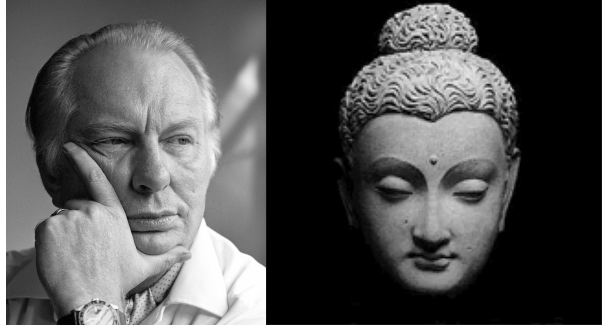
L. Ron Hubbard claimed to be the reincarnation of Buddha. He believed that his system of Scientology was a much improved version of Buddhism. However, I found myself rejecting the claim because of the following fundamental difference between Scientology and Buddhism.
Scientology believes that a soul is eternal, and that its individuality is maintained forever. God has an individuality too. Therefore, the souls cannot merge with each other or with God.
Buddhism, on the other hand, does not believe on logical grounds that there can be eternally unchanging substance. Therefore, it does not believe in the eternity of soul. According to Buddhism, souls are part of a changing reality that has the property of “Oneness.” (See Ground State of the Universe). In short,
Scientology is based on the stable data of “Being”; whereas, Buddhism is based on the stable data of “Oneness.”
In Scientology 8-8008 Hubbard says, “There is evidently no Nirvana. It is the feeling that one will merge and lose his own individuality that restrains the thetan from attempting to remedy his lot.”
Hubbard did not understand that Nirvana is the attainment of oneness that permits the wisdom of seeing things as they are.
With this fundamental difference in Scientology and Buddhism, I must reject Hubbard’s claim that he is the reincarnation of Buddha. Scientology is unable to produce Nirvana that permits a person to, “See with wisdom.”
But Scientology does push the activity of meditation to produce rapid improvement in the beginning. It is more suited to get a person started on the path of improvement, even though it cannot carry that improvement all the way through.
.
I have decided to be consistent in my thinking with the stable data of ONENESS of Buddhism. At the same time I feel that the insightful innovations of Scientology, when applied to Buddhism, will make Buddhism better appreciated by the modern mind.
Scientology has a modern vocabulary that can be used to better explain the concepts of Buddhism. Scientology vocabulary has to be updated with better definitions from the consideration of ONENESS.
Scientology also has a better organizing system, such as, the “Grade Chart,” to explain spiritual progress. This system can be used quite beneficially to make Buddhism more effective.
By making the approach of Scientology more consistent with Buddhism, it is possible to come up with a powerful system of rapid spiritual progress. This system is currently being attempted through Subject Clearing.
.
