Author Archives: vinaire

I am originally from India. I am settled in United States since 1969. I love mathematics, philosophy and clarity in thinking.

“Holes” in Understanding

Reference: Subject: Education

[I wrote this essay back in 1996 when I was running a Math Club. This student went on to study later at Harvard, Cambridge, USA.]

If there is a virus, which can infect and incapacitate the thinking of a person, it is a “hole” created in the mind by a “concept not fully understood.”  Such holes prevent later concepts from being understood and, thus, multiply themselves rapidly.  Sometimes they are well camouflaged and hard to detect until they have multiplied to a great extent.  Their effects show up in the declining curiosity and interest of a child long before his or her grades start to slip.  Due to pressures at school and at home, a child still tries to keep the grades up by memorizing his materials.  The remedy to this situation is to “fill in the holes.”

Once, a parent came to me very much worried about his son.  According to him, his son was slow in study across the board and could not remember what he studied.  He was in seventh grade, but he could do math only up to fourth grade level.  The parents were so worried that they were considering taking their son to a psychiatrist.  Upon checking it was found that this student had been moved around to different schools as the parents tried to settle down in their business.  Upon consultation, a program was worked out to tutor the child at least four hours a week during the first month.  The parents agreed to defer any psychiatric treatment until the gaps in their son’s understanding were located and filled.

The first few sessions were quite interesting.  The student was compliant and easy to work with.  A short list was made of areas in math that he was confused about.  These areas were then addressed one by one.  The basic approach was to check the key concepts in each area to find what was misunderstood and then to clarify it.  Each confusion was traced back to the most fundamental concept which was not understood.  Once the basic concepts were explained, later concepts could be fully clarified.  An interesting discovery was that this student, who could not remember, had no difficulty retaining the basic concepts once they were fully comprehended.  A foundation in math was being built up slowly by locating and filling the “holes” one by one.

During these sessions, “holes” were found not only in math but also in Grammar, Science, and other subjects.  These were clarified as and when they came up.  However, the main focus was kept on math.  At times the student needed help on his current homework, and it was addressed by giving him working knowledge of the advanced concepts.  But as soon as he was through with his homework, the underlying concepts were addressed.  Things were discovered which he should have known, but he was never taught.  Soon the student’s interest and confidence started to improve.  He understood the importance of not going past a word or a concept until it was fully understood.  In addition, he was encouraged to become more curious.  He now had questions about things, such as, INFINITY, SPACE, ATOMIC BOMBS, and even UFO’s.

In a period of three months, a definite improvement was visible in the student’s grades.  Tutoring continued with much less intensity for another two months.  Summer arrived, and there were no more sessions.  Six months later when I happened to run across the parent, I found him quite satisfied with his son’s performance in school.  The boy was getting A’s in math and doing quite well in other subjects too.  He never went for any treatment.

The parent, however, was more impressed with something else.  The son was now spending more time reading the text books on his own.  He used a dictionary to clarify the meaning of words as he studied.  He now followed a discipline because he understood what “holes” could do to his thinking.  This student was not about to let the “holes” have their way again.
 .

Approach to Looking #2

October 2, 2013: This essay has been superseded by:

KHTK EXERCISE #3: Unwanted conditions

.

When no incident, confusion, shift or shock comes up in Approach to Looking #1 then approach as follows:

(1)   Look at the area absorbing most of your attention, and locate

(a)   Persons attached or connected to it

(b)   Places or locations attached or connected to it

(c)   Incidents or events attached or connected to it

(d)   Times or moments attached or connected to it

(e)   Situations or circumstances attached or connected to it

(f)    Anything else that comes to mind in connection with it

(2)   If at any time you spot when the condition, which is absorbing most of your attention, started then make a note of the fact.

(3)   If the attention goes back again and again to the moment when that condition started then apply Approach to Looking #1 to that area.

.

An Analysis of Cause

Cause

The following statement seems to summarize very efficiently what is believed in most western religions and philosophies.

“Before the beginning was a Cause and the entire purpose of the Cause was the creation of effect.”

Judaism emphasizes God as the ultimate creator. Christianity makes God a personal being. Islam seems to de-emphasize that identity of a personal being by declaring God to be formless. However, God is still retained as the cause of all existence.

Spinoza starts his philosophical system with the premise of “uncaused Cause.”  Aristotle starts his philosophical system with the premise of “unmoved Mover.” The system of philosophy that follows from either premise is pretty rational. But the underlying premise is at best arbitrary.

Regardless of how rational a system of philosophy might appear, the logical consistency of that system is set by its starting postulate.

Let’s examine the premise of “Cause.” It is taken for granted by the western religions. Cause is supposed to be there before the beginning of a manifestation. The question then arises, “Can Cause be there all by itself before its effect manifests itself?”

If the answer is “yes” then Cause will be a manifestation on its own right. The question then becomes, “What is the cause of the Cause?” This logic inevitably leads to an endless chain of causes, and the beginning keeps getting pushed back earlier and earlier.

If the answer is “no” then the “Cause” must occur simultaneously with effect. “Cause-effect” would then be part of the same manifestation as the beginning. The idea “before the beginning” would then be a projection that is created after the fact of beginning.

Cause is a projection backward that is created after the fact of beginning.

This is consistent with the idea that time itself would start at the beginning, and there would be no such thing as “before the beginning.” Cause would, therefore, be a consideration created at the beginning. As there is no “before the beginning,” Beyond the beginning would be unknowable. See Knowable and Unknowable.

The premise “uncaused cause” seems to be an attempt to fix the unwieldy conclusion of the endless chain of causes when Cause is assumed to exist all by itself.  “Uncaused cause” is just another arbitrary consideration. No wonder it appears to be self-contradictory.

“Uncaused cause” is a consideration that is self-contradictory.

CAUSE is part of the creation, and has no meaning prior to the creation as assumed in the statement at the beginning of this essay. Neither “Cause,” nor “Uncaused cause” is an independent premise. It is part of the system of philosophy it generates.

The system of western religion and philosophy is made up of interdependent considerations. They are not linear but they form more like a circle. We may visualize this system as a sphere of consideration, which is ballooning out from a premise at its center. The premise is forever contained within this sphere; and it cannot lead to anything beyond that sphere.

What is beyond the sphere of considerations may only be speculated. But a speculation being a consideration would remain within that sphere.

The assumption that the consideration of “Cause” can extend beyond the “system of considerations” seems to be the basic inconsistency.

“Cause” may appear to be consistent but only within a system of consideration and not beyond. What is beyond is unknowable and it cannot be symbolized as Cause.

.

Glossary

Starting Postulate
No matter how rational a system of philosophy might appear, if the starting postulate is inconsistent, the whole philosophical system would ultimately become unsustainable. The starting postulates, such as, “uncaused cause,” and “unmoved mover” are inconsistent in themselves. Therefore, the philosophical systems based on such postulates have become unsustainable in spite of all the effort to make them appear rational.

.

The Creation Hymn of Rig Veda

Reference: Religion

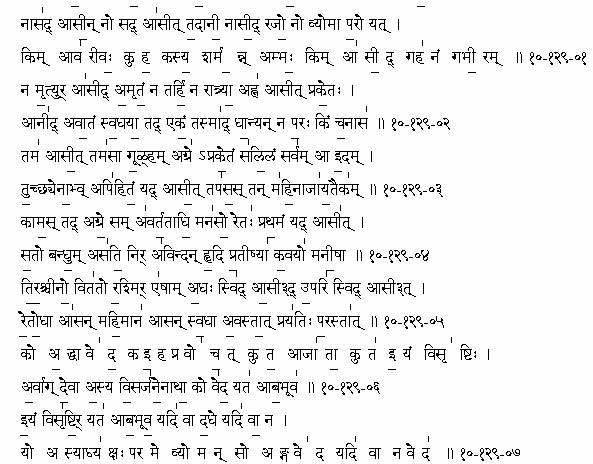
This is the Nasadiya Sukta (sometimes called Nasidya Sukta), which is the 129th hymn (sukta) of the 10th Mandala of the Rig Veda. This hymn is widely known as the “Hymn of Creation,” but more accurately, it is a profound meditation on the mystery and unknowability of cosmic origins.

Following is a translation by Wendy Doniger O’Flaherty. From the Book “The Rig Veda – Anthology”

There was neither non-existence nor existence then.
There was neither the realm of space nor the sky which is beyond.
What stirred?
Where?
In whose protection?
Was there water, bottomlessly deep?

There was neither death nor immortality then.
There was no distinguishing sign of night nor of day.
That One breathed, windless, by its own impulse.
Other than that there was nothing beyond.

Darkness was hidden by darkness in the beginning,
with no distinguishing sign, all this was water.
The life force that was covered with emptiness,
that One arose through the power of heat.

Desire came upon that One in the beginning,
that was the first seed of mind.
Poets seeking in their heart with wisdom
found the bond of existence and non-existence.

Their cord was extended across.
Was there below?
Was there above?
There were seed-placers, there were powers.
There was impulse beneath, there was giving forth above.

Who really knows?
Who will here proclaim it?
Whence was it produced?
Whence is this creation?
The gods came afterwards, with the creation of this universe.
Who then knows whence it has arisen?

Whence this creation has arisen
– perhaps it formed itself, or perhaps it did not –
the One who looks down on it,
in the highest heaven, only He knows
or perhaps He does not know.


Vinaire’s comments:

There was neither non-existence nor existence then.
There was neither the realm of space nor the sky which is beyond.
What stirred?
Where?
In whose protection?
Was there water, bottomlessly deep?

There were no considerations. There was no awareness of anything. None of the dichotomies were present then; but something stirred.

There was neither death nor immortality then.
There was no distinguishing sign of night nor of day.
That One breathed, windless, by its own impulse.
Other than that there was nothing beyond.

That primary sensation emerged on its own.

Darkness was hidden by darkness in the beginning,
with no distinguishing sign, all this was water.
The life force that was covered with emptiness,
that One arose through the power of heat.

Nothing had any meaning other than a primeval force emerging out of emptiness.

Desire came upon that One in the beginning,
that was the first seed of mind.
Poets seeking in their heart with wisdom
found the bond of existence and non-existence.

A desire to know arose. A meaning was assigned. Thus was found a bond from non-existence to existence.

Their cord was extended across.
Was there below?
Was there above?
There were seed-placers, there were powers.
There was impulse beneath, there was giving forth above.

Postulates extended across. Meanings manifested themselves. Thus there were maker of postulates and the power to postulate. Underlying the manifestation was the impulse.

Who really knows?
Who will here proclaim it?
Whence was it produced?
Whence is this creation?
The gods came afterwards, with the creation of this universe.
Who then knows whence it has arisen?

We may only speculate about the makers of postulates and their powers to postulate. For the whole creation and even the gods are the outcome of these postulates.

Whence this creation has arisen
– perhaps it formed itself, or perhaps it did not –
the One who looks down on it,
in the highest heaven, only He knows
or perhaps He does not know.

Who to say what occurred! There can only be postulates, speculations and assumptions.

.

The basic questions are: “Where?”, “When?”, Who?” or “What?”

Neither such questions, nor their answers are there in the beginning.

There is only manifestation, and awareness of that manifestation.

In case of absolute beginning, there is no “prior.”

In the “after,” there are these questions, and speculations for answers.

The questions manifest, and the speculations manifest

There is awareness of these manifestations.

This awareness then generates more questions and speculations.

Such speculations then going forward, as well as going backwards

Hide the unknowable.

.

Reference: The Quest for Certainty

.

Bible: Genesis (Part 1)

Reference: Religion

BIBLE:  THE BOOK OF GENESIS

Genesis 1:1 – In the beginning God created the heavens and the earth.

This first verse of the Bible introduces, acknowledges and celebrates the fact of CREATION. Creation is “bringing into existence,” or “manifesting that, which was not manifested.”

In creation there is always a manifestation that was not there before. In a light bulb, we have a form that didn’t exist before the light bulb was invented; therefore, the light bulb was a creation. But the light bulb was created out of existing materials.

That there are the manifestations we call heavens and earth is self-evident. So they must have been created out of something that existed earlier. This is confirmed by the law of conservation of matter and energy in Physics. Something that existed earlier is identified in Genesis 1:1 as God. It is, therefore, a natural conclusion that the concept of “God” implies the causative principle as well as the materials from which heavens and earth were created. Therefore, heavens and earth are simply an extension of God.

We may, therefore, say that God created the light bulb, even though that is an event much smaller in scale than the creation of heavens and earth. In this case, God is much more than the inventor, Thomas Edison. He wasn’t the only one who contributed to the development of this revolutionary technology. Many other notable figures are also remembered for their work with electric batteries, lamps and the creation of the first incandescent bulbs. Besides, we are looking at bodies and minds, which themselves are manifestations.

We may, therefore, conclude the following about God of Genesis 1:1.

  1. Heaven and earth are an extension of God because creator and creation cannot be separated from each other.
  2. God is not a human like beingness. It is rather a deep abstract principle describing order precipitating from chaos.

This nature of God is beautifully expressed in the Vedic Hymn of Creation. To think of God to be otherwise is to operate from a viewpoint of mystery. Bible need not be interpreted from this viewpoint of mystery.

.