Author Archives: vinaire

I am originally from India. I am settled in United States since 1969. I love mathematics, philosophy and clarity in thinking.

Glossary for Bhagavad Gita

This Glossary arranges the concepts of Bhagavad Gita from the Earliest to latest.

.

BHAGAVĀN
Bhagavān literally means “fortunate”, “blessed”, and hence “illustrious”, “divine”, “venerable”, and “holy”. It refers to one who understands the creation and dissolution, the appearance and disappearance of beings, the wisdom and ignorance. In Bhāgavad Gīta, Krishna is referred to as bhagavān.

BRAHMA
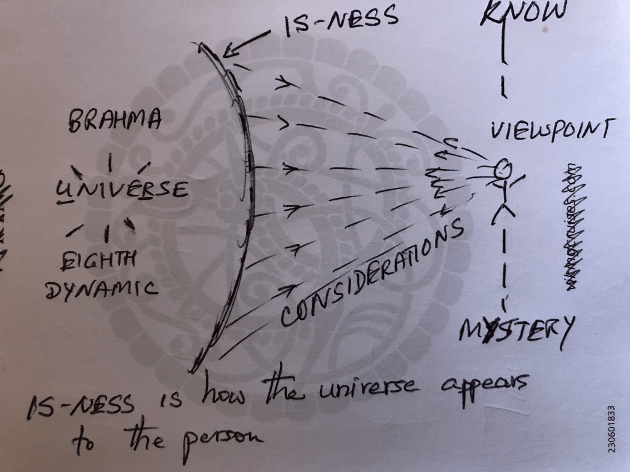
The one self-existent Spirit, the Absolute. This is the highest metaphysical reality. More practically, Brahma represents the innate impulse that permeates the fabric of the universe. It lies at the core of what we call SELF. Bhagavad Gita talks about “desire” to exist at this level. That is why desire is so difficult to control. (Verse 2:17)

CHANGE & CHANGELESS
Ātman that carries mental impressions never perishes, but the mental impressions carried by ātman are forever changing. (Verse 2:12-14).

DESIRE
All desires have deep roots in innate impulse, and they are shaped by the self. (Verse 2:42).

DHARMA
Dharma means, “Established in nature”. For example, the “Dharma” of the sun is to shine and give warmth. Dharma is the basis of all science—physical and spiritual. Nature is continuous, harmonious and consistent. Therefore, dharma exists when there is continuity, harmony and consistency.

ENLIGHTENED ACTION
When one engages in an action simply to restore the truth of the natural order, then it is an enlightened action. (Verse 2:47).

ENLIGHTENED PERSON
A person who is established in the truth of natural order; who is always seeing things as they are. (Verse 2:46).

GUNA
Guṇas are “modes of existence” (tendencies, qualities, attributes). It is a philosophical and psychological concept developed by the Samkhya school of Hindu philosophy. There are three gunas: sattva (goodness, constructive, harmonious), rajas (passion, active, confused), and tamas (darkness, destructive, chaotic). All of these three gunas are present in everyone and everything, it is the proportion that is different. The interplay of these gunas defines the character of someone or something, of nature and determines the progress of life. (Verse 2:45).

“I”
The viewpoint of self.

IMMORTALITY
Immortality is not identifying with perishable mental impressions of sense-objects. It is freedom from fixations on sense-objects. (Verse 2:15).

ĪŚVARÁ
Īśvará means, “one who is capable of”, It is used for master, lord, prince, king, mistress, and queen.

KSHATRIYA
Kshatriya is one who protects from hurt or wound. A Kshatriya is a member of the second of the four great Hindu castes, the military caste. The traditional function of the Kshatriyas is to protect society by fighting in wartime and governing in peacetime. (Verse 2:32).

MIND
The embodied ātman is aware. It has the natural capacity to recognize what is there and what is not. This is its mind. (Verse 2:16). Mind may be looked upon as “energy form, activated by innate impulse, that is controlling and transmitting motion.”

PURUŚA
Puruśa is abstract essence of the Self, Spirit and the Universal Principle that is eternal, indestructible, without form and is all pervasive.

SAMKHYA
Samkhya refers to the philosophical school in Hinduism based on systematic enumeration and rational examination. It ‘enumerates’ twenty-five Tattvas or true principles; and its chief object is to effect the final emancipation of the twenty-fifth Tattva, i.e. the puruṣa or Self. (Verse 2:39).

SIN
Sin consists of acting against one’s inherent beingness, or not acting according to it. (Verse 2:33).

SVADHARMA
Svadharma is “one’s own duty”. These are actions that follows naturally from beingness. Svadharma is a property peculiar to the beingness. (Verse 2:31).

YOGA
Yoga school of philosophy is closely related to Samkhya school. It systematically studies to better oneself physically, mentally and spiritually by renouncing attachment and attaining equanimity. (Verse 2:39, 2:48).

.

Research & Contemplation

Once you have your own glossary for a subject you may continue with your original research. This requires deep contemplation. The secret of contemplation is to find out what you are (a) denying, (b) avoiding, (c) resisting, and/or (d) suppressing. Then look at that area more closely. Most importantly it is looking at things that you are taking for granted.

.

Earliest Postulates

The earliest postulates in a subject determine how that subject has developed. If a new discovery is made in the area of those postulates, it may change the look of the whole subject.

Just imagine if somebody discovers the nature of electric charge or the nature of gravity. Or explains the very idea of force of attraction and repulsion differently. It will revolutionize the whole subject of Physics.

Or, just imagine if the gap between physics and metaphysics has been bridged and thought is discovered to be the lower part of the electromagnetic spectrum. It will revolutionize the whole subject of knowledge itself.

Or, just imagine if you could look at the ideas of “self” and “God” objectively. It will revolutionize the whole subject of religion.

.

Inconsistencies

The modus operandi of Subject Clearing is simply this:

Note any inconsistencies among the ideas and concepts and clarify them.

There are likely to be many contributors to a subject who may use different words for the same concept. This is the case with religious knowledge from different cultures. Group such words together to discover inconsistencies among them. For example, the concept of Brahma (God) in Vedic religions (Hinduism, Buddhism and Sikhism) is very different from the concept of God in Semitic religions (Judaism, Christianity and Islam). Clearing up the inconsistency between the words ‘Brahma’ and ‘God’ can be quite enlightening.

Study of inconsistencies may lead to discovery of arbitrary beliefs that were advanced in the absence of knowledge, or simple notions taken for granted. This may reveal gaps in the subject. Try to fill these gaps by further study and research.

.

The Subject of Self

In subject clearing, getting rid of the past misunderstandings in various subjects is just the beginning. All the work done so far simply prepares you to clear the most difficult subject of all—the subject of “Self”. This is the most intimate subject, and also the subject that is misunderstood the most.

The subject of self has been dealt by religion and psychology. These are subjects where inconsistencies abound. As you follow up these inconsistencies you encounter dubious explanations and fixed beliefs. These are indicators of gaps in general knowledge. When the exact gaps are revealed, real progress becomes possible.

.

The Future

Discovering gaps in subjects and filling them is the direction of evolution. Use direct experience and experimentation to make your favorite subjects as complete as possible.

.

Subject Glossary (old)

Please see Course on Subject Clearing

As you clear a subject, it is helpful to create your own glossary for that subject. You may have that Glossary arranged like a Key Word List or sequenced alphabetically. By putting that glossary on an Excel Worksheet, you can easily switch back and forth between these two arrangements. This will be your own glossary in which the key words are explained the way you understand them. This glossary is dynamic in the sense that you will be updating it continually as your understanding of the subject increases.

.

Making the Glossary

The material for the glossary may be prepared during the general study as follows.

(1) Obtain the materials as an editable document on computer.
When you have the study material in an editable format on the computer, you can divide them into manageable paragraphs in each chapter.

(2) Check the paragraph for key words/ideas.
After studying and understanding a paragraph check it to see if contains a key word for that subject and defines it in some way.

(3) Note the key word/idea.
You may note that key word and idea in a different color right after that paragraph, along with any other comment you wish to record.

(4) Summarize all your notes and comments at the end of the chapter.
This keeps your data compact and to the point.

(5) Make a final summary at the end of the study of those materials.
Make this final summary in the form of a glossary on an Excel Worksheet.

(6) Build up the glossary on that subject.
As you study more materials on that subject, follow the procedure above to keep building up the glossary.

.

Filling Holes

Set up a view of the glossary that arranges it from the earliest to the latest concepts in the subject. Review these concepts to see if they lead you logically from one to the next. The most important area is the fundamental concepts, where some starting postulates have to be made.

See if there are any gaping holes in the sequence of concepts.  Such a conceptual hole can hide behind an assumption. It can also be an “everybody knows” type consideration. If you find a hole, look for any research done in that area. If not, then there is an opportunity for you to make a discovery.

.

Summary

A unique personal glossary is a valuable asset for life. It will grow as you grow. It will come handy in many different ways. It can even become a window into yourself.

.

General Study (old)

Please see Course on Subject Clearing

When you are studying a subject from a textbook or any other material, it is very important that you do not go by any word or symbol that you do not understand the meaning of. The moment there is confusion look back for a misunderstood word. A word behaves as a misunderstood when the right definition is not being used for it. You may think that you know the word, but you may not have the right definition. This is specially true for small words like ‘of,’ ‘in’ and ‘on’ because they are used in many different ways.

.

Common Words

Here is the recommended procedure for handling common words that are misunderstood.

1. Read one paragraph at a time.
If the paragraph is too long, you may break it down into sub-paragraphs of reasonable size.  If the paragraph is too small, and the thought continues to the next paragraph then read the two paragraphs together. 

2. Take a pause to see if the paragraph is fully understood.
Summarize the paragraph to its main thought. If you can do it easily then you have understood it fully. If you can’t, then find the sentence in that paragraph that is a bit troublesome. Then locate the word in that sentence that doesn’t seem to fit quite right.

3. Look up misunderstood word or symbol if there are any.
A misunderstood word does not always stand out. It may be a familiar word for which you may be using the wrong definition. So, you check the word out.

4. Determine the broad concept of the word from its etymology.
You may google the etymology or look it up in a simple dictionary.

5. Check its definition in the present context.
A common word has many different definitions. Apply each of them in the present context to see which one fits the best. To do so, visualize each definition. You may use “google image” to visualize something concrete like “oak”. Or, you may make some real-life examples from your experience to visualize something abstract like “love”.

6. Familiarize yourself with that particular usage of the word.
Make some sentences of your own using the word in the same sense as used in the given context to become comfortable with that meaning.

Hopefully the above will resolve the difficulty with the sentence and the paragraph. If there are more such words, handle them in the same manner.

.

Word Chains

Sometimes the definition of a word may contain words that are not fully understood. So you look up that word. The same thing may happen again and you may get in a long word chain. This usually happens when you are using a dictionary that is using big words. So a simpler dictionary may be the solution. But a dictionary that is too simple, may get you into circular definitions without clearly explaining the word.

Some word chains are simply not avoidable. When that happens, note down the words on a separate paper as you look them up. The word chain may branch out in many directions. You simply continue noting down the words. At some point, the words will start clearing up. When that happens you cross the word out of the word chain and work your way back. It is okay to look up the same word as many times as necessary. Each time you look up a word you may pick up a new dimension of its meaning.

.

Clarity of Understanding

You will be amazed at the clarity a proper understanding can bring. After using word clearing for some time, your general vocabulary will increase by leaps and bounds and you will start making much faster progress in your studies.

It is the tendency of the mind to fill the missing definitions by preconceived notions. This leads to contradictions and conflicts in the mind. Therefore, it is very important to examine the definitions of the words in the context at hand. Correct definitions bring continuity, harmony and consistency to the understanding of the materials.

.

Key Word Clearing

Please see Course on Subject Clearing

In today’s world the understanding of a subject depends on the words and symbols used to express its basic ideas. When there is confusion in a subject, the first thing to do is to create a list of its key concepts from the earliest to latest in the form of words. You not only clear up those word but also relate them to each other until you have a clear picture of the subject. You will need a good dictionary, a thesaurus, and a basic textbook for this purpose.

.

Key Word List

Every subject has its own vocabulary. Knowing the purpose of the subject, one may easily arrange its key concepts from the earliest to the latest in the form of words. We know that if it takes ‘concept 1’ to understand ‘concept 2’ then ‘concept 1’ must precede ‘concept 2’ on the list. For example, the purpose of Mathematics is to learn about quantities in a systematic manner. Knowing that, we may arrange its key words as follows: Counting, Number, Digit, Place Values, Unit, Tens, Hundreds, Groups (in reading and writing numbers) , Addition, Addend, Carry over, Sum, and so on. 

As you become more aware of the key words, you may sometimes find that a different sequence provides a more consistent picture. It may even reveal some holes in the sequence. Therefore, there is need for dynamic sequencing of the Key Word list. An Excel worksheet may fulfill this requirement nicely. 

Keep building up the Key Word List, and clearing the words, as you study the subject.

.

Clearing the Words

As the Key Word List comes into existence, we start clearing these words. It is important to clear the most fundamental concepts first. The steps to clear up a word are as follows.

  1. Determine the broad concept of the word from its etymology.
  2. Determine the most appropriate definition of the word from dictionary.
  3. Visualize that definition by means of “google image” and/or real-life examples.
  4. Contemplate on the word in relation to nearby key words.
  5. Meditate on the concept underlying the word in the context of your experience.

These steps lead you to deepening awareness of the ideas associated with the subject.

.