Author Archives: vinaire

I am originally from India. I am settled in United States since 1969. I love mathematics, philosophy and clarity in thinking.

OT III Anomaly

Reference: The Level of OT III

Specially refer to LRH OT III Instructions (Transcript)

OT III Anomaly

  1. It is interesting to observe that “mass implanting” was seen as the solution to overpopulation on OT III background story instead of death.
  2. It may mean that the population was considered to be made up of immortal thetans, and death of the body could not properly eliminate them. So, dead people were also counted as part of the population.
  3. If so, then the anomaly is that if the number of thetans cannot decrease through death, then it cannot increase through birth either. There is no one-way street in this matter. If the thetans were always there then their number should have remained constant.
  4. “Mass implanting” is no way of decreasing the number of thetans. It can only make them controllable. In that case, the problem was one of control and not of over population. But Hubbard did not use that as the problem.
  5. This means that overpopulation is a made-up story. Hubbard simply wanted to stress upon the idea of “mass implanting.” This is because there exists sameness of the reactive mind mechanism from person to person.
  6. One needs to analyze how OT III addresses this sameness of the reactive mind mechanism from person to person.
  7. H-bomb in the story simply means that at the bottom of reactive mechanism, there is a severe explosion-like shock. A severe shock allows  misleading data to become deeply embedded in the mind. 
  8. It is very difficult to handle such deeply embedded data, without approaching it in a very precise manner. On OT III the approach is to run Incidents I and II as engrams on each body thetan one at a time.
  9. Hubbard must have experienced Incidents I and II repeatedly during his OT III research in full detail. That must have made quite an impression on him. He ended with the conclusion that “One’s body is a mass of individual thetans stuck to oneself or to the body.”
  10. These body thetans appear to be units of deep programming much like AI (artificial intelligence) that manifest as body sensations.
  11. When you are running a body thetan, you are essentially sorting out a viewpoint. This viewpoint may be associated with some body sensation. That sensation may be connected eventually to some experience. 
  12. This viewpoint of body thetan must be pared down to its simplest form before running it. As an example, one can have a very unappreciative viewpoint toward the body; whereas, body is a wonderful and useful mechanism.
  13. The suggested primary handling of body thetans is by running them through Incidents I and II. Sometimes level 0 to VI processes are required before they can run engrams (Inc 1 & Inc 2). Sometimes they have to be run on Power Processes first.
  14. In the auditing of body thetans, the person acts as pure awareness. He is thus exterior to the condition while observing that condition. The viewpoint (body thetan) is part of that condition. That condition can be out of valance condition, psychosis, fixed ideas, or service facsimiles. 
  15. The auditing is done per the grade chart, and directed at what needs to be addressed. Such auditing is fast. The e-meter is not that useful other than indicating the TA movement.
  16. Running OT III requires extensive training in running all other Scientology procedures. That makes it too long a runaway.
  17. When OT III is not working, precision is missing in terms of having the precise viewpoint or running the precise process.
  18. LRH provides the datum: “Thetans believed they were one. This is the primary error.” But this is an erroneous viewpoint.
  19. Actually, the primary error is not addressing the precise viewpoint with the precise process when auditing OT III.
  20. The precision is provided through subject clearing by simplifying the L&N process. Please see The Listing Procedure.

.

Subject Clearing

Subject Clearing starts with the following basics.

  1. The Unknowable
  2. The Postulate
  3. The Universe
  4. The Oneness
  5. The Reality
  6. The Anomaly

According to Subject Clearing, a body thetan would be a special kind of anomaly that affects the viewpoint.

.

The Form

Reference: Postulate Mechanics

The Form

FORM is the shape and structure of something as distinguished from its material. All forms arise from the postulate of space; and the postulate of space arises from the postulate of substance. Therefore, when forms are applied to substance we have objects.

Forms are defined by their boundaries. There is a change in the nature of substance across an actual boundary. This change may be in terms of wavelength.

There can be infinite variety of forms. Forms can be large and small, simple and complex, static or dynamic.

Basically, a form is a phenomenon of space. Without space there can be no form.

.

The Dimension

Reference: Postulate Mechanics

The Dimension

Substance has dimensions. It means that substance has different aspects, features, or angles that can be measured and displayed on a scale. The primary dimensions of substance are: consistency, time and space.

CONSISTENCY is the dimension of substantiality of the substance. The dictionary definition of consistency is a degree of density, firmness, viscosity, etc. The consistency of substance increases from thought to radiation to matter. The consistency of matter is very high and it is referred to as MASS. The higher is the consistency of substance the more FORCE it can impart because of its INERTIA.

TIME is the dimension that describes duration of the substance against the background of infinite duration. Substances of varying durations appear as if they are in MOTION relative to each other. The time/duration of substance increases as its consistency increases from thought to radiation to matter. As the duration increases the motion appears to decrease correspondingly. The duration of matter is almost infinite. And its motion is insignificant compared to the motion of radiation and thought.

SPACE is the dimension that describes the extents of substance. What appears to us as “empty space” is empty of visible matter only. It is not empty of radiation and thought. The background of seemingly infinite space actually describes the extents of thought and radiation that are invisible to us. Against this background the finite space of matter appears as material forms. The space of substance contracts as its consistency increases from thought to radiation to matter. The space of matter is studied in the subject of geometry.

.

The Quantum

Reference: Essays on Substance

The Quantum

A quantum is a particle of substance, where substance is anything substantial enough to be sensed. A quantum is defined by its frequency. The frequency determines the consistency (a degree of density, firmness, viscosity, etc) of the quantum. A quantum of very high consistency is called mass. These very high consistency quanta form the nucleus of the atom.

As the frequency of quantum decreases its wavelength increases. The wavelength determines the size of the quantum. In other words, as the consistency of the quantum decreases, its size increases. For example, an electron has much less consistency (is much softer) and also has much bigger in size than a nucleon in the nucleus. This is evident from the hydrogen atom, where its single electron is the size of the atom.

There is a whole spectrum of quantum from neutron in the nucleus of the atom to the photon of light. On the spectrum, the frequency (consistency) is continually decreasing and, consequently, the wavelength (size) is continually increasing. The size of the photon is large enough to explain the phenomenon of “quantum entanglement” over a distance of miles. 

A quantum does not have a point location. That is a fixed idea among some people, which is a holdover from classical mechanics. In classical mechanics, the location of a matter particle was approximated by a point because of the property of center of mass. This center of mass property no longer applies in quantum domain.

The Schrödinger Equation, which is the core equation of quantum mechanics, is basically an analogue of Newton’s second law of motion. This equation is solved for the wave function that includes information about the quantum, such as, position, momentum, spin, the form and its evolution. The time-independent Schrödinger equation describes a fixed pattern among quanta, such as that of electrons in a stable atom.

The wave-particle property has to do with the size and consistency of a quantum. The Planck’s constant in the Schrödinger Equation links the consistency of quantum to its frequency, and the momentum of the particle to its wavelength. The imaginary unit enables accurate descriptions of wave functions, probability conservation, and interference effects. The mass affects the spatial spread, radiation quantization, curvature and oscillations of the wave function. 

Thus, on the spectrum of the quantum, as the frequency (consistency or rigidity) of the quantum decreases, and its wavelength (the size or spatial spread) increases, the velocity (motion characteristic) of the quantum also increases.

.

Quantum Mechanics and Reality

Reference: Essays on Substance

Quantum Mechanics and Reality

Quantum Mechanics may be mathematically consistent, but it is not consistent with the reality that we observe. The Scientific Method requires consistency with both the mathematical logic and the live logic.

The Scientific Method

Here are couple of specifics:

(1) Wave-Particle Duality:

Wave-particle duality is a fundamental concept in quantum mechanics that describes the dual nature of quantum objects exhibiting both wave-like and particle-like properties depending on the experimental circumstances. But this quantum object is described mathematically only. There is no equivalent object described in the real sense. This has created an anomaly with respect to the double-slit experiment, which is still not resolved.

This quantum object can be described in reality, but that would require some new postulates as done in the Theory of Substance. The Substance theory views the quantum object as a “fluid particle” that can split and coalesce back together. The photon or electron can appear as a point on the photographic plate in the double-slit experiment. But, being a fluid-particle, it has real dimensions that extend in spacetime, such that it can also coalesce with the next photon when it comes along. So there is a fluid-like aspect to light and electrons that seems to make all the difference. This representation adds a dimension to quantum particles, which has been missed by the mathematical model.

(2) Superposition:

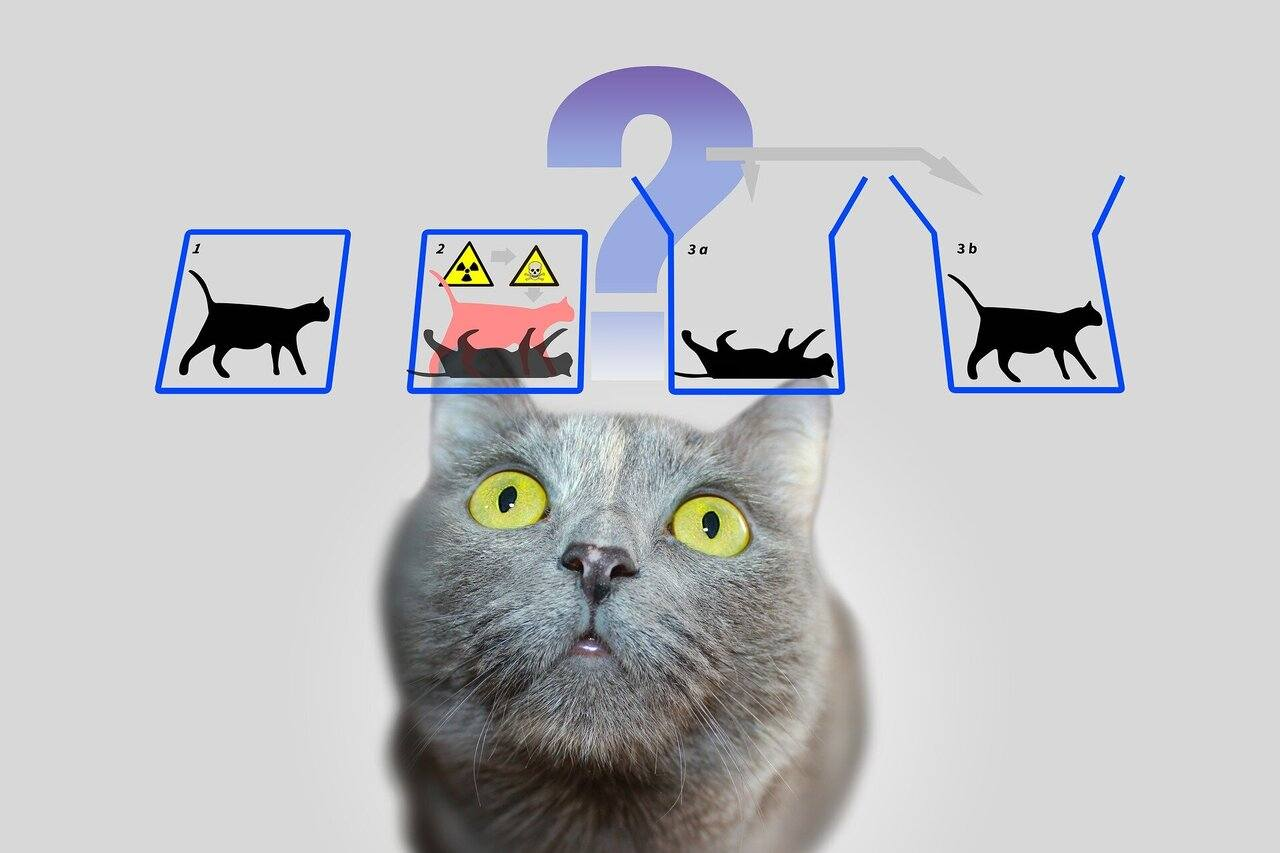
Superposition is a fundamental concept in quantum mechanics that describes the ability of quantum systems to exist in multiple states simultaneously until it is measured. It is mathematically represented as a linear combination of all possible states of a system. This principle is a direct consequence of the linear nature of the Schrödinger equation, which allows for linear combinations of solutions to represent valid quantum states. This created the famous paradox of Schrodinger’s cat being both dead and alive until actually observed. It highlights the apparent conflict between quantum superposition and our everyday experience of reality. The conflict arises due to QM assuming point locations for quantum objects, and then ends up relying on probabilities. But quantum objects have dimensions as represented by their wavelengths, and do not really have point locations.

The Substance theory proposes a spectrum of substance based on their wavelengths (or corresponding frequency) that is consistent with reality.

The Spectrum of Substance

This opens the door to using Schrödinger equation without the use of probabilities.

.