
Reference: Postulate Mechanics
What Is “Everything”?
Have you ever tried to think about everything — every planet, every star, every thought, every feeling — all at once? That’s what this chapter is about. Some people call “everything” the universe. Some people call it God or the divine. And almost everyone agrees on one thing: it goes on forever. That “forever” is what we call infinity.
.
Stuff That Goes On Forever
A long, long time ago, a thinker named Anaximander had a big idea. He said there must be some original “stuff” that everything is made of — and that stuff has no beginning and no end. Everything comes from it, and everything goes back to it.
Later, a philosopher named Spinoza said that God is that stuff — and that stuff is the universe. In other words, God and nature are the same thing. Another thinker, Leibniz, said that God keeps creating things — kind of like how the sun keeps shining light without ever running out.
In this book, “stuff” means anything you can sense — things you can touch (matter), feel as energy, or think about (thoughts). The biggest, most powerful kind of thought is called a postulate — a deep, foundational idea. Those postulates are where the divine lives.
.
Space That Never Ends
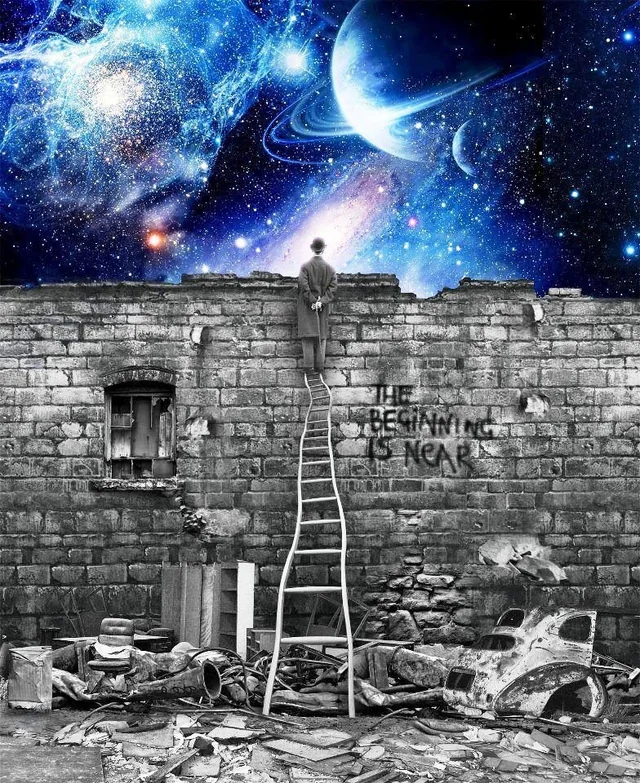
Have you ever stared up at the night sky and wondered: does space ever stop? A Greek thinker named Archytas asked the same thing. He said: if space had a wall, you could always stretch your hand beyond it — so there can’t really be a wall. Space just keeps going.
Newton said space is like a giant invisible box that goes on forever in every direction — flat and endless.
But this book has a different idea: space isn’t really empty. Space is just how big things feel. When you fill a room with furniture, the room feels different than when it’s empty. Space is like that — it changes depending on what fills it: matter, energy, or thought.
Even “nothing” isn’t really nothing. To imagine an empty space, you have to think about it — and that thought is already something filling it up!
.
What Is Infinity?
Infinity means something that never ends — no finish line, no stopping point, no edge. It has its own symbol: ∞ (it looks like the number 8 lying on its side). A mathematician named John Wallis came up with that symbol.
Think of it this way:
- Count to 10. Now count to 100. Now imagine you could never stop counting — that’s infinity.
- Look at the stars. Now imagine there are always more stars beyond the ones you can see — forever. That’s infinity.
This book says infinity is a big idea that we attach to the universe, to God, and to our deepest thoughts. It connects three huge things:
- The universe — everything that exists
- Divinity — the deepest level of thought and awareness
- Infinity — the fact that it all goes on without end
They all go together, like three ways of describing the same amazing, endless mystery.
.
The universe is so big, so deep, and so full of wonder — and infinity is just the word we use when we run out of words.
