
Reference: Subject Clearing Universe
NOTE: The subject of Physics treats these fundamental particles mathematically, and it does not provide a proper visualization for them. The effort on this blog is to provide a visualization that is consistent with what is known. It does not change the mathematics of Physics.
Proton refers to that consistency of substance that is under the tension to evaporate from mass back into electronic liquidity. This tension is seen as positive charge.
.
Definition of PROTON
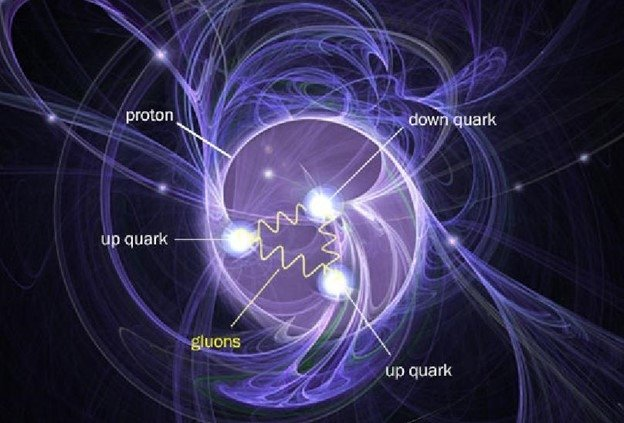
Protons form the surface layer of the nucleus. The charge of the proton comes from the fact that it is the substance that has condensed into mass from the electronic substance, and it can evaporate back into its previous electronic consistency. This proton layer is in equilibrium with the layer of the electronic substance immediately surrounding it.
The charge exists, because we have two very different consistencies in equilibrium, such that, the substance is being continuously exchanged between them. The exchanged substance appears as transitory particles listed under Leptons and Baryons.
When the proton layer separates itself from the atom it appears as its own little vortex called a proton. A proton has a precise configuration as well. It has the limiting consistency of mass, which is measured as 1.673 × 10⁻²⁷ kilograms. This is 1836 times more condensed than the nearest electronic layer. It is considered to have a unit positive charge measured as 1.602 × 10⁻¹⁹ coulombs. This is equal and opposite to the charge of an electron.
The proton, too, does not exist as an independent particle within the atom because it is integrated with rest of the atom into layers of condensing substance. Therefore, it is an error to visualize protons as “particles” within the atom.
.
Misconception
1. It is a misconception to think that protons exist as independent “particles” within the atom. Protons form the first layer of mass in the nucleus that is still increasing in consistency as neutrons toward the center. Proton is the first layer of the nucleus that is formed after the last electronic layer condenses.
.

Comments
you are deluded like a nutty drunk fake hindu professor!
You are in violation of mindfulness. Please see below.
Mindfulness Discussions