Reference: Beginning Physics II
Chapter 3: COULOMB’S LAW AND ELECTRIC FIELDS
.
KEY WORD LIST
Electric Charge, Electric Force, Law Of Conservation Of Charge, Conductors, Ground, Coulomb’s Law, Electric Field, Electric Field Lines, Flux Density, Flux, Flux Density, Gauss’ Law (for Electric Field), Gaussian Surface
.
GLOSSARY
For details on the following concepts, please consult Chapter 3.
ELECTRIC CHARGE
Electric charge is created when amber rod is rubbed with fur. By convention, the charge on amber rod is considered positive and that on the fur is considered negative. In ordinary matter, negative charge is carried by electrons, and positive charge is carried by the protons in the nuclei of atoms. Atoms are neutral because the number of electrons surrounding the nucleus equals the number of protons in the nucleus. A point charge that is static requires a material base to exist on, which is usually an atom or a molecule. The negative charge is the material base with an additional electron. The positive charge is a material base lacking an electron. Charge is measured in units of Coulomb (C). The magnitude of the charge of an electron (e) is 1.602 x 10⁻¹⁹ C.
ELECTRIC FORCE
All charged particles exert a force on each other called the electric force. When one separates the charges one can explore the force between them. It is found that the force is one of attraction between charges of opposite polarity and of repulsion between charges of like polarity. Furthermore, the magnitude of the force decreases as the charges move further apart.
LAW OF CONSERVATION OF CHARGE
This law requires that the total amount of charge remains unchanged. If one starts with uncharged materials the initial charge present is zero. Then the total charge after it has been separated must still add to zero, requiring that there be equal amounts of positive and negative charge present.
CONDUCTORS
In many materials, called conductors, there are some charges, usually electrons in the outer reaches of the atoms, which are free to move in the material. If the conducting material is uncharged, then the electrons are uniformly distributed in the material, with each electron being attracted to a fixed, positively charged nucleus. If other charges are inserted in the conductor, then the free charges move in response to the electrical forces that occur. Since it is the electrons that move, a piece of conductor can be given a negative charge by adding some electrons from elsewhere, or a positive charge by removing some electrons to another location. This charge is found distributed on the surface of the conductor because similar charges repels each and they end up on the surface where the area is maximum to spread out on. The interior of the conductor remains neutral. when a charged conductor is brought close to a neutral conductor, it creates an opposite charge on the surface of the second conductor.
GROUND
The ground is a large uncharged reservoir.
COULOMB’S LAW
Coulomb’s law is the quantitative law which gives the force between two charged particles. It states that the magnitude of the electrostatic force of attraction or repulsion between two point charges is directly proportional to the product of the magnitudes of charges and inversely proportional to the square of the distance between them.
Here, ke is the Coulomb constant (ke ≈ 8.988 × 10⁹ N⋅m2⋅C−2), q1 and q2 are the assigned magnitudes of the charges, and the scalar r is the distance between the charges.
The direction of the force is along the line joining the charges. If the charges are of the same sign, then the force is one of repulsion, i.e. it is directed away from q1, while if the charges are of opposite sign then the force is one of attraction, i.e. it is directed toward q1. Of course, there will also be a force exerted by q2 on q1, which will have the same magnitude as the force on q2 but will be in the opposite direction.
NOTE: Like the gravitational force, the electric force is also looked upon as “action at a distance.” The formula for the magnitude of the force is identical in form to that for the gravitational force between two masses. On an atomic and molecular scale, gravitational forces are negligible compared to electrical forces and can almost invariably be neglected.
ELECTRIC FIELD
An electric field is the physical field that surrounds electrically charged particles and exerts force on all other charged particles in the field, either attracting or repelling them. It also refers to the physical field for a system of charged particles. The electric field is defined as a vector field that associates to each point in space the electrostatic (Coulomb) force per unit of charge exerted on an infinitesimal positive test charge at rest at that point. The derived SI unit for the electric field is the newton per coulomb (N/C).
Suppose one has an electric field E at a certain position in space. If we now place a charge Q at that point the electric field will exert a force on the charge, given by:
F = QE
ELECTRIC FIELD LINES
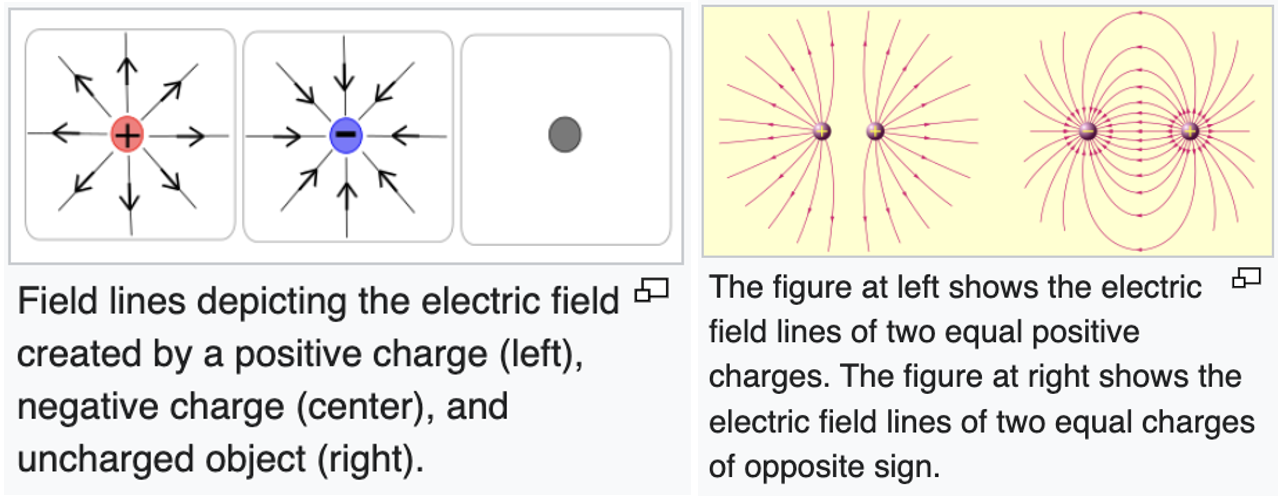
A field line is a graphical visual aid for visualizing vector fields. These are lines traced through space in such a way that as the line passes through a point it always aims in the direction of the electric field at that point. One can always determine the direction of the electric field at a point in space by drawing the tangent to the electric field line going through that point. All the lines begin on positive charges and end on negative charges. It cannot happen that lines cross each other since at the point of crossing there would then be two directions for the electric field, which cannot happen.
FLUX (F)
Flux is the number of field lines passing through any given area. The field produced by the charge q has a magnitude of (1/4πε0) q/r2. Equating this to the number of field lines per unit area, we get N/4πr2 = q/4 πε0 r2, or N = q/ε0.
Choosing N, the representative number of field lines drawn from the charge q, to equal q/ε0 is particularly useful because we can now deduce the magnitude of the electric field at any point P at any distance R from the charge in terms of the lines/area at that point. The lines/area at a point P is defined as the number of lines passing through a small “window” centered on the point P and facing perpendicular to the field lines, divided by the small area of the window.
The lines/area (as defined above) when chosen to equal |E|, is called the flux density, and the number of lines passing through any given area is called the flux through that area. Flux is positive when its direction is the same as the area vector.
Note: Thinking in terms of lines/area is a very useful pictorial device for understanding the behavior of the electric field, but ultimately all the results we obtain are expressible directly in terms of the electric field E and do not depend on the artifact of lines that are drawn through space.
Noting that E cos θ is just the component of E parallel to A (area vector), we see that the flux through A is just the component of E along A times the magnitude of A:
Flux = E (cos θ) A
This is an equivalent definition of flux that needs no reference to “field lines per unit area” or other intuitive constructs.
GAUSS’ LAW (ELECTRIC FIELD)
For a closed surface, if the flux is positive then net flux leaves the surface, i.e. more lines leave the surface than enter the surface. If the sum is negative, then on net more lines have entered the surface from outside than leave. The net electric flux through any hypothetical closed surface is equal to 1/ε0 times the net electric charge enclosed within that closed surface.
where E is the total electric field due to all charges in the universe and Qin is the total charge enclosed in the surface. The closed surface is also referred to as Gaussian surface.
.
Mathematical Results
See the chapter for problems and their solutions.
(1) The electric field produced by the charge on the ring:
The field at the center of the ring (P1) will be zero. The field at point P2 will be:
.
(2) The electric field produced by the charge distributed uniformly on a sphere:
The magnitude of the field outside the sphere is given by E = kQ/r2, where Q is the total charge on the sphere. This is the same field that would be produced by a point charge Q located at the center of the sphere.
.
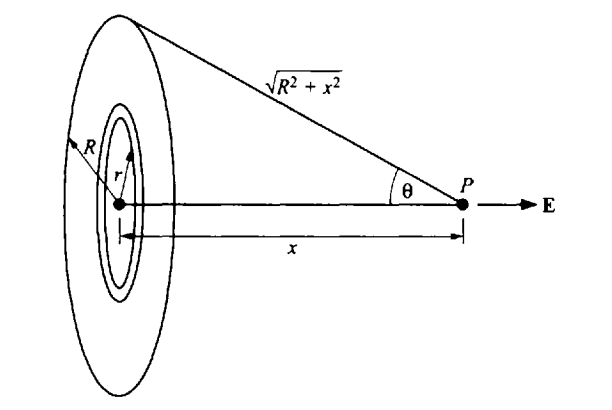
(2) The electric field produced by the charge distributed uniformly on a disk:
The field at point P will be:
When one is close to the disk or “far” from the edge from planar planar charge distribution of any shape (i.e. x << R):
.
(3) The electric field produced by the charge distributed uniformly on a rod:
The field at point P will be:
where Q = 2Lλ is the total charge on the rod.
.
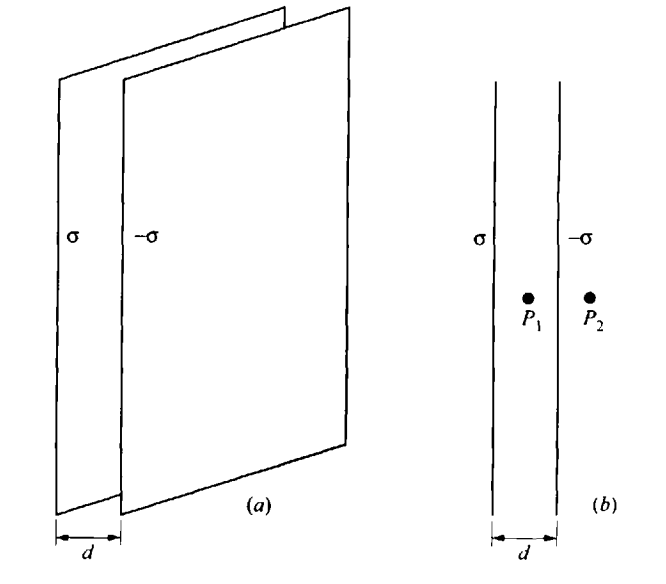
(4) The electric field produced by two oppositely charged parallel plates, where the distance between them is much smaller than the linear dimension of the charged area:
At point P1, both fields point toward the right, and the total field is therefore,
At point P2, the fields point in opposite directions, and the total field is therefore zero.
.