
Reference: Einstein’s 1920 Book
Section XX (Part 2)
The Equality of Inertial and Gravitational Mass as an Argument for the General Postulate of Relativity
Please see Section XX at the link above.
.
Summary
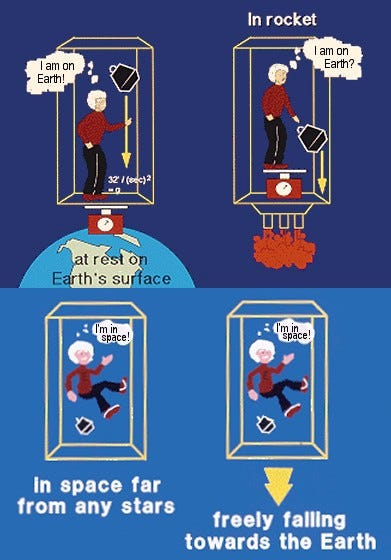
In a Galilean space, bodies are either at rest or moving at uniform velocity. There is neither acceleration, nor any sense of gravity. But, when uniformly accelerated motion is applied to a body, the velocity of the body will increase to enormous values in course of time. However, from the reference point of the body, it would appear to be at rest; but, as its inertia resists the acceleration, it would acquire weight, as if it is in a gravitational field. We have thus good grounds for extending the principle of relativity to include bodies of reference which are accelerated with respect to each other.
From the viewpoint of the accelerating body, bodies that are at rest or in uniform motion will appear to accelerate uniformly in the opposite direction irrespective of their masses. This is the fundamental property of the gravitational field of giving all bodies the same acceleration. Guided by this example, we see that our extension of the principle of relativity implies the necessity of the law of the equality of inertial and gravitational mass.
Thus, we see that a general theory of relativity must yield important results on the laws of gravitation. But it is not so straightforward, because we cannot always choose another reference-body such that no gravitational field exists with reference to it. It is, for instance, impossible to choose a body of reference such that, as judged from it, the gravitational field of the earth (in its entirety) vanishes.
.
Final Comments
A uniformly moving body appears at rest relative to itself. But, a uniformly accelerating body appears at rest relative to itself too; except, in this case, there is also a sense of mass or consistency.
.
