Tag Archives: 000000

Eddington 1927: Significance and Values

????????

Reference: The Nature of the Physical World

This paper presents Chapter XV (section 5) from the book THE NATURE OF THE PHYSICAL WORLD by A. S. EDDINGTON. The contents of this book are based on the lectures that Eddington delivered at the University of Edinburgh in January to March 1927.

The paragraphs of original material are accompanied by brief comments in color, based on the present understanding.  Feedback on these comments is appreciated.

The heading below links to the original materials.

.

Significance and Values

When we think of the sparkling waves as moved with laughter we are evidently attributing a significance to the scene which was not there. The physical elements of the water—the scurrying electric charges—were guiltless of any intention to convey the impression that they were happy. But so also were they guiltless of any intention to convey the impression of substance, of colour, or of geometrical form of the waves. If they can be held to have had any intention at all it was to satisfy certain differential equations—and that was because they are the creatures of the mathematician who has a partiality for differential equations. The physical no less than the mystical significance of the scene is not there; it is here—in the mind.

The physical attributes are much more set compared to the poetical or mystical attributes.

What we make of the world must be largely dependent on the sense-organs that we happen to possess. How the world must have changed since man came to rely on his eyes rather than his nose ! You are alone on the mountains wrapt in a great silence ; but equip yourself with an extra artificial sense-organ and, lo! the aether is hideous with the blare of the Savoy bands. Or—

The isle is full of noises,

Sounds, and sweet airs, that give delight, and hurt not.

Sometimes a thousand twangling instruments

Will hum about mine ears ; and sometimes voices.

So far as broader characteristics are concerned we see in Nature what we look for or are equipped to look for. Of course, I do not mean that we can arrange the details of the scene; but by the light and shade of our values we can bring out things that shall have the broad characteristics we esteem. In this sense the value placed on permanence creates the world of apparent substance; in this sense, perhaps, the God within creates the God in Nature. But no complete view can be obtained so long as we separate our consciousness from the world of which it is a part. We can only speak speculatively of that which I have called the “background of the pointer readings”; but it would at least seem plausible that if the values which give the light and shade of the world are absolute they must belong to the background, unrecognised in physics because they are not in the pointer readings but recognised by consciousness which has its roots in the background. I have no wish to put that forward as a theory; it is only to emphasise that, limited as we are to a knowledge of the physical world and its points of contact with the background in isolated consciousness, we do not quite attain that thought of the unity of the whole which is essential to a complete theory. Presumably human nature has been specialised to a considerable extent by the operation of natural selection; and it might well be debated whether its valuation of permanence and other traits now apparently fundamental are essential properties of consciousness or have been evolved through interplay with the external world. In that case the values given by mind to the external world have originally come to it from the external world-stuff. Such a tossing to and fro of values is, I think, not foreign to our view that the world-stuff behind the pointer readings is of nature continuous with the mind.

The mind does not generate entirely what is out there, but it may modify their view through filters. The mind generates filters also from what is out there.

In viewing the world in a practical way values for normal human consciousness may be taken as standard. But the evident possibility of arbitrariness in this valuation sets us hankering after a standard that could be considered final and absolute. We have two alternatives. Either there are no absolute values, so that the sanctions of the inward monitor in our consciousness are the final court of appeal beyond which it is idle to inquire. Or there are absolute values; then we can only trust optimistically that our values are some pale reflection of those of the Absolute Valuer, or that we have insight into the mind of the Absolute from whence come those strivings and sanctions whose authority we usually forbear to question.

“No absolute values” is the standard of “absolute emptiness”.

I have naturally tried to make the outlook reached in these lectures as coherent as possible, but I should not be greatly concerned if under the shafts of criticism it becomes very ragged. Coherency goes with finality; and the anxious question is whether our arguments have begun right rather than whether they have had the good fortune to end right. The leading points which have seemed to me to deserve philosophic consideration may be summarised as follows:

(1) The symbolic nature of the entities of physics is generally recognised; and the scheme of physics is now formulated in such a way as to make it almost self-evident that it is a partial aspect of something wider.

(2) Strict causality is abandoned in the material world. Our ideas of the controlling laws are in process of reconstruction and it is not possible to predict what kind of form they will ultimately take; but all the indications are that strict causality has dropped out permanently. This relieves the former necessity of supposing that mind is subject to deterministic law or alternatively that it can suspend deterministic law in the material world.

Strict causality applies only to the special case of material-substance. Additional consideration of quantization is needed to apply causality to field-substance. Boundary conditions of “continuum” apply to thought-substance, which provides form to material and field substance.

 (3) Recognising that the physical world is entirely abstract and without “actuality” apart from its linkage to consciousness, we restore consciousness to the fundamental position instead of representing it as an inessential complication occasionally found in the midst of inorganic nature at a late stage of evolutionary history.

The material and field substance are concrete form of thought-substance. The thought-substance goes from concrete to abstract.

 (4) The sanction for correlating a “real” physical world to certain feelings of which we are conscious does not seem to differ in any essential respect from the sanction for correlating a spiritual domain to another side of our personality.

The abstract to concrete forms of thought-substance should all be consistent. In other words, the feelings should be consistent with the situation which evokes them.

It is not suggested that there is anything new in this philosophy. In particular the essence of the first point has been urged by many writers, and has no doubt won individual assent from many scientists before the recent revolutions of physical theory. But it places a somewhat different complexion on the matter when this is not merely a philosophic doctrine to which intellectual assent might be given, but has become part of the scientific attitude of the day, illustrated in detail in the current scheme of physics.

.

Eddington 1927: Science and Mysticism

Mysticism

Reference: The Nature of the Physical World

This paper presents Chapter XV (section 1) from the book THE NATURE OF THE PHYSICAL WORLD by A. S. EDDINGTON. The contents of this book are based on the lectures that Eddington delivered at the University of Edinburgh in January to March 1927.

The paragraphs of original material are accompanied by brief comments in color, based on the present understanding.  Feedback on these comments is appreciated.

The heading below links to the original materials.

.

Science and Mysticism

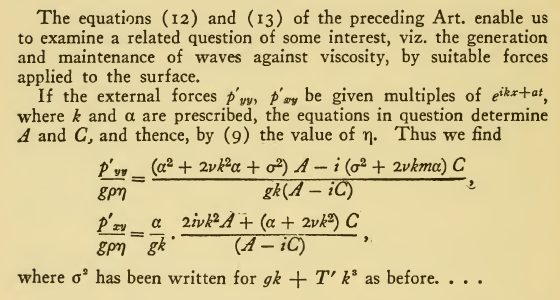
One day I happened to be occupied with the subject of “Generation of Waves by Wind”. I took down the standard treatise on hydrodynamics, and under that heading I read—

XV

And so on for two pages. At the end it is made clear that a wind of less than half a mile an hour will leave the surface unruffled. At a mile an hour the surface is covered with minute corrugations due to capillary waves which decay immediately the disturbing cause ceases. At two miles an hour the gravity waves appear. As the author modestly concludes, “Our theoretical investigations give considerable insight into the incipient stages of wave-formation”.

On another occasion the same subject of “Generation of Waves by Wind” was in my mind; but this time another book was more appropriate, and I read—

There are waters blown by changing winds to laughter
And lit by the rich skies, all day. And after,
Frost, with a gesture, stays the waves that dance
And wandering loveliness. He leaves a white
Unbroken glory, a gathered radiance,
A width, a shining peace, under the night.

The magic words bring back the scene. Again we feel Nature drawing close to us, uniting with us, till we are filled with the gladness of the waves dancing in the sunshine, with the awe of the moonlight on the frozen lake. These were not moments when we fell below ourselves. We do not look back on them and say, “It was disgraceful for a man with six sober senses and a scientific understanding to let himself be deluded in that way. I will take Lamb’s Hydrodynamics with me next time”. It is good that there should be such moments for us. Life would be stunted and narrow if we could feel no significance in the world around us beyond that which can be weighed and measured with the tools of the physicist or described by the metrical symbols of the mathematician.

Of course it was an illusion. We can easily expose the rather clumsy trick that was played on us. Aethereal vibrations of various wave-lengths, reflected at different angles from the disturbed interface between air and water, reached our eyes, and by photoelectric action caused appropriate stimuli to travel along the optic nerves to a brain-centre. Here the mind set to work to weave an impression out of the stimuli. The incoming material was somewhat meagre; but the mind is a great storehouse of associations that could be used to clothe the skeleton. Having woven an impression the mind surveyed all that it had made and decided that it was very good. The critical faculty was lulled. We ceased to analyse and were conscious only of the impression as a whole. The warmth of the air, the scent of the grass, the gentle stir of the breeze, combined with the visual scene in one transcendent impression, around us and within us. Associations emerging from their storehouse grew bolder. Perhaps we recalled the phrase “rippling laughter”. Waves—ripples—laughter—gladness —the ideas jostled one another. Quite illogically we were glad; though what there can possibly be to be glad about in a set of aethereal vibrations no sensible person can explain. A mood of quiet joy suffused the whole impression. The gladness in ourselves was in Nature, in the waves, everywhere. That’s how it was.

The mind is capable of great imagination. The person is not being deceived as long as he aware that it is imagination.

It was an illusion. Then why toy with it longer? These airy fancies which the mind, when we do not keep it severely in order, projects into the external world should be of no concern to the earnest seeker after truth. Get back to the solid substance of things, to the material of the water moving under the pressure of the wind and the force of gravitation in obedience to the laws of hydrodynamics. But the solid substance of things is another illusion. It too is a fancy projected by the mind into the external world. We have chased the solid substance from the continuous liquid to the atom, from the atom to the  electron, and there we have lost it. But at least, it will be said, we have reached something real at the end of the chase—the protons and electrons. Or if the new quantum theory condemns these images as too concrete and leaves us with no coherent images at all, at least we have symbolic co-ordinates and momenta and Hamiltonian functions devoting themselves with single-minded purpose to ensuring that qp—pq shall be equal to ih/2π.

After atom we have gotten only as far as the proton and electron; and mathematical functions and relationships.

In a previous chapter I have tried to show that by following this course we reach a cyclic scheme which from its very nature can only be a partial expression of our environment. It is not reality but the skeleton of reality. “Actuality” has been lost in the exigencies of the chase. Having first rejected the mind as a worker of illusion we have in the end to return to the mind and say, “Here are worlds well and truly built on a basis more secure than your fanciful illusions. But there is nothing to make any one of them an actual world. Please choose one and weave your fanciful images into it. That alone can make it actual”. We have torn away the mental fancies to get at the reality beneath, only to find that the reality of that which is beneath is bound up with its potentiality of awakening these fancies. It is because the mind, the weaver of illusion, is also the only guarantor of reality that reality is always to be sought at the base of illusion. Illusion is to reality as the smoke to the fire. I will not urge that hoary untruth “There is no smoke without fire”. But it is reasonable to inquire whether in the mystical illusions of man there is not a reflection of an underlying reality.

The knowledge obtained through science may be in the form of a cyclic scheme (tautology), but that cycle keeps on growing in detail. The difference between illusion and reality lies in the amount of anomalies present. The fewer anomalies there are the more real it is. Imagination is not opposite of reality. It has its place in reality as long as we recognize it for what it is, and resolve any anomalies present.

To put a plain question—Why should it be good for us to experience a state of self-deception such as I have described? I think everyone admits that it is good to have a spirit sensitive to the influences of Nature, good to exercise an appreciative imagination and not always to be remorselessly dissecting our environment after the manner of the mathematical physicists. And it is good not merely in a utilitarian sense, but in some purposive sense necessary to the fulfilment of the life that is given us. It is not a dope which it is expedient to take from time to time so that we may return with greater vigour to the more legitimate employment of the mind in scientific investigation. Just possibly it might be defended on the ground that it affords to the non-mathematical mind in some feeble measure that delight in the external world which would be more fully provided by an intimacy with its differential equations. (Lest it should be thought that I have intended to pillory hydrodynamics, I hasten to say in this connection that I would not rank the intellectual (scientific) appreciation on a lower plane than the mystical appreciation; and I know of passages written in mathematical symbols which in their sublimity might vie with Rupert Brooke’s sonnet.) But I think you will agree with me that it is impossible to allow that the one kind of appreciation can adequately fill the place of the other. Then how can it be deemed good if there is nothing in it but self-deception? That would be an upheaval of all our ideas of ethics. It seems to me that the only alternatives are either to count all such surrender to the mystical contact of Nature as mischievous and ethically wrong, or to admit that in these moods we catch something of the true relation of the world to ourselves—a relation not hinted at in a purely scientific analysis of its content. I think the most ardent materialist does not advocate, or at any rate does not practice, the first alternative; therefore I assume the second alternative, that there is some kind of truth at the base of the illusion.

In no way is the literary pursuit of imagination deceptive if it is understood for what it is. Using science is a reference point to judge is false.

But we must pause to consider the extent of the illusion. Is it a question of a small nugget of reality buried under a mountain of illusion? If that were so it would be our duty to rid our minds of some of the illusion at least, and try to know the truth in purer form. But I cannot think there is much amiss with our appreciation of the natural scene that so impresses us. I do not think a being more highly endowed than ourselves would prune away much of what we feel. It is not so much that the feeling itself is at fault as that our introspective examination of it wraps it in fanciful imagery. If I were to try to put into words the essential truth revealed in the mystic experience, it would be that our minds are not apart from the world; and the feelings that we have of gladness and melancholy and our yet deeper feelings are not of ourselves alone, but are glimpses of a reality transcending the narrow limits of our particular consciousness—that the harmony and beauty of the face of Nature is at root one with the gladness that transfigures the face of man. We try to express much the same truth when we say that the physical entities are only an extract of pointer readings and beneath them is a nature continuous with our own. But I do not willingly put it into words or subject it to introspection. We have seen how in the physical world the meaning is greatly changed when we contemplate it as surveyed from without instead of, as it essentially must be, from within. By introspection we drag out the truth for external survey; but in the mystical feeling the truth is apprehended from within and is, as it should be, a part of ourselves.

.

Eddington 1927: Causation

karma

Reference: The Nature of the Physical World

This paper presents Chapter XIV (section 1) from the book THE NATURE OF THE PHYSICAL WORLD by A. S. EDDINGTON. The contents of this book are based on the lectures that Eddington delivered at the University of Edinburgh in January to March 1927.

The paragraphs of original material are accompanied by brief comments in color, based on the present understanding.  Feedback on these comments is appreciated.

The heading below links to the original materials.

.

Causation

In the old conflict between freewill and predestination it has seemed hitherto that physics comes down heavily on the side of predestination. Without making extravagant claims for the scope of natural law, its moral sympathy has been with the view that whatever the future may bring forth is already foretold in the configurations of the past—

Yea, the first Morning of Creation wrote
What the Last Dawn of Reckoning shall read.

Free will exists in formulating the postulates at the beginning of a theory, but as the theory develops, the free will is constrained by the logic of consistency, harmony and continuity.

I am not so rash as to invade Scotland with a solution of a problem which has rent her from the synod to the cottage. Like most other people, I suppose, I think it incredible that the wider scheme of Nature which includes life and consciousness can be completely predetermined; yet I have not been able to form a satisfactory conception of any kind of law or causal sequence which shall be other than deterministic. It seems contrary to our feeling of the dignity of the mind to suppose that it merely registers a dictated sequence of thoughts and emotions; but it seems equally contrary to its dignity to put it at the mercy of impulses with no causal antecedents. I shall not deal with this dilemma. Here I have to set forth the position of physical science on this matter so far as it comes into her territory. It does come into her territory, because that which we call human will cannot be entirely dissociated from the consequent motions of the muscles and disturbance of the material world. On the scientific side a new situation has arisen. It is a consequence of the advent of the quantum theory that physics is no longer pledged to a scheme of deterministic law. Determinism has dropped out altogether in the latest formulations of theoretical physics and it is at least open to doubt whether it will ever be brought back.

Free will is constrained by the laws it creates to bring order. The first such law is the LAW OF CONTINUUM, which demands consistency, harmony and continuity of all reality. We have yet to determine the laws for the new quantum theory.

The foregoing paragraph is from the manuscript of the original lecture delivered in Edinburgh. The attitude of physics at that time was one of indifference to determinism. If there existed a scheme of strictly causal law at the base of phenomena the search for it was not at present practical politics, and meanwhile another ideal was being pursued. The fact that a causal basis had been lost sight of in the new theories was fairly well known; many regretted it, and held that its restoration was imperative.*

* A few days after the course of lectures was completed, Einstein wrote in his message on the Newton Centenary, “It is only in the quantum theory that Newton’s differential method becomes inadequate, and indeed strict causality fails us. But the last word has not yet been said. May the spirit of Newton’s method give us the power to restore unison between physical reality and the profoundest characteristic of Newton’s teaching—strict causality.” (Nature, 1927, March 26, p. 467.)

We have yet to determine proper laws of quantization for the new quantum theory.

In rewriting this chapter a year later I have had to mingle with this attitude of indifference an attitude more definitely hostile to determinism which has arisen from the acceptance of the Principle of Indeterminacy (p. 220). There has been no time for more than a hurried examination of the far-reaching consequences of this principle; and I should have been reluctant to include “stop-press” ideas were it not that they appear to clinch the conception towards which the earlier developments were leading. The future is a combination of the causal influences of the past together with unpredictable elements

—unpredictable not merely because it is impracticable to obtain the data of prediction, but because no data connected causally with our experience exist. It will be necessary to defend so remarkable a change of opinion at some length. Meanwhile we may note that science thereby withdraws its moral opposition to freewill. Those who maintain a deterministic theory of mental activity must do so as the outcome of their study of the mind itself and not with the idea that they are thereby making it more conformable with our experimental knowledge of the laws of inorganic nature.

Science by its very nature is deterministic. The principle of Indeterminacy exists because we lack the law of quantization.

.

Eddington 1927: Physical Illustrations

quantum_ill

Reference: The Nature of the Physical World

This paper presents Chapter XIII (section 4) from the book THE NATURE OF THE PHYSICAL WORLD by A. S. EDDINGTON. The contents of this book are based on the lectures that Eddington delivered at the University of Edinburgh in January to March 1927.

The paragraphs of original material are accompanied by brief comments in color, based on the present understanding.  Feedback on these comments is appreciated.

The heading below links to the original materials.

.

Physical Illustrations

If the reader is unconvinced that there can be anything indefinite in the question whether a thing exists or not, let him glance at the following problem. Consider a distribution of matter in Einstein’s spherical “finite but unbounded” space. Suppose that the matter is so arranged that every particle has an exactly similar particle at its antipodes. (There is some reason to believe that the matter would necessarily have this arrangement in consequence of the law of gravitation; but this is not certain.) Each group of particles will therefore be exactly like the antipodal group not only in its structure and configuration but in its entire surroundings; the two groups will in fact be indistinguishable by any possible experimental test. Starting on a journey round the spherical world we come across a group A, and then after going half round we come to an exactly similar group A’ indistinguishable by any test; another half circle again brings us to an exactly similar group, which, however, we decide is the original group A. Now let us ponder a little. We realise that in any case by going on far enough we come back to the same group. Why do we not accept the obvious conclusion that this happened when we reached A’; everything was exactly as though we had reached the starting-point again? We have encountered a succession of precisely similar phenomena but for some arbitrary reason have decided that only the alternate ones are really the same. There is no difficulty in identifying all of them; in that case the space is “elliptical” instead of “spherical”. But which is the real truth? Disregard the fact that I introduced A and A’ to you as though they were not the same particles, because that begs the question; imagine that you have actually had this adventure in a world you had not been told about. You cannot find out the answer. Can you conceive what the question means ? I cannot. All that turns on the answer is whether we shall provide two separate haloes for A and A’ or whether one will suffice.

Descriptions of the phenomena of atomic physics have an extraordinary vividness. We see the atoms with their girdles of circulating electrons darting hither and thither, colliding and rebounding. Free electrons torn from the girdles hurry away a hundred times faster, curving sharply round the atoms with side slips and hairbreadth escapes. The truants are caught and attached to the girdles and the escaping energy shakes the aether into vibration. X-rays impinge on the atoms and toss the electrons into higher orbits. We see these electrons falling back again, sometimes by steps, sometimes with a rush, caught in a cul-de-sac of metastability, hesitating before “forbidden passages”. Behind it all the quantum h regulates each change with mathematical precision. This is the sort of picture that appeals to our understanding—no insubstantial pageant to fade like a dream.

The spectacle is so fascinating that we have perhaps forgotten that there was a time when we wanted to be told what an electron is. The question was never answered. No familiar conceptions can be woven round the electron; it belongs to the waiting list. Similarly the description of the processes must be taken with a grain of salt. The tossing up of the electron is a conventional way of depicting a particular change of state of the atom which cannot really be associated with movements in space as macroscopically conceived. Something unknown is doing we don’t know what—that is what our theory amounts to. It does not sound a particularly illuminating theory. I have read something like it elsewhere—

The slithy toves

Did gyre and gimble in the wabe.

There is the same suggestion of activity. There is the same indefiniteness as to the nature of the activity and of what it is that is acting. And yet from so unpromising a beginning we really do get somewhere. We bring into order a host of apparently unrelated phenomena; we make predictions, and our predictions come off. The reason—the sole reason—for this progress is that our description is not limited to unknown agents executing unknown activities, but numbers are scattered freely in the description. To contemplate electrons circulating in the atom carries us no further; but by contemplating eight circulating electrons in one atom and seven circulating electrons in another we begin to realise the difference between oxygen and nitrogen. Eight slithy toves gyre and gimble in the oxygen wabe; seven in nitrogen. By admitting a few numbers even “Jabberwocky” may become scientific. We can now venture on a prediction; if one of its toves escapes, oxygen will be masquerading in a garb properly belonging to nitrogen. In the stars and nebulae we do find such wolves in sheep’s clothing which might otherwise have startled us. It would not be a bad reminder of the essential unknownness of the fundamental entities of physics to translate it into “Jabberwocky”; provided all numbers—all metrical attributes —are unchanged, it does not suffer in the least. Out of the numbers proceeds that harmony of natural law which it is the aim of science to disclose. We can grasp the tune but not the player. Trinculo might have been referring to modern physics in the words, “This is the tune of our catch, played by the picture of Nobody”.

We do not know the reality but the mathematical models work.

.

Eddington 1927: The New Quantum Theory

New-Quantum-Theory

Reference: The Nature of the Physical World

This paper presents Chapter X (section 1) from the book THE NATURE OF THE PHYSICAL WORLD by A. S. EDDINGTON. The contents of this book are based on the lectures that Eddington delivered at the University of Edinburgh in January to March 1927.

The paragraphs of original material are accompanied by brief comments in color, based on the present understanding.  Feedback on these comments is appreciated.

The heading below links to the original materials.

.

The New Quantum Theory

The conflict between quantum theory and classical theory becomes especially acute in the problem of the propagation of light. Here in effect it becomes a conflict between the corpuscular theory of light and the wave theory.

In the early days it was often asked, How large is a quantum of light? One answer is obtained by examining a star image formed with the great 100-inch reflector at Mt. Wilson. The diffraction pattern shows that each emission from each atom must be filling the whole mirror. For if one atom illuminates one part only and another atom another part only, we ought to get the same effect by illuminating different parts of the mirror by different stars (since there is no particular virtue in using atoms from the same star) ; actually the diffraction pattern then obtained is not the same. The quantum must be large enough to cover a 100-inch mirror.

But if this same star-light without any artificial concentration falls on a film of potassium, electrons will fly out each with the whole energy of a quantum. This is not a trigger action releasing energy already stored in the atom, because the amount of energy is fixed by the nature of the light, not by the nature of the atom. A whole quantum of light energy must have gone into the atom and blasted away the electron. The quantum must be small enough to enter an atom.

I do not think there is much doubt as to the ultimate origin of this contradiction. We must not think about space and time in connection with an individual quantum; and the extension of a quantum in space has no real meaning. To apply these conceptions to a single quantum is like reading the Riot Act to one man. A single quantum has not travelled 50 billion miles from Sirius; it has not been 8 years on the way. But when enough quanta are gathered to form a quorum there will be found among them statistical properties which are the genesis of the 50 billion miles’ distance of Sirius and the 8 years’ journey of the light.

The contradiction about the size of light quantum comes about when we consider it in terms of material-space and material-time. According to Einstein’s papers on quantization and relativity, the space and time for light quanta are much less condensed than the material-space and material-time.

The classical laws are based on the material substance, material-space and material-time. Even when light is not material (it is physical), it was treated only in context of material substance.

As science went deeper into the properties of light and electromagnetic phenomena, it ran into the property of quantization. The electromagnetic spectrum revealed a new substance, which may be called “field-substance”. The field-substance acted as continuous wave at lower frequencies, but with increased frequency it became condensed and acted more like a particle. Ultimately, the field-substance condensed to form the material-substance as in the nucleus of the atom.

Classical mechanics did not have to deal with quantization because it did not deal with field-substance. The New Quantum Theory was then developed to deal with field-substance.

.

Wave-Theory of Matter

It is comparatively easy to realise what we have got to do. It is much more difficult to start to do it. Before we review the attempts in the last year or two to grapple with this problem we shall briefly consider a less drastic method of progress initiated by De Broglie. For the moment we shall be content to accept the mystery as a mystery. Light, we will say, is an entity with the wave property of spreading out to fill the largest object glass and with all the well-known properties of diffraction and interference; simultaneously it is an entity with the corpuscular or bullet property of expending its whole energy on one very small target. We can scarcely describe such an entity as a wave or as a particle; perhaps as a compromise we had better call it a “wavicle”.

We misunderstand light by defining its wavelength, period and cycles in material units. A light quantum is the energy per cycle in light-units.

There is nothing new under the sun, and this latest. volte-face almost brings us back to Newton’s theory of light—a curious mixture of corpuscular and wave-theory. There is perhaps a pleasing sentiment in this “return to Newton”. But to suppose that Newton’s scientific reputation is especially vindicated by De Broglie’s theory of light, is as absurd as to suppose that it is shattered by Einstein’s theory of gravitation. There was no phenomenon known to Newton which could not be amply covered by the wave-theory; and the clearing away of false evidence for a partly corpuscular theory, which influenced Newton, is as much a part of scientific progress as the bringing forward of the (possibly) true evidence, which influences us to-day. To imagine that Newton’s great scientific reputation is tossing up and down in these latter-day revolutions is to confuse science with omniscience.

The wave-particle confusion with respect to light is resolved by the property of quantization discovered by Einstein.

To return to the wavicle.—If that which we have commonly regarded as a wave partakes also of the nature of a particle, may not that which we have commonly regarded as a particle partake also of the nature of a wave? It was not until the present century that experiments were tried of a kind suitable to bring out the corpuscular aspect of the nature of light; perhaps experiments may still be possible which will bring out a wave aspect of the nature of an electron.

So, as a first step, instead of trying to clear up the mystery we try to extend it. Instead of explaining how anything can possess simultaneously the incongruous properties of wave and particle we seek to show experimentally that these properties are universally associated. There are no pure waves and no pure particles.

The discovery that there are no pure waves and no pure particles, as made by de Broglie, supports the fundamental perspective of “continuum of substance”.  One special case of this broad perspective that applies only to material-substance is the “particles in void” perspective.

The characteristic of a wave-theory is the spreading of a ray of light after passing through a narrow aperture —a well-known phenomenon called diffraction. The scale of the phenomenon is proportional to the wavelength of the light. De Broglie has shown us how to calculate the lengths of the waves (if any) associated with an electron, i.e. considering it to be no longer a pure particle but a wavicle. It appears that in some circumstances the scale of the corresponding diffraction effects will not be too small for experimental detection. There are now a number of experimental results quoted as verifying this prediction. I scarcely know whether they are yet to be considered conclusive, but there does seem to be serious evidence that in the scattering of electrons by atoms phenomena occur which would not be produced according to the usual theory that electrons are purely corpuscular. These effects analogous to the diffraction and interference of light carry us into the stronghold of the wave-theory. Long ago such phenomena ruled out all purely corpuscular theories of light; perhaps to-day we are finding similar phenomena which will rule out all purely corpuscular theories of matter.*

*The evidence is much stronger now than when the lectures were delivered.

One cycle in light units shall appear as many cycles in material units. Using de Broglie’s method to calculate wavelengths from diffraction of waves, we may be able to find the ratio of light-units to material units for lengths. This shall reveal how much length shrinks from light frequency to material frequency.

A similar idea was entertained in a “new statistical mechanics” developed by Einstein and Bose—at least that seems to be the physical interpretation of the highly abstract mathematics of their theory. As so often happens the change from the classical mechanics, though far-reaching in principle, gave only insignificant corrections when applied to ordinary practical problems. Significant differences could only be expected in matter much denser than anything yet discovered or imagined. Strange to say, just about the time when it was realised that very dense matter might have strange properties different from those expected according to classical conceptions, very dense matter was found in the universe. Astronomical evidence seems to leave practically no doubt that in the so-called white dwarf stars the density of matter far transcends anything of which we have terrestrial experience; in the Companion of Sirius, for example, the density is about a ton to the cubic inch. This condition is explained by the fact that the high temperature and correspondingly intense agitation of the material breaks up (ionises) the outer electron systems of the atoms, so that the fragments can be packed much more closely together. At ordinary temperatures the minute nucleus of the atom is guarded by outposts of sentinel electrons which ward off other atoms from close approach even under the highest pressures; but at stellar temperatures the agitation is so great that the electrons leave their posts and run all over the place. Exceedingly tight packing then becomes possible under high enough pressure. R. H. Fowler has found that in the white dwarf stars the density is so great that classical methods are inadequate and the new statistical mechanics must be used. In particular he has in this way relieved an anxiety which had been felt as to their ultimate fate; under classical laws they seemed to be heading towards an intolerable situation—the star could not stop losing heat, but it would have insufficient energy to be able to cool down!**

** The energy is required because on cooling down the matter must regain a more normal density and this involves a great expansion of volume of the star. In the expansion work has to be done against the force of gravity.

The matter inside white dwarf stars is much denser than ordinary matter because it involves more dense packing of atomic nuclei. Such dense matter shall have higher quantization level compared to ordinary matter.

.