Oneness gives us the ideal scene for Logic, and its violation gives us anomalies, such as, discontinuity (missing data), inconsistency (contradictory data), and disharmony (arbitrary data).
Oneness also provides the criterion for Truth. Truth depends on the absence of anomalies.
Oneness is not a monotone canvas; but a beautiful painting full of colors and forms that are continuous, consistent and harmonious. Oneness appears equally from the universal scale down to the minutest detail.
“In a way, everyone is a ghost. Whether you are a ghost with the body or without a body is the only question.” ~ Sadhguru
10.1 What Are Ghosts
Life extends beyond the body as well. That is why you have what are generally known as ghosts. All beings, embodied or disembodied, are playing out their lives only as per their karmic structures.
GHOST
A ghost is a being who has left his body, usually, in an unnatural way; but his tendencies still persist due to unfinished Prarabdha Karma. If his tendency, when alive, was pinching people; he will still want to pinch even after his body is gone. But he can no longer have conscious intention because the intellect is gone. Such a being will have a denser presence if his tendencies are very strong. You can feel those tendencies. If you happen to see ghosts it is your psychological response to those tendencies. It has nothing to do with that being. Existence in the form of a ghost is considered undesirable because it can unnecessarily extend for a long time. If he were in a physical body, maybe his Prarabdha Karma would have lasted for another twenty years. Now that there is no physical body; so the lifespan may last for 200 or 2000 years.
CELESTIAL BEING
A celestial being is also a disembodies being but he is not a ghost. He is aware because he lived and died in a certain sense of awareness. He has refused to take another body. He is looking for ways of dissolution.
PSYCHOLOGICAL RESPONSE TO GHOSTS
You are basically responding to tendencies that are external to you. These tendencies are not out to harm you. They are simply operating compulsively according to some genetic memory. They don’t have a discriminatory intellect to choose. They may be intense, mild or meek. They may just hang around certain places per their memory. They are everywhere in some way. This is the reason why processes exist to clear out such influences.
NAGA DOSHA
Besides humans, only cobras and cows are capable of having a subtle body. Naga Dosha happens when a disembodied cobra has touched you somehow. Your skin breaks into rashes and begins to peel away in scales. It looks like psoriasis but is not exactly psoriasis. It can also create a very strange sense of stillness and movement. It can cause people to have serious hearing impediments. People are known to recover from it totally by doing Naga Pooja.
NOTE: It appears to me that, just like the water cycle, the being, upon death, evaporates into the thought space (universal mind). There it may collect other vibrations similar to it and, thus, become more condensed. It may then precipitate into a new body that is forming in a pregnant woman, especially when it resonates with its vibrations.
10.2 Ghost Troubles
If you are vulnerable, these ghosts (external tendencies) can “possess” you, and thus influence your actions. But, if you have the quality of meditativeness, you cannot be possessed. A person who is easily frightened, can, however, be terrorized; and it can lead to situations that are fatal. But, if you have raised yourself to that level of awareness where you can feel these beings, you will have no problem with them.
10.3 Ghost Solutions
These disembodied beings exist only in the level of awareness in which they left. They are in a stagnant state that has a certain lifespan. They can be trapped and used for selfish purposes; but it is a very negative karma to do so, because these beings are, in a way, very helpless creatures. Disembodied beings can be helped and dissolved. To do so we just break their karma. For a disembodied being, the karma is in the energy body. This karmic structureis held by certain pins or chakras. So all we do is pull those pins and the karmic body just collapses. But you have to know what you are doing.
10.4 Dissolving Frozen Beings
Dissolving people in their disembodied state is a much easier thing to do, if the necessary conditions are in place. This section provides Sadhguru’s experience with dissolving a couple of disembodied beings.
10.5 Nirmanakaya
There are yogis who are nirmanakayas. Nirman means ‘to create’, kaya means ‘a body’. It is very rare that this would happen, but there have been some beings who have done that. These yogis are of the highest calibre and are able to materialize their body at will. But the phenomenon has been too exaggerated and presented in many distorted ways.
10.6 Downloading Beings
An ancient idea has been to create an ideal being who can transform the whole world in one shot. Many yogis have put their inputs into this being. This being is expected to mature and find a body in the world about now; and he will be the ultimate teacher in the Creation.
There are beings who are highly evolved and are reluctant to take on a new body. They are looking for a suitable vehicle through which they can fulfill the final phase of their lives. If you have done sufficient work and preparation and are absolutely willing, they can be downloaded into your body. It is a different level of sadhana altogether. The existing being dissolves completely and the downloaded being takes over the body. It is a very complex operation.
After having been here for this long, if we could not produce sufficient beings here of such a level of evolution, then we have to import them from somewhere. I hope such a need will not come to us, for we are doing good work.
“I want you to understand that your grief is not because someone has died. One life going away does not mean anything to you. Thousands of people in the world die in a day. But it does not leave a vacuum in you. You are still partying. The problem is, this particular life going away leaves a hole in your life.” ~ Sadhguru
9.1 The Essential Nature of Grief
You grieve because you have suffered a loss; but this also brings to your attention the incompleteness of you. You realize how incomplete you are with this person now gone. Of course, there is immense love for the departed one; but you must also examine why it is that you feel incomplete. It could mean that you have not experienced the whole life the way it is.
9.2 Going beyond Grief
Your connection with people is very physical. You may have emotions attached to it, but your deepest connection is physical. Once someone leaves their body, whether you like it or not, they have nothing to do with you any more. Only when you are embodied, you have a mother, you have a father, you have a brother, you have a sister. After that, there is no such thing.
When someone is dead it is over. You are unwilling to come to terms with it, so grief sets in. It is time to accept it the way it is. When death happens, it is time to look back and cherish what has been, and it is time to accept it and look at what you can do with the life that is here.
As long as you are alive, it is important that you see how to contribute to the living because other than doing a few rituals within the stipulated time, there is nothing that you can do about the dead. Moreover, if you believe that the person you are grieving for has enriched your life, show that enrichment in how you live.
One of the tools you could use to overcome grief is to perform Kalabhairava Karma. It is not a ritual to handle your grief, but because of what it does, it can handle grief also.
9.3 Articles of the Dead
It is possible that there is a certain residual element of your grandmother that is left behind in her clothes after she dies. And they may cause some things. But there is no need to play into it. All these things were taken care of in India by various customs that were built incorporated into the culture. People accepted these things as a normal happening. When a person died, all the clothes that were closely in touch with that person’s body were burned. They were never kept. The clothes that the person occasionally wore were given only to a blood relative, no one else. And even in such an instance, the clothes were not worn for the first year.
The only thing that you do when someone dies is you cherish the beautiful moments that you had with them—that is all, otherwise, forget about them. Don’t try to work your guilt and your problems through the dead. It can become very complicated.
9.4 Empathetic Death
This happens with some birds, it also happens with animals and human beings: if they were a couple or were very close, when one of them dies, within three to six months, the other will also die. One life following another in death is not necessarily because of loss of companionship or emotional debacle. Two lives that lived in tandem, that were tied together energetically, tend to dismantle in response. This does not happen at the level of thought; it is deeper than that.
9.5 Large-scale Death and Its Consequences
If a violent or unnatural death happens, then the being hangs around and this in turn impacts the place. Now, in case of wars, where a lot of people are killed violently, there are negative consequences only when they were in extreme fear or terrorized. When people die of fear on a large scale, very morbid manifestations may happen. The next few generations after that would have this gore of death in their samskara. So they could never have really known the joy of bonding with people, nor the simple joy of living. They would have slogged, they would have built and they would have done things. Here and there, they would have laughed, they would have lived, they would know everything, but there would have been no real sense of joy. This can be undone by creating many consecrated spaces that are strategically located. It requires creating awareness about the truth.
9.6 Mourning Period
In India, there is a peculiar tradition of mourning that depends on being genealogically related to the dead person in a particular way. Such people are supposed to avoid going to temples or participating in social events or celebrations for forty days. This is because, in ancient India, they followed the system of kula, which is like a clan, but with a much more genetic basis to it.
9.7 Memorials, Samadhis and Pyramids
Building memorials for people who are dear to us or those who were of certain significance or prominence, after their death, is common in all cultures of the world. These memorials also have social and political significance where they help in building our identities. In India people created another kind of memorials called samadhis. There is some spiritual significance to such samadhis and people go to a samadhi not just to remember the dead or pay their respects but also to be in its presence and meditate.
The pyramids of Egypt are perhaps physically the largest and most spectacular attempt ever at connecting the here with the hereafter. The basic quality of the pyramid is preservation. It does not help the dead in any way, except assisting in the preservation of the physical. This is how mummies were preserved for thousands of years. In India, preserving the dead body is the last thing we want to do. Destroying the body immediately is very good for both the dead and the living. Preserving the body is only a torture for the person who has departed.
“As we have responsibilities for the living, we have responsibilities for the dead.” ~ Sadhguru
8.1 Why Are After-death Rituals Needed
Death rituals are not just to assist the dead person in his or her journey, they are also for the benefit of those who are left behind. If the person who dies leaves a lot of unsettled life around us, our lives will not be good.
Death is a process that happens over a period of time. Life exits the body in stages. We can do something for the deceased up to fourteen days after death. We want to help them in such a way that they do not hang around for too long and dissolve quickly. If there is any positive or negative energy around, adolescents are the first people to absorb it. It is like loose software hanging around and adolescent life naturally tangles with that. In Indian culture, after the body is disposed off, there are elaborate processes to clean the person too.
Today, these rituals have become even more important because almost everyone on the planet is beginning to die in unawareness, without the necessary understanding of the life mechanism within themselves. Unfortunately, these rituals also have become largely commercial, with some kind of ritualistic circus being conducted.
8.2 Runanubandha—The Web of Debt
RUNANUBANDHA With everything that our five sense organs come in touch with, in some way, knowingly or unknowingly, consciously or unconsciously, we establish a certain bond with it. This is not just with the people around us but also with the very land that we walk upon, the air that we breathe and just about everything that we see, hear, smell, taste and touch. This is because none of these things happen without investing a certain amount of energy in it. In traditional terms, this is called runanubandha. It is a term which refers to the body’s memory, which comprises of genetic memory and memory of intimate physical connect. It is this memory which is said to bind a parent and a child, a husband and a wife or any other intimate relationships.
BODY MEMORY Body memory is a certain kind of physical memory that you carry within you. It is different from the genetic factors that are transmitted from parent to child. You pick up body memory through physical contact. The body remembers any kind of intimacy you have with any physical substance. This is the reason why, traditionally, in India, people greet each other with folded hands because they do not want to acquire that extra memory that can create bondage and impede their Liberation process. Contact with certain types of substances also has more of an impact than others.
SEXUAL CONTACT Another way you develop runanubandha is through relationships. Even if you just as much as hold someone’s hand, you develop runanubandha. Of all the relationships, sexual relationships have maximum impact in terms of the amount of memory that they leave upon you, compared to any other kind of substance you come in touch with. This is not a question of guilt or ridding yourself of guilt. Guilt is a social phenomenon. What you feel guilty about essentially depends upon the norms of the society you live in. If you feel guilty about something in one society, you may not feel guilty about the same in another society. This is not about social conditioning—this is an existential reality.
DISSOLUTION You must break this relationship with the dead person for you to be able to live well, because the nature of life is such that at times you can become susceptible; then both the right and wrong kind of things can enter you. If this runanubandha is not properly broken it can weaken your body and your psychological structure in such a way that you will not only suffer from grief, it will also lead to certain derangement of life. This is why Indian culture evolved many methods in the rituals that were performed after death to consciously dissolve the runanubandha.
8.3 Kalabhairava Karma—An After-death Ritual at Isha
MEMORY AND SUFFERING Everything that you know as life right now is in some way an imprint of a certain memory. There is the evolutionary blueprint, or genetic memory, that produces the human form, the skin color, the shape of the nose, etc. Beyond that, each human being is different in some way because of individual Karmic Memory. These memories are present in the mind, body and the energies of a person and play out in so many ways. A human being has the most complex memory that enhances his abilities as well as his suffering. He can remember a million small things and suffer a million times over. That is torture!
IMPRINTS OF THE DEAD After a person dies, maybe they have attained mukti or they have gone somewhere else, we don’t know, but either because you were born to them or you were in touch with them in some way or the other, their memory imprints are on you. These imprints are not just in your mind but also in your body and energies as well. This will start to work within you in many unconscious ways. We don’t want to become unconscious of them; we just want to carry it a little loosely on us. So with these death rituals, we do some things to free the departed but it is also important to free the living. Some distance from memories must happen.
KALABHAIRAVA KARMA This is an after death ritual done at Sadhguru’s Yoga Center. This greatly aids and assists the journey the departed being has to make. All it requires is a photograph of the dead person and a piece of cloth used by them. It would be good if the blood relatives of this person are present while the ritual is being performed at the Yoga Center. We do not know where all the memories of the person who died are stuck. So we do whatever best we can. One simple thing to do is that you take a whiff of their memory and put it in a place which is naturally about disentanglement. So we burn the photograph and the piece of cloth, and tie the ashes in a cloth to the tamarind tree outside the Dhyanalinga entrance to take care of whatever is left. Kalabhairava Karma is not a dig-and-clean process. We just mop up the surface so that nothing holds as far as possible. For most cases, this itself is enough.
8.4 The Scope of Kalabhairava Karma
CONDITION AFTER DEATH Once you drop the physical body, you don’t have the discriminatory mind, so there is no comprehension of language. And there is no sound or silence. So there is no question of this person understanding this or that. That is for the living. With rituals, you can draw the being to something, you can direct the being in a particular direction, but you cannot talk to it.
PURPOSE OF RITUALS The best thing is to make that ‘life bubble’ thinner and leave it. It will find its own way to a better place. Rituals should only be concerned about peeling that life off attachment as much as possible. If possible, all the way, but at least as much as you can make it into a thinner bubble than what it is. What will happen, how it will be reborn is not for you to worry about.
DIAGNOSIS Now, once someone is dead, people are very interested in knowing where the departed person is—in heaven or hell or whatever. Some people claim to be able to tell you that. You can determine whether a being is comfortable or in struggle. Accordingly, you can do certain rituals for that being. This is possible, but determining geographically where it is is rubbish because there is no ‘geographical where’.
PURPOSE OF KALABHAIRAVA KARMA Basically, Kalabhairava Karma is being performed, after you are dead, to mop up bits of your life that are sticking around here and there. It is being done because you are not a yogi and you are unable to do the mopping up yourself. A yogi will withdraw to the forest and die alone somewhere in the forest because he has done everything that he needs to do for his life. No one has to do anything for him later. Everything is finished. No Kalabhairava Karma is needed. When he is gone, it is a complete evacuation of the space that he occupied.
KALABHAIRAVA KRIYA If you want to do Kalabhairava Karma for yourself when you are alive, it becomes Kalabhairava Kriya. It can be taught to people but it will need an extreme sense of discipline about who you are and how you manage your energies and system. It requires being alert to every small thing. It creates genetic distance that makes the family or the community over for them. You cannot go back to your home or village and live a social life.
SUBTLE BODY All rituals done after death are about transporting the subtle body to the right place. When the subtle body is not well defined, as in case of plants and animals, there is no need to do anything nor is there a possibility to do something.
8.5 Training People for Death Rituals
APPLICATION OF RITUALS To train people to conduct a ritual is so much easier than training people to do the same thing without a ritual. But when the general fabric of integrity has gone down in the social structure, then, all rituals will be under suspicion because there is room for misuse. Only if we generate people who are responsible enough to not do even one thing more than what is necessary, these things can be done.
WOMEN AND RITUALS Women are more vulnerable to external influences in the sense that they can pass those influences to children who have little defenses. Therefore, a woman will need to take care in doing such rituals much more than a man, especially when they are capable of bearing children. Once they are past the age of bearing children, they can perform rituals as safely as men. In fact, it is far easier to help women to organize and discipline themselves than men. Women have a natural capacity to absorb order due to the deeper sense of survival instinct that is needed to fulfill their reproductive responsibilities.
PREREQUISITES AT ISHA If you are willing to offer this service, then we can train you to do these things properly. But you should never make it your profession; it should be done only as a service. When someone has lost their body, they are completely helpless; they need help and they can be helped, but not with corrupt, contaminated hands. It needs someone who cares and someone who has the necessary sense about it.
8.6 The Death of Infants
The way life manifests in a child is different from the way life manifests in an adult, because the life in a child is still in the process of taking shape. So its death is not the same as the death of an adult.
CHOOSING PRARABDH KARMA There is an entire system of rituals during preconception, conception, birth and thereafter to ensure that this becomes a life which will take on the maximum possibility. So if life becomes stable enough and capable enough by the time it is forty-eight months, it will choose a much bigger Prarabdha Karma.
BIGGER POSSIBILITY Bigger possibility need not necessarily mean one is going to do well in the eyes of the society. In some way, it becomes a life that you cannot ignore. They are a bigger bubble that easily gets noticed.
CHILDHOOD MEMORY Generally, most people will not remember anything below four years of age because infancy is a time when life has not yet decided how it wants to shape itself. It is still exploring whether to expand or contract and what to do and how much. You must interact lovingly with the child to help it expand.
DEATH OF A CHILD In some children, sometimes the quantity of Prarabdha Karma for this lifetime is not decided properly, so they die unexpectedly. Children of extraordinary intelligence who do things absolutely beyond people’s perception tend to die before they are six because their Prarabdha Karma was not properly fixed. The body cannot sustain it and it just collapses.
8.7 The Parent–Offspring Connection in the Afterlife
There is a certain ‘life connection’ between the children and the parents, and if you make use of it in doing rituals for parents, they can be much more effective. If the child does the right things after the death of the parent, he can even liberate the parent through this connection.
CONNECTION After four years, when the child really clicks on to the body that you provided as a parent, something clicks on within you and occupies a certain space within your own system. This is how, if we just check someone’s energy, we know whether they have had children or not. This is why, if you die, we can do something for you through your children. But the reverse is not true. You cannot use the parents to liberate their dead offspring.
8.8 The Importance of Death Anniversaries
POST-DEATH RITES The post-death rites are known as antyeshti and are to be performed by the son of the deceased. It ensures the future welfare of the dead and frees the living from the debt or obligations they owe the parent. Some of the post-death rituals extend throughout the lifetime of the descendants, though on a progressively smaller scale. These rituals are typically performed as shraadha, on each anniversary of the last deceased ancestor. The most important reason these anniversary rituals are done in India is not for remembrance but to distance yourself from the Genetic Memory of your ancestors as much as possible.
8.9 Ancestor Worship
Our debt to our ancestors is huge. So it is customary in most cultures to express one’s gratitude to the ancestors. In some cultures, this ancestor veneration takes on a different proportion and turns to worship. However, in India, we distance ourselves from our ancestors; we don’t worship them. Ancestors taking care of you is not so prevalent in India, because not every ancestor is capable of this.
8.10 Of Heaven and Hell
The large-scale marketing of heaven and hell as destinations for the afterlife was done by the religions of the world to bring control in society. The fact is you do not go anywhere. It is just that the dimensional shift has happened from being embodied to disembodied, or from physicality to a subtler physicality. It is not a geographical shift. And the most important thing is, what happens after is not based on God’s retribution. If you really make them believe everything is going to be better somewhere, you will only mess up life here.
Existentially, there is a little bit of a basis for the notions of heaven and hell. It is because your life does not end with death; it only takes on many other forms after that. It can take on pleasant forms or it can take on very unpleasant forms depending on many factors. It is these pleasant forms that we refer to as Swarga, or heaven, and the unpleasant forms as Naraka, or hell. These are not geographic locations—they are forms taken by the being after the body is dropped. If you go beyond all forms, then we say it is mukti, or Liberation. A spiritual seeker is not interested in going to heaven or hell. They want to go beyond this duality of heaven or hell.
Chapter 18: ATOMIC, NUCLEAR AND SOLID-STATE PHYSICS
.
KEY WORD LIST
Atom, Bohr Atom, Energy Level Diagram, Quantized Energy Levels, Bohr’s Theory, Quantum Theory of Atom, Principal Quantum Number (n), Electron Shells, Second Quantum Number (l), Third Quantum Number (ml), Fourth Quantum Number (ms), Bohr Radius, Electron Probability Cloud, Pauli Exclusion Principle, Bremsstrahlung radiation, X-Ray Lines, Ground State, Excited State, Spontaneous Emission, Stimulated Emission, Laser, Binding Energy, Mass Defect, Maximum Binding Energy, Radioactivity, Half-Life, Dating, Conservation Laws, Natural Decay Processes, Neutrino, Positron, γ-Decay, Induced Reactions, Fission Reaction, Nuclear Energy, Chain Reaction, Cross-Section, Enrichment, Breeder Reactors, Moderator, Critical Reaction, Control Rods, Fusion Reactions, Elementary Particles, Baryons, Leptons, Anti-Particle, Photon, Virtual Photons, Electrodynamics, Muon, Strong Interaction, Weak Interaction, Tau Particle, Meson, Hadron, Quarks, Strangeness, Gluons, “Color” Charge, Chromodynamics, Standard Model, Solid-State Physics, Crystal, Energy “Band”, Energy Gap And Overlap, Energy Gap And Overlap, Conduction Band, Insulator, Semiconductor, Holes, N-Type Semiconductor, P-Type Semiconductor, Photodetectors.
(From KHTK) Atomic Structure, Electron Shells, Charge, Nuclear Shells, Fundamental Particles
.
GLOSSARY
For details on the following concepts, please consult Chapter 18.
ATOM An atom is composed of a positively charged nucleus consisting of protons and neutrons and a surrounding shell of negatively charged electrons which have about 2000 times less mass than the protons and neutrons of the nuclei.
BOHR ATOM Bohr assumed that a wave drawn around the circle representing the path of the electron is an integral multiple of the wavelength. Thus, he asserted that the angular momentum is quantized in multiples of h, and that the only possible allowed orbits for the electron were ones with such an angular momentum. Niels Bohr showed that if one makes certain ad hoc assumptions about quantization, like those suggested by Planck for the black-body radiation, he could indeed explain some detailed phenomena associated with atoms containing a single electron
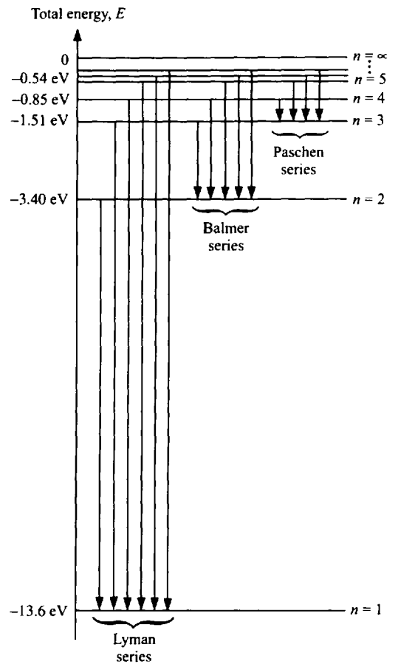
ENERGY LEVEL DIAGRAM We usually picture the allowed states for the atom in an energy level diagram. Here, the energy is zero if the nucleus and the electrons are not bound to each other (Ionized atom). The ground state is the lowest allowed energy (E1) bound state, and it is negative. The atom can make a transition by moving from one allowed level to another.
QUANTIZED ENERGY LEVELS The Bohr theory of the atom thus predicts the existence of quantized energy levels, each associated with a distinct label, n, which is called the quantum number of that level. In those levels the atom cannot radiate away any energy unless, after losing an amount of radiant energy, the atom finds itself in another allowed energy level. Thus, only specific frequencies of radiation (and correspondingly, only specific wavelengths) can be radiated by an atom. Some of these transitions are shown in the diagram below.
BOHR’S THEORY The Bohr theory was successful in giving a rationale for the stability of atoms, and it correctly predicted the wavelengths of radiation from single electron atoms. The theory further showed that the radiation from atoms in general was determined by differences in energy levels of the atoms. However, his theory was unable to be generalized to atoms with more than one electron and was unable to explain why the energy levels of atoms should be quantized in the first place.
QUANTUM THEORY OF ATOM In the quantum theory, the behavior of electrons is determined by the wavefunction solutions of Schrödinger’s equation, which yield the probability that a particle is at a given point in space at a given time. There are stationary solutions of this equation only for certain energies that can be found for bound states. These solutions require labels n, l, and m in three dimensions. It was experimentally determined from the details of the radiation emitted by these atoms, that a fourth label was required as well. These labels are called “quantum numbers” and the accepted notation for these quantum numbers in a one electron atom are n, 1, ml and ms. This fourth quantum number arises from a purely quantum mechanical concept, the intrinsic spin of the electron.
PRINCIPAL QUANTUM NUMBER (n) The quantum number n is called the principal quantum number. It corresponds to the energy quantum number in Bohr’s theory. This number takes on integral values beginning with 1 with no upper bound. It is associated with the distance, r, between the nucleus and the electron; but the concept of a circulating electron in an orbit as prescribed by the Bohr theory, has no validity in quantum mechanics and angular momentum cannot be given a simple visual picture as in the Bohr theory.
ELECTRON SHELLS In the case of multi electron atoms, all electrons with a common principal quantum number n are said to be in the same shell, approximating a single electron atom. All electrons with n = 1 are said to be in the K shell, and all have essentially the same energy. All electrons with the n = 2 are said to be in the L shell, with n = 3 they are in the M shell, with n = 4 in the N shell, etc
SECOND QUANTUM NUMBER (l) The quantum number l is related to one of the angular coordinates. It is called the angular momentum quantum number, since it determines the magnitude of the orbital angular momentum of the electron about the nucleus. In multi electron atoms, the energy levels of an electron are dependent somewhat on 1 as well. For a given n, the allowed values of l are restricted to integers in the range from zero to (n – 1). All electrons with the same quantum number 1 have the same angular momentum.
Any electron with 1 = 0 is called an s electron and has no angular momentum. When 1 = 1, the electron has certain angular momentum and is called a p electron. When 1 = 2, the electron has a different value of angular momentum and is called a d electron. An electron with 1 = 3 is called an f electron, with 1 = 4 is called a g electron, etc.
THIRD QUANTUM NUMBER (ml) The third quantum number ml is related to the second angular coordinate. It indicates the allowed directions for the angular momentum. This is called space quantization. For a given l the values of ml are restricted to integer values ranging from -l to +l. If 1 = 1, there are three possible values for ml: -1, 0, and + 1. This quantum number is often called the magnetic quantum number because the energy of an electron depends on ml in the presence of a magnetic field. The magnetic quantum number has only a very small effect on the energy of the quantum state, except when a magnetic field is existent. It is again important to reiterate that although angular momentum remains an important physical quantity in quantum mechanics, one cannot identify this quantity with the concept of a circulating electron! NOTE: See KHTK explanation below.
FOURTH QUANTUM NUMBER (ms) We need an additional quantum number msto get agreement between the theory and experiment. This additional quantum number does not arise from the motion of an electron in three dimensions, but rather arises from the intrinsic properties of the electron itself. If one assumes that the electron has an intrinsic spin (an internal spin about its own axis) which is quantized, then the atom has additional angular momentum due to the intrinsic spin. This assumption was an ad hoc assumption until quantum mechanics was made to conform to the theory of relativity and the Schrödinger equation was replaced by the Dirac equation. The relativistic equation predicted the correct value for the electron spin. This spin angular momentum is intrinsic to the electron just as its charge and its mass are. These intrinsic values cannot be increased or decreased.
As in the case of the orbital angular momentum, the spin angular momentum is also quantized in space, with its component restricted to two possible states. We assign two possible spins of ±1/2 to quantum number ms. We now must designate each energy level by four quantum numbers, n, 1, ml and ms. Because the electron is charged, the spinning electron produces a magnetic field which in turn impacts slightly on the energy levels of the electrons. With the addition of this spin, the theory agrees with experiment to a remarkable degree.
BOHR RADIUS Bohr radius a0 = 5.29 x 10-l1 m, which is the radius of the lowest level orbit in the Bohr atom.
ELECTRON PROBABILITY CLOUD We see that the electron cannot be located at any specific position in space, but rather there is an “electron probability cloud” in which the electron is concentrated. For n = 1, the maximum probability location for the electron is r = a0, while the average position of the electron is 1.5a0. The total probability of finding the electron at any radial distance is the area under the curve between r = 0 and r = ∞, and must equal 1 since the electron is definitely somewhere in this range.
PAULI EXCLUSION PRINCIPLE This principle states that no more than one electron in an atom can have the same quantum numbers n, 1, ml and ms. We now know that this principle applies to any particle that has a spin of 1/2 (or 3/2, 5/2, etc.). In that case, only one electron can have the quantum numbers for the lowest energy level. The next electron will have to go into the next level, and subsequent electrons into ever higher levels.
BREMSSTRAHLUNG RADIATION X-rays can be produced by taking energetic electrons and letting them strike a metal plate. The energy from a decelerating electron is converted directly to a photon. This is called Bremsstrahlung or braking radiation.
X-RAY LINES X-ray lines are produced when the incident electron loses energy by a “collision” to one of the bound electrons in the material, resulting in the removal of that electron from the atom. If that removed electron is one of the inner electrons, then one of the outer electrons could transfer to this state. By dropping into the inner state, the electron loses energy, and that energy is radiated away by a photon with a wavelength corresponding to the difference in energy between the two states. These wavelengths are often in the X-ray region, especially for materials with many electrons. These characteristic wavelengths then appear in the X-ray spectrum in addition to the continuous spectrum of the Bremsstrahlung radiation.
GROUND STATE The electrons in all the atoms would tend to be found in the “ground state”, in which the electrons fill the various levels from the bottom up, and thus has the lowest overall energy.
EXCITED STATE If the electrons were somehow removed to a higher state, we say that the atom is in an “excited state,” and have a higher overall energy.
SPONTANEOUS EMISSION In spontaneous emission, an excited state electron rapidly transitions downward emitting a photon of a definite frequency f.
STIMULATED EMISSION When the atom can stay in the excited state for a relatively long time, and a photon at that definite frequency f, passes by, it can stimulate the electron to make the transition back to the ground state, by emitting a second photon at frequency f, that is in phase with the first photon. Such a process is called “stimulated emission”. The new photon also travels in the same direction as the initial photon.
LASER When there are many atoms in the excited metastable state then each of the photons can stimulate other emissions which then stimulate even more emissions causing a cascade of photons at the same frequency. This radiation would be especially intense since the radiation from all the independent atoms are in phase with each other. This is the basic concept needed for understanding the operation of the laser.
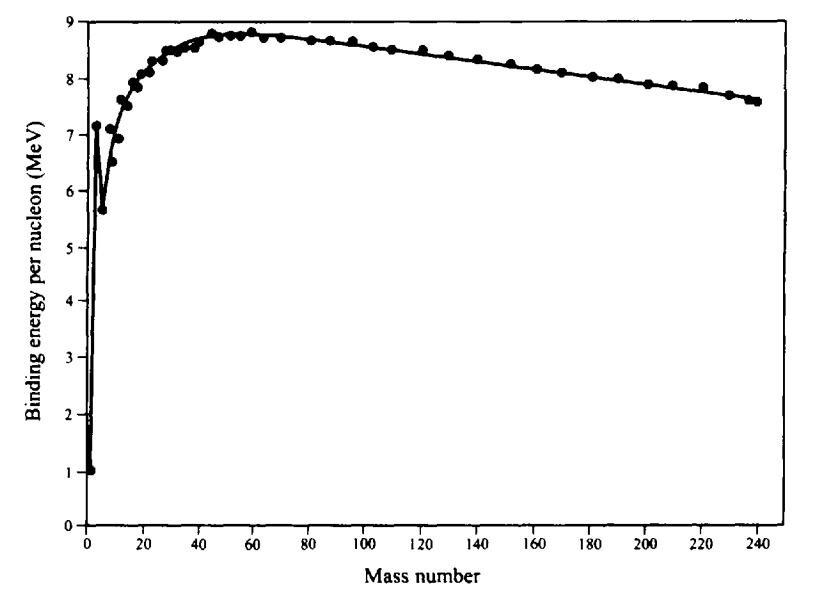
BINDING ENERGY Binding energy is the energy required to remove a nucleon from the nucleus. The energy required to separate all the nucleons from each other is the total binding energy (B.E.) of the nucleus. For a nucleus with A nucleons the average energy needed to remove one nucleon is (B.E.)/A, or the binding energy per nucleon. When one separates all the nucleons, one must supply this amount of energy per nucleon. The total binding energy, B.E., is also the amount of energy released when one forms the nucleus from individual nucleons.
MASS DEFECT The binding energy released when one forms the nucleus from individual nucleons is equivalent to the mass lost. The nucleus will have less mass than the sum of the masses of its constituents. This “lost” mass is called the “mass defect”, and must be equal to the (B.E.)/c2. If we measure the mass of the nucleus, we can calculate the mass defect by comparing this mass to the sum of the masses of its constituents. This will then give us the binding energy of the nucleus.
MAXIMUM BINDING ENERGY We note that a maximum (B.E.)/A of 8.77 MeV/nucleon occurs for Fe57. This nucleus has nucleons which are more tightly bound than in any other nucleus. If the nucleons in other nuclei would be able to rearrange themselves into Fe57, they would each release more energy until their new binding energy increases to 8.77 MeV/nucleon. This can occur if the light elements (A < 57) fuse together to form nuclei with larger A. One can also release energy by converting very heavy nuclei (such as uranium) into lighter nuclei which have a larger (B.E.)/A, thus releasing energy.
RADIOACTIVITY Many nuclei, including those occurring naturally, are unstable, and they decay to another nucleus in a characteristic manner. Radioactivity is the emission of ionizing radiation or particles caused by the spontaneous disintegration of atomic nuclei. Highly radioactive means short half-life, weakly radioactive means long half-life.
HALF-LIFE Each nuclear decay is characterized by a “half-life”, which is the average time that it takes for half of the nuclei to decay. Although one cannot predict which individual atom will have its nucleus decay at any time, only half the original nuclei remain after “half-life.”
DATING One of the applications of naturally occurring radioactivity is in dating of geological or archeological samples. If one assumes that one knows the initial composition of a material in terms of the nuclei present, then, if some of the nuclei are radioactive, we can determine the age of the sample by measuring the composition at the present time.
This technique would allow us to date organic materials on the basis of the following assumptions: (1) The ratio of C12/C14 in the atmosphere has remained essentially stable over geologic time; (2) As an organic substance grows and absorbs carbon, the ratio absorbed is the same as the ratio in the sea of air above; (3) Once the organic material (e.g. a tree) dies there is no more carbon absorbed or emitted chemically, so that the only change in composition comes from the radioactive decay of the carbon 14. We can usually compensate for uncertainties in these assumptions, and in many cases, we can check the accuracy of age determinations by using additional radioactive decays of other isotopes. This has become a standard technique, although it requires careful measurements as well as thorough analysis to be sure that it is legitimately applied in each case.
CONSERVATION LAWS From mechanics, we have the laws of conservation of energy, of linear momentum and of angular momentum. From electricity, we have the law of conservation of charge. All of these conservation laws must be satisfied in any decay that occurs in nature. In addition, we find in the naturally occurring decays that the total number of protons and neutrons (nucleons) must be the same before and after a decay.
NATURAL DECAY PROCESSES There are three naturally occurring decays, which are called α, β and γ. In α -decay the particle emitted from a larger nucleus is the nucleus of a helium atom, in β-decay the particle emitted is an electron and in γ-decay the particle emitted is a photon. A particle will decay by itself only if the decay products have less rest mass than the original particle. The excess mass of the original particle is given as kinetic energy to the decay products.
NEUTRINO Neutrino is a neutral subatomic particle with a mass close to zero and half-integral spin, rarely reacting with normal matter.
POSITRON The positron or antielectron is the particle with an electric charge of +1e, a spin of 1/2, and the same mass as an electron. It is the antiparticle of the electron. When a positron collides with an electron, annihilation occurs.
γ-DECAY Inγ-decay the effect of the emission of a y-ray is merely to carry away energy from the nucleus. We view this in the same manner as for atomic physics where a photon carries away energy as the electrons make transitions between different levels. Similarly, the nucleus has energy levels, and a photon is emitted when the nucleus makes a transition to a lower level.
INDUCED REACTIONS In addition to the naturally occurring nuclear transformations via radioactivity, it is possible to induce nuclear transformations by bombarding the nucleus with another particle or nucleus. For instance, one can strike the nucleus with a proton, or a neutron, or an α -particle, or a γ -ray, etc. The result of such a collision could be a new nucleus plus the emission of a different particle or particles. In all such collisions, called nuclear reactions, the outcomes are restricted by all the conservation laws.
FISSION REACTION If a uranium nucleus would “fission”, i.e. break apart into two smaller nuclei, then each nucleon on average would gain binding energy and this additional binding energy would be released in the form of kinetic energy given to the fission products. To help the uranium nucleus to fission, we can send in additional energy via a photon (photofission) or a neutron. Then the nucleus has enough energy to surmount the barrier and it will immediately break apart. Often, the products of fission include, in addition to massive nuclei, other more elemental particles such as neutrons.
NUCLEAR ENERGY The energy released in a nuclear reaction is huge compared to the energy released in a chemical reaction of two atoms or two molecules, such as the explosion of TNT. In chemical reactions the energy released per molecular interaction is typically a few eV, which is 108 times smaller than the above fission reaction. This is why nuclear energy is much more potent than chemical energy.
CHAIN REACTION We must arrange to have many nuclei fission to produce a large total amount of energy. This is made possible by using the extra neutrons that are released in each fission to initiate a new fission. The process is known as a “chain reaction”. If the chain is not controlled it could produce a large, nearly instantaneous release of energy as in a bomb. If it is controlled, the energy release can be gradual, as in a reactor.
CROSS-SECTION The cross-section is the likelihood of fission occurring in a material. Only U235 (and a new nucleus, produced in reactions, plutonium, Pu239) has a sufficiently large cross-section for use in a reactor.
ENRICHMENT Natural uranium contains mainly U238 (99.3%), with only 0.7% of U235. The cross-section of U238 is too small to use as a practical material. It is very difficult to separate U235 from U238 since both isotopes have the same chemical properties and they differ only slightly in mass. When one has “enriched” the uranium so that it contains about 3% of U235, one can use this mixture as the fuel for a reactor.
BREEDER REACTORS One can build a reactor that produces more fuel (in the form of Pu239) than it consumes (in the form of U235). These reactors are called “breeder” reactors. The plutonium produced in these reactors can be chemically separated from the uranium and used as fuel for a fission reactor.
MODERATOR The fission reaction that is induced by the incoming neutron produces extra neutrons, with a large amount of kinetic energy, which we want to use to induce further fissions in a chain reaction. However, only slow neutrons are efficient in inducing fission, so we first must slow down the neutrons. This is done by a “moderator”, which is a material with which the neutrons collide, and to which they transfer their energy. Energy transfer is most efficient if an energetic object collides with another body of roughly the same mass. The closest material in mass to neutron would be hydrogen (a proton), which is plentiful in water. However, water tends to absorb the neutron and form a deuteron (1H2), which removes the neutron from play instead of slowing it down, thus inhibiting the chain reaction tremendously. Therefore, “heavy” water, already made from deuterium is a much better alternative moderator.
CRITICAL REACTION If the excess neutrons that are produced in a fission induce, on average, less than one new fission, then the reactor is “sub-critical” and will not produce a chain reaction. If more than one fission is induced, on average, then the reaction will increase rapidly in number, possibly leading to an explosion. If the average number of fissions induced by the extra neutrons is just one, the reactor is critical, and a chain reaction will be sustained.
CONTROL RODS The number of induced fissions produced is controlled using “control rods” made of material that absorbs neutrons. These are automatically adjusted to keep the energy production at the intended level. Another control mechanism that prevents a properly constructed reactor from getting out of control is the fact that as the reactor core overheats, the moderator will boil away, and this will automatically reduce the number of slow neutrons and hence the fission reaction.
FUSION REACTIONS The binding energy per nucleon of light nuclei is smaller than that of nuclei with mass numbers near 70, and fusing those light nuclei together increases the average binding energy per nucleon, thus releasing energy. This process is known as fusion, and it is the source of energy of the sun and other stars. In the sun, the process used to generate energy fuses four protons. The conservation of charge requires that electrons be emitted in this process. If one could build a controlled fusion reactor, we would be able to generate energy by combining the very abundant hydrogen and/or deuterium found in water, and create helium, a very useful, yet environmentally harmless inert gas. No radioactive byproducts would be produced.
ELEMENTARY PARTICLES These are the new sub-atomic particles that we have been considering, such as, baryons, leptons and photons.
BARYONS This is the class of particles that contain protons and neutrons.
KHTK NOTE: Baryons represent the very condensed substance in the nuclear region.
LEPTONS This is the class of particles that contain the electron, positron and neutrino.
KHTK NOTE: Leptons represent the much less condensed substance in the electronic region.
ANTI-PARTICLE Positrons were predicted by Dirac after he showed that the correct set of quantum wave equations that are consistent with relativity predicted the existence of an “antiparticle” for each particle. These antiparticles are nearly identical with their particles and have either the same or the opposite properties of their particle. Thus, a positron has the same mass as the electron, but the opposite charge. The properties of particles and antiparticles are always such that they can annihilate each other if they meet, with their entire rest masses being converted into energy (usually γ-rays), without violating any conservation law. Similarly, pairs of particle-antiparticle can be produced directly from the conversion of γ-ray energy into the pair (usually in the presence of some heavy object such as a nucleus) without violating any conservation laws. The γ-ray must, of course, have at least an energy equal to the combined rest mass energy of the created particles.
PHOTON The photon is a particle that turns out to be its own antiparticle. This means that there is no distinction between particle and antiparticle photons, since both have the same charge (zero), rest mass (zero), baryon number (zero), spin (one), etc.
VIRTUAL PHOTONS See ELECTROMAGNETIC INTERACTION. Since these photons are not free to travel away, they are called virtual photons to distinguish them from photons that carry energy through space. Thus, virtual photon can be considered the carrier of the electric and magnetic force between charged particles.
KHTK NOTE: Particles of very near consistencies maybe considered to be exchanging virtual photons because charge represents the gradient of consistency (degree of condensation) of the substance.
ELECTROMAGNETIC INTERACTIONElectromagnetic interaction is the interaction between the electrons and nucleus in an atom. These interactions can be described in terms of the “virtual” exchange of photons. By this we mean that the electromagnetic interaction between charged particles can be considered a consequence of a possible continuous creation of photons by one charge and absorption by the other charge.
ELECTRODYNAMICS The full theory of these interactions with virtual photons is called quantum electrodynamics. The idea that one type of particle is the carrier of the force between other particles can be carried over to other forces as well. The electromagnetic force allows charged particles to exist in both bound states (electrons in an atom) or free states (electrons or protons moving through space).
MUON Muons make up much of the cosmic radiation reaching the earth’s surface. A muon is an unstable subatomic particle that has spin ½, and a negative charge e, but with a mass around 200 times greater. But in other respects, it behaves essentially the same as an electron. It is sometimes called a heavy electron.
KHTK NOTE: The charge of “-1” means that the particle exists at the electron-nucleus interface. It represents the steep change in the consistency of substance.
STRONG INTERACTION Strong interaction is the force that that holds nucleons together in the nucleus. In Strong interactions the decay proceeds very fast and they require the conservation of strangeness quantum number. The strong interaction can be considered as arising from the interchange of particles, called “gluons,” among quarks.
KHTK NOTE: Strong interaction represents the gradient of consistency of substance within the nucleus.
WEAK INTERACTION Weak interaction is the interaction at short distances between subatomic particles called leptons mediated by the weak force. The weak interaction can be considered as arising from the virtual interchange of particles, called “vector bosons.” The weak interaction and the electromagnetic interaction have now been shown to be two aspects of the common “electroweak” interaction.
KHTK NOTE: Weak interaction represents the gradient of consistency of substance within the electron region.
TAU PARTICLE The tau particle is similar to the electron and muon with a rest mass of 3490 times that of electron. The muons and the tau particle are unstable, and decay to electrons of smaller rest mass.
KHTK NOTE: The electron-muon-tau represent the suddenly increasing consistency of substance at the interface between the electronic and nuclear regions.
MESON Meson is a subatomic particle which is intermediate in mass between an electron and a proton and transmits the strong interaction that binds nucleons together in the atomic nucleus. The least massive meson is a pion, which is 270 times heavier than the electron. The next massive meson is the kaon, which is 970 times heavier than the electron.
KHTK NOTE: Mesons glue together the baryons just like photons glue together the Leptons.
HADRON Hadron is a subatomic particle of a type including the baryons and mesons, which can take part in the strong interaction.
QUARKS The mesons and the baryons are viewed as composites of more fundamental particles, called quarks. We know of six different quarks, and all six have been detected indirectly by identifying the properties of mesons containing these quarks. All mesons are composed of one quark and one antiquark, and all baryons are composed of three quarks. The quarks interact by means of the strong interaction.
STRANGENESS It is hard to understand why some particles, like the kaon, should have such a long half-life. After all, the kaon participates in the strong interaction, and can decay into pions that also participate in the strong interaction. There is a similar problem with the decay of a massive baryon called the lambda-particle, which is often created together with the kaon. The solution that was conceived is that these particles (as well as some other new particles) have a new quantum number, called “strangeness”, which must be conserved in an interaction involving nuclear forces (strong interaction). Strangeness is a new property that, like electric charge, baryon number and lepton number, can be both positive and negative. Strangeness is conserved in strong interactions but not in weak interactions. Decay through weak interactions have a relatively longer half-life. Conservation of strangeness introduces a new concept insofar as it is not an absolute conservation law. It is required for the strong interaction (and the electromagnetic interaction), but not for the weak interaction.
GLUONS The particles that are being interchanged among quarks in strong interaction are called “gluons” since they are responsible for “gluing together” the quarks.
“COLOR” CHARGE Each quark has a three valued index called “color” charge. The color charge is a quantity comparable to electric charge in electrodynamics, except that there are two types of electric charges and three types of color charges.
CHROMODYNAMICS The theory of the strong interaction is called “chromodynamics” because the label “color” has been commonly used for this index. Neither quarks nor gluons have ever been seen alone. It is now believed that quarks can only exist in bound states so that one will never see a free quark. This is a consequence of the nature of the strong force provided by the gluons to the quarks.
STANDARD MODEL Much of our present understanding of elementary particles and the world built out of them is explained by a comprehensive theory called the “Standard Model”. Even so, much more needs to be understood, such as the reason the fundamental particles have the rest masses that they do, and whether all the forces of nature can be understood to be different aspects of the same interaction.
KHTK NOTE: The rest masses are a measure of the consistency (degree of condensation) of energy particles. The interactions provide the continuity of substance that is condensing.
SOLID-STATE PHYSICS Solid-state physics studies how the large-scale properties of solid materials result from their atomic-scale properties. Thus, solid-state physics forms a theoretical basis of materials science. Along with solid-state chemistry, it also has direct applications in the technology of transistors and semiconductors.
CRYSTAL The simplest case of solid is the situation when the atoms are arranged in a fixed symmetric pattern which is repeated throughout the solid. Such a system is called a crystal. The results of analyzing this special case can be generalized to more complicated cases of solids with varying degrees of disorder (amorphous solids) and even to liquids. Together all the classes of material are called “condensed matter”.
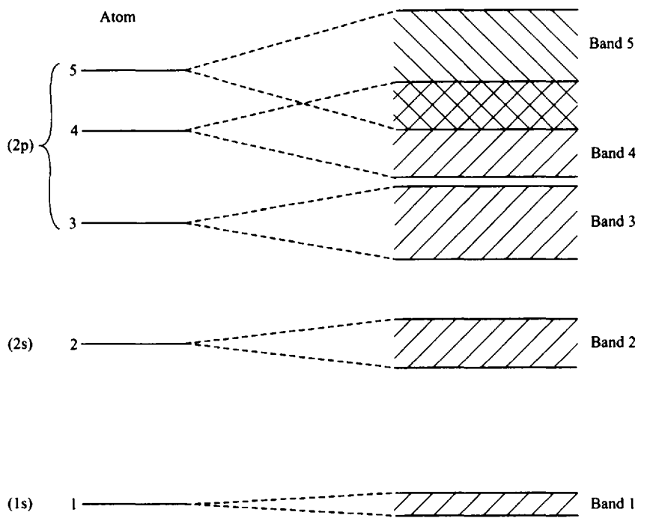
ENERGY “BAND” Two or more atoms that are far apart, have their own identical energy level structure. The electrons can be specified as being in a particular level of a particular atom. As one brings two atoms closer together, the wave functions begin to overlap, and the electron can no longer be considered as confined to only one atom. The result is that the individual levels of each of the two overlapping atoms become two closely spaced shared levels in each of which the electron is shared by the two atoms. As one adds more and more atoms, the electrons are shared by more atoms and the energy levels are best described as energy “bands.” Each band will have twice the number of electrons because of the overlapping of the two individual energy levels. Each energy level of the individual atoms become converted to a band able to accommodate two electrons per atom.
ENERGY GAP AND OVERLAP There is an “energy gap” between some of the bands (see the figure above). This gap is large between bands 1 and 2 and is small between bands 3 and 4. At the energies within these gaps, there cannot be any electrons in the solid.
If there are an even number of electrons per atom, then one expects the highest band to be filled. However, if the bands overlap, as do bands 4 and 5 in the figure above, then the highest band containing electrons may not be filled even for an even number of electrons per atom.
This basic idea permits us to understand why certain solids act as insulators, while others act as conductors, and still others act as “semiconductors”.
ENERGY GAP AND OVERLAP When one imposes a voltage between the ends of a wire, an electric field tries to accelerate the electrons in the material. The electrons that can move because of the imposed voltage are called “free” electrons.
CONDUCTION BAND The energy band in which the “free” electrons move is called the conduction band. This is the case if the highest band containing electrons is not filled. The lower bands are called valence bands.
INSULATOR If the upper valence band is filled, then there are no energy levels available for the highest energy electrons, and they will be unable to accelerate. We will then have an insulator.
SEMICONDUCTOR If one can excite electrons from this filled valence band to the empty next higher band, that band would constitute a conduction band, and these excited electrons can move in an electric field. This type of excitation can occur if the temperature is sufficiently high that the thermal energy of the electrons allows them to jump to the conduction band. Materials such as these, with small energy gaps, are called semiconductors. They can change from insulators to conductors as the temperature increases.
HOLES When an electron excites into the conduction band, we say that there is a positive “hole” created in the valence band and that the positive holes act just like positively charged particles and provide conduction in this band.
N-TYPE SEMICONDUCTOR If one inserts atoms in the base semiconductor material, which have one extra electron, then there will be one more electron per impurity atom than is needed to fill the valence band. These added electrons can partially fill the conduction band and provides conduction appropriate to negative electrons. We call this material an n-type semiconductor.
P-TYPE SEMICONDUCTOR If one inserts atoms in the base semiconductor material, which have one less electron, then there will be one state in the valence band that may be unfilled. This “hole” acts to provide conduction appropriate to a positive charge, and this material is called p-type semiconductor.
PHOTODETECTORS It is also possible to excite electrons in an insulator or semiconductor to the conduction band by absorbing a photon. The incident photon that is absorbed will make it possible for the material to conduct electricity. This process is the basis for constructing photodetectors since the absorption of a photon is signaled by a change in the conductivity of the material.
.
The following definitions are from the philosophy of KHTK:
ATOMIC STRUCTURE An electron cannot be treated as a point particle. The electron has a volume, and, within that volume, the energy substance of electron has the same consistency (degree of condensation) throughout. Multiple electrons come about due to different consistencies. The consistency of the electrons decreases with increasing distance from the nucleus. Therefore, multiple electrons appear as multiple shells around the nucleus of an atom. The quantum numbers simply specify the shells, and a fine structure of sub-shells within those shells.
ELECTRON SHELLS Each energy level of the atom is associated with the consistency of electrons. The four quantum numbers seem to determine the shape of the electron shells within the atom. This shape is almost spherical close to the nucleus, but it flattens out to a disk-like shape away from the nucleus. This makes the shape of the atom look like the shape of a galaxy as it appears from its side.
CHARGE The electron charge seems to be due to the sudden change in energy consistency at the electron-nucleus interface. The “attraction” is due to the CONTINUITY of the substance. Strong attraction corresponds to high gradient of continuity. Light attraction corresponds to light gradient of continuity. The “repulsion” occurs when the gradient of this consistency does not match. The electrons inside an atom are arranged by the gradient of their consistency and so they do not repel each other. Two negatively charged surfaces repel each other because there is a complete mismatch of the gradients of energy levels between them.
NUCLEAR SHELLS Protons and neutrons are bound together in the nucleus because of the continuity of substance. They simply make different layers of the nucleus. These layers get more condensed as they get closer to the center. Protons have charge so they must form the surface of the nucleus to interface with the electrons. Neutrons fill the inside of the nucleus and are more condensed; so, they have slightly greater mass. As the nucleus grows, the number of neutrons get larger more rapidly than the number of protons because they fill the inside of the nucleus.
FUNDAMENTAL PARTICLES There is a seemingly inexhaustible array of oddball particles, and the conservation laws begin to seem arbitrary and capricious. Most of these particles lie in the high gradient of consistency between the electron and proton at the electronic-nuclear interface. Such particles are unstable and decay into other particles. This indicates dynamic migration of substance across this interface.