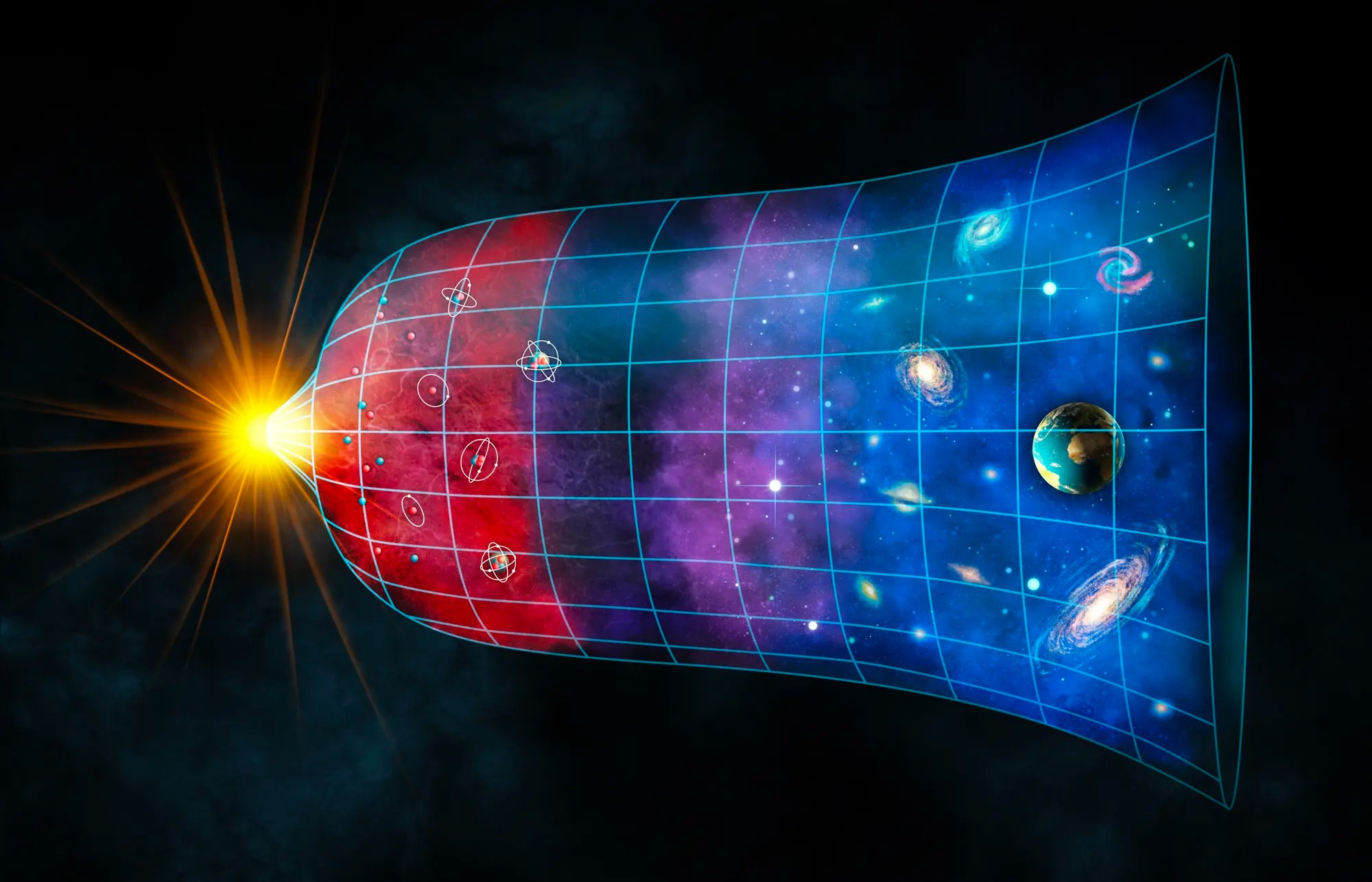
The Matter

Reference: Postulate Mechanics

The Matter

Most of us recognize matter as substance. The classical understanding of matter is as follows:

Matter has the characteristics of volume, density, weight, shape, color, etc. Matter can exist in the states of solid, liquid, and gas depending on factors like temperature and pressure. In solid state, matter holds its shape. In liquid state, matter takes the shape of its container. In gaseous state, matter fills the entire container. Matter has mass, which is very compact and rigid. It allows matter to be divided into very small particles. The motion of a material object, regardless of its size, can be treated mathematically as if it belongs to a point where all the mass of the object is concentrated. We call this point the center-of-mass.

The smallest particle of matter is an atom. The atom is actually configured of substances of different masses, such as, nucleons and electrons. This makes matter a composite substance.

.

The Substance

Reference: Postulate Mechanics

The Substance

Substance is what we sense. It is anything substantial enough to be sensed. We may refer to the degree of substantiality as the consistency of substance.

A postulate is a substance of very low consistency. The postulate and the reasoning following from it, may be referred to as thought. Thought is a substance.

As thought manifests and becomes more persistent and automatic, its consistency assumes a higher range. It may now be referred to as electromagnetic radiation. Radiation is a substance.

As radiation becomes more condensed into patterns and starts to assume a structure, its consistency becomes extremely high. It may now be referred to as matter. Matter is the substance we are most familiar with.

Thus, we have a spectrum of substance of increasing consistency from thought to radiation to matter. As the consistency increases, the substance becomes more condensed and acquires greater endurance. 

The condensation manifests as the contracting dimensions of the substance. This is measured by wavelength, and it is the characteristic of SPACE of the substance.

The greater endurance manifests as the increasing durability of the substance. This is measured by frequency, and it is the characteristic of TIME of the substance.

.

The Universe

Reference: Postulate Mechanics

The Universe

The Universe consists of all that is knowable. It gets its meaning from the postulates that are in existence. The word, UNIVERSE, means “combined into one.” The oneness of universe means that it is continuous, consistent and harmonious. It provides a complete picture of all our combined experience. The reality of the universe depends on the oneness of all its forms.

The universe is formed by postulates. Thus, postulates are the primary substance of the universe categorized as thought. Thoughts evolve into higher categories of substance, which are radiation and matter. These categories of substance make a continuous spectrum. All forms in this universe contain these three categories of substance. The universe continues to evolve into increasingly complex forms that possess greater capabilities.

The universe has been described through our scriptures, philosophy and science.

.

Notes

Fundamental to the universe is the principle of Oneness. Consciousness is made up of postulates that manifest as primary existence. These postulates are constrained by oneness. Combinations of these postulates further evolve in their forms, once again compliant to the principle of oneness. Thus, come about thought, energy and matter.

.

Subject Clearing Logic

Please see The Book of Misconceptions

Processing is the application of a procedure to bring about an improvement in a person’s condition. In Subject Clearing, the processes have been obtained from the study of Vedic Hinduism, Buddhism, Psychoanalysis and Scientology.

In Subject Clearing, you can always go back to a previously applied process and run it again.

.

Process

This Subject Clearing process explores the subject of thought. 

PREREQUISITE: Subject Clearing Mind

Look up these words in this sequence per the definitions given below.

LOGIC, PRINCIPLE OF ONENESS, ANOMALY, OUT-POINT, IDEAL SCENE, FIXED IDEA, PERSONAL IDEAL, OPERATIONAL, FACT, OPINION, STATISTICS, EXISTING SCENE, OBSERVATION, SITUATION ANALYSIS, SITUATION, DATA, WHY, HANDLING.

As you look up a definition, ask yourself,

“What crosses my mind as I look up this definition?”

Notice the internal reaction. Apply The 12 Aspects of Mindfulness to that reaction. If there is a disagreement, or you sense some anomaly, then address it with Subject Clearing Viewpoint.

You may consult dictionaries, Wikipedia, Textbooks, etc., to sort out the disagreement or anomaly present. Contemplate on these words until you are fully satisfied with your understanding.

For more definitions, please refer to KHTK Glossary: Subject Clearing.

.

Definitions

LOGIC
Origin: “Of speech or reason.” The continuity, consistency and harmony in the dimension of thought provides the sense of logic. Logic is a study of associations. Associations are logical when they can be assimilated into a consistent whole. The mind naturally follows logic unless interfered with. Logic may be reduced to a system or principles of reasoning. The ideal scene of Logic is represented by the Principle of Oneness.

PRINCIPLE OF ONENESS
Oneness does not imply sameness. Oneness means that all that is known is continuous, consistent and harmonious. There are dimensions in Oneness, where continuity exists. There are realities in Oneness, where consistency exists. There are relations in Oneness, where harmony exists. This Principle of Oneness underlies the very concept of the universe. It also underlies the Scientific method. This principle gives us the ideal scene for logic, and its violation gives us anomalies.  

ANOMALY
An ANOMALY is any violation of the Principle of Oneness, such as, discontinuity (missing data), inconsistency (contradictory data), or disharmony (arbitrary data). An anomaly is always viewed from one’s viewpoint. Resolution of anomaly always expand’s the knowingness of one’s viewpoint.

OUT-POINT
An out-point is the Scientology version of an anomaly. It is defined as an illogical departure from the ideal scene. By comparing the existing scene with the ideal scene one easily sees the out-points. Hubbard categorizes these out-points as follows:

  1. Omit a fact.
  2. Change sequence of events.
  3. Drop out time.
  4. Add a falsehood.
  5. Alter importance. 

IDEAL SCENE
In Scientology, the entire concept of an ideal scene for any activity is really a clean statement of its purpose. From the viewpoint of Subject Clearing, that purpose must not violate the Principle of Oneness. From that purpose one then constructs an ideal organization to carry out the activity.

FIXED IDEA
A fixed idea is an idea held in the mind that influences perception in a certain way. Prejudiced people are suffering mainly from a fixed idea. A fixed idea is not examined by the person holding it. It blocks the existence of any contrary observation. Fixed ideas are held as personal ideals. An example of a fixed idea is, “Life is always like that.”

PERSONAL IDEAL
This is an ideal held by a person which is in violation of the Principle of Oneness. Departure from such an ideal is an error and not an out-point. 

OPERATIONAL
An activity to be operational must contain parts of its ideal scene. The fact that something is actually operating and solvent can outweigh the untested advantages of changing it.

FACT
A fact is something consistent with what is observable; but it is true only to the degree that it is free of anomalies.

OPINION
An opinion is a belief or judgment that may or may not be based on facts; but it is likely influenced by personal ideals. 

STATISTICS
A statistic is a numerical measure of the effect caused by an activity. It provides the most direct judgment of the activity as it bypasses the influence of varying opinions. The statistic is considered positive When the activity contributes positively to survival.

EXISTING SCENE
The existing scene is the broad general scene on which a body of current data exists. It is what is really there—the people or personnel, their current state, the lines, the hats, the buildings, equipment, and the state of them, the tech in use and current news.

OBSERVATION
Application of logic starts with the observation of the existing scene. The ability to observe things as they are requires the absence of fixed ideas, personal ideals and assumptions.

SITUATION ANALYSIS
We obtain an analysis of the situation by analyzing all the data we have and assigning the outpoint data to the areas or parts. The area having the most outpoints is the target for correction. A situation analysis only indicates the area that has to be closely inspected and handled. 

SITUATION
A situation is a major departure from the ideal scene.It is a not expected state of affairs. It is either very good or it is very bad.

DATA
Data are facts, graphs, statements, decisions, actions, descriptions which are supposedly true. These are observations leading to investigation. From this data one traces the string of out-points to finally get the WHY.

WHY
The why is the major out-point that explains all other out-points related to a situation. It explains how come the situation is such a departure from the ideal scene. The real why opens the door to handling. The why must permit a closer approach to the ideal scene.

HANDLING
Just as you proceed to the SITUATION—go big, when it comes to handling it usually occurs that reverse is true—go small! 

.

CHAPTER 12: Final Round

Reference: DEATH: An Inside Story

“We can make this life the last one for you but we cannot make this the most wonderful one. That only you have to do. For that, you must do sadhana. You must promise me that.” ~ Sadhguru

12.1 One Drop Spirituality

You may have realized how to live ecstatically but It is not easy to teach that to others. But it may be possible to teach them how to die well. Most people on the planet die badly. When a being is disembodied, whether their experience of life becomes heavenly or hellish largely depends on how they die. Many people have their life worked out according to their dreams, but when they come to the last mile of their life, they are completely out of sorts. They are completely broken people and die in a bad way. They die badly because modern societies are neither aware nor have they taken care of this important aspect as to how to die well.

LIVING WELL
If you feel happy because you have more things and comforts compared to others, then that is not living well. Living well is if you are able to sit here in such a way that nothing matters; whether you have something or not, even whether there is food to eat or not, it does not matter to you. You are just fine. It is not that you are incapable of earning your food and other things, but that does not decide who you are right now. If you are like this, you are living well for sure. Wherever you sit, your experience of life will be beautiful.

DYING WELL
Helping people to die well does not mean assisting them to die as euthanasia supporters advocate. Helping people to die means helping people to manage the moment of passing from physicality to beyond, from being embodied to being disembodied, in utmost awareness and grace. There are many methods to cultivate this awareness in life so that when the moment of death comes, it will carry you through in grace.

HELPING TO DIE WELL
Sometimes you stretch a person’s life because he has not exhausted his Prarabdha Karma but has run out of steam; and sometimes he has exhausted his Prarabdha Karma but still has steam, so you have to release it. Both are needed in life. Someone being liberated for good is possible only when someone has run the full course of prarabdha.

KARMIC BREAK
There are many people who die of old age; they may have lived as utter fools, but in the final few days, suddenly, there is a new sense of wisdom within them, a new sense of awareness about them because their karma allotment has finished. Just the minor things are left and the next quota of karma has not come in yet, so that is a blessed period. They are in a certain space where there is a karmic break. Such people can be dissolved very easily. We can help them die consciously rather than in an unconscious state.

DYING OF DISEASE
But when they die of disease before the Prarabdha Karma is complete, if one tries to dissolve them, it is not going to work. All we can do for them is help them to die with awareness; then they will have a little enhanced life somewhere else.

12.2 Once You Made a Mistake of . . .

It is better you live well, not just aim towards dying well. If you live well, then you would be prepared to die well also. So, you should be willing to do those things that will help you live well. To live gracefully is something you have to earn.

MAYA
Maya means that the way you are existing right now, your perception and understanding of life, is illusory. The most essential part of this illusion is your idea of you as a being or an individual. It is illusory.

INDIVIDUAL
You exist as an individual because you are a piece of earth. The illusory idea is that you are something connected to earth because it implies you are something else. 

BRAHMACHARYA
Brahmacharya means you are on the path of the Divine where the focus is on a universal process rather than on individuality.

SEPARATENESS
Two unconscious entities cannot come together, they will always remain two separate bubbles of their own, even though the atmospheric transfer between the two is happening. So this illusion that you are a separate entity is a big problem.

THE PROCESS OF BEING
The whole process of being with something means just this, that you did not fix your boundaries for a moment. If you can do it for a day—that you did not fix any boundaries, you are simply here—we will worship you because that which does not have boundaries is Divine. So not a whole day, if you have experienced this state without boundaries for even one moment, there will be no more rebirth for you.

.