Reference: Subject Clearing Universe
The knowable is sensed but it still needs to be given meaning with the help of postulates. Postulates have existed since the ancient times, and they have improved over the time. As a result we have a much better knowledge of the universe today.
.
Definition of KNOWABLE
The ancients postulated earth, water, air, fire and aether as the elements that helped describe the universe. Today these elements have been refined to matter, energy, space and time. All that we sense is understood in terms of these elements.
Since Einstein equated energy to matter, both of these may be combined together into a single element called substance. We then find that thought can also be included in the element of substance.
We may further associate space and time with the element of substance according to the theory of relativity. Space comes to represent the extents of substance, and Time comes to represent the duration of substance.
This reduces all the elements to the sole element of substance. We may say that the knowable universe starts to take shape with the postulate of substance.
.
Misconceptions
1. It is a misconception to think that the primary division exists between the physical and spiritual “universes”. The spiritual and physical domains may be very different, but they both consist of substance. The primary division is between the knowable universe and the Unknowable.
2. MEST is an acronym formed in Scientology from the initial letters of Matter, Energy, Space and Time. Scientology makes the error of limiting the designation of MEST to the physical universe only. But MEST applies equally to the spiritual universe which is made of thought substance.
.
Reference: Subject Clearing Universe
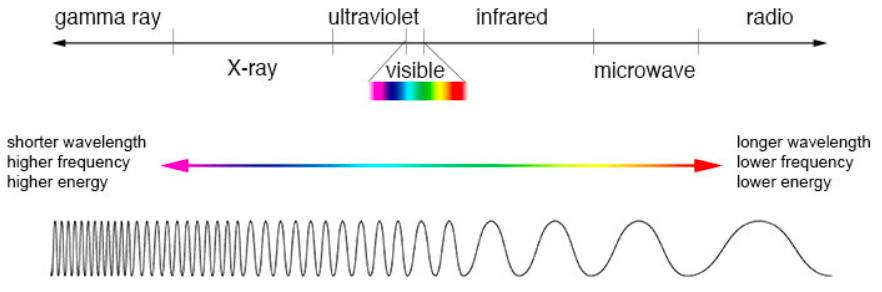
The highest degree of consistency (mass) is measured indirectly by the weight of matter. We cannot do that with energy because its consistency is many orders of magnitude less. So we measure the consistency of energy by its wavelength that tells us how thick or thin the energy field is.
.
Definition of WAVELENGTH
The wave-length as applied to energy is not really the distance between two adjacent crests as we imagine for the ripples of water. That visualization is limited to matter only.
For energy, the wave-length is a measure of how expanded or contracted the field of energy is. As the consistency of energy increases its field condenses, and its wave-length becomes shorter.
Thus, we may use wavelength as a measure of the consistency of substance.
Even matter can be shown to have a wavelength, but it is extremely short.
On the other hand, the wavelength of thought shall be larger than the largest wavelength of energy by many orders of magnitude.
.
Misconceptions
1. It is a misconception to think of the wavelength of substance as the distance between two adjacent crests of waves because at the basic level, any substance is a field of force. The wavelength is simply a number that tells one how thick of thin the field is.
.
Reference: Postulate Mechanics
The Thought
Thoughts manifest, and they can be sensed. We routinely sense our own thoughts directly and work with them. We sense the thoughts of others mostly indirectly, and work with them.
Because thoughts are substantial enough to be sensed, they are a kind of substance; but the laws that apply to thoughts are very different. The primary law is:
Thoughts are as real and perceivable, as they are continuous, consistent and harmonious among themselves and with their context.
The more discontinuous, inconsistent and disharmonious the thoughts are, the more unreal they become.
The wavelengths of thoughts, in general, are much larger than those of electromagnetic radiation. There is a thought spectrum from larger to smaller wavelengths. At the higher end, thoughts are extremely flexible, differentiable and rational. But as identification sets in down the spectrum, rationality gives way to emotions and reactions. Each emotion has its own peculiar wavelength.
A quantum of thought may be described as a basic idea or a concept. Such quanta of thoughts interact to produce more complex ideas and concepts. Human thoughts are very complex. They interface with radiation and matter in the human body.
.
Reference: Postulate Mechanics
The Motion
For motion to occur, there must be substance with extent and duration. Thus, the prerequisites for motion are consistency, space and time. As consistency increases from thought to radiation to matter, space contracts and time becomes more durable. Motion also slows down.
But the motion is not random. It seeks to evolve and bring about more sophisticated motion. So, there must be additional postulates to guide and generate learning on part of motion. These postulates are likely to be similar to the postulates underlying current research in Artificial Intelligence.
Embarking on the study of motion is like opening the Pandora’s Box. Physics has hardly scratched the surface.
.
Reference: Subject Clearing Universe
Reference: “Energy” in Quantum Mechanics
NOTE: The subject of Physics treats these fundamental particles mathematically, and it does not provide a proper visualization for them. The effort on this blog is to provide a visualization that is consistent with what is known. It does not change the mathematics of Physics.
The concept of quantum was first applied to electromagnetic radiation. It had to do with the amount of radiation that was absorbed and emitted by atoms. Such an amount was found to be proportional to the frequency of radiation, and not to its intensity.
.
Definition of QUANTUM
In physics, a quantum is the minimum amount of any physical entity involved in an interaction. In the Standard Model of Particle Physics, quantum applies to the discrete amount of energy, which is radiated from an atom, or absorbed in an atom. This amount is proportional to the frequency of the radiation it represents.
Thus, the concept of quantum applies to the radiative “particles” of spin 1 that can merge into each other forming a continuous flow that has a definite consistency. The particles of spin 1/2 are spinning vortices that cannot merge with each other to form a continuous flow; so, they are treated as units in themselves and don’t need the concept of quantum.
In summary, the concept of quantum is used to specify the unit of radiative energy that otherwise have a continuous flow with no distinguishable particles. Radiative energy of different consistencies have different quanta.
.
Misconceptions
1. It is a misconception to think of a quantum of energy as a particle in space and not as the amount of energy involved in a sub-atomic reaction.
2. It is a misconception to think of a quantum as a “wave-packet” of energy. The quanta do not have defined boundaries as a continuous flow in space, just like drops of water do not have defined boundaries in a glass of water.
3. It is a misconception to think of a “wave-packet” as a packet of waves of certain wave-length. It is actually an energy field of certain consistency.
.