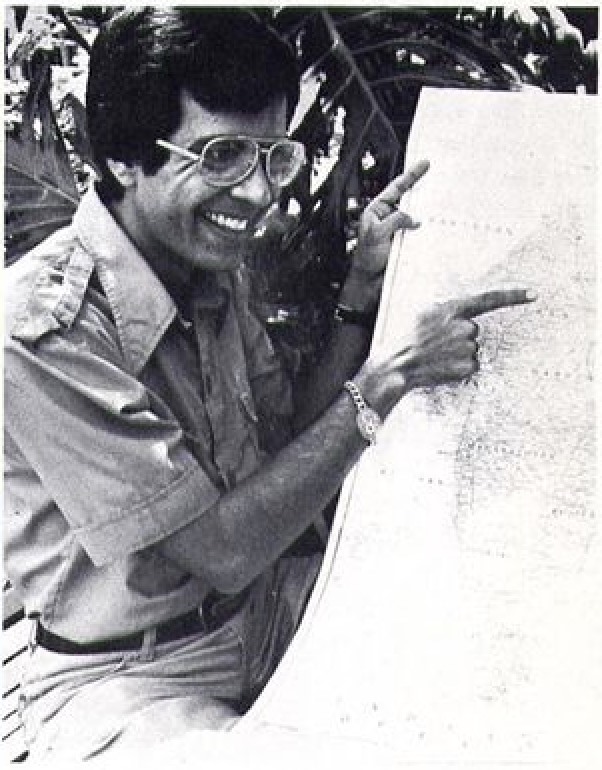
Memory from IITK (1964)

This too is another life… another world.

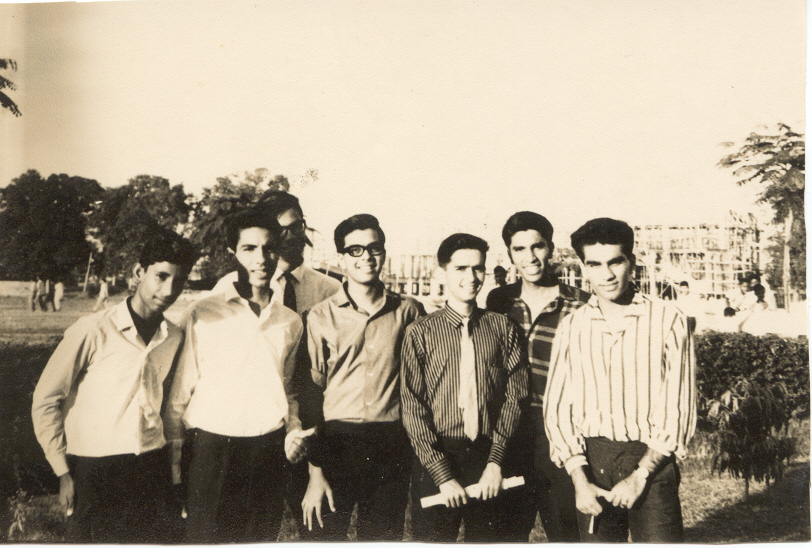
From left to right: Ravi Mathur, Sunil Dhawan, Yogendra Singh, Vinay Agarwala, Shri Nandan, Sushil Handa, and Ashok Dhawan

I am the eighteen-year old in the center with glasses… I am currently in touch with my friends here. We may meet in the class reunion in March 2013 and get another picture like this one.

The IITK campus was still under construction as can be seen in the background. Our batch was the first to arrive directly at this campus.

.

Memories at Sea (1972-75)

Another life… another world!

.

The Context of KHTK

Reference: What is KHTK?

KHTK is practiced within the context of The Fourth Noble Truth – The Path as taught by Buddha. The eight categories of this path are outlined below. Please note that this is eastern psychology and not a religion.

.

(A) Wisdom

1.  Right Understanding (seeing a thing in its true nature, without name and label)

(a) The nature of life is Dukkha

(b) The origin of Dukkha is ‘thirst’

(c) Nirvana is the cessation of Dukkha.

(d) The path to Nirvana is eight fold.

2.  Right Thought (extended to all beings)

(a) Thoughts of selfless renunciation or detachment

(b) Thoughts of love

(c) Thoughts of non-violence

.

(B) Ethical Conduct

3.  Right Speech

(a) Abstain from telling lies

(b) Abstain from backbiting and slander and talk that may bring about hatred, enmity, disunity, and disharmony among individuals or groups of people.

(c) Abstain from harsh, rude, impolite, malicious and abusive language.

(d) Abstain from idle, useless and foolish babble and gossip.

(e) Do not speak carelessly: speech should be at the right time and place.

(f) If one cannot say something useful, one should keep ‘noble silence’.

4.  Right Action

(a) Abstain from destroying life, from stealing, from dishonest dealings, and from illegitimate sexual intercourse.

(b) Always aim at promoting moral, honorable and peaceful product.

(c) Help others to lead a peaceful and honorable life in the right way.

5.  Right Livelihood

(a) Abstain from making living through a profession that brings harm to others, such as

  • Trading in arms and lethal weapons,
  • Intoxicating drinks,
  • Poisons,
  • Killing animals,
  • Cheating, etc.

(b) Live by a profession which is honorable, blameless and innocent of harm to others.

.

(C) Mental Discipline

6.  Right Effort (energetic will)

(a) To prevent evil and unwholesome states of mind from arising

(b) To get rid of such evil and unwholesome states that have already arisen within a man

(c) To produce, to cause to arise, good and wholesome states of mind not yet arisen

(d) To develop and bring to perfection the good and wholesome states of mind already present in a man.

7.  Right Mindfulness (to be diligently aware, mindful and attentive with regard to)

(a) The activities of the body.

  • Be clearly aware of breathing
  • Whether it is deep or shallow
  • Of how it appears and disappears within the body

(b) Sensations or feelings.

  • Be clearly aware of all forms of feelings and sensations
  • Whether pleasant, unpleasant and neutral
  • Of how they appear and disappear within oneself

(c) The activities of the mind

  • Whether one’s mind is lustful or not, given to hatred or not, deluded or not, distracted or concentrated, etc.
  • All movements of mind, how they arise and disappear.

(d) Ideas, thoughts, conceptions and things

  • One should know their nature
  • How they appear and disappear
  •  How they are developed
  •  How they are suppressed, and destroyed, and so on

8.  Right Concentration

(a) First Stage

  • Passionate desires and certain unwholesome thoughts like sensuous lust, ill-will, languor, worry, restlessness, and skeptical doubt are discarded
  • Feelings of joy and happiness are maintained, along with certain mental activities.

(b) Second Stage

  • All intellectual activities are suppressed
  • Tranquility and ‘one-pointedness’ of mind is developed
  • The feelings of joy and happiness are still retained.

(c) Third Stage

  • The feeling of joy, which is an active sensation, also disappears
  • The disposition of happiness still remains
  • Mindful equanimity remains

(d) Fourth Stage

  • All sensations, even of happiness and unhappiness, of joy and sorrow, disappear
  • Only pure equanimity and awareness remains

.

The practice of KHTK helps bring about ‘Right Mindfulness’, which then supports the development of overall mental discipline. The mental discipline goes hand in hand with ‘wisdom’ and ‘ethical conduct’. So, when one is working with KHTK, one is working with all the eight categories above simultaneously.

.

Introduction to KHTK (old-2)

October 2, 2013: This essay has been superseded by: What is KHTK?

.

This is a set of essays that have come to be known by the acronym KHTK (from the phrase “Knowing How TKnow”). This is the first of the KHTK essays.

KHTK helps you answer the question, “Who am I?” Nobody can answer this question for you. You have to find this answer yourself.

KHTK is based on a system of looking and not on logic. Logic may help you figure out where to look, but the precise knowledge comes from looking.

KHTK is derived from the principle of Vipassana as rediscovered and described by Buddha. The word passana means to see with open eyes, in the ordinary way; but, the word vipassana means,

“Observe things as they are, not just as they seem to be.”

.

Vipassana

Here is an excerpt on Vipassana from the link Vipassana Meditation.

“Vipassana, which means to see things as they really are, is one of India’s most ancient techniques of meditation. It was rediscovered by Gotama Buddha more than 2500 years ago and was taught by him as a universal remedy for universal ills.

“This non-sectarian technique aims for the total eradication of mental impurities and the resultant highest happiness of full liberation. Healing, not merely the curing of diseases, but the essential healing of human suffering, is its purpose.

“Vipassana is a way of self-transformation through self-observation. It focuses on the deep interconnection between mind and body, which can be experienced directly by disciplined attention to the physical sensations that form the life of the body, and that continuously interconnect and condition the life of the mind. It is this observation-based, self-exploratory journey to the common root of mind and body that dissolves mental impurity, resulting in a balanced mind full of love and compassion.

“The scientific laws that operate one’s thoughts, feelings, judgments and sensations become clear. Through direct experience, the nature of how one grows or regresses, how one produces suffering or frees oneself from suffering is understood. Life becomes characterized by increased awareness, non-delusion, self-control and peace.”

Here is a success story from the use of these principles.

Doing Time Doing Vipassana

.

KHTK

KHTK techniques may be described as ‘Looking to Know’. Looking is described here as using sense organs (eye, ear, nose, tongue, body and the mind) to observe and experience what is there. Please note that mind is considered a sense organ, like the eye or the ear.

The purpose of KHTK is to enable a person to practice by oneself, the principles of Vipassana, which may be summed up as mindfulness – looking, observing, and contemplating on things as they are.

The recommended textbook is: What the Buddha Taught by Walpola Rahula.

.

KHTK Exercise Set 2 (old)

This exercise is based on The Basics of Meditation (old). You may practice the following as often as you want for any period from 15 minutes to 2 hours or more. You may make it a part of your daily routine.

  1. Find a place where you can sit comfortably for a while without being disturbed or distracted.

  2. Simply observe with your eyes open. If you find your mind adding to what is plainly visible, simply notice that fact and continue.

  3. Once you can comfortably notice what is there, you may close your eyes.

  4. If you just see blackness, then observe that blackness. If you see a play of light and darkness, then observe that play of light and darkness.

  5. Observe the various sound and smells as they offer themselves to you. Do not strain to perceive them.

  6. Observe what your senses present to you, such as, the temperature in the room, the pull of gravity, or the taste in your mouth. Do not look for anything in particular. Just look at whatever comes up. Do not fix your attention on any one thing.

  7. The mind may present memories of current and past events, some flattering and some not so flattering. Simply look at them non-judgmentally without resisting. The scene may shift around continually.

  8. The mind may present emotions, such as, embarrassment, guilt, anxiety, anger, etc. Look at them non-judgmentally and recognize them for what they are.

  9. The mind may present hot and cold sensations, twitches in muscles, pain, etc. Do not avoid, resist or suppress them back. Look and experience them as they appear.

  10. There may be tendency to squirm, move or change position as discomfort presents itself. You may readjust your body to a more comfortable position as necessary, while experiencing the discomfort.

  11. If you find yourself getting involved in thoughts, or mentally doing something else, then simply recognize this fact, and continue. Do not suppress anything. Do not add anything.

  12. Let these feelings, emotions and sensations play themselves out. Do not speculate on reasons and possibilities. As you persevere in your looking, the uncomfortable feelings and sensations will clear out.

  13. Though it may not always be possible, try ending this exercise at a point when some persistent emotion, sensation or thoughts have just left.

Practice this mode of  looking until you are applying it naturally in your life during all you waking hours.

.