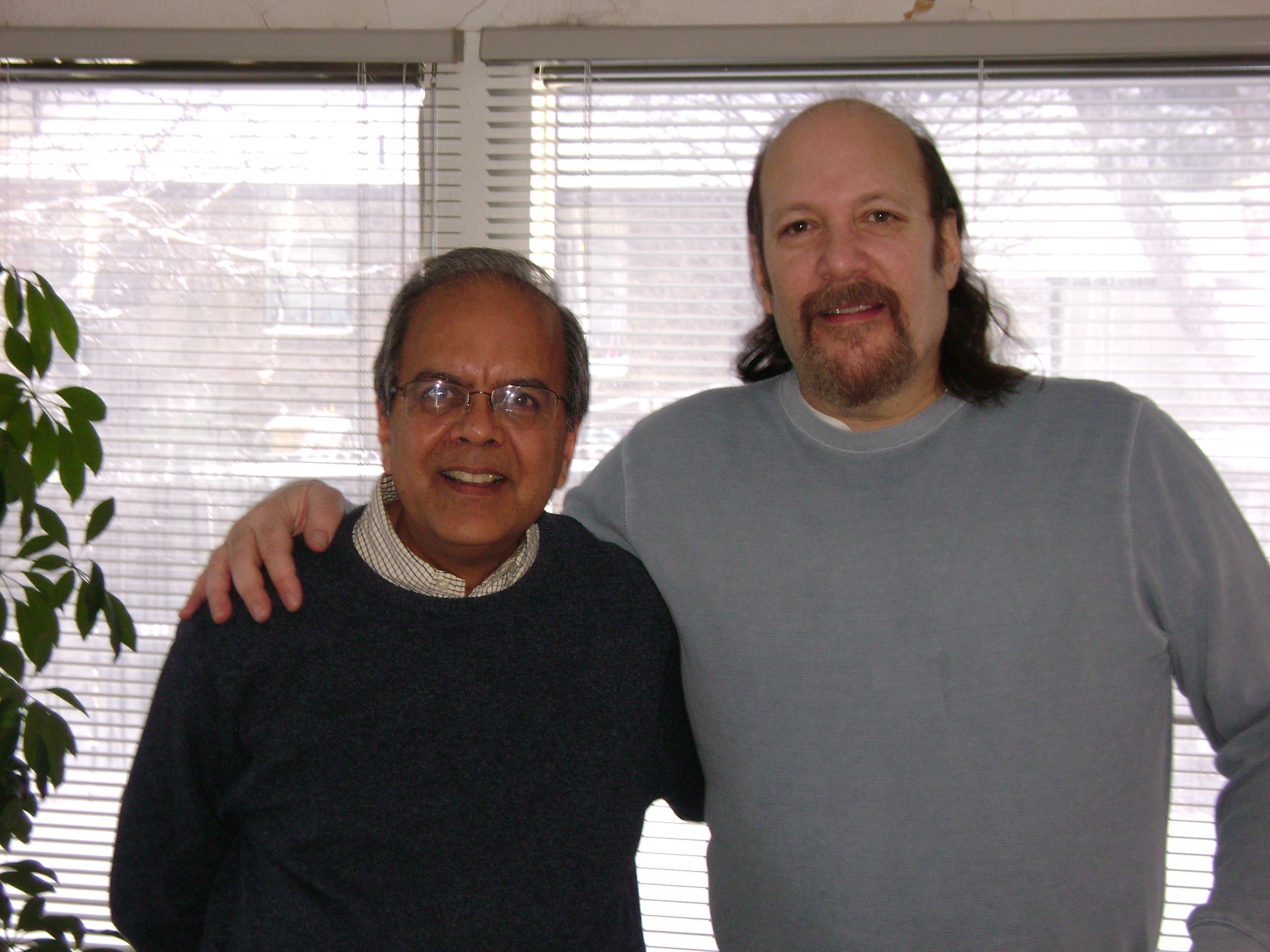
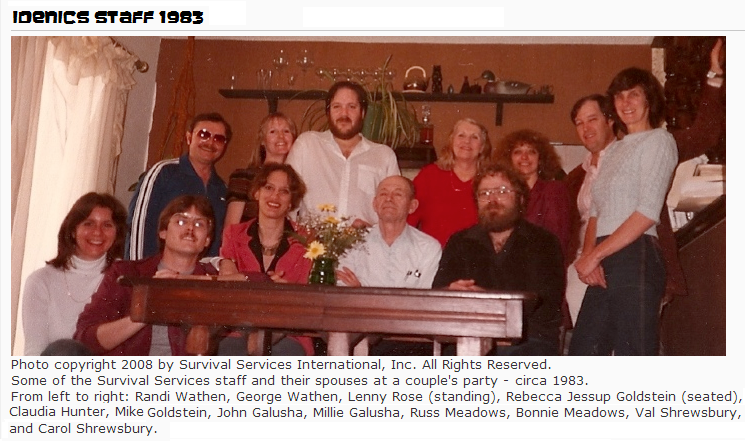
I visited Denver in 2008 to get trained on Idenics by Mike Goldstein. Since then I have applied hundreds of hours of Idenics to people around the world on phone and Skype, as well as face-to-face. Idenics is my application of choice to handle unwanted conditions. I find it to be very effective and helpful. The theory underlying Idenics inspires me to this day.
I greatly admire this work done in the field of psychology by John Galusha and Mike Goldstein. My friendship with Mike goes back to the seventies.
NOTE added June 12, 2015,
The only thing I don’t like about Idenics is making the knowledge proprietary. It is a holdover from Scientology. Knowledge should be free, though one may charge for its delivery.
Obsessive desire to “own”, or to be “source”, is one of those things that traps one.
Isene provides the following logic in his article:
For a system to be deterministic, its underlying rules must be consistent.
For a system to be deterministic, its underlying rules must be complete.
No system of rules can be both complete and consistent per Godels Incompleteness Theorems.
Thus, no system can be deterministic.
This is how I see it.
Godel’s incompleteness theorem applies only to axiomatic systems capable of doing arithmetic. I do not know if Godel’s argument can be extended to as complex a system as the universe.
.
Definitions:
de•ter•min•ism (noun) 1. the doctrine that all facts and events exemplify natural laws. 2. the doctrine that all events, including human choices and decisions, have sufficient causes.
axiomatic system In mathematics, an axiomatic system is any set of axioms from which some or all axioms can be used in conjunction to logically derive theorems.
complete A set of axioms is complete if, for any statement in the axioms’ language, either that statement or its negation is provable from the axioms.
consistent A set of axioms is (simply) consistent if there is no statement such that both the statement and its negation are provable from the axioms.
e·nu·mer·ate verb (used with object) 1. to mention separately as if in counting; name one by one; specify, as in a list: Let me enumerate the many flaws in your hypothesis. 2. to ascertain the number of; count.
effectively generated A formal theory is said to be effectively generated if there is a computer program that, in principle, could enumerate all the axioms of the theory without listing any statements that are not axioms. This is equivalent to the existence of a program that enumerates all the theorems of the theory without enumerating any statements that are not theorems.
Any effectively generated theory capable of expressing elementary arithmetic cannot be both consistent and complete. In particular, for any consistent, effectively generated formal theory that proves certain basic arithmetic truths, there is an arithmetical statement that is true, but not provable in the theory…
Gödel’s theorem shows that, in theories that include a small portion of number theory, a complete and consistent finite list of axioms can never be created, nor even an infinite list that can be enumerated by a computer program. Each time a new statement is added as an axiom, there are other true statements that still cannot be proved, even with the new axiom. If an axiom is ever added that makes the system complete, it does so at the cost of making the system inconsistent.
There are complete and consistent lists of axioms for arithmetic that cannot be enumerated by a computer program. For example, one might take all true statements about the natural numbers to be axioms (and no false statements), which gives the theory known as “true arithmetic”. The difficulty is that there is no mechanical way to decide, given a statement about the natural numbers, whether it is an axiom of this theory, and thus there is no effective way to verify a formal proof in this theory.
This may mean that if this universe (with both its physical and spiritual aspects) can be expressed through a consistent set of principles, then there is a truth about this universe that cannot be demonstrated using those set of principles. That truth may look at this universe (as a whole) exactly for what it is. Such a truth may not be derivable from the set of principles that supposedly describe the universe.
For any formal effectively generated theory T including basic arithmetical truths and also certain truths about formal provability, if T includes a statement of its own consistency then T is inconsistent.
The second incompleteness theorem does not rule out consistency proofs altogether, only consistency proofs that could be formalized in the theory that is proved consistent. The second incompleteness theorem is similar to the Liar’s paradox, “This sentence is false,” which contains an inherent contradiction about its truth value.
This may mean that this universe cannot contain the ultimate truth about itself. The ultimate truth is unknowable from the reference point of this universe.
.
If we go by the definition of determinism that all facts and events exemplify natural laws, we cannot say for certain if that is true or not. In other words, not everything may be predictable ahead of its occurrence.
Manifestations may be related to each other in strict logical sequence meaning that any manifestation may be shown to follow from another manifestation. However, it may be impossible to determine how a manifestation may come to be on its own. This is another version of saying, “Absolutes are unattainable.”
So a system may be deterministic only in a relative sense. It can neither be absolutely deterministic, nor can it be absolutely non-deterministic.
[Offbeat Graduation Speech Gets Standing Ovation:2012’s Baccalaureate speaker at the University of Pennsylvania was an unconventional choice for an Ivy League school. To address their newly-minted graduates, aspiring to dazzling careers, they picked a man who has never in his adult life, applied for a job. A man who hasn’t worked for pay in nearly a decade, and whose self-stated mission is simply “to bring smiles to the world and stillness to my heart”. This off-the-radar speaker launched his address with a startling piece of advice. Following up with four key insights gleaned from a radical 1000 km walking pilgrimage through the villages of India. As he closed his one-of-a-kind Graduation Day speech, the sea of cap and gowned students rose to their feet for a standing ovation. What follows is the full transcript of the talk by Nipun Mehta.]
Thank you to my distinguished friends, President Amy Gutmann, Provost Vincent Price and Rev. Charles Howard for inviting me to share a few reflections on this joyous occasion. It is an honor and privilege to congratulate you — UPenn’s class of 2012.
Right now each one of you is sitting on the runway of life primed for takeoff. You are some of the world’s most gifted, elite, and driven college graduates – and you are undeniably ready to fly. So what I’m about to say next may sound a bit crazy. I want to urge you, not to fly, but to – walk. Four years ago, you walked into this marvelous laboratory of higher learning. Today, head s held high, you walk to receive your diplomas. Tomorrow, you will walk into a world of infinite possibilities.
But walking, in our high-speed world, has unfortunately fallen out of favor. The word “pedestrian” itself is used to describe something ordinary and commonplace. Yet, walking with intention has deep roots. Australia’s aboriginal youth go on walkabouts as a rite of passage; Native American tribes conduct vision quests in the wilderness; in Europe, for centuries, people have walked the Camino de Santiago, which spans the breadth of Spain. Such pilgrims place one foot firmly in front of the other, to fall in step with the rhythms of the universe and the cadence of their own hearts.
Back in 2005, six months into our marriage, my wife and I decided to “step it up” ourselves and go on a walking pilgrimage. At the peak of our efforts with ServiceSpace, we wondered if we had the capacity to put aside our worldly success and seek higher truths. Have you ever thought of something and then just known that it had to happen? It was one of those things. So we sold all our major belongings, and bought a one-way ticket to India. Our plan was to head to Mahatma Gandhi’s ashram, since he had always been an inspiration to us, and then walk South. Between the two of us, we budgeted a dollar a day, mostly for incidentals — which meant that for our survival we had to depend utterly on the kindness of strangers. We ate whatever food was offered and slept wherever place was offered.
Now, I do have to say, such ideas come with a warning: do not try this at home, because your partner might not exactly welcome this kind of honeymoon. 🙂
For us, this walk was a pilgrimage — and our goal was simply to be in a space larger than our egos, and to allow that compassion to guide us in unscripted acts of service along the way. Stripped entirely of our comfort zone and accustomed identities, could we still “keep it real”? That was our challenge.
We ended up walking 1000 kilometers over three months. In that period, we encountered the very best and the very worst of human nature — not just in others, but also within ourselves.
Soon after we ended the pilgrimage, my uncle casually popped the million dollar question at the dinner table: “So, Nipun, what did you learn from this walk?” I didn’t know where to begin. But quite spontaneously, an acronym — W-A-L-K — came to mind, which encompassed the key lessons we had learned, and continue to relearn, even to this day. As you start the next phase of your journey, I want to share those nuggets with the hope that it might illuminate your path in some small way too.
The W in WALK stands for Witness. When you walk, you quite literally see more. Your field of vision is nearly 180 degrees, compared to 40 degrees when you’re traveling at 62 mph. Higher speeds smudge our peripheral vision, whereas walking actually broadens your canvas and dramatically shifts the objects of your attention. For instance, on our pilgrimage, we would notice the sunrise everyday, and how, at sunset, the birds would congregate for a little party of their own. Instead of adding Facebook friends online, we were actually making friends in person, often over a cup of hot “chai”. Life around us came alive in a new way.
A walking pace is the speed of community. Where high speeds facilitate separation, a slower pace gifts us an opportunity to commune.
As we traversed rural India at the speed of a couple of miles per hour, it became clear how much we could learn simply by bearing witness to the villagers’ way of life. Their entire mental model is different — the multiplication of wants is replaced by the basic fulfillment of human needs.When you are no longer preoccupied with asking for more and more stuff; then you just take what is given and give what is taken. Life is simple again. A farmer explained it to us this way: “You cannot make the clouds rain more, you cannot make the sun shine less. They are just nature’s gifts — take it or leave it.”
When the things around you are seen as gifts, they are no longer a means to an end; they are the means andthe end. And thus, a cow-herder will tend to his animals with the compassion of a father, a village woman will wait 3 hours for a delayed bus without a trace of anger, a child will spend countless hours fascinated by stars in the galaxy, and finding his place in the vast cosmos.
So with today’s modernized tools at your ready disposal, don’t let yourself zoom obliviously from point A to point B on the highways of life; try walking the backroads of the world, where you will witness a profoundly inextricable connection with all living things.
The A in WALK stands for Accept. When walking in this way, you place yourself in the palm of the universe, and face its realities head on. We walked at the peak of summer, in merciless temperatures hovering above 120 degrees. Sometimes we were hungry, exhausted and even frustrated. Our bodies ached for just that extra drink of water, a few more moments in the shade, or just that little spark of human kindness. Many times we received that extra bit, and our hearts would overflow with gratitude. But sometimes we were abruptly refused, and we had to cultivate the capacity to accept the gifts hidden in even the most challenging of moments.
I remember one such day, when we approached a rest house along a barre n highway. As heavy trucks whizzed past, we saw a sign, announcing that guests were hosted at no charge. “Ah, our lucky day,” we thought in delight. I stepped inside eagerly. The man behind the desk looked up and asked sharply, “Are you here to see the temple?” A simple yes from my lips would have instantly granted us a full meal and a room for the night. But it wouldn’t have been the truth. So instead, I said, “Well, technically, no sir. We’re on a walking pilgrimage to become better people. But we would be glad to visit the temple.” Rather abruptly, he retorted: “Um, sorry, we can’t host you.” Something about his curt arrogance triggered a slew of negative emotions. I wanted to make a snide remark in return and slam the door on my way out. Instead, I held my raging ego in check. In that state of physical and mental exhaustion, it felt like a Herculean task– but through the inner turmoil a voice surfaced within, telling me to accept the reality of this moment.
There was a quiet metamorphosis in me. I humbly let go of my defenses, accepted my fate that day, and turned to leave without a murmur. Perhaps the man behind the counter sensed this shift in me, because he yelled out just then, “So what exactly are you doing again?” After my brief explanation he said, “Look, I can’t feed you or host you, because rules are rules. But there are restrooms out in the back. You could sleep outside the male restroom and your wife can sleep outside the female restroom.” Though he was being kind, his offer felt like salt in my wounds. We had no choice but to accept.
That day we fasted and that night, we slept by the bathrooms. A small lie could’ve bought us an upgrade, but that would’ve been no pilgrimage. As I went to sleep with a wall separating me from my wife, I had this beautiful, unbidden vision of a couple climbing to the top of a mountain from two different sides. Midway through this difficult ascent, as the man contemplated giving up, a small sparrow flew by with this counsel, “Don’t quit now, friend. Your wife is eager to see you at the top.” He kept climbing. A few days later, when the wife found herself on the brink of quitting, the little sparrow showed up with the same message. Step by step, their love sustained their journey all the way to the mountaintop. Visited by the timely grace of this vision, I shed a few grateful tears — and this story became a touchstone not only in our relationship, but many other noble friendships as well.
So I encourage you to cultivate equanimity and accept whatever life tosses into your laps — when you do that, you will be blessed with the insight of an inner transformation that is yours to keep for all of time.
The L in WALK stands for Love. The more we learned from nature, and built a kind of inner resilience to external circumstances, the more we fell into our natural state — which was to be loving. In our dominant paradigm, Hollywood has insidiously co-opted the word, but the love I’m talking about here is the kind of love that only knows one thing — to give with no strings attached. Purely. Selflessly.
Most of us believe that to give, we first need to have something to give. The trouble with that is, that when we are taking stock of what we have, we almost always make accounting errors. Oscar Wilde once quipped, “Now-a-days, people know the price of everything, but the value of nothing.” We have forgotten how to value things without a price tag. Hence, when we get to our most abundant gifts — like attention, insight, compassion — we confuse their worth because they’re, well, priceless.
On our walking pilgrimage, we noticed that those who had the least were most readily equipped to honor the priceless. In urban cities, the people we encountered began with an unspoken wariness: “Why are you doing this? What do you want from me?” In the countryside, on the other hand, villagers almost always met us with an open-hearted curiosity launching straight in with: “Hey buddy, you don’t look local. What’s your story?”
In the villages, your worth wasn’t assessed by your business card, professional network or your salary. That innate simplicity allowed them to love life and cherish all its connections.
Extremely poor villagers, who couldn’t even afford their own meals, would often borrow food from their neighbors to feed us. When we tried to refuse, they would simply explain: “To us, the guest is God. This is our offering to the divine in you that connects us to each other.” Now, how could one refuse that? Street vendors often gifted us vegetables; in a very touching moment, an armless fruit-seller once insisted on giving us a slice of watermelon. Everyone, no matter how old, would be overjoyed to give us directions, even when they weren’t fully sure of them. 🙂 And I still remember the woman who generously gave us water when we were extremely thirsty — only to later discover that she had to walk 10 kilometers at 4AM to get that one bucket of water. These people knew how to give, not because they had a lot, but because they knew how to love life. They didn’t need any credit or assurance that you would ever return to pay them back. Rather, they just trusted in the pay-it-forward circle of giving.
When you come alive in this way, you’ll realize that true generosity doesn’t start when you have some thing to give, but rather when there’s nothing in you that’s trying to take. So I hope that you will make all your precious moments an expression of loving life. 🙂
And lastly, the K in WALK stands for Know Thyself.
Sages have long informed us that when we serve others unconditionally, we shift from the me-to-the-we and connect more deeply with the other. That matrix of inter-connections allows for a profound quality of mental quietude. Like a still lake undisturbed by waves or ripples, we are then able to see clearly into who we are and how we can live in deep harmony with the environment around us.
When one foot walks, the other rests. Doing and being have to be in balance.
Our rational mind wants to rightfully ensure progress, but our intuitive mind also needs space for the emergent, unknown and unplanned to arise. Doing is certainly important, but when we aren’t aware of our internal ecosystem, we get so vested in our plans and actions, that we don’t notice the buildup of mental residue. Over time, that unconscious internal noise starts polluting our motivations, our ethics and our spirit. And so, it is critical to still the mind. A melody, after all, can only be created with the silence in between the notes.
As we walked — witnessed, accepted, loved — our vision of the world indeed grew clearer. That clarity, paradoxically enough, blurred our previous distinctions between me versus we, inner transformation versus external impact, and selfishness versus selflessness. They were inextricably connected. When a poor farmer gave me a tomato as a parting gift, with tears rolling down his eyes, was I receiving or giving? When sat for hours in silent meditation, was the benefit solely mine or would it ripple out into the world? When I lifted the haystack off an old man’s head and carried it for a kilometer, was I serving him or serving myself?
Which is to say, don’t just go through life — grow through life. It will be easy and tempting for you to arrive at reflexive answers — but make it a point, instead, to acknowledge mystery and welcome rich questions … questions that nudge you towards a greater understanding of this world and your place in it.
That’s W-A-L-K. And today, at this momentous milestone of your life, you came in walking and you will go out walking. As you walk on into a world that is increasingly aiming to move beyond the speed of thought, I hope you will each remember the importance of traveling at the speed of thoughtfulness. I hope that you will take time to witness our magnificent interconnections. That you will accept the beautiful gifts of life even when they aren’t pretty, that you will practice loving selflessly and strive to know your deepest nature.
I want to close with a story about my great grandfather. He was a man of little wealth who still managed to give every single day of his life. Each morning, he had a ritual of goi ng on a walk — and as he walked, he diligently fed the ant hills along his path with small pinches of wheat flour. Now that is an act of micro generosity so small that it might seem utterly negligible, in the grand scheme of the universe. How does it matter? It matters in that it changed him inside. And my great grandfather’s goodness shaped the worldview of my grandparents who in turn influenced that of their children — my parents. Today those ants and the ant hills are gone, but my great grandpa’s spirit is very much embedded in all my actions and their future ripples. It is precisely these small, often invisible, acts of inner transformation that mold the stuff of our being, and bend the arc of our shared destiny.
On your walk, today and always, I wish you the eyes to see the anthills and the heart to feed them with joy.
May you be blessed. Change yourself — change the world.
This is a transcript of the Baccalaureate address to UPenn’s graduating class of 2012, delivered by Nipun Mehta. Nipun is the founder of ServiceSpace.org, a nonprofit that works at the intersection of gift-economy, technology and volunteerism. His popular TED talk Designing for Generosity provides an overview of their work and guiding principles.
The purpose of a discussion is to learn by exchanging viewpoints. One uses experience and experimentation to obtain data and then brings it to the table to be discussed.
The participants in a discussion focus on the subject and not on each other. A discussion is not a debate where one is in a contest to win argument against others. There is no need for sophistry. In a discussion there are no opponents. All participants are on the same side. On the other side may just be ignorance. In a discussion each participant’s viewpoint is bound to change and evolve as he/she learns from the data pooled together by all.
Thus, a discussion is a cooperative effort. There is no reason to censor any data in a discussion. The data simply needs to be examined in detail.
.
Integrity of Reality
The integrity of reality underlies the very concept of universe. The word UNIVERSE is derived from a Latin root, which means “entire, all, literally, turned into one.” The integrity of reality leads to the universe being continuous, harmonious and consistent.
The scientific method follows this law as best as it can when investigating a phenomenon.
A violation of the integrity of reality would be an anomaly. This may manifest as discontinuity (missing data), inconsistency (contradictory data), or disharmony (arbitrary data). An anomaly flags the presence of a hidden impression on the mind in the form of an assumption. When the assumption, and the underlying impression is discovered it produces a realization that resolves the anomaly.
A discussion seeks to restore the integrity of reality by discovering the anomalies present and resolving them.
.
Rules of Discussion
In mindfulness discussion one is guided by mindfulness, as learned through the practice of mindfulness meditation. Here are some specific instructions.
.
(1) Do not defend a viewpoint, instead look for some anomaly generated by it.
For example, a person may believe that God is a being who has created this world. He may reject those who think differently. This viewpoint generates an inconsistency. A being has a form, but all forms are created only when the world gets created. So either God must have been created along with the world, or God is not a being. The person may not be aware of this inconsistency caused by his belief, and he may be willing to engage in a mindful discussion.
But when a person refuses to engage in a discussion despite inconsistency, and continues to defend his belief, then he may be using that belief to hide some confusion. He may be afraid that if his belief is shaken, some confusion will overwhelm him. But as he gets exposed to mindfulness, he may be willing to examine his confusions. Mindful discussion could then help resolve that confusion. Everybody wins.
.
(2) Focus on the data being presented and not on the person presenting it.
Many people feel so invested in their beliefs that they feel attacked when they are unable to uphold their viewpoint in a discussion. They start commenting on the perceived characteristics of another participant holding a different viewpoint. They may even become accusative, emotional and combative.
Any focus on participants rather than on the subject of discussion causes much distraction. It must be avoided.
.
(3) In a disagreement never call the other person wrong, instead provide further clarification regarding your viewpoint.
In any disagreement effort should be made to clarify one’s viewpoint as much as possible. Not doing so, and simply saying that the other person is wrong, does not resolve anything. It only produces distraction.
.
(4) Furthermore, in a disagreement, ask for clarification and, when it is provided, consider it with mindfulness.
A person can be so convinced about being right that he would not even ask the other person for further clarification. He would not even listen if the other person offers any clarification. He simply would not engage in a discussion. This kind of behavior also produces much distraction.
.
(5) Do not complain that the other person is not answering your question, instead discuss what you are expecting.
When a person is committed to certain expectations, he may not even see an answer when it is given to him. An indication of that is his continual complaint that he is not getting an answer. The solution is for the person to honestly look at the expectations he has committed himself to and compare it to answers he is getting. If he then finds an anomaly, he should bring it to the table for discussion. But as long as that person is justifying his expectations in his mind, no discussion is possible.
.
(6) Always focus on anomalies and isolate them as best as you can. Never be discouraged if others are taking time to recognize it.
An anomaly is a discontinuity (missing information), an inconsistency (contradicting information), or disharmony (arbitrariness of altered importance). It is something that does not make sense. Mindfulness discussion is very successful because it focuses on anomalies only. When an anomaly is difficult to resolve simply look around for more data on that area of discontinuity, inconsistency, or disharmony, and consider it carefully.
.
Summary
A disagreement doesn’t mean that what is being disagreed with is untrue. To show untruthfulness of something one needs to point out the anomaly. Then that anomaly needs to be resolved to find the actual element, which makes the observations free of anomalies. That element shall qualify as the truth.