The Proton

Reference: Subject Clearing Universe

NOTE: The subject of Physics treats these fundamental particles mathematically, and it does not provide a proper visualization for them. The effort on this blog is to provide a visualization that is consistent with what is known. It does not change the mathematics of Physics.

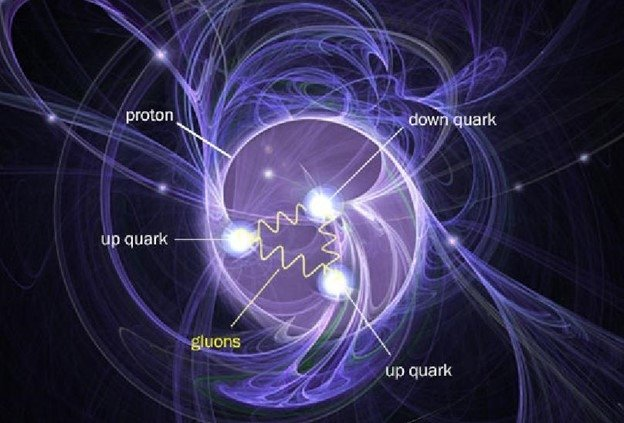
Proton refers to that consistency of substance that is under the tension to evaporate from mass back into electronic liquidity. This tension is seen as positive charge.

.

Definition of PROTON

Protons form the surface layer of the nucleus. The charge of the proton comes from the fact that it is the substance that has condensed  into mass from the electronic substance, and it can evaporate back into its previous electronic consistency. This proton layer is in equilibrium with the layer of the electronic substance immediately surrounding it.

The charge exists, because we have two very different consistencies in equilibrium, such that, the substance is being continuously exchanged between them. The exchanged substance appears as transitory particles listed under Leptons and Baryons.

When the proton layer separates itself from the atom it appears as its own little vortex called a proton. A proton has a precise configuration as well. It has the limiting consistency of mass, which is measured as 1.673 × 10⁻²⁷ kilograms. This is 1836 times more condensed than the nearest electronic layer. It is considered to have a unit positive charge measured as 1.602 × 10⁻¹⁹ coulombs. This is equal and opposite to the charge of an electron.

The proton, too, does not exist as an independent particle within the atom because it is integrated with rest of the atom into layers of condensing substance. Therefore, it is an error to visualize protons as “particles” within the atom.

.

Misconception

1. It is a misconception to think that protons exist as independent “particles” within the atom. Protons form the first layer of mass in the nucleus that is still increasing in consistency as neutrons toward the center. Proton is the first layer of the nucleus that is formed after the last electronic layer condenses.

.

The Electromagnetic Radiation

Reference: Subject Clearing Universe

NOTE: The subject of Physics treats these fundamental particles mathematically, and it does not provide a proper visualization for them. The effort on this blog is to provide a visualization that is consistent with what is known. It does not change the mathematics of Physics.

The free flowing radiant energy is called electromagnetic radiation because it is found to consist of electric and magnetic fields. It has a whole range of properties as expressed through an electromagnetic spectrum. 

.

Definition of ELECTROMAGNETIC RADIATION

Electromagnetic radiation, such as, light, is free flowing energy that has not yet condensed into spinning vortices. The consistency of the radiation is represented by its assigned “frequency.” 

The electromagnetic spectrum presents different ranges of frequencies of radiation. From lowest to highest, these ranges are called radio waves, microwaves, terahertz radiation, Infrared radiation, visible radiation, ultraviolet radiation, X-rays and Gamma rays. Gamma rays have the highest consistency. As this consistency increases the gamma rays are likely to coalesce into spinning vortices, such as, the electrons. 

The configuration of the atom exists in equilibrium with the electromagnetic spectrum. The gamma rays are seen to be emitted by the nucleus, and X-rays from inner electrons. Other frequencies of the spectrum may be seen to be emitted from the upper electronic region of the atom.

An electromagnetic radiation has a certain frequency. Any effort to change that frequency activates a restoring force similar to the inertia of matter. In an electromagnetic field, force exists because different frequencies exist side-by-side. The higher is the gradient of frequencies, the higher is the force.

.

Misconceptions

1. It is not perceived in Physics that the electromagnetic radiation is a part of the spectrum of substance. At the upper end of the electromagnetic spectrum is the spectrum of the quantum particles and matter. Below the electromagnetic spectrum is the spectrum of thought substance in the form of space.

.

The Electron

Reference: Subject Clearing Universe

NOTE: The subject of Physics treats these fundamental particles mathematically, and it does not provide a proper visualization for them. The effort on this blog is to provide a visualization that is consistent with what is known. It does not change the mathematics of Physics.

Electron refers to that consistency of substance that is under the tension to crystallize into the solidification of mass. This tension is seen as negative charge.

.

Definition of ELECTRON

Electrons are considered to be constituents of atoms. To understand electrons, one must understand the atom first.

The atom is a vortex of substance in which energy exists in equilibrium with mass. The free flowing energy starts to form into spinning vortices of energy. The spinning vortex consists of gradually condensing layers of electronic substance. At the center of these layers, the energy starts to precipitate into mass. Thus comes about the configuration of the atom.

The condensing layers of electronic substance are in equilibrium, and they have a precise configuration. They have been defined mathematically as orbitals. There are sub-layers within these layers, which are spotted through their atomic spectra.

When the electronic substance separates itself from the atom it appears as its own little vortex called an electron. An electron has a precise configuration as well. It has the limiting consistency of energy, which is measured in “mass” as 9.108 × 10⁻³¹ kilograms. It is considered to have a unit negative charge measured as 1.602 × 10⁻¹⁹ coulombs. The charge of the electron comes from the fact that it has a consistency that is just about to condense into mass.

The electron does not exist as an independent particle within the atom because it is integrated with rest of the atom into layers of condensing substance. Therefore, it is an error to visualize electrons as “particles” within the atom.

.

Misconceptions

1. It is a misconception to think that electrons exist as independent “particles” within the atom. Electrons do not have a center of mass to make them into a matter particle, which is represented by a point. As a spinning vortex, an electron is thousands of times larger than the nucleus in an atom, simply because it is much less condensed. Electrons basically surround the nucleus in the form of layers.

.

The Concept

Reference: Subject Clearing Universe

The particle of thought has to be something very basic and precise. We identify it as a concept.

.

Definition of CONCEPT

The particle of thought is a concept that has a precise definition. It is formed by mentally combining all the characteristics or particulars of something. It is defined as an abstract idea. 

A concept is understood to be a fundamental building block underlying principles, thoughts and beliefs. Concepts play an important role in all aspects of cognition. As such, concepts are studied within such disciplines as linguistics, psychology, and philosophy, and these disciplines are interested in the logical and psychological structure of concepts, and how they are put together to form thoughts and sentences. The study of concepts has served as an important flagship of an emerging interdisciplinary approach, cognitive science.

.

Misconceptions

1. Concepts cannot be arbitrary. They fit into the oneness of thought. By nature they are a unit in themselves.

2. Concepts cannot be fuzzy and unclear. They are a part of the laws that apply to thought. Concepts must be very precise by nature.

3. Any fuzzy and unclear concept is an anomaly.

.

L10 Prior Assessment

Reference: The L Processes

This L10 R/D provides a list of potentially charged items for each dynamic. Make sure you have completed the Basic L10 approach before you attempt this rundown.

  1. Study the 8 dynamics (see The Dynamics).
  2. Handle the charge (tension) from the Eighth dynamic to the First dynamic in descending order.
  3. For each dynamic do the following:
    1. Go down the expanded list of items for the dynamic (see below).
    2. Stop at the item that you feel you have some charge on.
    3. If you don’t understand the nature of that item then clear up its meaning.
    4. If you are resisting that item in some way, then
      1. Examine your considerations about that item.
      2. Check if you are using that item to explain some disability.
      3. Check if you are using that item to make others wrong.
      4. Check if there are evil purposes restimulated by that item.
    5. Date/Locate any evil purposes found.
    6. Repeat Step 3 . 4 (1 – 5) until there is no charge left on the dynamics.
  4. Repeat Step 3 (1 – 6) until you have covered all the dynamics.

.

Alternate Approach

  1. Handle the charge (tension) from the Eighth dynamic to the First dynamic in descending order.
  2. For each dynamic, L&N : “Who or what would represent the (Dynamic)?
  3. Address the item found as follows:
    1. Examine your considerations about that item.
    2. Check if you are using that item to explain some disability.
    3. Check if you are using that item to make others wrong.
    4. Check if there are evil purposes restimulated by that item.
  4. Date/Locate any evil purposes found.
  5. Repeat Steps 2 – 4 until you have covered all the dynamics.

.

Please view these listed items as opportunity to discover more items of your own on each dynamic. As you resolve the considerations underlying these items, it will strengthen and broaden your viewpoint.

.

Expanded List of Items

8D, Infinity:

  • religion, worship, goddesses, profanity
  • priest, guru, avatar, sacrifice
  • omnipotence, omnipresence, gods, deity
  • divinity, sublime essence, immanence, radiance
  • grace, infinite potentiality, hymn, blasphemy
  • demon, transcendence, church, prayer
  • religious practice, rites, absolute, co-existence of static
  • basic truth, as-is-ness, miracles, divine healing
  • faith, belief, idols, sacred texts
  • gospels, sutras, parables, urge to ultimate truth
  • self transcendence, sacred teachings, heaven, hell
  • devil, angel, paradise, wrath of God
  • godlike states

.

7D, Spirit:

  • aesthetic wave, value, ghost, spirit
  • art object, beauty, the occult, magic
  • voodoo, mediums, masters, symmetry
  • logic, creative urge, sublimation, ambiguity
  • poetry, theory, idea, theta
  • OT, virtue, architecture, literature
  • essay, writing, imagination, mathematics
  • evil, courage, goodness, purity
  • own universe, astral body, ectoplasm, telepathy
  • telekinesis, metaphysics, ethics, justice
  • philosophy, immortality, freedom, free will
  • nobility, style, urge to create

.

6D, MEST:

  • wavelength, object, mass, atom
  • molecule, quanta, particle, smoke
  • clouds, time, space, a dimension
  • form, gravity, force, light
  • fluids, chemicals, mineral, rock
  • earth, planet, star, plasma
  • air, galaxy, solar system, physical universe
  • shape, size, elements, direction
  • vector, ridge, beam, explosion
  • implosion, subatomic particles, electricity, density
  • compounds, vacuum, mixtures, weather
  • tendency to persist, condense, wind, fire
  • water, location

.

5D, Life Forms:

  • plant, animal, primate, body
  • bird, reptile, fish, cell
  • virus, biology, embryo, egg
  • organic, form, seed, insect
  • mollusk, lichen, protozoa, organs
  • tissue, bloom, chlorophyll, protein
  • amino acids, RNA, DNA, genes
  • garden, harvest, pets, ecology
  • pollution, extraterrestrials, aliens, urge to survive as life form
  • life energy, fertilizer, nutrients, urge to improve life forms
  • photon converter, bacteria, elan vital

.

4D, Mankind:

  • commerce, human species, ecology, development of space
  • space travel, world travel, genocide, exploration
  • human race, brotherhood, united nations, world organization
  • world trade, confederations, world citizenship, league of nations
  • esperanto, world health, world treaties, international agreements
  • human rights, world systems, world communication, urge to act in concert
  • free trade, global contract, world government, human dignity
  • common man

.

3D, Group:

  • club, flag, insignia, meeting place
  • uniform, rank, the state, members
  • membership, law, rules, corporation
  • agreement, team, a race, team mates
  • constitution, constituency, politics, leaders
  • followers, morals, commandments, policy
  • admin, organization, org board, orders
  • school, education, exchange, military
  • police, prison, criminal, mores
  • language, urge to join, war, government
  • democracy, tyranny, aristocracy, collective

.

2D, Sex & Family: 

  • food preparation, duplication, child, sex
  • genital, penis, vagina, sperm
  • ovum, semen, conception, childhood
  • mother, father, matriarch, patriarch
  • son, daughter, intercourse, family
  • home, desire, virility, impotence
  • a marriage, seduction, urge to procreate, sexual pleasure
  • sexual sensation, courting, femininity, masculinity
  • pregnancy, birth, babies, breasts
  • contraceptives, homosexuality, bisexuality, sexual practices
  • rape, promiscuity, VD, relatives
  • family ties, incest, mother’s milk, abortion
  • prenatal, influence, mating, nurturing
  • menstruation, infatuation, sexual love, sibling

.

1D, Self: 

  • thetan, individuality, identity, mental machinery 
  • a mind, a skill, tool, clothing 
  • career, identification, human body parts, brain 
  • body, cells, car, house 
  • food, meals, vehicle, decorations 
  • certificates, diplomas, body organs, viewpoints 
  • a habit, appetite, ego, urge to survive as individual 
  • auditing, hobby, medicine, self improvement 
  • study, book, ornament, grooming 
  • personal hygiene, self expression, health, product 
  • GE, job, paycheck

.