Tertium Organum, Chapter 6 (Reality)

pillars

Reference: Tertium Organum

.

Chapter 6: Reality

Methods of investigation of the problem of higher dimensions. The analogy between imaginary worlds of different dimensions. The one-dimensional world on a line. “Space” and “time” of a one-dimensional being. The two-dimensional world on a plane. “Space” and “time,” “ether,” “matter” and “motion” of a two-dimensional being. Reality and illusion on a plane. The impossibility of seeing an “angle.” An angle as motion. The incomprehensibility to a two-dimensional being of the functions of things in our world. Phenomena and noumena of a two-dimensional being. How could a plane being comprehend the third dimension?

.

A series of analogies and comparisons are used for the definition of that which can be, and that which cannot be, in the region of the higher dimension. Fechner, Hinton, and many others employ this method. 

They imagine “worlds” of one, and of two dimensions, and out of the relations of lower-dimensional worlds to higher ones they deduce possible relations of our world to one of four dimensions; just as out of the relations of points to lines, of lines to surfaces, and of surfaces to solids we deduce the relations of our solids to four-dimensional ones. 

Let us try to investigate everything that this method of analogy can yield. 

Let us imagine a world of one dimension

It will be a line. Upon this line let us imagine living beings. Upon this line, which represents the universe for them, they will be able to move forward and backward only, and these beings will be as the points, or segments of a line. Nothing will exist for them outside their line—and they will not be aware of the line upon which they are living and moving. For there will exist only two points, ahead and behind, or may be just one point ahead. Noticing the change in states of these points, the one-dimensional being will call these changes phenomena. If we suppose the line upon which the one-dimensional being lives to be passing through the different objects of our world, then of all these objects the one-dimensional being will perceive one point only; if different bodies intersect his line, the one-dimensional being will sense them only as the appearance, the more or less prolonged existence, and the disappearance of a point. This appearance, existence, and disappearance of a point will constitute a phenomenon. Phenomena, according to the character and properties of passing objects and the velocity and properties of their motions, for the one-dimensional being will be constant or variable, long or short-timed, periodical or unperiodical. But the one-dimensional being will be absolutely unable to understand or explain the constancy or variability, the duration or brevity, the periodicity or unperiodicity of the phenomena of his world, and will regard them simply as properties pertaining to them. The solids intersecting his line may be different, but for the one-dimensional being all phenomena will be absolutely identical—just the appearance or the disappearance of a point—and phenomena will differ only in duration and greater or less periodicity. 

Such strange monotony and similarity of the diverse and heterogeneous phenomena of our world will be the characteristic peculiarity of the one-dimensional world. 

Moreover, if we assume that the one-dimensional being possesses memory, it is clear that recalling all the points seen by him as phenomena, he will refer them to time. The point which was: this is the phenomenon already non-existent, and the point which may appear tomorrow: this is the phenomenon which does not exist yet. All of our space except one line will be in the category of time, i.e., something wherefrom phenomena come and into which they disappear. And the one-dimensional being will declare that the idea of time arises for him out of the observation of motion, that is to say, out of the appearance and disappearance of points. These will be considered as temporal phenomena, beginning at that moment when they become visible, and ending ceasing to exist—at that moment when they become invisible. The one-dimensional being will not be in a position to imagine that the phenomenon goes on existing somewhere, though invisibly to him; or he will imagine it as existing somewhere on his line, far ahead of him. 

We can imagine this one-dimensional being more vividly. Let us take an atom, hovering in space, or simply a particle of dust, carried along by the air, and let us imagine that this atom or partide of dust possesses a consciousness, i.e., separates himself from the outside world, and is conscious only of that which lies in the line of his motion, and with which he himself comes in contact. He will then be a one-dimensional being in the full sense of the word. He can fly and move in all directions, but it will always seem to him that he is moving upon a single line; outside of this line will be for him only great Nothingness—the whole universe will appear to him as one line. He will feel none of the turns and angles of his line, for to feel an angle it is necessary to be conscious of that which lies to right or left, above or below. In all other respects such a being will be absolutely identical with the before-described imaginary being living upon the imaginary line. Everything that he comes in contact with, that is, everything that he is conscious of, will seem to him to be emerging from time, i.e., from nothing, and vanishing into time, i.e., into nothing. This nothing will be all our world. All our world except one line will be called time and will be counted as actually non-existent.

.

Let us next consider the two-dimensional world, and the being living on a plane. The universe of this being will be one great plane. Let us imagine beings on this plane having the shape of points, lines, and flat geometrical figures. The objects and “solids” of that world will have the shape of flat geometrical figures too. 

In what manner will a being living on such a plane universe cognize his world? 

First of all we can affirm that he will not feel the plane upon which he lives. He will not do so because he will feel the objects, i.e., figures, which are on this plane. He will feel the lines which limit them, and for this reason he will not feel his plane, for in that case he would not be in a position to discern the lines. The lines will differ from the plane in that they produce sensations; therefore they exist. The plane does not produce sensations; therefore it does not exist. Moving on the plane, the two-dimensional being, feeling no sensations, will declare that nothing now exists. After having encountered some figure, having sensed its lines, he will say that something appeared. But gradually, by a process of reasoning, the two-dimensional being will come to the conclusion that the figures he encounters exist on something, or in something.

Thereupon he may name such a plane (he will not know, indeed, that it is a plane) the “ether.” Accordingly he will declare that the “ether” fills all space, but differs in its qualities from “matter.” By “matter” he will mean lines. Having come to this conclusion the two-dimensional being will regard all processes as happening in his “ether,” i.e., in his space. He will not be in a position to imagine anything outside of this ether, that is, out of his plane. If anything, proceeding out of his plane, comes in contact with his consciousness, then he will either deny it, or regard it as something subjective, the creation of his own imagination, or else he will believe that it is proceeding right on the plane, in the ether, as are all other phenomena. 

Sensing lines only, the plane being will not sense them as we do. First of all, he will see no angle. It is extremely easy for us to verify this by experiment. If we will hold before our eyes two matches, inclined one to the other in a horizontal plane, then we shall see one line. To see the angle we shall have to look from above. The two-dimensional being cannot look from above and therefore cannot see the angle. But measuring the distance between the lines of different “solids” of his world, the two-dimensional being will come continually in contact with the angle, and he will regard it as a strange property of the line, which is sometimes manifest and sometimes is not. That is, he will refer the angle to time, he will regard it as a temporary, evanescent phenomenon, a change in the state of a “solid,” or as motion. It is difficult for us to understand this. It is difficult to imagine how the angle can be regarded as motion. But it must be absolutely so, and cannot be otherwise. If we try to represent to ourselves how the plane being studies the square, then certainly we shall find that for the plane being the square will be a moving body. Let us imagine that the plane being is opposite one of the angles of the square. He does not see the angle—before him is a line, but a line possessing very curious properties. Approaching this line, the two-dimensional being observes that a strange thing is happening to the line. One point remains in the same position, and other points are withdrawing back from both sides. We repeat, that the two-dimensional being has no idea of an angle. Apparently the line remains the same as it was, yet something is happening to it, without a doubt. The plane being will say that the line is moving, but so rapidly as to be imperceptible to sight. If the plane being goes away from the angle and follows along a side of the square, then the side will become immobile. When he comes to the angle, he will notice the motion again. After going around the square several times, he will establish the fact of regular, periodical motions of the line. Quite probably in the mind of the plane being the square will assume the form of a body possessing the property of periodical motions, invisible to the eye, but producing definite physical effects (molecular motion)—or it will remain there as a perception of periodical moments of rest and motion in one complex line, and still more probably it will seem to be a rotating body

Quite possibly the plane being will regard the angle as his own subjective perception, and will doubt whether any objective reality corresponds to this subjective perception. Nevertheless he will reflect that if there is action, yielding to measurement, so must there be the cause of it, consisting in the change of the state of the line, i.e., in motion. 

The lines visible to the plane being he may call matter, and the angles—motion. That is, he may call the broken line with an angle, moving matter. And truly to him such a line by reason of its properties will be quite analogous to matter in motion. 

If a cube were to rest upon the plane upon which the plane being lives, then this cube will not exist for the two-dimensional being, but only the square face of the cube in contact with the plane will exist for him—as a line, with periodical motions. Correspondingly, all other solids lying outside of his plane, in contact with it, or passing through it, will not exist for the plane being. The planes of contact or cross-sections of these bodies will alone be sensed. But if these planes or sections move or change, then the two-dimensional being will think, indeed, that the cause of the change or motion is in the bodies themselves, i.e., right there on his plane. 

As has been said, the two-dimensional being will regard the straight lines only as immobile matter; irregular lines and curves will seem to him as moving. So far as really moving lines are concerned, that is, lines limiting the cross sections or planes of contact passing through, or moving along the plane, these will be for the two-dimensional being something inconceivable and incommensurable. It will be as though there were in them the presence of something independent, depending upon itself only, animated. This effect will proceed from two causes: He can measure the immobile angles and curves, the properties of which the two-dimensional being calls motion, for the reason that they are immobile; moving figures, on the contrary, he cannot measure, because the changes in them will be out of his control. These changes will depend upon the properties of the whole body and its motion, and of that whole body the two-dimensional being will know only one side or section. Not perceiving the existence of this body, and contemplating the motion pertaining to the sides and sections he probably will regard them as living beings. He will affirm that there is something in them which differentiates them from other bodies: vital energy, or even soul. That something will be regarded as inconceivable, and really will be inconceivable to the two-dimensional being, because to him it is the result of an incomprehensible motion of inconceivable solids. 

If we imagine an immobile circle upon the plane, then for the two-dimensional being it will appear as a moving line with some very strange and to him inconceivable motions. 

The two-dimensional being will never see that motion. Perhaps he will call such motion molecular motion, i.e., the movement of minutest invisible particles of “matter.” 

Moreover, a circle rotating around an axis passing through its center for the two-dimensional being will differ in some inconceivable way from the immobile circle. Both will appear to be moving, but moving differently. 

For the two-dimensional being a circle or a square, rotating around its center, on account of its double motion will be an inexplicable and incommensurable phenomenon, like a phenomenon of life for a modern physicist. 

Therefore, for a two-dimensional being, a straight line will be immobile matter; a broken or a curved line—matter in motion; and a moving line—living matter. 

The center of a circle or a square will be inaccessible to the plane being, just as the center of a sphere or of a cube made of solid matter is inaccessible to us—and for the two-dimensional being even the idea of a center will be incomprehensible, since he possesses no idea of a center. 

Having no idea of phenomena proceeding outside of the plane that is, out of his “space”—the plane being will think of all phenomena as proceeding on his plane as has been stated. And all phenomena which he regards as proceeding on his plane, he will consider as being in causal interdependence one with another: that is, he will think that one phenomenon is the effect of another which has happened right there, and the cause of a third which will happen right on the same plane. 

If a multi-colored cube passes through the plane, the plane being will perceive the entire cube and its motion as a change in the color of lines lying in the plane. Thus, if a blue line replaces a red one, then the plane being will regard the red line as a past event. He will not be in a position to realize the idea that the red line is still existing somewhere. He will say that the line is single, but that it becomes blue as a consequence of certain causes of a physical character. If the cube moves backward so that the red line appears again after the blue one, then for the two-dimensional being this will constitute a new phenomenon. He will say that the line became red again. 

For the being living on a plane, everything above and below (if the plane be horizontal), and on the right or left (if the plane be vertical) will be existing in time, in the past and in the future that which in reality is located outside of the plane will be regarded as non-existent, either as that which is already past, i.e., as something which has disappeared, ceased to be, will never return, or as in the future, i.e., as not existent, not manifested, as a thing in potentiality. 

.

Let us imagine that a wheel with the spokes painted different colors is rotating through the plane upon which the plane-being lives. To such a being all the motion of the wheel will appear as a variation of the color of the line of intersection of the wheel and the plane. The plane being will call this variation of the color of the line a phenomenon, and observing these phenomena he will notice in them a certain succession. He will know that the black line is followed by the white one, the white by the blue, the blue by the red, and so on. If simultaneously with the appearance of the white line some other phenomenon occurs—say the ringing of a bell—the two-dimensional being will say that the white line is the cause of that ringing. The change of the color of the lines, in the opinion of the two-dimensional being, will depend on causes lying right in his plane. Any presupposition of the possibility of the existence of causes lying outside of the plane he will characterize as fantastic and entirely unscientific. It will seem so to him because he will never be in a position to represent the wheel to himself, i.e., the parts of the wheel on both sides of the plane. After a rough study of the color of the lines, and knowing the order of their sequence, the plane being, perceiving one of them, say the blue one, will think that the black and the white ones have already passed, i.e., disappeared, ceased to exist, gone into the past; and that those lines which have not yet appeared—the yellow, the green, and so on, and the new white and black ones still to come—do not yet exist, but lie in the future. 

Therefore, though not conceiving the form of his universe, and regarding it as infinite in all directions, the plane being will nevertheless involuntarily think of the past as situated somewhere at one side of all, and of the future as somewhere at the other side of this totality. In such manner will the plane being conceive of the idea of time. We see that this idea arises because the two-dimensional being senses only two out of three dimensions of space; the third dimension he senses only after its effects become manifest upon the plane, and therefore he regards it as something different from the first two dimensions of space, calling it time

.

Now let us imagine that through the plane upon which the two-dimensional being lives, two wheels with multi-colored spokes are rotating and are rotating in opposite directions. The spokes of one wheel come from above and go below; the spokes of the other come from below and go above. 

The plane being will never notice it. 

He will never notice that where for one line (which he sees) there lies the past—for another line there lies the future. This thought will never even come into his head, because he will conceive of the past and the future very confusedly, regarding them as concepts, not as actual facts. But at the same time he will be firmly convinced that the past goes in one direction, and the future in another. Therefore it will seem to him a wild absurdity that on one side something past and something future can lie together, and on another side—and also beside these two—something future and something past. To the plane being the idea that some phenomena come whence others go, and vice versa, will seem equally absurd. He will tenaciously think that the future is that wherefrom everything comes, and the past is that whereto everything goes and wherefrom nothing returns. He will be totally unable to understand that events may arise from the past just as they do from the future. 

Thus we see that the plane being will regard the changes of color of the lines lying on the plane very naively. The appearance of different spokes he will regard as the change of color of one and the same line, and the repeated appearance of the same colored spoke he will regard every time as a new appearance of a given color. 

But nevertheless, having noticed periodicity in the change of the color of the lines upon the surface, having remembered the order of their appearance, and having learned to define the “time” of the appearance of certain spokes in relation to some other more constant phenomenon, the plane being will be in a position to foretell the change of the line from one color to another. Thereupon he will say that he has studied this phenomenon, that he can apply to it “the mathematical method”—can “calculate it.” 

.

If we ourselves enter the world of plane-beings, then its inhabitants will sense the lines limiting the sections of our bodies. These sections will be for them living beings; they will not know from whence they appear, why they alter, or whither they disappear in such a miraculous manner. So also, the sections of all our inanimate but moving objects will seem independent living beings. 

If the consciousness of a plane being should suspect our existence, and should come into some sort of communion with our consciousness, then to him we would appear as higher, omniscient, possibly omnipotent, but above all incomprehensible beings of a quite inconceivable category. 

We could see his world just as it is, and not as it seems to him. We could see the past and the future; could foretell, direct and even create events. We could know the very substance of things—could know what “matter” (the straight line) is, what “motion” (the broken line, the curve, the angle) is. We could see an angle, and we could see a center. All this would give us an enormous advantage over the two-dimensional being.

In all of the phenomena of the world of the two-dimensional being we could see considerably more than he sees—or could see quite other things than he. 

And we could tell him very much that was new, amazing, and unexpected about the phenomena of his world—provided, indeed, that he could hear us and understand us

First of all we could tell him that what he regards as phenomena—angles and curves, for instance—are properties of higher figures; that other “phenomena” of his world are not phenomena, but only “parts” or “sections” of phenomena; that what he calls “solids” are only sections of solids,—and many more things besides. 

We should be able to tell him that on both sides of his plane (i.e., of his space or ether) lies infinite space (which the plane being calls time) ; and that in this space lie the causes of all his phenomena, and the phenomena themselves, the past as well as the future ones; moreover, we might add that “phenomena” themselves are not something happening and then ceasing to be, but combinations of properties of higher solids. 

But we should experience considerable difficulty in explaining anything to the plane being; and it would be very difficult for him to understand us. First of all it would be difficult because he would not have the concepts corresponding to our concepts. He would lack necessary “words.” 

For instance, “section”—this would be for him a quite new and inconceivable word; then ” angle”—again an inconceivable word; “center”—still more inconceivable; the third perpendicular —something incomprehensible, lying outside of his geometry. 

The fallacy of his conception of time would be the most difficult thing for the plane being to understand. He could never understand that which has passed and that which is to be are existing simultaneously on the lines perpendicular to his plane. And he could never conceive the idea that the past is identical with the future, because phenomena come from both sides and go in both directions. 

But the most difficult thing for the plane being would be to conceive the idea that “time” includes in itself two ideas: the idea of space, and the idea of motion upon this space. 

We have shown that what the two-dimensional being living on the plane calls motion has for us quite a different aspect.

In his book “The Fourth Dimension,” under the heading “The First Chapter in the History of Four-space,” Hinton writes: 

Parmenides, and the Asiatic thinkers with whom he is in close affinity, propound a theory of existence which is in close accord with a conception of a possible relation between a higher and lower dimensional space. . . It is one which in all ages has had a strong attraction for pure intellect, and is the natural mode of thought for those who refrain from projecting their own volition into nature under the guise of causality. 

According to Parmenides of the school of Elea the all is one, unmoving and unchanging. The permanent amid the transient—that foothold for thought, that solid ground for feeling, on the discovery of which depends all our life—is no phantom; it is the image amidst deception of true being, the eternal, the unmoved, the one. Thus says Parmenides. 

But how is it possible to explain the shifting scene, these mutations of things? 

“Illusion,” answers Parmenides. Distinguishing between truth and error, he tells of the true doctrine of the one—the false opinion of a changing world. He is no less memorable for the manner of his advocacy than for the cause he advocates. 

Can the mind conceive a more delightful intellectual picture than that of Parmenides pointing to the one, the true, the unchanging, and yet on the other hand ready to discuss all manner of false opinion ! . . 

In support of the true opinion he proceeded by the negative way of showing the self-contradictions in the ideas of change and motion. . . To express his doctrine in the ponderous modern way we must make the statement that motion is phenomenal, not real. 

Let us represent his doctrine. 

Imagine a sheet of still water into which a slanting stick is being lowered with a motion vertically downwards. Let 1, 2, 3, (Fig. 1), be three consecutive positions of the stick. A, B, C will be three connective positions of the meeting of the stick with the surface of the water. As the stick passes down, the meeting will move from A on to B and C. 
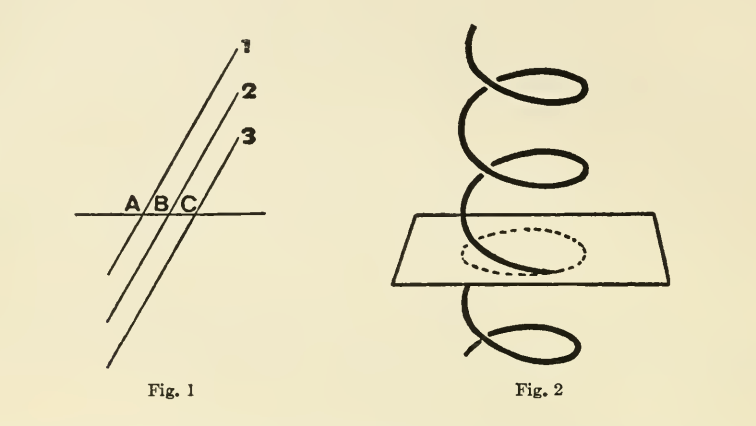
Suppose now all the water to be removed except a film. At the meeting of the film and the stick there will be an interruption of the film. If we suppose the film to have a property, like that of a soap bubble, of closing up round any penetrating object, then as the stick goes vertically downwards the interruption in the film will move on. If we pass a spiral through the film the intersection will give a point moving in a circle (shown by the dotted lines in Fig. 2). 

For the plane being such a point, moving in a circle in its plane, would probably constitute a cosmical phenomenon, something like the motion of a planet in its orbit. 

Suppose now the spiral to be still and the film to move vertically upward, the whole spiral will be represented in the film in the consecutive positions of the point of intersection.

If instead of one spiral we take a complicated construction consisting of spirals, inclined, and straight lines, broken and curved lines, and if the film move vertically upwards we shall have an entire universe of moving points the movements of which will appear to the plane being as original.

The plane being will explain these movements as depending one upon another, and indeed he will never happen to think that these movements are fictitious and are dependent upon the spirals and other lines lying outside his space.

Returning to the plane being and his perception of the world, and analyzing his relations to the three-dimensional world, we see that for the two-dimensional or plane being it will be very difficult to understand all the complexity of the phenomena of our world, as it appears to us. He (the plane being) is accustomed to perceive the world as being too simple. 

Taking into consideration the sections of figures instead of the figures themselves, the plane being will compare them in relation to their length and their greater or lesser curvature, i.e., their for him more or less rapid motion. 

The differences between the objects of our world, as they exist for us he would not understand. The functions of the objects of our world would be completely mysterious to his mind—incomprehensible, “supernatural.” 

Let us imagine that a coin, and a candle the diameter of which is equal to that of the coin, are on the plane upon which the twodimensional being lives. To the plane being they will seem two equal circles, i.e., two moving, and absolutely identical lines; he will never discover any difference between them. The functions of the coin and of the candle in our world—these are for him absolutely a terra incognita. If we try to imagine what an enormous evolution the plane being must pass through in order to understand the function of the coin and of the candle and the difference between these functions, we will understand the nature of the division between the plane world and the world of three dimensions, and the complete impossibility of even imagining, on the plane, anything at all like the three-dimensional world, with its manifoldness of function.

The properties of the phenomena of the plane world will be extremely monotonous; they will differ by the order of their appearance, their duration, and their periodicity. Solids, and the things of this world will be flat and uniform, like shadows, i.e., like the shadows of quite different solids, which seem to us uniform. Even if the plane being could come in contact with our consciousness, he would never be in a position to understand all the manifoldness and richness of the phenomena of our world and the variety of function of the things of that world. 

Plane beings would not be in a position to master our most ordinary concepts. 

It would be extremely difficult for them to understand that phenomena, identical for them, are in reality different; and on the other hand, that phenomena quite separate for them are in reality parts of one great phenomenon, and even of one object or one being. 

This last will be one of the most difficult things for the plane being to understand. If we imagine our plane being to be inhabiting a horizontal plane, intersecting the top of a tree, and parallel to the surface of the earth, then for such a being each of the various sections of the branches will appear as a quite separate phenomenon or object. The idea of the tree and its branches will never occur to him. 

Generally speaking, the understanding of the most fundamental and simple things of our world will be infinitely long and difficult to the plane being. He would have to entirely reconstruct his concepts of space and time. This would be the first step. Unless it is taken, nothing is accomplished. Until the plane being will imagine all our universe as existing in time, i.e., until he refers to time everything lying on both sides of his plane, he will never understand anything. In order to begin to understand “the third dimension” the inhabitant of the plane must conceive of his time concepts spatially, that is, translate his time into space.

To achieve even the spark of a true understanding of our world he will have to reconstruct completely all his ideas to revaluate all values, to revise all concepts, to dissever the uniting concepts, to unite those which are dissevered; and, what is most important, to create an infinite number of new ones. 

If we put down the five fingers of one hand on the plane of the two-dimensional being they will be for him five separate phenomena. 

Let us try to imagine what an enormous mental evolution he would have to undergo in order to understand that these five separate phenomena on his plane are the finger-tips of the hand of a large, active and intelligent being—man. 

To make out, step by step, how the plane being would attain to an understanding of our world, lying in the region of the to him mysterious third dimension—i.e., partly in the past, partly in the future—would be interesting in the highest degree. First of all, in order to understand the world of three dimensions, he must cease to be two dimensional—he must become three dimensional himself or, in other words, he must feel an interest in the life of three-dimensional space. After having felt the interest of this life, he will by so doing transcend his plane, and will never be in a position thereafter to return to it. Entering more and more within the circle of ideas and concepts which were entirely incomprehensible to him before, he will have already become, not two-dimensional, but three-dimensional. But all along the plane being will have been essentially three-dimensional, that is, he will have had the third dimension, without his being conscious of it himself. To become three-dimensional he must be three-dimensional. Then as the end of ends he can address himself to the self-liberation from the illusion of the two-dimensionality of himself and the world, and to the apprehension of the three-dimensional world.

.

Tertium Organum, Chapter 5 (Change)

pillars

Reference: Tertium Organum

.

Chapter 5: Change

Four-dimensional space. “Temporal body”—Linga Sharira. The form of a human body from birth to death. Incommensurability of three-dimensional and four-dimensional bodies. Newton’s fluents. The unreality of constant quantities in our world. The right and the left hands in three-dimensional and in four-dimensional space. Difference between three-dimensional and four-dimensional space. Not two different spaces but different methods of receptivity of one and the same world.

.

Four-dimensional space, if we try to imagine it to ourselves, will be the infinite repetition of our space, of our infinite three-dimensional sphere, as a line is the infinite repetition of a point. 

Many things that have been said before will become much clearer to us when we dwell on the fact that the fourth dimension must be sought for in time

It will become clear what is meant by the fact that it is possible to regard a four-dimensional body as the tracing of the movement in space of a three-dimensional body in a direction not confined within that space. Now the direction not confined in three-dimensional space in which any three-dimensional body moves—this is the direction of time. Any three-dimensional body, existing, is at the same time moving in time and leaves as a tracing of its movement the temporal, or four-dimensional body. We never see nor feel this body, because of the limitations of our receptive apparatus, but we see the section of it only, which section we call the three-dimensional body. Therefore we are in error in thinking that the three-dimensional body is in itself something real. It is the projection of the four-dimensional body—its picture—the image of it on our plane

The four-dimensional body is the infinite number of three-dimensional ones. That is, the four-dimensional body is the infinite number of moments of existence of the three-dimensional one—its states and positions. The three-dimensional body which we see appears as a single figure—one of a series of pictures on a cinematographic film as it were. 

Four-dimensional space—time—is really the distance between forms, states, and positions, of one and the same body (and different bodies, i.e., those seeming different to us). It separates those states, forms, and positions each from the other, and it binds them also into some to us incomprehensible whole. This incomprehensible whole can be formed in time out of one physical body—and out of different bodies.

It is easier for us to imagine the temporal whole as related to one physical body. 

If we consider the physical body of a man, we will find in it besides its “matter” something, it is true, changing, but undoubtedly one and the same from birth until death. 

This something is the Linga-Sharira of Hindu philosophy, i.e., the form on which our physical body is moulded. (H. P. Blavatsky “The Secret Doctrine.”) Eastern philosophy regards the physical body as something impermanent, which is in a condition of perpetual interchange with its surroundings. The particles come and go. After one second the body is already not absolutely the same as it was one second before. To-day it is in a considerable degree not that which it was yesterday. After seven years it is a quite different body. But despite all this, something always persists from birth to death, changing its aspect a little, but remaining the same. This is the Linga-Sharira

The Linga Sharira may be translated as the Genetic Entity.

The Linga-Sharira is the form, the image, it changes, but remains the same. That image of a man which we are able to represent to ourselves is not the Linga-Sharira. But if we try to represent to ourselves mentally the image of a man from birth to death, with all the particularities and traits of childhood, manhood and senility, as though extended in time, then it will be the Linga-Sharira

Form pertains to all things. We say that everything consists of matter and form. Under the category of “matter,” as already stated, the cause of a lengthy series of mixed sensations is predicated, but matter without form is not comprehensible to us; we cannot even think of matter without form. But we can think and imagine form without matter. 

The thing, i.e., the union of form and matter, is never constant; it always changes in the course of time. This idea afforded Newton the possibility of building his theory of fluents and fluxions.

Newton came to the conclusion that constant quantities do not exist in Nature. Variables do exist flowing, fluents only. The velocities with which different fluents change were called by Newton fluxions

From the standpoint of this theory all things known to us— men, plants, animals, planets—are fluents, and they differ by the magnitude of their fluxions. But the thing, changing continuously in time, sometimes very much, and quickly, as in the case of a living body for example, still remains one and the same. The body of a man in youth, the body of a man in senility—these are one and the same, though we know that in the old body there is not one atom left that was in the young one. The matter changes, but something remains one under all changes, this something is the Linga-Sharira. Newton’s theory is valid for the three-dimensional world existing in time. In this world there is nothing constant. All is variable because every consecutive moment the thing is already not that which it was before. We never see the Linga-Sharira, we see always its parts, and they appear to us variable. But if we observe more attentively we shall see that it is an illusion. Things of three dimensions are unreal and variable. They cannot be real because they do not exist in reality, just as the imaginary sections of a solid do not exist. Four-dimensional bodies alone are real. 

The form made of substance. The shape of the form may change. The consistency of substance may also change. But the concept “form made of substance” continues as a constant. This constant may be viewed as a “thought object.” This is linga-sharira.

In one of the lectures contained in the book, “A Pluralistic Universe,” Prof. James calls attention to Prof. Bergson’s remark that science studies always the t of the universe only, i.e., not the universe in its entirety, but the moment, the “temporal section” of the universe. 

.

The properties of four-dimensional space will become clearer to us if we compare in detail three-dimensional space with the surface, and discover the difference existing between them. 

Hinton, in his book, “A New Era of Thought,” examines these differences very attentively. He represents to himself, on a plane, two equal rectangular triangles, cut out of paper, the right angles of which are placed in opposite directions. These triangles will be equal, but for some reason quite different. The right angle of one is directed to the right, that of the other to the left. If anyone wants to make them quite similar, it is possible to do so only with the help of three-dimensional space. That is, it is necessary to take one triangle, turn it over, and put it back on the plane. Then they will be two equal, and exactly similar triangles. But in order to effect this, it was necessary to take one triangle from the plane into three-dimensional space, and turn it over in that space. If the triangle is left on the plane, then it will never be possible to make it identical with the other, keeping the same relation of angles of the one to those of the other. If the triangle is merely rotated in the plane this similarity will never be established. In our world there are figures quite analogous to these two triangles.

We know certain shapes which are equal the one to the other, which are exactly similar, and yet which we cannot make fit into the same portion of space, either practically or by imagination. 

If we look at our two hands we see this clearly, though the two hands represent a complex case of a symmetrical similarity. Now there is one way in which the right hand and the left hand may practically be brought into likeness. If we take the right hand glove and the left hand glove, they will not fit any more than the right hand will coincide with the left hand; but if we turn one glove inside out, then it will fit. Now suppose the same thing done with the solid hand as is done with the glove when it is turned inside out, we must suppose it, so to speak, pulled through itself. . . If such an operation were possible, the right hand would be turned into an exact model of the left hand.

But such an operation would be possible in the higher dimensional space only, just as the overturning of the triangle is possible only in a space relatively higher than the plane. Even granting the existence of four-dimensional space it is possible that the turning of the hand inside out and the pulling of it through itself is a practical impossibility on account of causes independent of geometrical conditions. But this does not diminish its value as an example. Things like the turning of the hand inside out are possible theoretically in four-dimensional space because in this space different, and even distant points of our space and time touch, or have the possibility of contact. All points of a sheet of paper lying on a table are separated one from another, but by taking the sheet from the table it is possible to fold it in such a way as to bring together any given points. If on one corner is written St. Petersburg, and on another Madras, nothing prevents the putting together of these corners. And if on the third corner is written the year 1812, and on the fourth 1912, these corners can touch each other too. If on one corner the year is written in red ink, and the ink has not yet dried, then the figures may imprint themselves on the other corner. And if afterwards the sheet is straightened out and laid on the table, it will be perfectly incomprehensible, to a man who has not followed the operation, how the figure from one corner could transfer itself to another corner. For such a man the possibility of the contact of remote points of the sheet will be incomprehensible, and it will remain incomprehensible so long as he thinks of the sheet in two-dimensional space only. The moment he imagines the sheet in three-dimensional space this possibility will become real and obvious to him.

In considering the relation of the fourth dimension to the three known to us, we must conclude that our geometry is obviously insufficient for the investigation of higher space. 

As before stated, a four-dimensional body is as incommensurable with a three-dimensional one as a year is incommensurable with St. Petersburg

It is quite clear why this is so. The four-dimensional body consists of an infinitely great number of three-dimensional ones; accordingly, there cannot be a common measure for them. The three-dimensional body, in comparison with the four-dimensional one is equivalent to the point in comparison with the line. 

And just as the point is incommensurable with the line, so is the line incommensurable with the surface; as the surface is incommensurable with the solid body, so is the three-dimensional body incommensurable with the four-dimensional one. 

It is clear also why the geometry of three dimensions is insufficient for the definition of the position of the region of the fourth dimension in relation to three-dimensional space. 

Just as in the geometry of one dimension, that is, upon the line, it is impossible to define the position of the surface, the side of which constitutes the given line; just as in the geometry of two dimensions, i.e., upon the surface, it is impossible to define the position of the solid, the side of which constitutes the given surface, so in the geometry of three dimensions, in three-dimensional space, it is impossible to define a four-dimensional space. Briefly speaking, as planimetry is insufficient for the investigation of the problems of stereometry, so is stereometry insufficient for four-dimensional space.

As a conclusion from all of the above we may repeat that every point of our space is the section of a line in higher space, or as B. Riemann expressed it: the material atom is the entrance of the fourth dimension into three-dimensional space.

All we can say is that the 3D object of one moment is continuous with the 3D object of the next moment. In other words, the 4D object is continuous in the fourth-dimension.

.

For a nearer approach to the problem of higher dimensions and of higher space it is necessary first of all to understand the constitution and properties of the higher dimensional region in comparison with the region of three dimensions. Then only will appear the possibility of a more exact investigation of this region, and a classification of the laws governing it. 

What is it that it is necessary to understand? 

It seems to me that first of all it is necessary to understand that we are considering not two regions spatially different, and not two regions of which one (again spatially, “geometrically”) constitutes a part of the other, but two methods of receptivity of one and the same unique world of a space which is unique.

Furthermore it is necessary to understand that all objects known to us exist not only in those categories in which they are perceived by us, but in an infinite number of others in which we do not and cannot sense them. And we must learn first to think things in other categories, and then so far as we are able, to imagine them therein. Only after doing this can we possibly develop the faculty to apprehend them in higher space—and to sense “higher” space itself. 

Or perhaps the first necessity is the direct perception of everything in the outside world which does not fit into the frame of three dimensions, which exists independently of the categories of time and space—everything that for this reason we are accustomed to consider as non-existent. If variability is an indication of the three-dimensional world, then let us search for the constant and thereby approach to an understanding of the four-dimensional world. 

We have become accustomed to count as really existing only that which is measurable in terms of length, breadth and height, but as has been shown it is necessary to expand the limits of the really existing. Mensurability is too rough an indication of existence, because mensurability itself is too conditioned a conception. We may say that for any approach to the exact investigation of the higher dimensional region the certainty obtained by the immediate sensation is probably indispensable, that much that is immeasurable exists just as really as, and even more really than, much that is measurable.

The object is continuous in dimensions one, two, three and four. We can predict that the object will be continuous in higher dimensions. A dimension applies to an aspect of the object.

The fifth dimension can apply to the consistency (a degree of density, firmness, viscosity, etc.) of the substance. In an atom, there are shells in the nucleus, which then interface with the shells in the electronic region. This atom exists in an environment of a spectrum of radiation. We can say that the substance is continuous from the “solid mass” of the nucleus to the “liquid mass” of the electronic region to the “gaseous mass” of the radiation environment.

All properties of an object, such as color, may be assigned their own dimensions. The object shall be continuous in the dimension of each of these properties.

We may conclude that any change in the object will always be continuous.

.

Some Thoughts

Space deals with relationships; and time deals with the history of those relationships.

An inconsistency may be spotted in space, but to resolve it we need to go into the dimension of time.

Static relationships are determined by relative positions and directions in space. Dynamic relationships have the additional dimension of time.

In geometrical space, positions are represented by points, and directions by solid angles. A solid angle further resolves into two planar angles in two different dimensions.

In physical space, positions are represented by objects, and the directions by relative positions. If there are no objects, the positions are determined by mental imagery.

An object is defined by its inertia expressed as mass. Inertia is a measure of how much structure is there. The structure appears by its resistance to change.

An object cruising at constant velocity cannot be differentiated from an object at rest. There is zero acceleration. Therefore, its actual motion is also zero.

Motion arises only with acceleration, as when force is applied, or during interactions among objects.

The reference point for an object shall be zero inertia and zero acceleration.

When inertia is zero then there is no resistance to work against, and no acceleration is possible. An object with zero rest mass shall always remain in a state of zero acceleration or constant velocity. This is the case with light.

An object with non-zero rest mass has non-zero inertia, and it can be accelerated by applying force to it.

When there is an object with mass M1 in space all by itself, and there is no second mass and no distance either, then the force due to gravity would be undefined.

The moment an object of mass M2 appears in space, the distance d between the two objects also gets defined, and a force and acceleration also appear.


Tertium Organum, Chapter 4 (Time)

pillars

Reference: Tertium Organum

.

Chapter 4: Time


In what direction may the fourth dimension lie? What is motion? Two kinds of motion—motion in space and motion in time—which are contained in every movement. What is time? Two ideas contained in the conception of time. The new dimension of space, and motion upon that dimension. Time as the fourth dimension of space. Impossibility of understanding the fourth dimension without the idea of motion. The idea of motion and the “time sense.” The time sense as a limit (surface) of the “space sense.” Hinton on the law of surfaces. The “ether” as a surface. Riemann’s idea concerning the translation of time into space in the fourth dimension. Present, past, and future. Why we do not see the past and the future. Life as a feeling of one’s way. Wundt on the subject of our sensuous knowledge.

.

We have established by a comparison of the relation of lower dimensional figures to higher dimensional ones that it is possible to regard a four-dimensional body as the tracing of the motion of a three-dimensional body upon the dimension not contained in it; i.e., that the direction of the motion upon the fourth dimension lies outside of all the directions which are possible in three-dimensional space. 

But in what direction is it? 

In order to answer this question it will be necessary to discover whether we do not know some motion not confined in three-dimensional space. 

We know that every motion in space is accompanied by that which we call motion in time. Moreover, we know that everything existing, even if not moving in space, moves eternally in time. 

And equally in all cases, whether speaking of motion or absence of motion, we have in mind an idea of what was before, what now becomes, and what will follow after. In other words, we have in mind the idea of time. The idea of motion of any kind, also the idea of absence of motion is indissolubly bound up with the idea of time. Any motion or absence of motion proceeds in time and cannot proceed out of time. Consequently, before speaking of what motion is, we must answer the question, what is time?

Time is the most formidable and difficult problem which confronts humanity. 

Time as a dimension simply adds the property to an object of endurance. The object then continues to be.

Kant regards time as he does space: as a subjective form of our receptivity; i.e., he says that we create time ourselves, as a function of our receptive apparatus, for convenience in perceiving the outside world. Reality is continuous and constant, but in order to make possible the perception of it, we must dissever it into separate moments; imagine it as an infinite series of separate moments out of which there exists for us only one. In other words, we perceive reality as though through a narrow slit, and what we are seeing through this slit we call the present; what we did see and now do not see—the past, and what we do not quite see but are expecting—the future. 

Space and time are basic dimensions that we use to make sense out of a constant and continuous reality. The moments in time are continuous, just like the locations in space. The spread of our awareness determines how much reality we perceive in terms of time and space.

Regarding each phenomenon as an effect of another, or others, and this in its turn as a cause of a third; that is, regarding all phenomena in functional interdependence one upon another, by this very act we are contemplating them in time, because we picture to ourselves quite clearly and precisely first a cause, then an effect; first an action, then its function, and cannot contemplate them otherwise. Thus we may say that the idea of time is bound up with the idea of causation and functional interdependence. Without time causation cannot exist, just as without time motion or the absence of motion cannot exist. 

Each moment in time is continuous with the moment just before it. This produces a connected sequence. This may be looked upon as functional interdependence. This may also be looked upon as forms of cause and effect.

But our perception concerning our “being in time” is entangled and misty up to improbability. 

First of all let us analyze our relation toward the past, present and future. Usually we think that the past already does not exist. It has passed, disappeared, altered, transformed itself into something else. The future also does not exist—it does not exist yet. It has not arrived, has not formed. By the present we mean the moment of transition of the future into the past, i.e., the moment of transition of a phenomenon from one non-existence into another one. Only for that short moment does the phenomenon exist for us in reality; before, it existed in potentiality, afterward it will exist in remembrance. But this short moment is in substance only a fiction: it has no measurement. We have a full right to say that the present does not exist. We can never catch it. That which we did catch is always the past!

If we are to stop at that we must admit that the world does not exist, or exists only in some phantasmagoria of illusions, flashing and disappearing.

Usually we take no account of this, and do not reflect that our usual view of time leads to utter absurdity. 

Let us imagine a stupid traveller going from one city to another and half way between these two cities. A stupid traveller thinks that the city from which he has departed last week does not exist now: only the memory of it is left; the walls are ruined, the towers fallen, the inhabitants have either died or gone away. Also that city at which he is destined to arrive in several days does not exist now either, but is being hurriedly built for his arrival, and on the day of that arrival will be ready, populated, and set in order, and on the day after his departure will be destroyed just as was the first one. 

We are thinking of things in time exactly in this way—everything passes away, nothing returns! The spring has passed, it does not exist still. The autumn has not come, it does not exist yet

But what does exist? 

The present. 

But the present is not a seizable moment, it is continuously transitory into the past. 

So, strictly speaking, neither the past, nor the present, nor the future exists for us. Nothing exists! And yet we are living, feeling, thinking—and something surrounds us. Consequently, in our usual attitude toward time there exists some mistake. This error we shall endeavor to detect. 

We accepted in the very beginning that something exists. We called that something the world. How then can the world exist it it is not existing in the past, in the present, in the future? 

That conception of the world which we deduced from our usual view of time makes the world appear like a continuously gushing out igneous fountain of fireworks, each spark of which flashes for a moment and disappears, never to appear any more. Flashes are going on continuously, following one after another, there are an infinite number of sparks, and everything together produces the impression of a flame, though it does not exist in reality. 

The autumn has not come yet. It will be, but it does not exist now. And we give no thought to how that can appear which is not.

We are moving upon a plane, and recognize as really existing only the small circle lighted by our consciousness. Everything out of this circle, which we do not see, we negate, we do not like to admit that it exists. We are moving upon the plane in one direction. This direction we consider as eternal and infinite. But the direction at right angles to it, those lines which we are intersecting, we do not like to recognize as eternal and infinite. We imagine them as going into non-existence at once, as soon as we have passed them, and that the lines before us have not yet risen out of non-existence. If, presupposing that we are moving upon a sphere, upon its equator or one of its parallels, then it will appear that we recognize as really existing only one meridian: those which are behind us have disappeared and those ahead of us have not appeared yet. 

We are going forward like a blind man, who feels paving stones and lanterns and walls of houses with his stick and believes in the real existence of only that which he touches now, which he feels now. That which has passed has disappeared and will never return! That which has not yet been does not exist. The blind man remembers the route which he has traversed; he expects that ahead the way will continue, but he sees neither forward nor backward because he does not see anything, because his instrument of knowledge—the stick—has a definite, and not very great length, and beyond the reach of his stick non-existence begins. 

Wundt, in one of his books, called attention to the fact that our famous five organs of sense are in reality just feelers by which we feel the world around us. We live groping about. We never see anything. We are always just feeling everything. With the help of the microscope and the telescope, the telegraph and the telephone we are extending our feelers a little, so to speak, but we are not beginning to see. To say that we are seeing would be possible only in case we could know the past and the future. But we do not see, and because of this we can never assure ourselves of that which we cannot feel

This is the reason why we count as really existing only that circle which our feelers grasp at a given moment. Beyond that darkness and non-existence. 

But have we any right to think in this way? 

Let us imagine a consciousness that is not bound by the conditions of sensuous receptivity. Such a consciousness can rise above the plane upon which we are moving; it can see far beyond the limits of the circle enlightened by our usual consciousness; it can see that not only does the line upon which we are moving exist, but also all lines perpendicular to it which we are intersecting, which we have ever intersected, and which we shall intersect. After rising above the plane this consciousness can see the plane, can convince itself that it is really a plane, and not a single line. Then it can see the past and the future, lying together and existing simultaneously.

That consciousness which is not bound by the conditions of sensuous receptivity can outrun the stupid traveler, ascend the mountain to see in the distance the town to which he is going, and be convinced that this town is not being built anew for his arrival, but exists quite independently of the stupid traveler. And that consciousness can look off and see on the horizon the towers of that city where that traveler had been, and be convinced that those towers have not fallen, that the city continues to stay and live just as it stayed and lived before the traveler’s advent. 

It can rise above the plane of time and see the spring behind and the autumn ahead, see simultaneously the budding flowers and ripening fruits. It can make the blind man recover his sight and see the road along which he passed and that which still lies before him. 

The past and the future cannot not exist, because if they do not exist then neither does the present exist. Unquestionably they exist somewhere together, but we do not see them. 

The present, compared with the past and the future, is the most unreal of all unrealities. 

We are forced to admit that the past, the present and the future do not differ in anything, one from another: there exists just one ‘present—the Eternal Now of Hindu philosophy. But we do not perceive this, because in every given moment we experience just a little bit of that present, and this alone we count as existent, denying a real existence to everything else. 

If we admit this, then our view of everything with which we are surrounded will change very considerably. 

Usually we regard time as an abstraction, made by us during the observation of really existing motion. That is, we think that observing motion, or changes of relations between things and comparing the relations which existed before, which exist now, and which may exist in the future, that we are deducing the idea of time. We shall see later on how far this view is correct.

Thus the idea of time is composed of the conception of the past, of that of the present, and of that of the future. 

Our conceptions of the past and present, though not very clear, are yet very much alike. As to the future there exists a great variety of views. 

It is necessary for us to analyze the theories of the future as they exist in the mind of contemporary man. 

There are in existence two theories—that of the preordained future, and that of the free future. 

Preordination is established in this way: we say that every future event is the result of those which happened before, and is created such as it will be and not otherwise as a consequence of a definite direction of forces which are contained in preceding events. This means, in other words, that future events are wholly contained in preceding ones, and if we could know the force and direction of all events which have happened up to the present moment, i.e., if we knew all the past, by this we could know all the future. And sometimes, knowing the present moment thoroughly, in all its details, we may really foretell the future. If the prophecy is not fulfilled, we say that we did not know all that had been, and we discover in the past some cause which had escaped our observation. 

The idea of the free future is founded upon the possibility of voluntary action and accidental new combinations of causes. The future is regarded as quite indefinite, or defined only in part, because in every given moment new forces, and new events and new phenomena are born which lie in a potential state, not causeless, but so incommensurable with causes—as the firing of a city from one spark—that it is impossible to detect or measure them. 

This theory affirms that one and the same action can have different results; one and the same cause, different effects; and it introduces the hypothesis of quite arbitrary volitional actions on the part of a man, bringing about profound changes in the subsequent events of his own life and the lives of others. 

Supporters of the preordination theory contend on the contrary that volitional, involuntary actions depend also upon causes, making them necessary and unavoidable at a given moment; that there is nothing accidental, and that there cannot be; that we call accidental only those things the causes of which we do not see by reason of our limitations; and that different effects of causes seemingly the same occur because the causes are different in reality and only seem similar for the reason that we do not understand them well enough nor see them sufficiently clear.

The dispute between the theory of the preordained future and that of the free future is an infinite dispute. Neither of these theories can say anything decisive. This is so because both theories are too literal, too inflexible, too material, and one repudiates the other: both say, “either this or the other.” In the one case there results a complete cold predestination; that which will be, will be, nothing can be changed—that which will befall tomorrow was predestined tens of thousands of years ago. There results in the other case a life upon some sort of needle-point called the present, which is surrounded on all sides by an abyss of non-existence, a journey in a country which does not yet exist, a life in a world which is born and dies every moment, in which nothing ever returns. And both these opposite views are equally untrue, because the truth, in the given case, as in so many others, is contained in a union of two opposite understandings in one. 

In every given moment all the future of the world is predestined and is existing, but is predestined conditionally, i.e., it will be such or another future according to the direction of events at a given moment, unless there enters a new fact, and a new fact can enter only from the side of consciousness and the will resulting from it. It is necessary to understand this, and to master it. 

There are laws of nature, so there is predestination. But there is also evolution, so there are new factors coming in.

Besides this we are hindered from a right conception of the relation of the present toward the future by our misunderstanding of the relation of the present to the past. The difference of opinion exists only concerning the future; concerning the past all agree that it has passed, that it does not exist now—and that it was such as it has been. In this last lies the key to the understanding of the incorrectness of our views of the future. As a matter of fact, in reality our relation both to the past and to the future is far more complicated than it seems to us. In the past, behind us, lies not only that which really happened, but that which could have been. In the same way, in the future lies not only that which will be, but everything that may be. 

The past and the future are equally undetermined, equally exist in all their possibilities, and equally exist simultaneously with the present.

The is always the possibility of some sensations, especially traumatic sensations, not getting assimilated in real time. The unassimilated sensations sink into subconscious and out of awareness. There they wait to get assimilated. Any lack of assimilation thus distorts our view of past, present and future. Thus, we may perceive both past and future with uncertainty.

By time we mean the distance separating events in the order of their succession and binding them in different wholes. This distance lies in a direction not contained in three-dimensional space, therefore it will be the new dimension of space

This new dimension satisfies all possible requirements of the fourth dimension on the ground of the preceding reasoning. 

It is incommensurable with the dimensions of three-dimensional space, as a year is incommensurable with St. Petersburg. It is perpendicular to all directions of three-dimensional space and is not parallel to any of them. 

Time is the distance separating events, just like space is the distance separating objects. Time is possible because objects are enduring. This endurance of an object is understood as the dimension of Time, just like the extents of an object are understood as the dimensions of Space. If we define Space solely in terms of dimensions, then Time provides the fourth dimension to “space.”

As a deduction from all the preceding we may say that time (as it is usually understood) includes in itself two ideas: that of a certain to us unknown space (the fourth dimension), and that of a motion upon this space. Our constant mistake consists in the fact that in time we never see two ideas, but see always only one. Usually we see in time the idea of motion, but cannot say from whence, where, whither, nor upon what space. Attempts have been made heretofore to unite the idea of the fourth dimension with the idea of time. But in those theories which have attempted to combine the idea of time with the idea of the fourth dimension appeared always the idea of some spatial element as existing in time, and along with it was admitted motion upon that space. Those who were constructing these theories evidently did not understand that leaving out the possibility of motion they were advancing the demand for a new time, because motion cannot proceed out of time. And as a result time goes ahead of us, like our shadow, receding according as we approach it. All our perceptions of motion have become confused. If we imagine the new dimension of space and the possibility of motion upon this new dimension, time will still elude us, and declare that it is unexplained, exactly as it was unexplained before. 

It is necessary to admit that by one term, time, we designated, properly, two ideas—”a certain space” and “motion upon that space.” This motion does not exist in reality, and it seems to us as existing only because we do not see the spatiality of time. That is, the sensation of motion in time, (and motion out of time does not exist) arises in us because we are looking at the world as though through a narrow slit, and are seeing the lines of intersection of the time-plane with our three-dimensional space only.

Therefore it is necessary to declare how profoundly incorrect is our usual theory that the idea of time is deduced by us from the observation of motion, and is really nothing more than the idea of that succession which is observed by us in motion. 

It is necessary to recognize quite the reverse: that the idea of motion is deduced by us out of an incomplete sensation of time, or of the time-sense, i.e., out of a sense or sensation of the fourth dimension, but out of an incomplete sensation. This incomplete sensation of time (of the fourth dimension)—the sensation through the slit—gives us the sensation of motion, that is, creates an illusion of motion which does not exist in reality, but instead of which there exists in reality only the extension upon a direction inconceivable to us.

.

One other aspect of the question has very great significance. The fourth dimension is bound up with the ideas of “time” and “motion.” But up to this point we shall not be able to understand the fourth dimension unless we shall understand the fifth dimension. 

Attempting to look at time as at an object, Kant says that it has one dimension: i.e., he imagines time as a line extending from the infinite future into the infinite past. Of one point of this line we are conscious—always only one point. And this point has no dimension because that which in the usual sense we call the present, is the recent past, and sometimes also the near future. 

This would be true in relation to our illusory perception of time. But in reality eternity is not the infinite dimension of time, but the one perpendicular to time; because, if eternity exists, then every moment is eternal. We can discover in time two dimensions. The second dimension of time, i.e., eternity, will be the fifth dimension of space. The line of the first dimension of time extends in that order of succession of phenomena which are in causal interdependence—first the cause, then the effect: before, now, after. The line of the second dimension of time—the line of eternity—extends perpendicularly to that line. 

It is impossible to understand the idea of time without conceiving to ourselves the idea of eternity; it is likewise impossible to understand space if we have no idea of eternity. 

Eternity would mean that an object is enduring without change. There is no succession of change in that object while it is enduring through the changes other objects are going through. No change means no motion because motion means succession of change in distance.

From the standpoint of eternity, time does not differ in anything from the other lines and dimensions of space—length, breadth, and height. This means that just as in space exist the things that we do not see, or speaking differently, not alone that which we see, so in time “events” exist before our consciousness has touched them, and they still exist after our consciousness has left them behind. Consequently, extension in time is extension into unknown space, and therefore time is the fourth dimension of space

But as has been shown already, time is not a simple, but a complex conception. And we shall have this in view—it consists of a conception of unknown space, vanishing in the past and future, and of illusory motion upon this space.

Eternity refers to the dimension of Time, the same way that distance refers to the dimension of Space. It is incorrect to say that eternity is the fifth dimension. It is a concept related to the fourth dimension.

.

It is necessary for us to regard time as a spatial conception considered with relation to our two data—the universe and consciousness. 

The idea of time appears when consciousness comes in contact with the world through sensuous receptivity. It has been already shown that because of the properties of sensuous receptivity, consciousness sees the world as through a narrow slit. 

Out of this the following questions arise: 

  1. Why does there exist in the world illusionary motion? That is, why does not consciousness see through this slit the same thing at all times? Why, behind the slit, do changes proceed creating the illusion of motion, i.e., in what manner, and how does the focus of our consciousness run over the world of phenomena? In addition to all this it is necessary to remember that through the very same slit through which it sees the world, consciousness observes itself as part of the world, and sees in itself changes similar to the changes in the rest of things. 
  2. Why cannot consciousness extend that slit? 

We shall endeavor to answer these questions. 

These questions are better posed as: (1) Why are we fixated on immediate sensation and do not consider the total awareness of past, present and future? (2) Why aren’t we addressing subconsciousness?

First of all we shall remark that within the limits of our usual observation consciousness is always in the same conditions and cannot escape these conditions. In other words, it is as it were chained to some plane above which it cannot rise. These conditions or that plane we call MATTER. Our consciousness lives, so to speak, upon the very plane, and never rises above it. If consciousness could rise above this plane, so undoubtedly it would see underneath itself simultaneously, a far greater number of events than it usually sees while on a plane. Just as a man, ascending a mountain, or going up in a balloon, begins to see simultaneously and at once many things which it is impossible to see simultaneously and at once from below: the movement of two trains toward one another between which a collision will occur; the approach of an enemy detachment to a sleeping camp ; two cities divided by a ridge, etc.—so consciousness rising above the plane in which it usually functions, must see simultaneously the events divided for ordinary consciousness by periods of time. These will be the events which ordinary consciousness never sees together, as cause and effect: the work, and the payment; the crime and the punishment; the movement of trains toward one another and their collision; the approach of the enemy and the battle; the sunrise and the sunset; the morning and the evening; the day and the night; spring, autumn, summer and winter; the birth and the death of a man.

It is incorrect to think that our consciousness cannot rise above the plane of MATTER. It can certainly rise when we realize that that the substance of the universe includes radiation and thought in addition to matter. The space filled only with radiation allows for a flexible scale. The space filled only with thought allows for additional metaphysical dimensions.

The angle of vision will enlarge during such an ascent, the moment will expand. 

If we imagine a consciousness higher than our consciousness, possessing a broader angle of view, then this consciousness will be able to grasp, as something simultaneous, i.e., as a moment, all that is happening for us during a certain length of time—minutes, hours, a day, a month. Within the limits of its moment such a consciousness will not be in a position to discriminate between before, now, after, all this will be for it now. Now will expand. 

But in order for this to happen it would be necessary for us to liberate ourselves from matter, because matter is nothing more than the conditions of space and time in which we dwell. Thence arises the question: can consciousness leave the conditions of material existence without itself undergoing fundamental changes or without disappearing altogether, as men of positivistic views would affirm. 

Space and time account for the dimensions of substance. Currently, we limit substance to inflexible matter. We just need to expand the sense of substance to include radiation and thought.

This is a debatable question, and later I shall give examples and proofs, speaking on behalf of the idea that our consciousness can leave the conditions of materiality. For the present I wish to establish purely theoretically what must proceed during this leaving. 

There would ensue the expansion of the moment, i.e., all that we are apprehending in time would become something like a single moment, in which the past, the present, and the future would be seen at once. This shows the relativity of motion, as depending for us upon the limitation of the moment, which includes only a very small part of the moments of life perceived by us. 

We have a perfect right to say, not that “time” is deduced from “motion,” but that motion is sensed because of the time-sense. We have that sense, therefore we sense motion. The time-sense is the sensation of changing moments. If we did not have this time-sense we could not feel motion. The “time-sense” is itself, in substance, the limit or the surface of our “space-sense.” Where the “space-sense” ends, there the “time-sense” begins. It has been made clear that “time” is identical in its properties with “space,” i. ., it has all the signs of space extension. However, we do not feel it as spatial extension, but we feel it as time, that is, as something specific, inexpressible, in other words, uninterruptedly bound up with “motion.” This inability to sense time spatially has its origin in the fact that the time-sense is a misty space-sense; by means of our time-sense we feel obscurely the new characteristics of space, which emerge from the sphere of three dimensions. 

Motion is not correctly described above. Motion is successive change of values on a dimensional scale whether it is changing distance from some fixed point, or if it is changing form from eternity. NOTE: Eternity is endurance of a form without change.

But what is the time-sense and why does there arise the illusion of motion? 

To answer this question at all satisfactorily is possible only by studying our consciousness, our I. 

“I” is a complicated quantity, and within itself goes on a continuous motion. About the nature of this motion we shall speak later, but this very motion inside of our I creates the illusion of motion around us, motion in the material world.

The premise of “I” stated above is problematic. The whole function of “I” is to spot and resolve anomalies that violate continuity, consistency and harmony of observations.

.

The noted mathematician Riemann understood that when higher dimensions of space are in question time, by some means, translates itself into space, and he regarded the MATERIAL ATOM as the entrance of the fourth dimension into three-dimensional space

In one of his books Hinton writes very interestingly about “surface tensions.” 

The relationship of a surface to a solid or of a solid to a higher solid is one which we often find in nature. 

A surface is nothing more nor less than the relation between two things. Two bodies touch each other. The surface is the relationship of one to the other. 

If our space is in the same co-relation with higher space as is the surface to our space, then it may be that our space is really the surface, that is the place of contact, of two higher-dimensional spaces. 

It is a fact worthy of notice that in the surface of a fluid different laws obtain from those which hold throughout the mass. There are a whole series of facts which are grouped together under the name of surface tensions, which are of great importance in physics, and by which the behavior of the surfaces of liquids is governed. 

And it may well be that the laws of our universe are the surface tensions of a higher universe. 

If the surface be regarded as a medium lying between bodies, then indeed it will have no weight, but be a powerful means of transmitting vibrations. Moreover, it would be unlike any other substance, and it would be impossible to get rid of it. However perfect a vacuum be made, there would be in this vacuum just as much of this unknown medium (i.e., of that surface) as there was before. 

Matter would pass freely through this medium. . . vibrations of this medium would tear asunder portions of matter. And involuntarily the conclusion would be drawn that this medium was unlike any ordinary matter. . . These would be very different properties to reconcile in one and the same substance. 

Now is there anything in our experience which corresponds to this medium? . . . 

Do we suppose the existence of any medium through which matter freely moves, which yet by its vibrations destroys the combinations of matter—some medium which is present in every vacuum however perfect, which penetrates all bodies, is weightless, and yet can never be laid hold of. 

The “substance” which possesses all these qualities is called the “ether.” . . 

The properties of the ether are a perpetual object of investigation in science. . . But taking into consideration the ideas expressed before it would be interesting to look at the world supposing that we are not in it but on the ether; where the “ether” is the surface of contact of two bodies of higher dimensions.

Hinton here expresses an unusually interesting thought, and brings the idea of the “ether” nearer to the idea of time. The materialistic, or even the energetic understanding of contemporary physics of the ether is perfectly fruitless—a dead-end siding. For Hinton the ether is not a substance but only a “surface,” the “boundary” of something. But of what? Again not that of a substance, but the boundary, the surface, the limit of one form of receptivity and the beginning of another. …

In one sentence the walls and fences of the materialistic deadend siding are broken down and before our thought open wide horizons of regions unexplored.

What is being considered “ether” here, could very well be “thought,” which is a valid substance.

.

Tertium Organum, Chapter 3 (Space)

pillars


Reference: Tertium Organum

.

Chapter 3: Space


What may we learn about the fourth dimension by a study of the geometrical relations within our space? What should be the relation between a three-dimensional body and one of four dimensions? The four-dimensional body as the tracing of the movement of a three-dimensional body in the direction which is not confined within it. A four-dimensional body as containing an infinite number of three-dimensional bodies. A three-dimensional body as a section of a four-dimensional one. Parts of bodies and entire bodies in three and in four dimensions. The incommensurability of a three-dimensional and a four-dimensional body. A material atom as a section of a four-dimensional line.

.

In another of his books, “The Fourth Dimension,” Hinton makes an interesting remark about the method by which we may approach the question of the higher dimensions. This is what he says:

Our space itself bears within it relations through which we can establish relations to other (higher) spaces. 

For within space are given the conception of point and line, line and plane, which really involve the relation of space to a higher space. 

If we concentrate upon this thought, and consider the very great difference between the point and the line, between the line and the surface, surface and solid, we shall indeed come to understand how much of the new and inconceivable the fourth dimension holds for us. 

As in the point it is impossible to imagine the line and the laws of the line; as in the line it is impossible to imagine the surface and the laws of the surface; as in the surface it is impossible to imagine the solid and the laws of the solid, so in our space it is impossible to imagine the body having more than three dimensions, and impossible to understand the laws of the existence of such a body. 

But studying the mutual relations between the point, the line, the surface, the solid, we begin to learn something about the fourth dimension, i.e., of four-dimensional space. We begin to learn what it can be in comparison with our three-dimensional space, and what it cannot be.

The three dimensions of space specify the three independent directions in which the extents of an inflexible solid object may be measured. This is a space filled by a inflexible solid object.

This last we learn first of all. And it is especially important, because it saves us from many deeply inculcated illusions, which are very detrimental to right knowledge. 

We learn what cannot be in four-dimensional space, and this permits us to set forth what can be there

Let us consider these relations within our space, and let us see what conclusions we can derive from their investigation. 

We know that our geometry regards the line as a tracing of the movement of a point; the surface as a tracing of the movement of a line; and the solid as a tracing of the movement of a surface. On these premises we put to ourselves this question: Is it not possible to regard the “four-dimensional body” as a tracing of the movement of a three-dimensional one? 

But what is this movement, and in what direction? 

The point, moving in space, and leaving the tracing of its movement, a line, moves in a direction not contained in it, because in a point there is no direction whatsoever. 

The line, moving in space, and leaving the tracing of its movement, the surface, moves in a direction not contained in it because, moving in a direction contained in it, a line will continue to be a line.

The surface, moving in space, and leaving a tracing of its movement, the solid, moves also in a direction not contained in it. If it should move otherwise, it would remain always the surface. In order to leave a tracing of itself as a “solid,” or three-dimensional figure, it must set off from itself, move in a direction which in itself it has not. 

A dimension need not depend on a physical direction. The next higher dimensional object may be obtained by extending the lower dimensional object in a dimension not contained in the object.

In analogy with all this, the solid, in order to leave as the tracing of its movement, the four-dimensional figure (hypersolid) shall move in a direction not confined in it; or in other words it shall come out of itself, set off from itself, move in a direction which is not present in it. Later on it will be shown in what manner we shall understand this. 

But for the present we can say that the direction of the movement in the fourth dimension lies out of all those directions which are possible in a three-dimensional figure

There is no fourth physical direction in reality. One may try to visualize a fourth physical direction mathematically. But mathematics only provides an abstract pattern.

We consider the line as an infinite number of points; the surface as an infinite number of lines; the solid as an infinite number of surfaces.

In analogy with this it is possible to consider that it is necessary to regard a four-dimensional body as an infinite number of three-dimensional ones, and four-dimensional space as an infinite number of three-dimensional spaces. 

Moreover, we know that the line is limited by points, that the surface is limited by lines, that the solid is limited by surfaces. 

It is possible that a four-dimensional body is limited by three-dimensional bodies

Or it is possible to say that the line is a distance between two points; the surface a distance between two lines; the solid—between two surfaces. 

Or again, that the line separates two points or several points from one another (for the straight line is the shortest distance between two points) ; that the surface separates two or several lines from each other; that the solid separates several surfaces one from another; so the cube separates six flat surfaces one from another—its faces. 

The line binds several separate points into a certain whole (the straight, the curved, the broken line) ; the surface binds several lines into something whole (the quadrilateral, the triangle); the solid binds several surfaces into something whole (the cube, the pyramid).

It is possible that four-dimensional space is the distance between a group of solids, separating these solids, yet at the same time binding them into some to us inconceivable whole, even though they seem to be separate from one another. 

Time has long been considered as the fourth dimension. The same object in a different time is a different version of it. Comparing different versions of an object at different points in time may produce an interesting four-dimensional object. The “time line” of a three­-dimensional object may provide a “linear” four-dimensional object.

Moreover, we regard the point as a section of a line; the line as a section of a surface; the surface as a section of a solid. 

By analogy, it is possible to regard the solid (the cube, sphere, pyramid) as a section of a four-dimensional body, and our entire three-dimensional space as a section of a four-dimensional space. 

If every three-dimensional body is the section of a four-dimensional one, then every point of a three-dimensional body is the section of a four-dimensional line. It is possible to regard an “atom” of a physical body, not as something material, but as an intersection of a four-dimensional line by the plane of our consciousness.

The view of a three-dimensional body as the section of a four-dimensional one leads to the thought that many (for us) separate bodies may be the sections of parts of one four-dimensional body.

A simple example will clarify this thought. If we imagine a horizontal plane, intersecting the top of a tree, and parallel to the surface of the earth, then upon this plane the sections of branches will seem separate, and not bound to one another. Yet in our space, from our standpoint, these are sections of branches of one tree, comprising together one top, nourished from one root, casting one shadow.

Or here is another interesting example expressing the same idea, given by Mr. Leadbeater, the theosophical writer, in one of his books. If we touch the surface of a table with our finger tips, then upon the surface will be just five circles, and from this plane presentment it is impossible to construe any idea of the hand, and of the man to whom this hand belongs. Upon the table’s surface will be five separate circles. How from them is it possible to imagine a man, with all the richness of his physical and spiritual life? It is impossible. Our relation to the four-dimensional world will be analogous to the relation of that consciousness which sees five circles upon the table to a man. We see just “finger tips;” to us the fourth dimension is inconceivable. 

We know that it is possible to represent a three-dimensional body upon a plane, that it is possible to draw a cube, a polyhedron or a sphere. This will not be a real cube or a real sphere, but the projection of a cube or of a sphere on a plane. We may conceive of the three-dimensional bodies of our space somewhat in the nature of images in our space of to us incomprehensible four-dimensional bodies.

In reality, there is no fourth geometrical direction. But time naturally occurs as the fourth dimension. Mathematics points to patterns only. Looking at time as a dimension of space is novel idea, but it fits the mathematical pattern. The only difference is that time is a mental dimension. All higher dimensions of space are, more likely, going to be perceived mentally. Substantiality of space (as discussed in Chapter 2) may be regarded as another physical dimension though.

.