From Wikipedia article on Copernican heliocentrism:
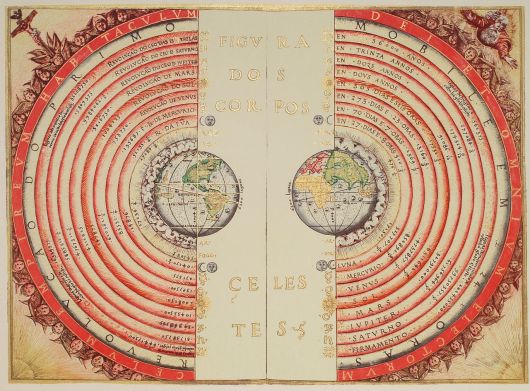
“Copernican heliocentrism is the name given to the astronomical model developed by Nicolaus Copernicus and published in 1543. It positioned the Sun near the center of the Universe, motionless, with Earth and the other planets rotating around it in circular paths modified by epicycles and at uniform speeds. The Copernican model departed from the Ptolemaic system that prevailed in Western culture for centuries, placing Earth at the center of the Universe, and is often regarded as the launching point to modern astronomy and the Scientific Revolution.”
From Wikipedia article on Galileo Galilei:
“Galileo’s championing of heliocentrism and Copernicanism was controversial within his lifetime, when most subscribed to either geocentrism or the Tychonic system. He met with opposition from astronomers, who doubted heliocentrism due to the absence of an observed stellar parallax. The matter was investigated by the Roman Inquisition in 1615, and they concluded that it could only be supported as a possibility, not as an established fact. Galileo later defended his views in Dialogue Concerning the Two Chief World Systems, which appeared to attack Pope Urban VIII and thus alienated him and the Jesuits, who had both supported Galileo up until this point. He was tried by the Inquisition, found “vehemently suspect of heresy”, forced to recant, and spent the rest of his life under house arrest.”
The geocentric viewpoint was so embedded in the minds of the 17th century scientists that the heliocentric viewpoint took a long time to be accepted. But when finally that happened it created a scientific revolution.
The prevailing viewpoint in science today can aptly be described as matter-centrism. Current science looks at space and energy through the filter of matter. The Theory of Relativity looks at light travelling relative to matter. Quantum Mechanics looks at energy as discrete “particles” in the fashion of matter.
Recently I asked the following question on Quora,
This question innocently reversed the prevailing viewpoint on relativity. It looked at matter moving relative to light instead of light moving relative to matter. Nothing else was changed. The “speed of light” remained a universal constant as before.
But the protests were immediate. “Your opening assumption is not consistent with the known physics.” “There is no such thing as the frame of reference of light.” “To say we’re traveling at the speed of light relative to a light ray is superficially true, but irrelevant.” “None of what you said makes sense. That is not how speed of light is defined.” etc.
Why can’t we consider matter moving relative to light? Did Einstein provide a reason against it? Or, did he simply never consider it?
This question put on Quora was definitely jarring, but it was not out of line. Maybe it will improve known physics if we consider matter moving relative to light. There is no reason why light cannot be used as a reference. Our minds are conditioned to using matter as the basis. But we can certainly turn that around and pursue new paths.
If we take the viewpoint that all matter is already traveling at ‘c’ relative to light, then the motion among material objects seems to occur on a different plane. It is as if light forms the bottom of a lake, matter floats on the surface of the lake relative to other matter.
The theory of relativity correctly points out that there is no material aether. That makes space itself a medium in which light appears as a disturbance. This brings about a new concept of “undisturbed space”, which replaces the concept of “void”. The universe is now seen as a disturbance spreading out into undisturbed space.
The undisturbed space appears at the lower end of the light spectrum as frequency approaches zero. Matter then appears at the higher end of the light spectrum where increasing frequency finally collapses.
This Disturbance theory presents a “light-centric” approach, which is no less valid than the “matter-centric” approach. It opens the door to a whole lot of new possibilities. It does not change the “speed of light” as a fundamental constant. That constant can now be seen as the wavelength to period ratio that does not change while frequency changes.
There is nothing unscientific or illogical about the postulates of the Disturbance theory. Its basis rests in the recognition of an assumption that current science makes unwittingly. Recognition of this matter-centric assumption opens the door to a myriads of new possibilities.
This is good for science.
.