Inertia is the resistance of any physical object to any change in its state of motion. This includes changes to the object’s speed, direction, or state of rest.
In Newton’s time all physical objects were considered to be composed of matter. The knowledge of field as a physical substance came later. Therefore, the definition of inertia may be broadened as follows: “Inertia is the resistance of any physical substance to any change in its state of motion”.
Inertia is also defined as the tendency of objects to keep moving in a straight line at a constant velocity. The principle of inertia is one of the fundamental principles in classical physics that are still used to describe the motion of objects and how they are affected by the applied forces on them.
If an object is not accelerating, it is not really moving relative to itself. Its constant velocity is fictitious because it is determined by the inertial frame of reference, which can be selected arbitrarily. So the object is pretty much where it is. The inertia resists any effort to move the physical object relative to itself.
Inertia comes from the Latin word, iners, meaning idle, sluggish. Inertia is one of the primary manifestations of mass, which is a quantitative property of physical systems. Isaac Newton defined inertia as his first law in his Philosophiæ Naturalis Principia Mathematica, which states:
“The vis insita, or innate force of matter, is a power of resisting by which every body, as much as in it lies, endeavours to preserve its present state, whether it be of rest or of moving uniformly forward in a straight line.”
There is no difference between the state of rest and the state of moving uniformly except for a different inertial frame of reference in use.
In common usage, the term “inertia” may refer to an object’s “amount of resistance to change in velocity” (which is quantified by its mass), or sometimes to its momentum, depending on the context. The term “inertia” is more properly understood as shorthand for “the principle of inertia” as described by Newton in his First Law of Motion: an object not subject to any net external force moves at a constant velocity. Thus, an object will continue moving at its current velocity until some force causes its speed or direction to change.
Inertia is the property of substance of which physical objects are made. Since Newton’s time, field has been discovered as more basic physical substance. Therefore, the property of inertia applies equally to the field. It is the frequency of field that represents its “state of motion”.
On the surface of the Earth, inertia is often masked by the effects of friction and air resistance, both of which tend to decrease the speed of moving objects (commonly to the point of rest), and gravity. This misled the philosopher Aristotle to believe that objects would move only as long as force was applied to them:
“…it [body] stops when the force which is pushing the travelling object has no longer power to push it along…”
The motion worth considering with respect to inertia is acceleration and not the uniform motion.
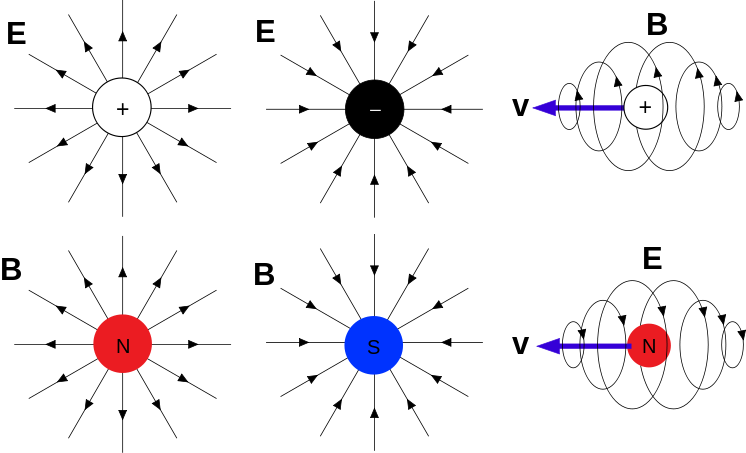
In physics, a field is a physical quantity, represented by a number or tensor, that has a value for each point in space and time. For example, on a weather map, the surface wind velocity is described by assigning a vector to each point on a map. Each vector represents the speed and direction of the movement of air at that point. As another example, an electric field can be thought of as a “condition in space” emanating from an electric charge and extending throughout the whole of space. When a test electric charge is placed in this electric field, the particle accelerates due to a force. Physicists have found the notion of a field to be of such practical utility for the analysis of forces that they have come to think of a force as due to a field. The sloppy use of language to which physicists are prone may lead to confusion in the student as to whether field here means “region” or “single point force vector” within a given region or “a set of point force vectors” within a given region or “all point force vectors” within a given region (bear in mind the fact that Gravitational and Electromagnetic Forces have ranges that are theoretically infinite).
The concept of field started out as a mathematical device to describe fluid flows at every point in space, such as on a weather map. Later it was used to describe electric and magnetic fields by their lines of forces at every point in space. Now it is being used to describe force vectors due to gravitation at every point of a theoretically infinite space.
It is only recently that the electromagnetic field has come to be looked upon as a basic substance on its own right that has dimensions. An example of such a field is light. The concept of substance as an electromagnetic field is yet to be sorted out fully. As a physical substance, this field has extensions and varying degrees of solidity. We may now divide substance into “matter” and “field”.
In the modern framework of the quantum theory of fields, even without referring to a test particle, a field occupies space, contains energy, and its presence precludes a classical “true vacuum”. This led physicists to consider electromagnetic fields to be a physical entity, making the field concept a supporting paradigm of the edifice of modern physics. “The fact that the electromagnetic field can possess momentum and energy makes it very real … a particle makes a field, and a field acts on another particle, and the field has such familiar properties as energy content and momentum, just as particles can have.” In practice, the strength of most fields has been found to diminish with distance to the point of being undetectable. For instance the strength of many relevant classical fields, such as the gravitational field in Newton’s theory of gravity or the electrostatic field in classical electromagnetism, is inversely proportional to the square of the distance from the source (i.e., they follow Gauss’s law). One consequence is that the Earth’s gravitational field quickly becomes undetectable on cosmic scales.
This brings a revolution to the concept of “space”. Space has always been conceived in the context of physical extensions. We have been measuring space as if it were rigid like matter. Now we can conceive of space differently as the extensions of the invisible “field”. A “true vacuum” may be free of substance as “matter”, but it may not be free of substance as “field”. We notice that as we see light travel through the intergalactic space. What we think of “empty space” may just be the invisible “field”. This would explain dark matter and dark energy quite nicely.
We may now explain space itself as the extensions of the field. We come to see space as a property of substance rather than as the absence of substance. We no longer see space existing in the absence of substance. It now seems absurd to talk about “matter occupying space” or “field being a condition in space”. The context of “space” is replaced by the concept of emptiness. Space is the property of extension of field that exists in emptiness. We can experience space because we can experience substance. That is how substance is defined. But we cannot experience emptiness, which is an absence of substance.
An electric field is, therefore, a condition in emptiness and not a “condition in space”. This shift in viewpoint makes “energy” of field comparable to “mass” of matter. The electric charge can now be viewed as a condensed region within the electric field and not merely a mathematical entity of a “single point force vector”. The density of the field may be defined in terms of the compactness of cycles due to higher frequencies.
Force is expressed as a gradient of momentum. In case of the field, this momentum is proportional to frequency. Therefore, force exists in a field as a gradient of frequency. Thus, forces arise due to gradients in frequency around the condensed regions of the field. “Strength” of the field diminishes as frequency gradients diminish in the field.
A field can be classified as a scalar field, a vector field, a spinor field or a tensor field according to whether the represented physical quantity is a scalar, a vector, a spinor, or a tensor, respectively. A field has a unique tensorial character in every point where it is defined: i.e. a field cannot be a scalar field somewhere and a vector field somewhere else. For example, the Newtonian gravitational field is a vector field: specifying its value at a point in spacetime requires three numbers, the components of the gravitational field vector at that point. Moreover, within each category (scalar, vector, tensor), a field can be either a classical field or a quantum field, depending on whether it is characterized by numbers or quantum operators respectively. In fact in this theory an equivalent representation of field is a field particle, namely a boson.
The classification of fields as scalar, vector, spinor, or tensor is mathematical. In reality, the primary field is electromagnetic. The secondary field is gravitational, which is made of frequency gradients.
An electromagnetic field is much more than either electric or magnetic field. An electromagnetic field consists of dynamic cycles in which electric and magnetic energies are rapidly interchanging just like kinetic and potential energies interchange during the oscillations of a pendulum. Thus we may compare electric to kinetic energy, and magnetic to potential energy. Each cycle of the electromagnetic field is composed of energy equal to the Planck’s constant ‘h’. The properties of these cycles change as they get compressed with increasing frequency. This is observed in the electromagnetic spectrum.
The cycles in the gamma region start to become so compacted that they start to display the property of mass. This part of spectrum is displayed in the structure of the atom in which the gradient of frequency (or density) rapidly increases towards the center. Quantum particles appear in rapidly condensing field like eddies appear in a rapidly moving flow. All quantum particles are manifestations of the condensed regions of the electromagnetic field in the gamma range of frequencies. The fundamental quantization occurs in terms of the energy of cycle and its frequency.
.
History
To Isaac Newton his law of universal gravitation simply expressed the gravitational force that acted between any pair of massive objects. When looking at the motion of many bodies all interacting with each other, such as the planets in the Solar System, dealing with the force between each pair of bodies separately rapidly becomes computationally inconvenient. In the eighteenth century, a new quantity was devised to simplify the bookkeeping of all these gravitational forces. This quantity, the gravitational field, gave at each point in space the total gravitational force which would be felt by an object with unit mass at that point. This did not change the physics in any way: it did not matter if all the gravitational forces on an object were calculated individually and then added together, or if all the contributions were first added together as a gravitational field and then applied to an object.
The gravitational force is more accurately defined in the context of a field. It is more than just a mathematical convenience. The gravitational force is the cumulative effect of all the gradients of field density between any two bodies.
The development of the independent concept of a field truly began in the nineteenth century with the development of the theory of electromagnetism. In the early stages, André-Marie Ampère and Charles-Augustin de Coulomb could manage with Newton-style laws that expressed the forces between pairs of electric charges or electric currents. However, it became much more natural to take the field approach and express these laws in terms of electric and magnetic fields; in 1849 Michael Faraday became the first to coin the term “field”.
The independent nature of the field became more apparent with James Clerk Maxwell’s discovery that waves in these fields propagated at a finite speed. Consequently, the forces on charges and currents no longer just depended on the positions and velocities of other charges and currents at the same time, but also on their positions and velocities in the past.
The field is naturally bound by emptiness, whose frequency is zero. The field, therefore, develops from a frequency of zero to higher frequencies in a continuous fashion. The first quantization occurs in terms of the cycles of frequency.
The field acquires different properties throughout its frequency range in the electromagnetic spectrum. The electrical properties are part of it. The forces depend on three dimensional frequency gradients rather than on linear distances. Waves in the field propagate at a finite speed because field has inertia. This inertia occurs in the form of permittivity and permeability. This inertia produces the finite characteristic of the velocity of light ‘c’.
Maxwell, at first, did not adopt the modern concept of a field as a fundamental quantity that could independently exist. Instead, he supposed that the electromagnetic field expressed the deformation of some underlying medium—the luminiferous aether—much like the tension in a rubber membrane. If that were the case, the observed velocity of the electromagnetic waves should depend upon the velocity of the observer with respect to the aether. Despite much effort, no experimental evidence of such an effect was ever found; the situation was resolved by the introduction of the special theory of relativity by Albert Einstein in 1905. This theory changed the way the viewpoints of moving observers should be related to each other in such a way that velocity of electromagnetic waves in Maxwell’s theory would be the same for all observers. By doing away with the need for a background medium, this development opened the way for physicists to start thinking about fields as truly independent entities.
An electromagnetic wave is a disturbance in the electromagnetic field in the form of a ripple. There is no other substance. Underlying this field is “emptiness”, which is complete absence of substance. At lower frequencies the field comes very close to being “no substance” with its inertia reduced to zero and its wavelength and duration expanded to infinite.
The “velocity” of light is not infinite because field has inertia. As the density of the field increases with frequency, the magnitude of this “velocity” decreases. The velocity of the quantum particles in the gamma region is a fraction of ‘c’. This velocity may be plotted against inertia of the field. This velocity approaches infinity as inertia approaches zero. This velocity is independent of the observer (the frame of reference) of the theory of relativity. The theory of relativity does not take inertia into account. It works only in those cases where the differences in inertia are extremely large, such as, between light and planetary body. The Michelson-Morley’s experiment failed only because it lacked the accuracy to compare the inertia of light to the inertia of earth.
Einstein assumed the inertia of light to be zero, but if that were the case, the velocity of light would be infinite. This inconsistency underlies the theory of relativity. We are dealing here with a range of inertia that is mind boggling.
In the late 1920s, the new rules of quantum mechanics were first applied to the electromagnetic fields. In 1927, Paul Dirac used quantum fields to successfully explain how the decay of an atom to a lower quantum state lead to the spontaneous emission of a photon, the quantum of the electromagnetic field. This was soon followed by the realization (following the work of Pascual Jordan, Eugene Wigner, Werner Heisenberg, and Wolfgang Pauli) that all particles, including electrons and protons, could be understood as the quanta of some quantum field, elevating fields to the status of the most fundamental objects in nature. That said, John Wheeler and Richard Feynman seriously considered Newton’s pre-field concept of action at a distance (although they set it aside because of the ongoing utility of the field concept for research in general relativity and quantum electrodynamics).
In atomic interactions, energy always changes in terms a certain number of frequency cycles. Therefore, such change appears to be quantized. Quanta relates to a packet of energy involved in an energy interaction among fields. All quantum particles consist of quanta.
.
Further Comments
These are the comments inspired by the rest of Wikipedia article.
Classical fields are mathematical only. They represent vector force, an idea based on the mass property of matter. The gravitational and electric fields have been looked upon as emanating from matter.
Newtonian gravitation
According to Disturbance theory mass is a very condensed region of the field in the upper gamma range. There is no emptiness between two bodies. There is only a continuation of much less dense field between them.
The distance between the two bodies is the sum of all the wavelengths of the field cycles between them. These cycles are not rigid like matter. They can also vary in their wavelengths and frequency.
The attractive force of gravitation between two bodies is the summation of all frequency gradients between them. The highest frequency gradient exists at the surface of the bodies. Newton’s law of gravitation provides an approximation of this force.
A mass particle moves as a high inertia ripple in a very low inertia field. Its natural velocity is based on the interaction of its inertia with the surrounding inertia. Inertia depends on the density of the field.
Electromagnetism
A charge particle is a condensed region of the field in lower gamma range. Its frequency gradient is also steep but less condensed compared to the gradient in the upper gamma range. Therefore, the two ends of the gradient appear to be separated as negative and positive.
The relationship between electric and magnetic energy is similar to the relationship between kinetic and potential energy.
Gravitation in general relativity
In general relativity, mass-energy warps space time. Per Disturbance theory it is the other way around. Fundamental reality is the electromagnetic field, which condenses into energy-mass. The condensation creates frequency gradients that act as force. The nature of this force differs depending on its position on the electromagnetic spectrum.
Waves as fields
Waves are part of the electromagnetic field in which they move as a three-dimensional ripple. They have finite propagation speed because of inertia intrinsic to the field. Their 3D nature results in the inverse-square law.
Quantum fields
All physical phenomena start with electromagnetic field. The electromagnetic field consists of cycles, and, therefore, it is quantized. Only when it condenses into mass that it is no longer quantized. All that changes from classical to quantum is the mathematics.
Field theory
Field theory deals with the dynamic aspects of the field.
The concept of field started out as a mathematical abstraction in fluid dynamics, but it acquired the reality of a substance in electrodynamics of Faraday. Maxwell showed light to be made up of this substance. Einstein then showed this substance to be more basic than matter.
The fundamental substance that fills emptiness is the FIELD.
It is the field that condenses as matter. The atom is mostly made up of field. The field of the atom condenses in the direction of the center. As it condenses the electrons are formed. The most condensed part is the nucleus at the center of the atom. Matter is made up of atoms.
MATTER results from the condensation of field.
The background of the sun, moon and stars that we see should more properly be called the field. The sun, moon, and stars are simply the more enduring aspects of the field. So the ‘space” among them is actually field that can transmit force. This explains the supposed “action at a distance”.
This universe is a FIELD with the background of EMPTINESS.
The field is a continuation of emptiness. Not only must it change from emptiness to become a field, but it must continue to change to maintain itself as a field. As observed, the basic field oscillates continually between electric and magnetic states to maintain itself. The fundamental property of the field is CHANGE that distinguishes it from background emptiness.
It is true that any mathematical work must have its basis in actual experimental data. I am glad that Maxwell decided to consult Faraday’s work first. Faraday’s way of conceiving phenomena was very different from other mathematicians. The main difference was in their basic postulates.
Maxwell observes that Faraday considered space to be a dimension of force, whereas the mathematicians took space for granted as something standalone. Thus, Faraday saw force as the medium, which the mathematicians didn’t. Faraday sought the seat of the phenomena in real actions going on in the medium; whereas, the mathematicians were satisfied with the idea of action at a distance.
Faraday’s approach was analytical as it was based on experiments; whereas, the approach of mathematicians was a synthesis that started out with certain assumptions. Faraday’s ideas clarified observed phenomena much better than “most fertile methods of research discovered by the mathematicians.”
According to Maxwell, the whole theory of potential as a quantity was more compatible with the ideas of Faraday and with the mathematical discoveries of Laplace, Poisson, Green and Gauss, than with the various speculations of “mathematicians”.
Maxwell decided to take the Faraday’s approach to develop a theory of electromagnetism, hoping that someone else might take up the “action at a distance” approach.
.
The contents of this preface follow. My comments follow the quoted paragraphs in bold italics.
The fact that certain bodies, after being rubbed, appear to attract other bodies, was known to the ancients. In modern times, a great variety of other phenomena have been observed, and have been found to be related to these phenomena of attraction. They have been classed under the name of Electric phenomena, amber, having been the substance in which they were first described.
Other bodies, particularly the loadstone, and pieces of iron and steel which have been subjected to certain processes, have also been long known to exhibit phenomena of action at a distance. These phenomena, with others related to them, were found to differ from the electric phenomena, and have been classed under the name of Magnetic phenomena, the loadstone, being found in the Thessalian Magnesia.
The electromagnetic attraction seems to come about because of the separation of the two sides of the particle-void interface. There is more nuclei and less motion on one side and more void and motion on the other. Void does contain substance but it is not concentrated like mass in the nucleus. Thus, there is contact with continuity of substance that passes action across a distance.
These two classes of phenomena have since been found to be related to each other, and the relations between the various phenomena of both classes, so far as they are known, constitute the science of Electromagnetism.
Electricity and magnetism are two aspects of the same phenomenon to be studied here.
In the following Treatise I propose to describe the most important of these phenomena, to shew how they may be subjected to measurement, and to trace the mathematical connexions of the quantities measured. Having thus obtained the data for a mathematical theory of electromagnetism, and having shewn how this theory may be applied to the calculation of phenomena, I shall endeavour to place in as clear a light as I can the relations between the mathematical form of this theory and that of the fundamental science of Dynamics, in order that we may be in some degree prepared to determine the kind of dynamical phenomena among which we are to look for illustrations or explanations of the electromagnetic phenomena.
Maxwell intends to keep his mathematical analysis of the electromagnetic phenomenon consistent with Newtonian mechanics, such that all effects are measurable in a consistent fashion.
In describing the phenomena, I shall select those which most clearly illustrate the fundamental ideas of the theory, omitting others, or reserving them till the reader is more advanced.
The most important aspect of any phenomenon from a mathematical point of view is that of a measurable quantity. I shall therefore consider electrical phenomena chiefly with a view to their measurement, describing the methods of measurement, and defining the standards on which they depend.
In the application of mathematics to the calculation of electrical quantities, I shall endeavour in the first place to deduce the most general conclusions from the data at our disposal, and in the next place to apply the results to the simplest cases that can be chosen. I shall avoid, as much as I can, those questions which, though they have elicited the skill of mathematicians, have not enlarged our knowledge of science.
In working out his theory, Maxwell decides to focus on electrical phenomena chiefly with a view to their measurement, describing the methods of measurement, and defining the standards on which they depend.
The internal relations of the different branches of the science which we have to study are more numerous and complex than those of any other science hitherto developed. Its external relations, on the one hand to dynamics, and on the other to heat, light, chemical action, and the constitution of bodies, seem to indicate the special importance of electrical science as an aid to the interpretation of nature.
It appears to me, therefore, that the study of electromagnetism in all its extent has now become of the first importance as a means of promoting the progress of science.
The mathematical laws of the different classes of phenomena have been to a great extent satisfactorily made out.
The connexions between the different classes of phenomena have also been investigated, and the probability of the rigorous exactness of the experimental laws have been greatly strengthened by a more extended knowledge of their relations to each other.
Finally, some progress has been made in the reduction of electromagnetism to a dynamical science, by shewing that no electromagnetic phenomenon is contradictory to the supposition that it depends on purely dynamical action.
Maxwell is looking at the resolution of electromagnetic phenomena according to Newtonian dynamics to be central to the progress of science.
What has been hitherto done, however, has by no means exhausted the field of electrical research. It has rather opened up that field, by pointing out subjects of enquiry, and furnishing us with means of investigation.
It is hardly necessary to enlarge upon the beneficial results of magnetic research on navigation, and the importance of a knowledge of the true direction of the compass, and of the effect of the iron in a ship. But the labours of those who have endeavoured to render navigation more secure by means of magnetic observations have at the same time greatly advanced the progress of pure science.
Gauss, as a member of the German Magnetic Union, brought his powerful intellect to bear on the theory of magnetism, and on the methods of observing it, and he not only added greatly to our knowledge of the theory of attractions, but reconstructed the whole of magnetic science as regards the instruments used, the methods of observation, and the calculation of the results, so that his memoirs on Terrestrial Magnetism may be taken as models of physical research by all those who are engaged in the measurement of any of the forces in nature.
The important applications of electromagnetism to telegraphy have also reacted on pure science by giving a commercial value to accurate electrical measurements, and by affording to electricians the use of apparatus on a scale which greatly transcends that of any ordinary laboratory. The consequences of this demand for electrical knowledge, and of these experimental opportunities for acquiring it, have been already very great, both in stimulating the energies of advanced electricians, and in diffusing among practical men a degree of accurate knowledge which is likely to conduce to the general scientific progress of the whole engineering profession.
Maxwell is acknowledging the work done in the field of electromagnetism so far.
There are several treatises in which electrical and magnetic phenomena are described in a popular way. These, however, are not what is wanted by those who have been brought face to face with quantities to be measured, and whose minds do not rest satisfied with lecture-room experiments.
There is also a considerable mass of mathematical memoirs which are of great importance in electrical science, but they lie concealed in the bulky Transactions of learned societies; they do not form a connected system; they are of very unequal merit, and they are for the most part beyond the comprehension of any but professed mathematicians.
I have therefore thought that a treatise would be useful which should have for its principal object to take up the whole subject in a methodical manner, and which should also indicate how each part of the subject is brought within the reach of methods of verification by actual measurement.
Maxwell feels that there is a need for a treatise that examines the subject of electromagnetism quantitatively in a methodical manner.
The general complexion of the treatise differs considerably from that of several excellent electrical works, published, most of them, in Germany, and it may appear that scant justice is done to the speculations of several eminent electricians and mathematicians. One reason of this is that before I began the study of electricity I resolved to read no mathematics on the subject till I had first read through Faraday’s Experimental Researches in Electricity. I was aware that there was supposed to be a difference between Faraday’s way of conceiving phenomena and that of the mathematicians, so that neither he nor they were satisfied with each other’s language. I had also the conviction that this discrepancy did not arise from either party being wrong. I was first convinced of this by Sir William Thomson *, to whose advice and assistance, as well as to his published papers, I owe most of what I have learned on the subject.
* I take this opportunity of acknowledging my obligations to Sir W. Thomson and to Professor Tait for many valuable suggestions made during the printing of this work.
Maxwell decides to base his mathematical research on Faraday’s experimental work, because it is quite different from the theoretical approach of other mathematicians as regards their basic postulates.
As I proceeded with the study of Faraday, I perceived that his method of conceiving the phenomena was also a mathematical one, though not exhibited in the conventional form of mathematical symbols. I also found that these methods were capable of being expressed in the ordinary mathematical forms, and thus compared with those of the professed mathematicians.
For instance, Faraday, in his mind’s eye, saw lines of force traversing all space where the mathematicians saw centres of force attracting at a distance: Faraday saw a medium where they saw nothing but distance: Faraday sought the seat of the phenomena in real actions going on in the medium, they were satisfied that they had found it in a power of action at a distance impressed on the electric fluids.
Maxwell found that Faraday’s work could easily be treated mathematically. It was more practical and corresponded to reality closely.
When I had translated what I considered to be Faraday’s ideas into a mathematical form, I found that in general the results of the two methods coincided, so that the same phenomena were accounted for, and the same laws of action deduced by both methods, but that Faraday’s methods resembled those in which we begin with the whole and arrive at the parts by analysis, while the ordinary mathematical methods were founded on the principle of beginning with the parts and building up the whole by synthesis.
Faraday’s approach was analytical as it was based on experiments; whereas, the approach of mathematicians was a synthesis that started out with certain assumptions.
I also found that several of the most fertile methods of research discovered by the mathematicians could be expressed much better in terms of ideas derived from Faraday than in their original form.
Faraday’s ideas clarified observed phenomena much better.
The whole theory, for instance, of the potential, considered as a quantity which satisfies a certain partial differential equation, belongs essentially to the method which I have called that of Faraday. According to the other method, the potential, if it is to be considered at all, must be regarded as the result of a summation of the electrified particles divided each by its distance from a given point. Hence many of the mathematical discoveries of Laplace, Poisson, Green and Gauss find their proper place in this treatise, and their appropriate expressions in terms of conceptions mainly derived from Faraday.
Faraday’s ideas are very compatible with the mathematical discoveries of Laplace, Poisson, Green and Gauss, and with the theory of potential that satisfies a certain partial differential equation.
Great progress has been made in electrical science, chiefly in Germany, by cultivators of the theory of action at a distance. The valuable electrical measurements of W. Weber are interpreted by him according to this theory, and the electromagnetic speculation which was originated by Gauss, and carried on by Weber, Eiemann, J. and C. Neumann, Lorenz, &c., is founded on the theory of action at a distance, but depending either directly on the relative velocity of the particles, or on the gradual propagation of something, whether potential or force, from the one particle to the other. The great success which these eminent men have attained in the application of mathematics to electrical phenomena, gives, as is natural, additional weight to their theoretical speculations, so that those who, as students of electricity, turn to them as the greatest authorities in mathematical electricity, would probably imbibe, along with their mathematical methods, their physical hypotheses.
Maxwell acknowledges that mathematics based on the action at a distance approach has been quite successful, but it doesn’t resolve the question of how force propagates through the void.
These physical hypotheses, however, are entirely alien from the way of looking at things which I adopt, and one object which I have in view is that some of those who wish to study electricity may, by reading this treatise, come to see that there is another way of treating the subject, which is no less fitted to explain the phenomena, and which, though in some parts it may appear less definite, corresponds, as I think, more faithfully with our actual knowledge, both in what it affirms and in what it leaves undecided.
Maxwell, however, believes that there is another way of looking at the phenomena that corresponds more faithfully with our actual knowledge.
In a philosophical point of view, moreover, it is exceedingly important that two methods should be compared, both of which have succeeded in explaining the principal electromagnetic phenomena, and both of which have attempted to explain the propagation of light as an electromagnetic phenomenon and have actually calculated its velocity, while at the same time the fundamental conceptions of what actually takes place, as well as most of the secondary conceptions of the quantities concerned, are radically different.
Both approaches have succeeded in explaining the principal electromagnetic phenomena but their fundamental conceptions of what actually takes place are radically different.
I have therefore taken the part of an advocate rather than that of a judge, and have rather exemplified one method than attempted to give an impartial description of both. I have no doubt that the method which I have called the German one will also find its supporters, and will be expounded with a skill worthy of its ingenuity.
I have not attempted an exhaustive account of electrical phenomena, experiments, and apparatus. The student who desires to read all that is known on these subjects will find great assistance from the Traite d’ Electricite of Professor A. de la Rive, and from several German treatises, such as Wiedemann’s Galvanismus, Riess’ Reibungselektricitat, Beer’s Einleitung in die Elektrostatik, &c.
Maxwell decides to take the Faraday’s approach to develop a theory of electromagnetism, and focuses primarily on the theoretical aspects of the phenomena.
I have confined myself almost entirely to the mathematical treatment of the subject, but I would recommend the student, after he has learned, experimentally if possible, what are the phenomena to be observed, to read carefully Faraday’s Experimental Researches in Electricity. He will there find a strictly contemporary historical account of some of the greatest electrical discoveries and investigations, carried on in an order and succession which could hardly have been improved if the results had been known from the first, and expressed in the language of a man who devoted much of his attention to the methods of accurately describing scientific operations and their results*.
* Life and Letters of Faraday, vol. i. p. 395.
Maxwell is very approving of Faraday’s long and arduous experimental research for its accuracy and attention to detail.
It is of great advantage to the student of any subject to read the original memoirs on that subject, for science is always most completely assimilated when it is in the nascent state, and in the case of Faraday’s Researches this is comparatively easy, as they are published in a separate form, and may be read consecutively. If by anything I have here written I may assist any student in understanding Faraday’s modes of thought and expression, I shall regard it as the accomplishment of one of my principal aims–to communicate to others the same delight which I have found myself in reading Faraday’s Researches.
Maxwell heartily recommends the study of Faraday’s research work.
The description of the phenomena, and the elementary parts of the theory of each subject, will be found in the earlier chapters of each of the four Parts into which this treatise is divided. The student will find in these chapters enough to give him an elementary acquaintance with the whole science.
The remaining chapters of each Part are occupied with the higher parts of the theory, the processes of numerical calculation, and the instruments and methods of experimental research.
The relations between electromagnetic phenomena and those of radiation, the theory of molecular electric currents, and the results of speculation on the nature of action at a distance, are treated of in the last four chapters of the second volume.
In this lecture Faraday presents the concept of conservation of force. To him, Force is the cause of a physical action, and not just the tendency of the body to pass from one place to another. Force is the source or sources of all possible changes amongst the particles or materials of the universe. To Faraday force is an indicator of the substantialness of substance, much like inertia.
These ideas were opposed by many scientists of his time, who viewed Faraday’s ideas to contradict Newton’s. But Faraday believed that he was expanding upon Newton’s ideas to address the dilemma of action at a distance. Action at a distance was troublesome to Newton as well.
Faraday was an experimentalist. He did not have deep knowledge of mathematics, and could not verify his conclusions accordingly. Therefore he was criticized by other scientists. But Faraday did not think that he had any less capability for perceiving the nature and power of a natural principle of action.
Extensive and painstaking experiments had led Faraday to implicitly trust the principle of conservation of force. This principle went beyond the conservation of energy, mass and momentum put together, as it meant the conservation of the very substance underlying all forms. To him there was no absolute destruction or creation of such force of substance.
Faraday saw consistency in all forms of physical power, whether it was static electricity, electric current, magnetism, chemical action, or heat. Therefore, consistency was expected between gravitation and any of these forms of force. Faraday believed that bodies affecting each other by gravitation acted by lines of force of definite amount (somewhat in the manner of magnetic or electric induction but without polarity).
In Faraday’s view, the principle of conservation of force (in its broadest sense of inertia) could greatly aid experimental philosophers in the enunciation of problems to be solved.
.
The contents of Faraday’s talk follow. My comments follow the paragraphs in bold color italics.
Various circumstances induce me at the present moment to put forth a consideration regarding the conservation of force. I do not suppose that I can utter any truth respecting it that has not already presented itself to the high and piercing intellects which move within the exalted regions of science; but the course of my own investigations and views makes me think that the consideration may be of service to those persevering labourers (amongst whom I endeavour to class myself), who, occupied in the comparison of physical ideas with fundamental principles, and continually sustaining and aiding themselves by experiment and observation, delight to labour for the advance of natural knowledge, and strive to follow it into undiscovered regions.
There is continuity of substance from neutron to proton to electron to light. Faraday sees this continuity as lines of force that are centered at, let’s say, neutrons. These lines of force represent the substance. The overall force is conserved. Faraday’s concept of force includes both mass and energy. Therefore, it is different from Newton’s concept of force.
There is no question which lies closer to the root of all physical knowledge, than that which inquires whether force can be destroyed or not. The progress of the strict science of modern times has tended more and more to produce the conviction that “force can neither be created nor destroyed,” and to render daily more manifest the value of the knowledge of that truth in experimental research. To admit, indeed, that force may be destructible or can altogether disappear, would be to admit that matter could be uncreated; for we know matter only by its forces: and though one of these is most commonly referred to, namely gravity, to prove its presence, it is not because gravity has any pretension, or any exemption amongst the forms of force, as regards the principle of conservation; but simply that being, as far as we perceive, inconvertible in its nature and unchangeable in its manifestation, it offers an unchanging test of the matter which we recognize by it.
The force of gravity is one of these forces. Gravity is most commonly referred to prove the presence of matter because it isinconvertible in its nature and unchangeable in its manifestation. It offers an unchanging test of the matter which we recognize by it.
Agreeing with those who admit the conservation of force to be a principle in physics as large and sure as that of the indestructibility of matter, or the invariability of gravity, I think that no particular idea of force has a right to unlimited or unqualified acceptance, that does not include assent to it; and also, to definite amount and definite disposition of the force, either in one effect or another, for these are necessary consequences: therefore, I urge, that the conservation of force ought to be admitted as a physical principle in all our hypotheses, whether partial or general, regarding the actions of matter.
The conservation of force ought to be admitted as a physical principle in all our hypotheses, whether partial or general, regarding the actions of matter.
I have had doubts in my own mind whether the considerations I am about to advance are not rather metaphysical than physical. I am unable to define what is metaphysical in physical science; and am exceedingly adverse to the easy and unconsidered admission of one supposition upon another, suggested as they often are by very imperfect induction from a small number of facts, or by a very imperfect observation of the facts themselves: but, on the other hand, I think the philosopher may be bold in his application of principles which have been developed by close inquiry, have stood through much investigation, and continually increase in force.
The philosopher may be bold in his application of principles which have been developed by close inquiry, have stood through much investigation, and continually increase in force.
For instance, time is growing up daily into importance as an element in the exercise of force. The earth moves in its orbit in time; the crust of the earth moves in time; light moves in time; an electro-magnet requires time for its charge by an electric current: to inquire, therefore, whether power, acting either at sensible or insensible distances, always acts in time, is not to be metaphysical; if it acts in time and across space, it must act by physical lines of force; and our view of the nature of the force may be affected to the extremest degree by the conclusions, which experiment and observation on time may supply; being, perhaps, finally determinable only by them. To inquire after the possible time in which gravitating, magnetic, or electric force is exerted, is no more metaphysical than to mark the times of the hands of a clock in their progress; or that of the temple of Serapis in its ascents and descents; or the periods of the occultations of Jupiter’s satellites; or that in which the light from them comes to the earth.
If power acts in time and across space it must act by physical lines of force (continuity of substance). To inquire after the possible time in which gravitating, magnetic, or electric force is exerted, is no more metaphysical than to mark the times of the hands of a clock in their progress.
Again, in some of the known cases of action in time, something happens whilst the time is passing which did not happen before, and does not continue after: it is therefore not metaphysical to expect an effect in every case, or to endeavour to discover its existence and determine its nature. So in regard to the principle of the conservation of force; I do not think that to admit it, and its consequences, whatever they may be, is to be metaphysical: on the contrary, if that word have any application to physics, then I think that any hypothesis, whether of heat, or electricity, or gravitation, or any other form of force, which either wittingly or unwittingly dispenses with the principle of conservation, is more liable to the charge, than those which, by including it, become so far more strict and precise.
Any hypothesis, whether of heat, or electricity, or gravitation, or any other form of force, which either wittingly or unwittingly dispenses with the principle of conservation, is more liable to the charge of being metaphysical.
Supposing that the truth of the principle of the conservation of force is assented to, I come to its uses. No hypothesis should be admitted nor any assertion of a fact credited, that denies the principle. No view should be inconsistent or incompatible with it. Many of our hypotheses in the present state of science may not comprehend it, and may be unable to suggest its consequences; but none should oppose or contradict it.
No hypothesis should be admitted nor any assertion of a fact credited, that denies the principle of the conservation of force.
If the principle be admitted, we perceive at once, that a theory or definition, though it may not contradict the principle cannot be accepted as sufficient or complete unless the former be contained in it; that however well or perfectly the definition may include and represent the state of things commonly considered under it, that state or result is only partial, and must not be accepted as exhausting the power or being the full equivalent, and therefore cannot be considered as representing its whole nature; that, indeed, it may express only a very small part of the whole, only a residual phenomenon, and hence give us but little indication of the full natural truth. Allowing the principle its force, we ought, in every hypothesis; either to account for its consequences by saying what the changes are when force of a given kind apparently disappears, as when ice thaws, or else should leave space for the idea of the conversion. If any hypothesis, more or less trustworthy on other accounts, is insufficient in expressing it or incompatible with it, the place of deficiency or opposition should be marked as the most important for examination; for there lies the hope of a discovery of new laws or a new condition of force. The deficiency should never be accepted as satisfactory, but be remembered and used as a stimulant to further inquiry; for conversions of force may here be hoped for. Suppositions may be accepted for the time, provided they are not in contradiction with the principle. Even an increased or diminished capacity is better than nothing at all; because such a supposition, if made, must be consistent with the nature of the original hypothesis, and may, therefore, by the application of experiment, be converted into a further test of probable truth. The case of a force simply removed or suspended, without a transferred exertion in some other direction, appears to me to be absolutely impossible.
If any hypothesis, more or less trustworthy on other accounts, is insufficient in expressing the conservation of force or incompatible with it, the place of deficiency or opposition should be marked as the most important for examination; for there lies the hope of a discovery of new laws or a new condition of force.
If the principle be accepted as true, we have a right to pursue it to its consequences, no matter what they may be. It is, indeed, a duty to do so. A theory may be perfection, as far as it goes, but a consideration going beyond it, is not for that reason to be shut out. We might as well accept our limited horizon as the limits of the world. No magnitude, either of the phenomena or of the results to be dealt with, should stop our exertions to ascertain, by the use of the principle, that something remains to be discovered, and to trace in what direction that discovery may lie.
No magnitude, either of the phenomena or of the results to be dealt with, should stop our exertions to ascertain, by the use of the principle, that something remains to be discovered, and to trace in what direction that discovery may lie.
I will endeavour to illustrate some of the points which have been urged, by reference, in the first instance, to a case of power, which has long had great attractions for me, because of its extreme simplicity, its promising nature, its universal presence, and its invariability under like circumstances; on which, though I have experimented and as yet failed, I think experiment would be well bestowed: I mean the force of gravitation. I believe I represent the received idea of the gravitating force aright, in saying, that it is a simple attractive force exerted between any two or all the particles or masses of matter, at every sensible distance, but with a strength varying inversely as the square of the distance. The usual idea of the force implies direct action at a distance; and such a view appears to present little difficulty except to Newton, and a few, including myself, who in that respect, may be of like mind with him.
Gravitating force is defined as a simple attractive force exerted between any two or all the particles or masses of matter, at every sensible distance, but with a strength varying inversely as the square of the distance. This idea of direct action at a distance is troublesome.
This idea of gravity appears to me to ignore entirely the principle of the conservation of force; and by the terms of its definition, if taken in an absolute sense “varying inversely as the square of the distance” to be in direct opposition to it; and it becomes my duty, now, to point out where this contradiction occurs, and to use it in illustration of the principle of conservation. Assume two particles of matter A and B, in free space, and a force in each or in both by which they gravitate towards each other, the force being unalterable for an unchanging distance, but varying inversely as the square of the distance when the latter varies. Then, at the distance of 10 the force may be estimated as 1; whilst at the distance of 1, i.e. one-tenth of the former, the force will be 100: and if we suppose an elastic spring to be introduced between the two as a measure of the attractive force, the power compressing it will be a hundred times as much in the latter case as in the former. But from whence can this enormous increase of the power come? If we say that it is the character of this force, and content ourselves with that as a sufficient answer, then it appears to me, we admit a creation of power, and that to an enormous amount; yet by a change of condition, so small and simple, as to fail in leading the least instructed mind to think that it can be a sufficient cause:—we should admit a result which would equal the highest act our minds can appreciate of the working of infinite power upon matter; we should let loose the highest law in physical science which our faculties permit us to perceive, namely, the conservation of force. Suppose the two particles A and B removed back to the greater distance of 10, then the force of attraction would be only a hundredth part of that they previously possessed; this, according to the statement that the force varies inversely as the square of the distance would double the strangeness of the above results; it would be an annihilation of force ; an effect equal in its infinity and its consequences with creation, and only within the power of Him who has created.
This idea of gravity appears to ignore the principle of the conservation of force; and the statement “varying inversely as the square of the distance” seems to be in direct opposition to it. It assumes a force in the body by which it gravitates towards another body. This force varies with the distance between the bodies. It means “creation of tremendous power” with lessening of distance, and “annihilation of power” with increasing distance.
We have a right to view gravitation under every form that either its definition or its effects can suggest to the mind; it is our privilege to do so with every force in nature; and it is only by so doing, that we have succeeded, to a large extent, in relating the various forms of power, so as to derive one from another, and thereby obtain confirmatory evidence of the great principle of the conservation of force. Then let us consider the two particles A and B as attracting each other by the force of gravitation, under another view. According to the definition, the force depends upon both particles, and if the particle A or B were by itself, it could not gravitate, i.e. it could have no attraction, no force of gravity. Supposing A to exist in that isolated state and without gravitating force, and then B placed in relation to it, gravitation comes on, as is supposed, on the part of both. Now, without trying to imagine how B, which had no gravitating force, can raise up gravitating force in A; and how A, equally without force beforehand can raise up force in B, still, to imagine it as a fact done, is to admit a creation of force in both particles; and so to bring ourselves within the impossible consequences which have already been referred to.
From another view, the force of gravity depends on two particles. A particle cannot gravitate by itself. How does the force of gravity arise just because of the presence of another particle?
It may be said we cannot have an idea of one particle by itself, and so the reasoning fails. For my part I can comprehend a particle by itself just as easily as many particles; and though I cannot conceive the relation of a lone particle to gravitation, according to the limited view which is at present taken of that force, I can conceive its relation to something which causes gravitation, and with which, whether the particle is alone, or one of a universe of other particles, it is always related. But the reasoning upon a lone particle does not fail; for as the particles can be separated, we can easily conceive of the particle B being removed to an infinite distance from A, and then the power in A will be infinitely diminished. Such removal of B will be as if it were annihilated in regard to A, and the force in A will be annihilated at the same time: so that the case of a lone particle and that where different distances only are considered become one, being identical with each other in their consequences. And as removal of B to an infinite distance is as regards A annihilation of B, so removal to the smallest degree is, in principle, the same thing with displacement through infinite space: the smallest increase in distance involves annihilation of power; the annihilation of the second particle, so as to have A alone, involves no other consequence in relation to gravity; there is difference in degree, but no difference in the character of the result.
When two particles move away from each other to infinite distance, their power annihilate by degrees until it completely disappears.
It seems hardly necessary to observe, that the same line of thought grows up in the mind if we consider the mutual gravitating action of one particle and many. The particle A will attract the particle B at the distance of a mile with a certain degree of force ; it will attract a particle C at the same distance of a mile with a power equal to that by which it attracts B; if myriads of like particles be placed at the given distance of a mile, A will attract each with equal force ; and if other particles be accumulated round it, within and without the sphere of two miles diameter, it will attract them all with a force varying inversely with the square of the distance. How are we to conceive of this force growing up in A to a million fold or more? and if the surrounding particles be then removed, of its diminution in an equal degree? Or, how are we to look upon the power raised up in all these outer particles by the action of A on them, or by their action one on another, without admitting, according to the limited definition of gravitation, the facile generation and annihilation of force?
With the limited definition of gravitation we have to admit to the facile generation and annihilation of power.
The assumption which we make for the time with regard to the nature of a power (as gravity, heat, &c.), and the form of words in which we express it, i.e, its definition, should be consistent with the fundamental principles of force generally. The conservation of force is a fundamental principle; hence the assumption with regard to a particular form of force, ought to imply what becomes of the force when its action is increased or diminished, or its direction changed; or else the assumption should admit that it is deficient on that point, being only half competent to represent the force; and, in any case, should not be opposed to the principle of conservation. The usual definition of gravity as an attractive force between the particles of matter VARYING inversely as the square of the distance, whilst it stands as a full definition of the power, is inconsistent with the principle of the conservation of force. If we accept the principle, such a definition must be an imperfect account of the whole of the force, and is probably only a description of one exercise of that power, whatever the nature of the force itself may be. If the definition be accepted as tacitly including the conservation of force, then it ought to admit, that consequences must occur during the suspended or diminished degree of its power as gravitation, equal in importance to the power suspended or hidden; being in fact equivalent to that diminution. It ought also to admit, that it is incompetent to suggest or deal with any of the consequences of that changed part or condition of the force, and cannot tell whether they depend on, or are related to, conditions external or internal to the gravitating particle; and, as it appears to me, can say neither yes nor no to any of the arguments or probabilities belonging to the subject.
The current definition of gravity is an imperfect account of the whole of the force. It does not tell us about the nature of the force. During the diminishing of the power of gravitation, equivalent consequences must occur. Such consequences may be related to conditions external or internal to the gravitating particle.
If the definition denies the occurrence of such contingent results, it seems to me to be unphilosophical; if it simply ignores them, I think it is imperfect and insufficient; if it admits these things, or any part of them, then it prepares the natural philosopher to look for effects and conditions as yet unknown, and is open to any degree of development of the consequences and relations of power: by denying, it opposes a dogmatic barrier to improvement; by ignoring, it becomes in many respects an inert thing, often much in the way; by admitting, it rises to the dignity of a stimulus to investigation, a pilot to human science.
By admitting to its limitation, the current idea of gravity would stimulate further scientific investigation for effects and conditions as yet unknown.
The principle of the conservation of force would lead us to assume, that when A and B attract each other less because of increasing distance, then some other exertion of power, either within or without them, is proportionately growing up; and again, that when their distance is diminished, as from 10 to 1, the power of attraction, now increased a hundred-fold, has been produced out of some other form of power which has been equivalently reduced. This enlarged assumption of the nature of gravity is not more metaphysical than the half assumption; and is, I believe, more philosophical, and more in accordance with all physical considerations. The half assumption is, in my view of the matter, more dogmatic and irrational than the whole, because it leaves it to be understood, that power can be created and destroyed almost at pleasure.
When gravitational attraction is changing because of change in distance, then some other exertion of power, either within or without the particles, must also be changing proportionately.
When the equivalents of the various forms of force, as far as they are known, are considered, their differences appear very great; thus, a grain of water is known to have electric relations equivalent to a very powerful flash of lightning. It may therefore be supposed that a very large apparent amount of the force causing the phenomena of gravitation may be the equivalent of a very small change in some unknown condition of the bodies, whose attraction is varying by change of distance. For my own part, many considerations urge my mind toward the idea of a cause of gravity, which is not resident in the particles of matter merely, but constantly in them, and all space. I have already put forth considerations regarding gravity which partake of this idea, and it seems to have been unhesitatingly accepted by Newton.
It may be supposed that a very large apparent amount of the force causing the phenomena of gravitation may be the equivalent of a very small change in some unknown condition of the bodies, whose attraction is varying by change of distance.
There is one wonderful condition of matter, perhaps its only true indication, namely inertia; but in relation to the ordinary definition of gravity, it only adds to the difficulty. For if we consider two particles of matter at a certain distance apart, attracting each other under the power of gravity and free to approach, they will approach; and when at only half the distance each will have had stored up in it, because of its inertia, a certain amount of mechanical force. This must be due to the force exerted, and, if the conservation principle be true, must have consumed an equivalent proportion of the cause of attraction; and yet, according to the definition of gravity, the attractive force is not diminished thereby, but increased four-fold, the force growing up within itself the more rapidly, the more it is occupied in producing other force. On the other hand, if mechanical force from without be used to separate the particles to twice their distance, this force is not stored up in momentum or by inertia, but disappears; and three-fourths of the attractive force at the first distance disappears with it: How can this be?
There appears to be an anomaly of gravitational force with respect to the concept of inertia.
In Faraday’s example, two particle’s can maintain a certain distance between them only when they are moving with a certain velocity about each other. In that case the centripetal force shall balance the force of gravitational attraction. The natural motion is tied to the consistency of the particle. If the motion increases the consistency must decrease and vice versa. Looks like the general concept of consistency is similar to the concept of inertia in matter. A slight change in inertia shall create a very large change in the natural motion of a mass particle. It appears to me that as the force of gravitation increases when the mass particles come closer to each other, their consistency must convert into inertia and motion.
We know not the physical condition or action from which inertia results; but inertia is always a pure case of the conservation of force. It has a strict relation to gravity, as appears by the proportionate amount of force which gravity can communicate to the inert body; but it appears to have the same strict relation to other forces acting at a distance as those of magnetism or electricity, when they are so applied by the tangential balance as to act independent of the gravitating force. It has the like strict relation to force communicated by impact, pull, or in any other way. It enables a body to take up and conserve a given amount of force until that force is transferred to other bodies, or changed into an equivalent of some other form; that is all that we perceive in it: and we cannot find a more striking instance amongst natural, or possible, phenomena of the necessity of the conservation of force as a law of nature; or one more in contrast with the assumed variable condition of the gravitating force supposed to reside in the particles of matter.
Inertia results from the consistency of substance. The higher is the consistency of substance, the greater is the inertia and the lesser is its natural motion. Inertia balances the acceleration. This results in a constant natural motion for the particle along a curvature.
Even gravity itself furnishes the strictest proof of the conservation of force in this, that its power is unchangeable for the same distance; and is by that in striking contrast with the variation which we assume in regard to the cause of gravity, to account for the results at different distances.
When inertia is smaller the constant speed is higher.
It will not be imagined for a moment that I am opposed to what may be called the law of gravitating action, that is, the law by which all the known effects of gravity are governed; what I am considering, is the definition of the force of gravitation. That the result of one exercise of a power may be inversely as the square of the distance, I believe and admit; and I know that it is so in the case of gravity, and has been verified to an extent that could hardly have been within the conception even of Newton himself when he gave utterance to the law: but that the totality of a force can be employed according to that law I do not believe, either in relation to gravitation, or electricity, or magnetism, or any other supposed form of power.
Only an aspect of the force of gravitation, and not the totality of it, follows the law of inverse squares.
I might have drawn reasons for urging a continual recollection of, and reference to, the principle of the conservation of force from other forms of power than that of gravitation; but I think that when founded on gravitating phenomena, they appear in their greatest simplicity; and precisely for this reason, that gravitation has not yet been connected by any degree of convertibility with the other forms of force. If I refer for a few minutes to these other forms, it is only to point in their variations, to the proofs of the value of the principle laid down, the consistency of the known phenomena with it, and the suggestions of research and discovery which arise from it. Heat, for instance, is a mighty form of power, and its effects have been greatly developed; therefore, assumptions regarding its nature become useful and necessary, and philosophers try to define it. The most probable assumption is, that it is a motion of the particles of matter; but a view, at one time very popular, is, that it consists of a particular fluid of heat. Whether it be viewed in one way or the other, the principle of conservation is admitted, I believe, with all its force. When transferred from one portion to another portion of like matter the full amount of heat appears. When transferred to matter of another kind an apparent excess or deficiency often results; the word “capacity” is then introduced, which, whilst it acknowledges the principle of conservation, leaves space for research. When employed in changing the state of bodies, the appearance and disappearance of the heat is provided for consistently by the assumption of enlarged or diminished motion, or else space is left by the term “capacity” for the partial views; which remains to be developed. When converted into mechanical force, in the steam or air-engine, and so brought into direct contact with gravity, being then easily placed in relation to it, still the conservation of force is fully respected and wonderfully sustained. The constant amount of heat developed in the whole of a voltaic current described by M. P. A. Favre, and the present state of the knowledge of thermo-electricity, are again fine partial or subordinate illustrations of the principle of conservation. Even when rendered radiant, and for the time giving no trace or signs of ordinary heat action, the assumptions regarding its nature have provided for the belief in the conservation of force, by admitting, either that it throws the ether into an equivalent state, in sustaining which for the time the power is engaged; or else, that the motion of the particles of heat is employed altogether in their own transit from place to place.
There is no convertibility from gravitation to other forces because it is the simplest case. Heat exists in the motion of particles of matter. A concept of ‘capacity’ is used when heat is transferred to unlike matter. This leaves space for research. Heat converting change in state of bodies or into mechanical force also needs further research. Thermo-electricity and black-body radiation is also partially understood.
It is true that heat often becomes evident or insensible in a manner unknown to us; and we have a right to ask what is happening when the heat disappears in one part, as of the thermo-voltaic current, and appears in another; or when it enlarges or changes the state of bodies; or what would happen, if the heat, being presented, such changes were purposely opposed. We have a right to ask these questions, but not to ignore or deny the conservation of force; and one of the highest uses of the principle is to suggest such inquiries. Explications of similar points are continually produced, and will be most abundant from the hands of those who, not desiring to ease their labour by forgetting the principle, are ready to admit it either tacitly, or better still, effectively, being then continually guided by it. Such philosophers believe that heat must do its equivalent of work: that if in doing work it seem to disappear, it is still producing its equivalent effect, though often in a manner partially or totally unknown; and that if it give rise to another form of force (as we imperfectly express it), that force is equivalent in power to the heat which has disappeared.
Many aspects of heat appearing and disappearing along with other changes are not fully explored. Such enquiries are suggested by the principle of conservation of force.
What is called chemical attraction, affords equally instructive and suggestive considerations in relation to the principle of the conservation of force. The indestructibility of individual matter, is one case, and a most important one, of the conservation of chemical force. A molecule has been endowed with powers which give rise in it to various qualities, and these never change, either in their nature or amount. A particle of oxygen is ever a particle of oxygen—nothing can in the least wear it. If it enters into combination and disappears as oxygen,—if it pass through a thousand combinations, animal, vegetable, mineral,—if it lie hid for a thousand years and then be evolved, it is oxygen with its first qualities, neither more nor less. It has all its original force, and only that; the amount of force which it disengaged when hiding itself, has again to be employed in a reverse direction when it is set at liberty; and if, hereafter, we should decompose oxygen, and find it compounded of other particles, we should only increase the strength of the proof of the conservation of force, for we should have a right to say of these particles, long as they have been hidden, all that we could say of the oxygen itself.
Further exploration of chemical attraction is also suggested by the principle of the conservation of force. There exists conservation of chemical force. The atomic structure of elements is conserved within the various molecules.
Again, the body of facts included in the theory of definite proportions, witnesses to the truth of the conservation of force; and though we know little of the cause of the change of properties of the acting and produced bodies, or how the forces of the former are hid amongst those of the latter, we do not for an instant doubt the conservation, but are moved to look for the manner in which the forces are, for the time, disposed, or if they have taken up another form of force, to search what that form may be.
At the time of Faraday, the words ‘force’ and ‘energy’ were used interchangeably. In either case, Faraday is taking the word ‘force’ to far greater depth, which can only be expressed as ‘substance’ and all its properties.
Even chemical action at a distance, which is in such antithetical contrast with the ordinary exertion of chemical affinity, since it can produce effects miles away from the particles on which they depend, and which are effectual only by forces acting at insensible distances, still proves the same thing, the conservation of force. Preparations can be made for a chemical action in the simple voltaic circuit, but until the circuit be complete that action does not occur; yet in completing we can so arrange the circuit, that a distant chemical action, the perfect equivalent of the dominant chemical action, shall be produced; and this result, whilst it establishes the electro chemical equivalent of power, establishes the principle of the conservation of force also, and at the same time suggests many collateral inquiries which have yet to be made and answered, before all that concerns the conservation in this case can be understood.
The conservation of force applies even to chemical action at a distance and suggests many collateral inquiries.
This and other instances of chemical action at a distance, carry our inquiring thoughts on from the facts to the physical mode of the exertion of force; for the qualities which seem located and fixed to certain particles of matter appear at a distance in connexion with particles altogether different. They also lead our thoughts to the conversion of one form of power into another: as for instance, in the heat which the elements of a voltaic pile may either show at the place where they act by their combustion or combination together; or in the distance, where the electric spark may be rendered manifest; or in the wire or fluids of the different parts of the circuit.
It makes us curious about different modes of manifestation of force and their conversion.
When we occupy ourselves with the dual forms of power, electricity and magnetism, we find great latitude of assumption; and necessarily so, for the powers become more and more complicated in their conditions. But still there is no apparent desire to let loose the force of the principle of conservation, even in those cases where the appearance and disappearance of force may seem most evident and striking. Electricity appears when there is consumption of no other force than that required for friction; we do not know how, but we search to know, not being willing to admit that the electric force can arise out of nothing. The two electricities are developed in equal proportions; and having appeared, we may dispose variously of the influence of one upon successive portions of the other, causing many changes in relation, yet never able to make the sum of the force of one kind in the least degree exceed or come short of the sum of the other. In that necessity of equality, we see another direct proof of the conservation of force, in the midst of a thousand changes that require to be developed in their principles before we can consider this part of science as even moderately known to us.
The forms of power become increasingly complicated, but their total sum is always the same. Thus, force is conserved but we need to develop principles to describe the thousand of other changes.
One assumption with regard to electricity is, that there is an electric fluid rendered evident by excitement in plus and minus proportions.Another assumption is, that there are two fluids of electricity, each particle of each repelling all particles like itself, and attracting all particles of the other kind always, and with a force proportionate to the inverse square of the distance, being so far analogous to the definition of gravity. This hypothesis is antagonistic to the law of the conservation of force, and open to all the objections that have been, or may be, made against the ordinary definition of gravity. Another assumption is, that each particle of the two electricities has a given amount of power, and can only attract contrary particles with the sum of that amount, acting upon each of two with only half the power it could in like circumstances exert upon one. But various as are the assumptions, the conservation of force, (though wanting in the second,) is, I think, intended to be included in all. I might repeat the same observations nearly in regard to magnetism,—whether it be assumed as a fluid, or two fluids or electric currents,—whether the external action be supposed to be action at a distance, or dependent on an external condition and lines of force—still all are intended to admit the conservation of power as a principle to which the phenomena are subject.
The idea of plus and minus electricity, which exerts a force proportional to inverse square of distance, is inadequate like the ordinary definition of gravity, when examined for conservation of force. The principle of conservation of force takes priority over all these assumptions applied to electricity and magnetism.
The principles of physical knowledge are now so far developed as to enable us not merely to define or describe the known, but to state reasonable expectations regarding the unknown; and I think the principle of the conservation of force may greatly aid experimental philosophers in that duty to science, which consists in the enunciation of problems to be solved. It will lead us, in any case where the force remaining unchanged in form is altered in direction only, to look for the new disposition of the force; as in the cases of magnetism, static electricity, and perhaps gravity, and to ascertain that as a whole it remains unchanged in amount:—or, if the original force disappear, either altogether or in part, it will lead us to look for the new condition or form of force which should result, and to develop its equivalency to the force that has disappeared. Likewise, when force is developed, it will cause us to consider the previously existing equivalent to the force so appearing; and many such cases there are in chemical action. When force disappears, as in the electric or magnetic induction after more or less discharge, or that of gravity with an increasing distance; it will suggest a research as to whether the equivalent change is one within the apparently acting bodies, or one external (in part) to them. It will also raise up inquiry as to the nature of the internal or external state, both before the change and after. If supposed to be external, it will suggest the necessity of a physical process, by which the power is communicated from body to body; and in the case of external action, will lead to the inquiry whether, in any case, there can be truly action at a distance, or whether the ether, or some other medium, is not necessarily present.
In Faraday’s view, the principle of conservation of force could greatly aid experimental philosophers in the enunciation of problems to be solved. Faraday lays out the details of possible ways.
We are not permitted as yet to see the nature of the source of physical power, but we are allowed to see much of the consistency existing amongst the various forms in which it is presented to us. Thus if, in static electricity, we consider an act of induction, we can perceive the consistency of all other like acts of induction with it. If we then take an electric current, and compare it with this inductive effect, we see their relation and consistency. In the same manner we have arrived at a knowledge of the consistency of magnetism with electricity, and also of chemical action and of heat with all the former; and if we see not the consistency between gravitation with any of these forms of force, I am strongly of the mind that it is because of our ignorance only. How imperfect would our idea of an electric current now be, if we were to leave out of sight its origin, its static and dynamic induction, its magnetic influence, its chemical and heating effects? or our idea of any one of these results, if we left any of the others unregarded? That there should be a power of gravitation existing by itself, having no relation to the other natural powers, and no respect to the law of the conservation of force, is as little likely as that there should be a principle of levity as well as of gravity. Gravity may be only the residual part of the other forces of nature, as Mossotti has tried to show; but that it should fall out from the law of all other force, and should be outside the reach either of further experiment or philosophical conclusions, is not probable. So we must strive to learn more of this outstanding power, and endeavour to avoid any definition of it which is incompatible with the principles of force generally, for all the phenomena of nature lead us to believe that the great and governing law is one. I would much rather incline to believe that bodies affecting each other by gravitation act by lines of force of definite amount (somewhat in the manner of magnetic or electric induction, though without polarity), or by an ether pervading all parts of space, than admit that the conservation of force could be dispensed with.
There is consistency in all the forms of physical power, whether it is static electricity, electric current, magnetism, chemical action, or heat. Therefore, consistency is expected between gravitation with any of these forms of force. Faraday concludes that bodies affecting each other by gravitation may act by lines of force of definite amount (somewhat in the manner of magnetic or electric induction but without polarity).
It may be supposed, that one who has little or no mathematical knowledge should hardly assume a right to judge of the generality and force of a principle such as that which forms the subject of these remarks. My apology is this, I do not perceive that a mathematical mind, simply as such, has any advantage over an equally acute mind not mathematical, in perceiving the nature and power of a natural principle of action. It cannot of itself introduce the knowledge of any new principle. Dealing with any and every amount of static electricity, the mathematical mind can, and has balanced and adjusted them with wonderful advantage, and has foretold results which the experimentalist can do no more than verify. But it could not discover dynamic-electricity, nor electromagnetism, nor magneto-electricity, or even suggest them; though when once discovered by the experimentalist, it can take them up with extreme facility. So in respect of the force of gravitation, it has calculated the results of the power in such a wonderful manner as to trace the known planets through their courses and perturbations, and in so doing has discovered a planet before unknown; but there may be results of the gravitating force of other kinds than attraction inversely as the square of the distance, of which it knows nothing, can discover nothing, and can neither assert nor deny their possibility or occurrence. Under these circumstances, a principle, which may be accepted as equally strict with mathematical knowledge, comprehensible without it, applicable by all in their philosophical logic whatever form that may take, and above all, suggestive, encouraging, and instructive to the mind of the experimentalist, should be the more earnestly employed and the more frequently resorted to when we are labouring either to discover new regions of science, or to map out and develop those which are known into one harmonious whole; and if in such strivings, we, whilst applying the principle of conservation, see but imperfectly, still we should endeavour to see, for even an obscure and distorted vision is better than none. Let us, if we can, discover a new thing in any shape; the true appearance and character will be easily developed afterwards.
A mathematical mind, simply as such, has no advantage over an equally acute mind not mathematical, in perceiving the nature and power of a natural principle of action. It cannot of itself introduce the knowledge of any new principles, such as, dynamic-electricity, electromagnetism, or magneto-electricity. The conservation of force is a principle that is comprehensible without mathematical knowledge and applicable by all in their philosophical knowledge whatever form that may take. It encourages the experimentalist to discover a new thing in any shape, which may then be developed later by the mathematical mind.
Some are much surprised that I should, as they think, venture to oppose the conclusions of Newton: but here there is a mistake. I do not oppose Newton on any point; it is rather those who sustain the idea of action at a distance, that contradict him. Doubtful as I ought to be of myself, I am certainly very glad to feel that my convictions are in accordance with his conclusions. At the same time, those who occupy themselves with such matters ought not to depend altogether upon authority, but should find reason within themselves, after careful thought and consideration, to use and abide by their own judgment. Newton himself, whilst referring to those who were judging his views, speaks of such as are competent to form an opinion in such matters, and makes a strong distinction between them and those who were incompetent for the case.
Faraday’s ideas on gravitation do not oppose the conclusions of Newton, as Newton did not sustain the idea of action at a distance either. But Faraday was thought to oppose Newton by those who simply depended altogether upon authority, and made no effort to find reason within themselves, after careful thought and consideration, to use and abide by their own judgment.
But after all, the principle of the conservation of force may by some be denied. Well, then, if it be unfounded even in its application to the smallest part of the science of force, the proof must be within our reach, for all physical science is so. In that case, discoveries as large or larger than any yet made, may be anticipated. I do not resist the search for them, for no one can do harm, but only good, who works with an earnest and truthful spirit in such a direction. But let us not admit the destruction or creation of force without clear and constant proof. Just as the chemist owes all the perfection of his science to his dependence on the certainty of gravitation applied by the balance, so may the physical philosopher expect to find the greatest security and the utmost aid in the principle of the conservation of force. All that we have that is good and safe, as the steam-engine, the electric-telegraph, &c., witness to that principle,—it would require a perpetual motion, a fire without heat, heat without a source, action without reaction, cause without effect, or effect without a cause, to displace it from its rank as a law of nature.
Faraday was convinced about the principle of conservation of force though many theoretical scientists denied it. To him there was no absolute destruction or creation of force.
During the year that has passed since the publication of the preceding views regarding gravitation, &c., I have come to the knowledge of various observations upon them, some adverse, others favorable; these have given me no reason to change my own mode of viewing the subject, but some of them make me think that I have not stated the matter with sufficient precision. The word “force” is understood by many to mean simply “the tendency of a body to pass from one place to another,” which is equivalent, I suppose, to the phrase “mechanical force;” those who so restrain its meaning must have found my argument very obscure. What I mean by the word “force,” is the cause of a physical action; the source or sources of all possible changes amongst the particles or materials of the universe.
After getting feedback from Maxwell, Faraday is clarifying his position publicly. He is giving here the same clarifications that he wrote to Maxwell. I see Faraday’s force as the “innate impulse” that makes up the continuum of substance in this universe.
It seems to me that the idea of the conservation of force is absolutely independent of any notion we may form of the nature of force or its varieties, and is as sure and may be as firmly held in the mind, as if we, instead of being very ignorant, understood perfectly every point about the cause of force and the varied effects it can produce. There may be perfectly distinct and separate causes of what are called chemical actions, or electrical actions, or gravitating actions, constituting so many forces; but if the “conservation of force” is a good and true principle, each of these forces must be subject to it: none can vary in its absolute amount; each must be definite at all times, whether for a particle, or for all the particles in the universe; and the sum also of the three forces must be equally unchangeable. Or, there may be but one cause for these three sets of actions, and in place of three forces we may really have but one, convertible in its manifestations; then the proportions between one set of actions and another, as the chemical and the electrical, may become very variable, so as to be utterly inconsistent with the idea of the conservation of two separate forces (the electrical and the chemical), but perfectly consistent with the conservation of a force being the common cause of the two or more sets of action.
To Faraday the idea of the conservation of force is absolutely independent of any notion about the nature of force. It means complete understanding and accounting of the causes and effects that constitute a phenomena. For example, a decrease in something must be explained by proportional increase in something else. Faraday’s “conservation of force” may be called “conservation of substance” where that substance forms the single continuum of the universe.
It is perfectly true that we cannot always trace a force by its actions, though we admit its conservation. Oxygen and hydrogen may remain mixed for years without showing any signs of chemical activity; they may be made at any given instant to exhibit active results, and then assume a new state, in which again they appear as passive bodies. Now, though we cannot clearly explain what the chemical force is doing, that is to say, what are its effects during the three periods before, at, and after the active combination, and only by very vague assumption can approach to a feeble conception of its respective states, yet we do not suppose the creation of a new portion of force for the active moment of time, or the less believe that the forces belonging to the oxygen and hydrogen exist unchanged in their amount at all these periods, though varying in their results. A part may at the active moment be thrown off as mechanical force, a part as radiant force, a part disposed of we know not how; but believing, by the principle of conservation, that it is not increased or destroyed, our thoughts are directed to search out what at all and every period it is doing, and how it is to be recognized and measured. A problem, founded on the physical truth of nature, is stated, and, being stated, is on the way to its solution.
Mechanical force is only a part of the total force just as the radiant and other forms of force are. Faraday is talking about the conservation of the very substance of the phenomenon. When things don’t add up it is time to look for the missing ‘force’.
Those who admit the possibility of the common origin of all physical force, and also acknowledge the principle of conservation, apply that principle to the sum total of the force. Though the amount of mechanical force (using habitual language for convenience sake) may remain unchanged and definite in its character for a long time, yet when, as in the collision of two equal inelastic bodies, it appears to be lost, they find it in the form of heat and whether they admit that heat to be a continued mechanical action (as is most probable), or assume some other idea, as that of electricity, or action of a heat-fluid, still they hold to the principle of conservation by admitting that the sum of force, i. e. of the “cause of action,” is the same, whatever character the effects assume. With them the convertibility of heat, electricity, magnetism, chemical action and motion is a familiar thought; neither can I perceive any reason why they should be led to exclude, a priori, the cause of gravitation from association with the cause of these other phenomena respectively. All that they are limited by in their various investigations, whatever directions they may take, is the necessity of making no assumption directly contradictory of the conservation of force applied to the sum of all the forces concerned, and to endeavour to discover the different directions in which the various parts of the total force have been exerted.
We commonly think of the convertibility of heat, electricity, magnetism, chemical action and motion. All these are “causes of different actions.” There is no reason to exclude cause of gravitation from this list. The only limiting necessity is the principle of the conservation of force applied to the sum of all the forces concerned.
Those who admit separate forces inter-unchangeable, have to show that each of these forces is separately subject to the principle of conservation. If gravitation be such a separate force, and yet its power in the action of two particles be supposed to be diminished fourfold by doubling the distance, surely some new action, having true gravitation character, and that alone, ought to appear; for how else can the totality of the force remain unchanged? To define the force as “a simple attractive force exerted between any two or all the particles of matter, with a strength varying inversely as the square of the distance,” is not to answer the question; nor does it indicate or even assume what are the other complementary results which occur; or allow the supposition that such are necessary: it is simply, as it appears to me, to deny the conservation of force.
If the force of gravitation is not interchangeable with other forces, then it must be conserved in itself. If gravitation is changing with distance then some new action having true gravitation character must appear.
As to the gravitating force, I do not presume to say that I have the least idea of what occurs in two particles when their power of mutually approaching each other is changed by their being placed at different distances; but I have a strong conviction, through the influence on my mind of the doctrine of conservation, that there is a change; and that the phenomena resulting from the change will probably appear someday as the result of careful research. If it be said that “’twere to consider too curiously to consider so,” then I must dissent. To refrain to consider, would be to ignore the principle of the conservation of force, and to stop the inquiry which it suggests: whereas to admit the proper logical force of the principle in our hypotheses and considerations, and to permit its guidance in a cautious yet courageous course of investigation, may give us power to enlarge the generalities we already possess in respect of heat, motion, electricity, magnetism, &c.; to associate gravity with them; and perhaps enable us to know whether the essential force of gravitation (and other attractions) is internal or external as respects the attracted bodies.
When two particles are placed at different distances, their power of mutually approaching each other is changed. It must be compensated by some other change. Careful research may tell us about this change someday. This is not “thinking too much”. It is necessary inquiry.
Returning once more to the definition of the gravitating power as “a simple attractive force exerted between any two or all the particles or masses of matter at every sensible distance, but with a STRENGTH VARYING inversely as the square of the distance” I ought perhaps to suppose there are many who accept this as a true and sufficient description of the force, and who therefore, in relation to it, deny the principle of conservation. If both are accepted and are thought to be consistent with each other, it cannot be difficult to add words which shall make “varying strength” and “conservation” agree together. It cannot be said that the definition merely applies to the effects of gravitation as far as we know them. So understood, it would form no barrier to progress; for, that particles at different distances are urged towards each other with a power varying inversely as the square of the distance, is a truth; but the definition has not that meaning; and what I object to is the pretense of knowledge which the definition sets up, when it assumes to describe, not the partial effects of the force, but the nature of the force as a whole.
Faraday is basically objecting to ‘action at a distance’ belief present among scientists. There are things here, which are not known, and which needs to be researched.
NOTE: When the force of gravity changes with change in distance, it seems to be compensated by a change in inertia or consistency of substance. In other words, as two masses approach each other, they “thin out” as the gravitation increases; and as they move away from each other, they “thicken up” as the gravitation decreases. The universe is expanding means that the galaxies are thinning out as they try to approach each other due to gravitation.