Eddington 1927: The Four-Dimensional World

1. BQ_space_gazing_480x320

Reference: The Book of Physics

Note: The original text is provided below.
Previous / Next

.

Summary

.

Comments

.

Original Text

I do not know whether you have been keenly alive to the fact that for some time now we have been immersed in a four-dimensional world. The fourth dimension required no introduction; as soon as we began to consider events it was there. Events obviously have a fourfold order which we can dissect into right or left, behind or in front, above or below, sooner or later—or into many alternative sets of fourfold specification. The fourth dimension is not a difficult conception. It is not difficult to conceive of events as ordered in four dimensions; it is impossible to conceive them otherwise. The trouble begins when we continue farther along this line of thought, because by long custom we have divided the world of events into three-dimensional sections or instants, and regarded the piling of the instants as something distinct from a dimension. That gives us the usual conception of a three-dimensional world floating in the stream of time. This pampering of a particular dimension is not entirely without foundation; it is our crude appreciation of the absolute separation of space-relations and time-relations by the hour-glass figures. But the crude discrimination has to be replaced by a more accurate discrimination. The supposed planes of structure represented by Now lines separated one dimension from the other three; but the cones of structure given by the hourglass figures keep the four dimensions firmly pinned together. (In Fig. 4 the scale is such that a second of time corresponds to 70,000 miles of space. If we take a more ordinary scale of experience, say a second to a yard, the Seen-Now lines become almost horizontal; and it will easily be understood why the cones which pin the four dimensions together have generally been mistaken for sections separating them.)

We are accustomed to think of a man apart from his duration. When I portrayed “Myself” in Fig. 2, you were for the moment surprised that I should include my boyhood and old age. But to think of a man without his duration is just as abstract as to think of a man without his inside. Abstractions are useful, and a man without his inside (that is to say, a surface) is a well-known geometrical conception. But we ought to realise what is an abstraction and what is not. The “four-dimensional worms” introduced in this chapter seem to many people terribly abstract. Not at all; they are unfamiliar conceptions but not abstract conceptions. It is the section of the worm (the man Now) which is an abstraction. And as sections may be taken in somewhat different directions, the abstraction is made differently by different observers who accordingly attribute different FitzGerald contractions to it. The non-abstract man enduring through time is the common source from which the different abstractions are made.

The appearance of a four-dimensional world in this subject is due to Minkowski. Einstein showed the relativity of the familiar quantities of physics; Minkowski showed how to recover the absolute by going back to their four-dimensional origin and searching more deeply.

.

Eddinton 1927: Absolute Distinction of Space and Time

space-time

Reference: The Book of Physics

Note: The original text is provided below.
Previous / Next

.

Summary

.

Comments

.

Original Text

By dividing the world into Absolute Past and Future on the one hand and Absolute Elsewhere on the other hand, our hour-glasses have restored a fundamental differentiation between time and space. It is not a distinction between time and space as they appear in a space-time frame, but a distinction between temporal and spatial relations. Events can stand to us in a temporal relation (absolutely past or future) or a spatial relation (absolutely elsewhere), but not in both. The temporal relations radiate into the past and future cones and the spatial relations into the neutral wedge; they are kept absolutely separated by the Seen-Now lines which we have identified with the grain of absolute structure in the world. We have recovered the distinction which the Astronomer Royal confused when he associated time with the merely artificial Now lines.

I would direct your attention to an important difference in our apprehension of time-extension and space-extension. As already explained our course through the world is into the absolute future, i.e. along a sequence of time-relations. We can never have a similar experience of a sequence of space-relations because that would involve travelling with velocity greater than light. Thus we have immediate experience of the time-relation but not of the space-relation. Our knowledge of space-relations is indirect, like nearly all our knowledge of the external world—a matter of inference and interpretation of the impressions which reach us through our senseorgans. We have similar indirect knowledge of the time-relations existing between the events in the world outside us; but in addition we have direct experience of the time-relations that we ourselves are traversing— a knowledge of time not coming through external sense-organs, but taking a short cut into our consciousness. When I close my eyes and retreat into my inner mind, I feel myself enduring, I do not feel myself extensive. It is this feeling of time as affecting ourselves and not merely as existing in the relations of external events which is so peculiarly characteristic of it; space on the other hand is always appreciated as something external.

That is why time seems to us so much more mysterious than space. We know nothing about the intrinsic nature of space, and so it is quite easy to conceive it satisfactorily. We have intimate acquaintance with the nature of time and so it baffles our comprehension. It is the same paradox which makes us believe we understand the nature of an ordinary table whereas the nature of human personality is altogether mysterious. We never have that intimate contact with space and tables which would make us realise how mysterious they are; we have direct knowledge of time and of the human spirit which makes us reject as inadequate that merely symbolic conception of the world which is so often mistaken for an insight into its nature.

.

Eddington 1927: Absolute Past and Future

Fig 4

Reference: The Book of Physics

Note: The original text is provided below.
Previous / Next

.

Summary

.

Comments

.

Original Text

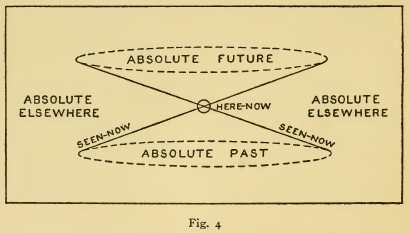
Let us now try to attain this absolute view. We rub out all the Now lines. We rub out Yourself and Myself, since we are no longer essential to the world. But the Seen-Now lines are left. They are absolute, since all observers from Here-Now agree about them. The flat picture is a section; you must imagine it rotated (twice rotated in fact, since there are two more dimensions outside the picture). The Seen-Now locus is thus really a cone; or by taking account of the prolongation of the lines into the future a double cone or hour-glass figure (Fig. 4). These hour-glasses (drawn through each point of the world considered in turn as a Here-Now) embody what we know of the absolute structure of the world so far as space and time are concerned. They show how the “grain” of the world runs.

Fig 4

Father Time has been pictured as an old man with a scythe and an hour-glass. We no longer permit him to mow instants through the world with his scythe; but we leave him his hour-glass.

Since the hour-glass is absolute its two cones provide respectively an Absolute Future and an Absolute Past for the event Here-Now. They are separated by a wedge-shaped neutral zone which (absolutely) is neither past nor future. The common impression that relativity turns past and future altogether topsy-turvy is quite false. But, unlike the relative past and future, the absolute past and future are not separated by an infinitely narrow present. It suggests itself that the neutral wedge might be called the Absolute Present; but I do not think that is a good nomenclature. It is much better described as Absolute Elsewhere. We have abolished the Now lines, and in the absolute world the present (Now) is restricted to Here-Now.

Perhaps I may illustrate the peculiar conditions arising from the wedge-shaped neutral zone by a rather hypothetical example. Suppose that you are in love with a lady on Neptune and that she returns the sentiment. It will be some consolation for the melancholy separation if you can say to yourself at some—possibly prearranged —moment, “She is thinking of me now”. Unfortunately a difficulty has arisen because we have had to abolish Now. There is no absolute Now, but only the various relative Nows differing according to the reckoning of different observers and covering the whole neutral wedge which at the distance of Neptune is about eight hours thick. She will have to think of you continuously for eight hours on end in order to circumvent the ambiguity of “Now”.

At the greatest possible separation on the earth the thickness of the neutral wedge is no more than a tenth of a second; so that terrestrial synchronism is not seriously interfered with. This suggests a qualification of our previous conclusion that the absolute present is confined to HereNow. It is true as regards instantaneous events (point-events). But in practice the events we notice are of more than infinitesimal duration. If the duration is sufficient to cover the width of the neutral zone, then the event taken as a whole may fairly be considered to be Now absolutely. From this point of view the “nowness” of an event is like a shadow cast by it into space, and the longer the event the farther will the umbra of the shadow extend.

As the speed of matter approaches the speed of light its mass increases to infinity, and therefore it is impossible to make matter travel faster than light. This conclusion is deduced from the classical laws of physics, and the increase of mass has been verified by experiment up to very high velocities. In the absolute world this means that a particle of matter can only proceed from Here-Now into the absolute future—which, you will agree, is a reasonable and proper restriction. It cannot travel into the neutral zone; the limiting cone is the track of light or of anything moving with the speed of light. We ourselves are attached to material bodies, and therefore we can only go on into the absolute future.

Events in the absolute future are not absolutely Elsewhere. It would be possible for an observer to travel from Here-Now to the event in question in time to experience it, since the required velocity is less than that of light; relative to the frame of such an observer the event would be Here. No observer can reach an event in the neutral zone, since the required speed is too great. The event is not Here for any observer (from Here-Now); therefore, it is absolutely Elsewhere.

.

Eddington 1927: Location of Events

Fig 1

Reference: The Book of Physics

Note: The original text is provided below.
Previous / Next

.

Summary

.

Comments

.

Original Text

In Fig. 1 you see a collection of events, indicated by circles. They are not at present in their right places; that is the job before me–to put them into proper locations in my frame of space and time. Among them I can immediately recognize and label the event Here-Now, viz. that which is happening in this room at the moment. The other events are at varying degrees of remoteness from Here-Now, and it is obvious to me that the remoteness is not only of different degrees but of different kinds. Some events spread away towards what in a general way I call the Past; I can contemplate others which are distant in the Future; others are remote in another kind of way towards China or Peru, or in general terms Elsewhere. In this picture I have only room for one dimension of Elsewhere; another dimension sticks out at right angles to the paper; and you must imagine the third dimension as best you can.

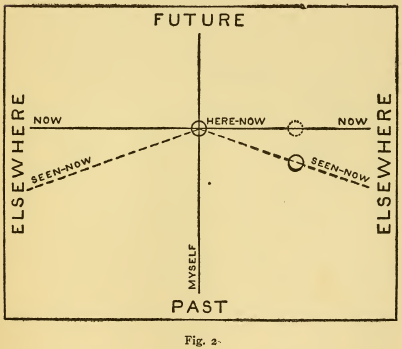
Now we must pass from this vague scheme of location to a precise scheme. The first and most important thing is to put Myself into the picture. It sounds egotistical; but, you see, it is my frame of space that will be used, so it all hangs round me. Here I am—a kind of four-dimensional worm (Fig. 2). It is a correct portrait; I have considerable extension towards the Past and presumably towards the Future, and only a moderate extension towards Elsewhere. The “instantaneous me”, i.e. myself at this instant, coincides with the event Here- Now. Surveying the world from HereNow, I can see many other events happening now. That puts it into my head that the instant of which I am conscious here must be extended to include them; and I jump to the conclusion that Now is not confined to Here-Now. I therefore draw the instant Now, running as a clean section across the world of events, in order to accommodate all the distant events which are happening now. I select the events which I see happening now and place them on this section, which I call a moment of time or an “instantaneous state of the world”. I locate them on Now because they seem to be Now.

Fig 2

This method of location lasted until the year 1667, when it was found impossible to make it work consistently. It was then discovered by the astronomer Roemer that what is seen now cannot be placed on the instant Now. (In ordinary parlance—light takes time to travel.) That was really a blow to the whole system of worldwide instants, which were specially invented to accommodate these events. We had been mixing up two distinct events; there was the original event somewhere out in the external world and there was a second event, viz. the seeing by us of the first event. The second event was in our bodies Here-Now; the first event was neither Here nor Now. The experience accordingly gives no indication of a Now which is not Here; and we might well have abandoned the idea that we have intuitive recognition of a Now other than Here-Now, which was the original reason for postulating world-wide instants Now.

However, having become accustomed to world-wide instants, physicists were not ready to abandon them. And, indeed, they have considerable usefulness provided that we do not take them too seriously. They were left in as a feature of the picture, and two Seen-Now lines were drawn, sloping backwards from the Now line, on which events seen now could be consistently placed.

The cotangent of the angle between the Seen-Now lines and the Now line was interpreted as the velocity of light.

Accordingly, when I see an event in a distant part of the universe, e.g. the outbreak of a new star, I locate it (quite properly) on the Seen-Now line. Then I make a certain calculation from the measured parallax of the star and draw my Now line to pass, say, 300 years in front of the event, and my Now line of 300 years ago to pass through the event. By this method I trace the course of my Now lines or world-wide instants among the events, and obtain a frame of time-location for external events. The auxiliary Seen-Now lines, having served their purpose, are rubbed out of the picture.

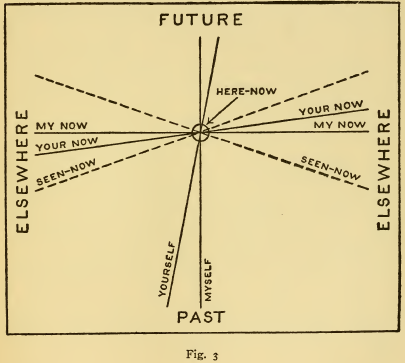
Fig 3

That is how I locate events; how about you? We must first put You into the picture (Fig. 3). We shall suppose that you are on another star moving with different velocity but passing close to the earth at the present moment. You and I were far apart in the past and will be again in the future, but we are both Here- Now. That is duly shown in the picture. We survey the world from HereNow, and of course we both see the same events simultaneously. We may receive rather different impressions of them; our different motions will cause different Doppler effects, FitzGerald  contractions, etc. There may be slight misunderstandings until we realise that what you describe as a red square is what I would describe as a green oblong, and so on. But, allowing for this kind of difference of description, it will soon become clear that we are looking at the same events, and we shall agree entirely as to how the Seen-Now lines lie with respect to the events. Starting from our common Seen-Now lines, you have next to make the calculations for drawing your Now line among the events, and you trace it as shown in Fig. 3.

How is it that, starting from the same Seen-Now lines, you do not reproduce my Now line? It is because a certain measured quantity, viz. the velocity of light, has to be employed in the calculations; and naturally you trust to your measures of it as I trust to mine. Since our instruments are affected by different FitzGerald contractions, etc., there is plenty of room for divergence. Most surprisingly we both find the same velocity of light, 299,796 kilometres per second. But this apparent agreement is really a disagreement; because you take this to be the velocity relative to your planet and I take it to be the velocity relative to mine. (The measured velocity of light is the average to-and-fro velocity. The velocity in one direction singly cannot be measured until after the Now lines have been laid down and therefore cannot be used in laying down the Now lines. Thus, there is a deadlock in drawing the Now lines which can only be removed by an arbitrary assumption or convention. The convention actually adopted is that (relative to the observer) the velocities of light in the two opposite directions are equal. The resulting Now lines must therefore be regarded as equally conventional.)  Therefore, our calculations are not in accord, and your Now line differs from mine.

If we believe our world-wide instants or Now lines to be something inherent in the world outside us, we shall quarrel frightfully. To my mind it is ridiculous that you should take events on the right of the picture which have not -happened yet and events on the left which are already past and call the combination an instantaneous condition of the universe. You are equally scornful of my grouping. We can never agree. Certainly, it looks from the picture as though my instants were more natural than yours; but that is because I drew the picture. You, of course, would redraw it with your Now lines at right angles to yourself.

But we need not quarrel if the Now lines are merely reference lines drawn across the world for convenience in locating events—like the lines of latitude and longitude on the earth. There is then no question of a right way and a wrong way of drawing the lines; we draw them as best suits our convenience. World-wide instants are not natural cleavage planes of time; there is nothing equivalent to them in the absolute structure of the world; they are imaginary partitions which we find it convenient to adopt.

We have been accustomed to regard the world—the enduring world—as stratified into a succession of instantaneous states. But an observer on another star would make the strata run in a different direction from ours. We shall see more clearly the real mechanism of the physical world if we can rid our minds of this illusion of stratification. The world that then stands revealed, though strangely unfamiliar, is actually much simpler. There is a difference between simplicity and familiarity. A pig may be most familiar to us in the form of rashers, but the unstratified pig is a simpler object to the biologist who wishes to understand how the animal functions.

.

Eddington 1927: Astronomer Royal’s Time

time-illusion

Reference: The Book of Physics

Note: The original text is provided below.
Previous / Next

Summary

.

Comments

.

Original Text

I have sometimes thought it would be very entertaining to hear a discussion between the Astronomer Royal and, let us say, Prof. Bergson on the nature of time. Prof. Bergson’s authority on the subject is well known; and I may remind you that the Astronomer Royal is entrusted with the duty of finding out time for our everyday use, so presumably he has some idea of what he has to find. I must date the discussion some twenty years back, before the spread of Einstein’s ideas brought about a rapprochement. There would then probably have been a keen disagreement, and I rather think that the philosopher would have had the best of the verbal argument. After showing that the Astronomer Royal’s idea of time was quite nonsensical, Prof. Bergson would probably end the discussion by looking at his watch and rushing off to catch a train which was starting by the Astronomer Royal’s time. 

Whatever may be time de jure, the Astronomer Royal’s time is time de facto. His time permeates every corner of physics. It stands in no need of logical defence; it is in the much stronger position of a vested interest. It has been woven into the structure of the classical physical scheme. “Time” in physics means Astronomer Royal’s time. You may be aware that it is revealed to us in Einstein’s theory that time and space are mixed up in a rather strange way. This is a great stumbling-block to the beginner. He is inclined to say, “That is impossible. I feel it in my bones that time and space must be of entirely different nature. They cannot possibly be mixed up.” The Astronomer Royal complacently retorts, “It is not impossible. I have mixed them up.” Well, that settles it. If the Astronomer Royal has mixed them, then his mixture will be the groundwork of present-day physics. 

We have to distinguish two questions which are not necessarily identical. First, what is the true nature of time? Second, what is the nature of that quantity which has under the name of time become a fundamental part of the structure of classical physics? By long history of experiment and theory the results of physical investigation have been woven into a scheme which has on the whole proved wonderfully successful. Time—the Astronomer Royal’s time—has its importance from the fact that it is a constituent of that scheme, the binding material or mortar of it. That importance is not lessened if it should prove to be only imperfectly representative of the time familiar to our consciousness. We therefore give priority to the second question. 

But I may add that Einstein’s theory, having cleared up the second question, having found that physical time is incongruously mixed with space, is able to pass on to the first question. There is a quantity, unrecognized in pre-relativity physics, which more directly represents the time known to consciousness. This is called proper-time or interval. It is definitely separate from and unlike proper-space. Your protest in the name of commonsense against a mixing of time and space is a feeling which I desire to encourage. Time and space ought to be separated. The current representation of the enduring world as a three-dimensional space leaping from instant to instant through time is an unsuccessful attempt to separate them. Come back with me into the virginal four-dimensional world and we will carve it anew on a plan which keeps them entirely distinct.  We can then resurrect the almost forgotten time of consciousness and find that it has a gratifying importance in the absolute scheme of Nature. 

But first let us try to understand why physical time has come to deviate from time as immediately perceived. We have jumped to certain conclusions about time and have come to regard them almost as axiomatic, although they are not really justified by anything in our immediate perception of time. Here is one of them. 

If two people meet twice they must have lived the same time between the two meetings, even if one of them has travelled to a distant part of the universe and back in the interim. 

An absurdly impossible experiment, you will say. Quite so; it is outside all experience. Therefore, may I suggest that you are not appealing to your experience of time when you object to a theory which denies the above statement? And yet if the question is pressed most people would answer impatiently that of course the statement is true. They have formed a notion of time rolling on outside us in a way which makes this seem inevitable. They do not ask themselves whether this conclusion is warranted by anything in their actual experience of time. 

Although we cannot try the experiment of sending a man to another part of the universe, we have enough scientific knowledge to compute the rates of atomic and other physical processes in a body at rest and a body travelling rapidly. We can say definitely that the bodily processes in the traveler occur more slowly than the corresponding processes in the man at rest (i.e. more slowly according to the Astronomer Royal’s time). This is not particularly mysterious; it is well known both from theory and experiment that the mass or inertia of matter increases when the velocity increases. The retardation is a natural consequence of the greater inertia. Thus so far as bodily processes are concerned the fast-moving traveler lives more slowly. His cycle of digestion and fatigue; the rate of muscular response to stimulus; the development of his body from youth to age; the material processes in his brain which must more or less keep step with the passage of thoughts and emotions; the watch which ticks in his waistcoat pocket; all these must be slowed down in the same ratio. If the speed of travel is very great we may find that, whilst the stay-at-home individual has aged 70 years, the traveler has aged 1 year. He has only found appetite for 365 breakfasts, lunches, etc.; his intellect, clogged by a slow-moving brain, has only traversed the amount of thought appropriate to one year of terrestrial life. His watch, which gives a more accurate and scientific reckoning, confirms this. Judging by the time which consciousness attempts to measure after its own rough fashion—and, I repeat, this is the only reckoning of time which we have a right to expect to be distinct from space—the two men have not lived the same time between the two meetings. 

Reference to time as estimated by consciousness is complicated by the fact that the reckoning is very erratic. “I’ll tell you who Time ambles withal, who Time trots withal, who Time gallops withal, and who he stands still withal.” I have not been referring to these subjective variations. I do not very willingly drag in so unsatisfactory a time-keeper; only I have to deal with the critic who tells me what “he feels in his bones” about time, and I would point out to him that the basis of that feeling is time lived, which we have just seen may be 70 years for one individual and 1 year for another between their two meetings. We can reckon “time lived” quite scientifically, e.g.  by a watch travelling with the individual concerned and sharing his changes of inertia with

velocity. But there are obvious drawbacks to the general adoption of “time lived”. It might be useful for each individual to have a private time exactly proportioned to his time lived; but it would be extremely inconvenient for making appointments. Therefore the Astronomer Royal has adopted a universal time-reckoning which does not follow at all strictly the time lived.

According to it the time-lapse does not depend on how the object under consideration has moved in the meanwhile. I admit that this reckoning is a little hard on our returned traveler, who will be counted by it as an octogenarian although he is to all appearances still a boy in his teens. But sacrifices must be made for the general benefit. In practice we have not to deal with human beings travelling at any great speed; but we have to deal with atoms and electrons travelling at terrific speed, so that the question of private time-reckoning versus general time-reckoning is a very practical one. 

Thus in physical time (or Astronomer Royal’s time) two people are deemed to have lived the same time between two meetings, whether or not that accords with their actual experience. The consequent deviation from the time of experience is responsible for the mixing up of time and space, which, of course, would be impossible if the time of direct experience had been rigidly adhered to. Physical time is, like space, a kind of frame in which we locate the events of the external world. We are now going to consider how in practice external events are located in a frame of space and time. We have seen that there is an infinite choice of alternative frames; so, to be quite explicit, I will tell you how I locate events in my frame. 

.