Cycles and Quantization


The field-substance that fills the emptiness is a disturbance. Therefore it is full of ACTIVITY. This activity is expressed as continual oscillations between two states—electric and magnetic. We may refer to this activity as ENERGY.

This activity is made up of oscillations that are repeating themselves interminably at a certain rate. Each repetition is a CYCLE, that has a PERIOD and a WAVELENGTH; and the rate of repetition is the FREQUENCY. Both cycle and frequency are properties of the field-substance.

The international units used for period and wavelength are seconds and meters respectively. But such units are arbitrary. There is no such thing as the smallest frequency. A “fractional frequency” may be expressed in whole numbers with larger unit of time. For example, ½ cycle per sec could be represented by a cycle every 2 seconds. So, we can have frequencies smaller than 1 Hz (cycle per second) without limit.

Energy of field-substance is proportional to its frequency. In international units, the proportionality constant is 6.626176 x 10-34 joule-seconds, called the Planck constant. But this value depends on the unit of time being 1 second.

A frequency expressed in Hz (cycles per second) can be expressed as a unit frequency using a different unit of time. This new unit frequency provides a light quanta, or field-particle, of a different quantization level. Energy would still be proportional to the frequency, when expressed in multiples of this unit frequency, but the proportionality constant will have a different value.

The whole subject of Quantum Mechanics in physics is constructed from this phenomenon of quantization. As frequency increases, the field-particle acquires greater energy and becomes more discrete and penetrating. At the same time the quantization levels occur closer to each other.

With the formation of nucleus of the atom, the unstructured field-substance transitions to structured material-substance. The quantization levels of field-substance become continuous levels of inertia of material substance. Throughout the range of material-substance, the value of inertia varies little compared to the values of quantization for the range of field-substance.

.

Eddington 1927: Time’s Arrow

Time arrow

Reference: The Book of Physics

Note: The original text is provided below.
Previous / Next

.

Summary

.

Comments

.

Original Text

The great thing about time is that it goes on. But this is an aspect of it which the physicist sometimes seems inclined to neglect. In the four-dimensional world considered in the last chapter the events past and future lie spread out before us as in a map. The events are there in their proper spatial and temporal relation; but there is no indication that they undergo what has been described as “the formality of taking place”, and the question of their doing or undoing does not arise. We see in the map the path from past to future or from future to past; but there is no signboard to indicate that it is a one-way street. Something must be added to the geometrical conceptions comprised in Minkowski’s world before it becomes a complete picture of the world as we know it. We may appeal to consciousness to suffuse the whole—to turn existence into happening, being into becoming. But first let us note that the picture as it stands is entirely adequate to represent those primary laws of Nature which, as we have seen, are indifferent to a direction of time. Objection has sometimes been felt to the relativity theory because its four-dimensional picture of the world seems to overlook the directed character of time. The objection is scarcely logical, for the theory is in this respect no better and no worse than its predecessors. The classical physicist has been using without misgiving a system of laws which do not recognise a directed time; he is shocked that the new picture should expose this so glaringly.

Without any mystic appeal to consciousness it is possible to find a direction of time on the four-dimensional map by a study of organization. Let us draw an arrow arbitrarily. If as we follow the arrow we find more and more of the random element in the state of the world, then the arrow is pointing towards the future; if the random element decreases the arrow points towards the past. That is the only distinction known to physics. This follows at once if our fundamental contention is admitted that the introduction of randomness is the only thing which cannot be undone.

I shall use the phrase “time’s arrow” to express this one-way property of time which has no analogue in space. It is a singularly interesting property from a philosophical standpoint. We must note that—

  1. It is vividly recognised by consciousness.
  2. It is equally insisted on by our reasoning faculty, which tells us that a reversal of the arrow would render the external world nonsensical.
  3. It makes no appearance in physical science except in the study of organization of a number of individuals.

Here the arrow indicates the direction of progressive increase of the random element.

Let us now consider in detail how a random element brings the irrevocable into the world. When a stone falls it acquires kinetic energy, and the amount of the energy is just that which would be required to lift the stone back to its original height. By suitable arrangements the kinetic energy can be made to perform this task; for example, if the stone is tied to a string it can alternately fall and re-ascend like a pendulum. But if the stone hits an obstacle its kinetic energy is converted into heat-energy. There is still the same quantity of energy, but even if we could scrape it together and put it through an engine we could not lift the stone back with it. What has happened to make the energy no longer serviceable?

Looking microscopically at the falling stone we see an enormous multitude of molecules moving downwards with equal and parallel velocities—an organized motion like the march of a regiment. We have to notice two things, the energy and the organization of the energy. To return to its original height the stone must preserve both of them.

When the stone falls on a sufficiently elastic surface the motion may be reversed without destroying the organization. Each molecule is turned backwards and the whole array retires in good order to the starting-point—

The famous Duke of York
With twenty thousand men,
He marched them up to the top of the hill
And marched them down again.

History is not made that way. But what usually happens at the impact is that the molecules suffer more or less random collisions and rebound in all directions. They no longer conspire to make progress in any one direction; they have lost their organization. Afterwards they continue to collide with one another and keep changing their directions of motion, but they never again find a common purpose. Organization cannot be brought about by continued shuffling. And so, although the energy remains quantitatively sufficient (apart from unavoidable leakage which we suppose made good), it cannot lift the stone back. To restore the stone we must supply extraneous energy which has the required amount of organization.

Here a point arises which unfortunately has no analogy in the shuffling of a pack of cards. No one (except a conjurer) can throw two half-shuffled packs into a hat and draw out one pack in its original order and one pack fully shuffled. But we can and do put partly disorganized energy into a steam-engine, and draw it out again partly as fully organized energy of motion of massive bodies and partly as heat-energy in a state of still worse disorganization. Organization of energy is negotiable, and so is the disorganization or random element; disorganization does not forever remain attached to the particular store of energy which first suffered it, but may be passed on elsewhere. We cannot here enter into the question why there should be a difference between the shuffling of energy and the shuffling of material objects; but it is necessary to use some caution in applying the analogy on account of this difference. As regards heat-energy the temperature is the measure of its degree of organization; the lower the temperature, the greater the disorganization.

.

Eddington 1927: Shuffling

thermo2

Reference: The Book of Physics

Note: The original text is provided below.
Previous / Next

.

Summary

.

Comments

.

Original Text

The modern outlook on the physical world is not composed exclusively of conceptions which have arisen in the last twenty-five years; and we have now to deal with a group of ideas dating far back in the last century which have not essentially altered since the time of Boltzmann. These ideas display great activity and development at the present time. The subject is relevant at this stage because it has a bearing on the deeper aspects of the problem of Time; but it is so fundamental in physical theory that we should be bound to deal with it sooner or later in any comprehensive survey.

If you take a pack of cards as it comes from the maker and shuffle it for a few minutes, all trace of the original systematic order disappears. The order will never come back however long you shuffle. Something has been done which cannot be undone, namely, the introduction of a random element in place of arrangement.

Illustrations may be useful even when imperfect, and therefore I have slurred over two points, which affect the illustration rather than the application which we are about to make. It was scarcely true to say that the shuffling cannot be undone. You can sort out the cards into their original order if you like. But in considering the shuffling which occurs in the physical world we are not troubled by a deus ex machina like you. I am not prepared to say how far the human mind is bound by the conclusions we shall reach. So I exclude you—at least I exclude that activity of your mind which you employ in sorting the cards. I allow you to shuffle them because you can do that absent-mindedly.

Secondly, it is not quite true that the original order never comes back. There is a ghost of a chance that someday a thoroughly shuffled pack will be found to have come back to the original order. That is because of the comparatively small number of cards in the pack. In our applications the units are so numerous that this kind of contingency can be disregarded.

We shall put forward the contention that—

Whenever anything happens which cannot be undone, it is always reducible to the introduction of a random element analogous to that introduced by shuffling.

Shuffling is the only thing which Nature cannot undo.

When Humpty Dumpty had a great fall—
All the king’s horses and all the king’s men
Cannot put Humpty Dumpty together again.

Something had happened which could not be undone. The fall could have been undone. It is not necessary to invoke the king’s horses and the king’s men; if there had been a perfectly elastic mat underneath, that would have sufficed. At the end of his fall Humpty Dumpty had kinetic energy which, properly directed, was just sufficient to bounce him back on to the wall again. But, the elastic mat being absent, an irrevocable event happened at the end of the fall—namely, the introduction of a random element into Humpty Dumpty.

But why should we suppose that shuffling is the only process that cannot be undone?

The Moving Finger writes; and, having writ,
Moves on: nor all thy Piety and Wit
Can lure it back to cancel half a Line.

When there is no shuffling, is the Moving Finger stayed? The answer of physics is unhesitatingly Yes. To judge of this we must examine those operations of Nature in which no increase of the random element can possibly occur. These fall into two groups. Firstly, we can study those laws of Nature which control the behaviour of a single unit. Clearly no shuffling can occur in these problems; you cannot take the King of Spades away from the pack and shuffle him. Secondly, we can study the processes of Nature in a crowd which is already so completely shuffled that there is no room for any further increase of the random element. If our contention is right, everything that occurs in these conditions is capable of being undone. We shall consider the first condition immediately; the second must be deferred until p. 78.

Any change occurring to a body which can be treated as a single unit can be undone. The laws of Nature admit of the undoing as easily as of the doing. The earth describing its orbit is controlled by laws of motion and of gravitation; these admit of the earth’s actual motion, but they also admit of the precisely opposite motion. In the same field of force the earth could retrace its steps; it merely depends on how it was started off. It may be objected that we have no right to dismiss the starting-off as an inessential part of the problem; it may be as much a part of the coherent scheme of Nature as the laws controlling the subsequent motion. Indeed, astronomers have theories explaining why the eight planets all started to move the same way round the sun. But that is a problem of eight planets, not of a single individual—a problem of the pack, not of the isolated card. So long as the earth’s motion is treated as an isolated problem, no one would dream of putting into the laws of Nature a clause requiring that it must go this way round and not the opposite.

There is a similar reversibility of motion in fields of electric and magnetic force. Another illustration can be given from atomic physics. The quantum laws admit of the emission of certain kinds and quantities of light from an atom; these laws also admit of absorption of the same kinds and quantities, i.e. the undoing of the emission. I apologize for an apparent poverty of illustration; it must be remembered that many properties of a body, e.g. temperature, refer to its constitution as a large number of separate atoms, and therefore the laws controlling temperature cannot be regarded as controlling the behaviour of a single individual.

The common property possessed by laws governing the individual can be stated more clearly by a reference to time. A certain sequence of states running from past to future is the doing of an event; the same sequence running from future to past is the undoing of it—because in the latter case we turn round the sequence so as to view it in the accustomed manner from past to future. So if the laws of Nature are indifferent as to the doing and undoing of an event, they must be indifferent as to a direction of time from past to future. That is their common feature, and it is seen at once when (as usual) the laws are formulated mathematically. There is no more distinction between past and future than between right and left. In algebraic symbolism, left is — x, right is +x; past is —t, future is +t. This holds for all laws of Nature governing the behaviour of non-composite individuals—the “primary laws”, as we shall call them. There is only one law of Nature—the second law of thermodynamics—which recognizes a distinction between past and future more profound than the difference of plus and minus. It stands aloof from all the rest. But this law has no application to the behaviour of a single individual, and as we shall see later its subject- matter is the random element in a crowd.

Whatever the primary laws of physics may say, it is obvious to ordinary experience that there is a distinction between past and future of a different kind from the distinction of left and right. In The Plattner Story H. G. Wells relates how a man strayed into the fourth dimension and returned with left and right interchanged. But we notice that this interchange is not the theme of the story; it is merely a corroborative detail to give an air of verisimilitude to the adventure. In itself the change is so trivial that even Mr. Wells cannot weave a romance out of it. But if the man had come back with past and future interchanged, then indeed the situation would have been lively. Mr. Wells in The Time-Machine and Lewis Carroll in Sylvie and Bruno give us a glimpse of the absurdities which occur when time runs backwards. If space is “looking-glassed” the world continues to make sense; but looking-glassed time has an inherent absurdity which turns the world-drama into the most nonsensical farce.

Now the primary laws of physics taken one by one all declare that they are entirely indifferent as to which way you consider time to be progressing, just as they are indifferent as to whether you view the world from the right or the left. This is true of the classical laws, the relativity laws, and even of the quantum laws. It is not an accidental property; the reversibility is inherent in the whole conceptual scheme in which these laws find a place. Thus the question whether the world does or does not “make sense” is outside the range of these laws. We have to appeal to the one outstanding law— the second law of thermodynamics—to put some sense into the world. It opens up a new province of knowledge, namely, the study of organization; and it is in connection with organization that a direction of time-flow and a distinction between doing and undoing appears for the first time.

.

Eddington 1927: Practical Applications

albert einstein
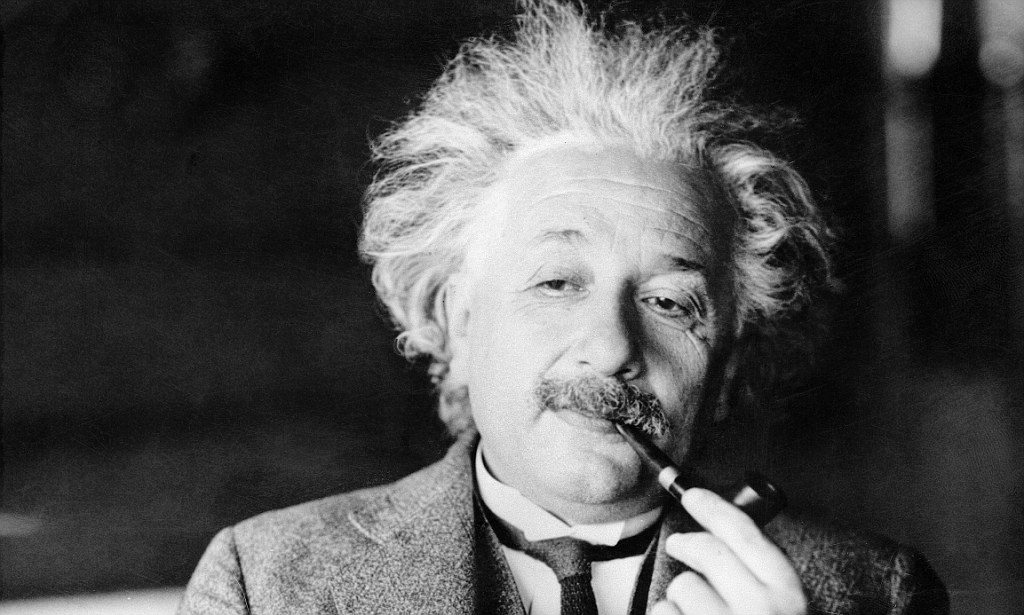
This undated file photo shows famed physicist Albert Einstein.

Reference: The Book of Physics

Note: The original text is provided below.
Previous / Next

.

Summary

.

Comments

.

Original Text

In these lectures I am concerned more with the ideas of the new theories than with their practical importance for the advancement of science. But the drawback of dwelling solely on the underlying conceptions is that it is likely to give the impression that the new physics is very much “up in the air”. That is by no means true, and the relativity theory is used in a businesslike way in the practical problems to which it applies. I can only consider here quite elementary problems which scarcely do justice to the power of the new theory in advanced scientific research. Two examples must suffice.

(1) It has often been suggested that the stars will be retarded by the back-pressure of their own radiation. The idea is that since the star is moving forward the emitted radiation is rather heaped up in front of it and thinned out behind. Since radiation exerts pressure the pressure will be stronger on the front surface than on the rear, Therefore there is a force retarding the star tending to bring it gradually to rest. The effect might be of great importance in the study of stellar motions; it would mean that on the average old stars must have lower speeds than young stars—a conclusion which, as it happens, is contrary to observation.

But according to the theory of relativity “coming to rest” has no meaning. A decrease of velocity relative to one frame is an increase relative to another frame. There is no absolute velocity and no absolute rest for the star to come to. The suggestion may therefore be at once dismissed as fallacious.

(2) The β particles shot out by radioactive substances are electrons travelling at speeds not much below the speed of light. Experiment shows that the mass of one of these high-speed electrons is considerably greater than the mass of an electron at rest. The theory of relativity predicts this increase and provides the formula for the dependence of mass on velocity. The increase arises solely from the fact that mass is a relative quantity depending by definition on the relative quantities length and time.

Let us look at a β particle from its own point of view. It is an ordinary electron in no wise different from any other. But it is travelling with unusually high speed? “No”, says the electron, “That is your point of view. I contemplate with amazement your extraordinary speed of 100,000 miles a second with which you are shooting past me. I wonder what it feels like to move so quickly. However, it is no business of mine.” So the β particle, smugly thinking itself at rest, pays no attention to our goings on, and arranges itself with the usual mass, radius and charge. It has just the standard mass of an electron, 9×10-28 grams. But mass and radius are relative quantities, and in this case the frame to which they are referred is evidently the frame appropriate to an electron engaged in self-contemplation, viz. the frame in which it is at rest. But when we talk about mass we refer it to the frame in which we are at rest. By the geometry of the four-dimensional world, we can calculate the formulae for the change of reckoning of mass in two different frames, which is consequential on the change of reckoning of length and time; we find in fact that the mass is increased in the same ratio as the length is diminished (FitzGerald factor). The increase of mass that we observe arises from the change of reckoning between the electron’s own frame and our frame.

All electrons are alike from their own point of view. The apparent differences arise in fitting them into our own frame of reference which is irrelevant to their structure. Our reckoning of their mass is higher than their own reckoning, and increases with the difference between our respective frames, i.e. with the relative velocity between us.

We do not bring forward these results to demonstrate or confirm the truth of the theory, but to show the use of the theory. They can both be deduced from the classical electromagnetic theory of Maxwell coupled (in the second problem) with certain plausible assumptions as to the conditions holding at the surface of an electron. But to realise the advantage of the new theory we must consider not what could have been but what was deduced from the classical theory. The historical fact is that the conclusions of the classical theory as to the first problem were wrong; an important compensating factor escaped notice. Its conclusions as to the second problem were (after some false starts) entirely correct numerically. But since the result was deduced from the electromagnetic equations of the electron it was thought that it depended on the fact that an electron is an electrical structure; and the agreement with observation was believed to confirm the hypothesis that an electron is pure electricity and nothing else. Our treatment above makes no reference to any electrical properties of the electron, the phenomenon having been found to arise solely from the relativity of mass. Hence, although there may be other good reasons for believing that an electron consists solely of negative electricity, the increase of mass with velocity is no evidence one way or the other.

.

Eddington 1927: The Velocity of Light

abstract-speed-of-light

Reference: The Book of Physics

Note: The original text is provided below.
Previous / Next

.

Summary

.

Comments

.

Original Text

A feature of the relativity theory which seems to have aroused special interest among philosophers is the absoluteness of the velocity of light. In general velocity is relative. If I speak of a velocity of 40 kilometres a second, I must add “relative to the earth”, “relative to Arcturus”, or whatever reference body I have in mind. No one will understand anything from my statement unless this is added or implied. But it is a curious fact that if I speak of a velocity of 299,796 kilometres a second it is unnecessary to add the explanatory phrase. Relative to what? Relative to any and every star or particle of matter in the universe.

It is no use trying to overtake a flash of light; however fast you go it is always travelling away from you at 186,000 miles a second. Now from one point of view this is a rather unworthy deception that Nature has practiced upon us. Let us take our favourite observer who travels at 161,000 miles a second and send him in pursuit of the flash of light. It is going 25,000 miles a second faster than he is; but that is not what he will report. Owing to the contraction of his standard scale his miles are only half-miles; owing to the slowing down of his clocks his seconds are double-seconds. His measurements would therefore make the speed 100,000 miles a second (really half-miles per double-second). He makes a further mistake in synchronizing the clocks with which he records the velocity. (You will remember that he uses a different Now line from ours.). This brings the speed up to 186,000 miles a second. From his own point of view the traveler is lagging hopelessly behind the light; he does not realise what a close race he is making of it, because his measuring appliances have been upset. You will note that the evasiveness of the light-flash is not in the least analogous to the evasiveness of the rainbow.

But although this explanation may help to reconcile us to what at first seems a blank impossibility, it is not really the most penetrating. You will remember that a Seen-Now line, or track of a flash of light, represents the grain of the world-structure. Thus the peculiarity of a velocity of 299,796 kilometres a second is that it coincides with the grain of the world. The four-dimensional worms representing material bodies must necessarily run across the grain into the future cone, and we have to introduce some kind of reference frame to describe their course. But the flash of light is exactly along the grain, and there is no need of any artificial system of partitions to describe this fact.

The number 299,796 (kilometres per second) is, so to speak, a code-number for the grain of the wood. Other code-numbers correspond to the various wormholes which may casually cross the grain. We have different codes corresponding to different frames of space and time; the code-number of the grain of the wood is the only one which is the same in all codes. This is no accident; but I do not know that any deep inference is to be drawn from it, other than that our measure-codes have been planned rationally so as to turn on the essential and not on the casual features of world-structure.

The speed of 299,796 kilometres per second which occupies a unique position in every measure-system is commonly referred to as the speed of light. But it is much more than that; it is the speed at which the mass of matter becomes infinite, lengths contract to zero, clocks stand still. Therefore it crops up in all kinds of problems whether light is concerned or not.

The scientist’s interest in the absoluteness of this velocity is very great; the philosopher’s interest has been, I think, largely a mistaken interest. In asserting its absoluteness scientists mean that they have assigned the same number to it in every measure-system; but that is a private arrangement of their own—an unwitting compliment to its universal importance. (In the general relativity theory, chapter VI, measure-systems are employed in which the velocity of light is no longer assigned the same constant value, but it continues to correspond to the grain of absolute world-structure.) Turning from the measure-numbers to the thing described by them, the “grain” is certainly an absolute feature of the wood, but so also are the “worm-holes” (material particles). The difference is that the grain is essential and universal, the worm-holes casual. Science and philosophy have often been at cross-purposes in discussing the Absolute—a misunderstanding which is I am afraid chiefly the fault of the scientists. In science we are chiefly concerned with the absoluteness or relativity of the descriptive terms we employ; but when the term absolute is used with reference to that which is being described it has generally the loose meaning of “universal” as opposed to “casual”.

Another point on which there has sometimes been a misunderstanding is the existence of a superior limit to velocity. It is not permissible to say that no velocity can exceed 299,796 kilometres per second. For example, imagine a search-light capable of sending an accurately parallel beam as far as Neptune. If the search-light is made to revolve once a minute, Neptune’s end of the beam will move round a circle with velocity far greater than the above limit. This is an example of our habit of creating velocities by a mental association of states which are not themselves in direct causal connection. The assertion made by the relativity theory is more restricted, viz.—

Neither matter, nor energy, nor anything capable of being used as a signal can travel faster than 299,796 kilometres per second, provided that the velocity is referred to one of the frames of space and time considered in this chapter. (Some proviso of this kind is clearly necessary. We often employ for special purposes a frame of reference rotating with the earth; in this frame the stars describe circles once a day, and are therefore ascribed enormous velocities.)

The velocity of light in matter can under certain circumstances (in the phenomenon of anomalous dispersion) exceed this value. But the higher velocity is only attained after the light has been passing through the matter for some moments so as to set the molecules in sympathetic vibration. An unheralded light-flash travels more slowly. The speed, exceeding 299,796 kilometres a second, is, so to speak, achieved by prearrangement, and has no application in signaling.

We are bound to insist on this limitation of the speed of signaling. It has the effect that it is only possible to signal into the Absolute Future. The consequences of being able to transmit messages concerning events Here-Now into the neutral wedge are too bizarre to contemplate. Either the part of the neutral wedge that can be reached by the signals must be restricted in a way which violates the principle of relativity; or it will be possible to arrange for a confederate to receive the messages which we shall send him to-morrow, and to retransmit them to us so that we receive them to-day. The limit to the velocity of signals is our bulwark against that topsy-turvydom of past and future, of which Einstein’s theory is sometimes wrongfully accused.

Expressed in the conventional way this limitation of the speed of signaling to 299,796 kilometres a second seems a rather arbitrary decree of Nature. We almost feel it as a challenge to find something that goes faster. But if we state it in the absolute form that signaling is only possible along a track of temporal relation and not along a track of spatial relation the restriction seems rational. To violate it we have not merely to find something which goes just 1 kilometer per second better, but something which overleaps that distinction of time and space—which, we are all convinced, ought to be maintained in any sensible theory.

.