This paper presents Chapter
II, section 5 from the book THE EVOLUTION
OF PHYSICS by A. EINSTEIN and L. INFELD. The contents are from the original
publication of this book by Simon and Schuster, New York (1942).
The paragraphs of the original
material (in black) are accompanied by brief comments (in color) based on the present
understanding. Feedback on these comments is appreciated.
The heading below is linked to
the original materials.
Again
we start with a few experimental facts. The number just quoted concerns the
velocity of light in vacuo.
Undisturbed, light travels with this speed through empty space. We can see
through an empty glass vessel if we extract the air from it. We see planets, stars,
nebulae, although the light travels from them to our eyes through empty space.
The simple fact that we can see through a vessel whether or not there is air inside
shows us that the presence of air matters very little. For this reason we can
perform optical experiments in an ordinary room with the same effect as if there
were no air.
The presence of air matters very little to the propagation of light in space.
One
of the simplest optical facts is that the propagation of light is rectilinear.
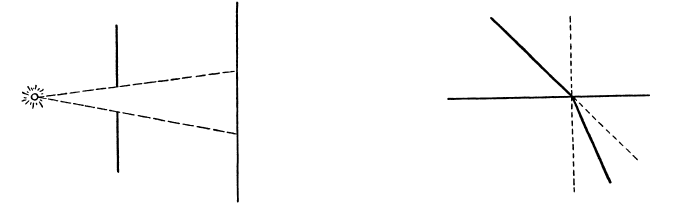
We shall describe a primitive and naive experiment showing this. In front of a
point source is placed a screen with a hole in it. A point source is a very
small source of light, say, a small opening in a closed lantern. On a distant
wall the hole in the screen will be represented as light on a dark background. The
next drawing shows how this phenomenon is connected with the rectilinear
propagation of light. All such phenomena, even the more complicated cases in
which light, shadow, and half-shadows appear, can be explained by the
assumption that light, in vacuo or in
air, travels along straight lines.
The propagation of light is rectilinear. Light, in vacuo or in air, travels along straight lines.
Let
us take another example, a case in which light passes through matter. We have a
light beam travelling through a vacuum and falling on a glass plate. What happens?
If the law of rectilinear motion were still valid, the path would be that shown
by the dotted line. But actually it is not. There is a break in the path, such as
is shown in the drawing. What we observe here is the phenomenon known as refraction. The familiar appearance of a
stick which seems to be bent in the middle if half-immersed in water is one of
the many manifestations of refraction.
Light bends down as it enters denser medium. This is a phenomenon known as refraction.
These
facts are sufficient to indicate how a simple mechanical theory of light could
be devised. Our aim here is to show how the ideas of substances, particles, and
forces penetrated the field of optics, and how finally the old philosophical
point of view broke down.
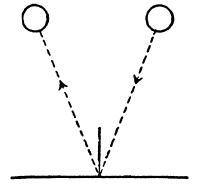
The theory here suggests itself in its simplest and most primitive form. Let us assume that all lighted bodies emit particles of light, or corpuscles, which, falling on our eyes, create the sensation of light. We are already so accustomed to introduce new substances, if necessary for a mechanical explanation, that we can do it once more without any great hesitation. These corpuscles must travel along straight lines through empty space with a known speed, bringing to our eyes messages from the bodies emitting light. All phenomena exhibiting the rectilinear propagation of light support the corpuscular theory, for just this kind of motion was prescribed for the corpuscles. The theory also explains very simply the reflection of light by mirrors as the same kind of reflection as that shown in the mechanical experiment of elastic balls thrown against a wall, as the next drawing indicates.
Light can be assumed to be a weightless substance made of particles or corpuscles. Light travels along straight lines through empty space with a known speed, as any particle would. The theory also explains very simply the reflection of light by mirrors.
The
explanation of refraction is a little more difficult. Without going into
details, we can see the possibility of a mechanical explanation. If corpuscles
fall on the surface of glass, for example, it may be that a force is exerted on
them by the particles of the matter, a force which strangely enough acts only
in the immediate neighbourhood of matter. Any force acting on a moving particle
changes the velocity, as we already know. If the net force on the
light-corpuscles is an attraction perpendicular to the surface of the glass,
the new motion will lie somewhere between the line of the original path and the
perpendicular. This simple explanation seems to promise success for the
corpuscular theory of light. To determine the usefulness and range of validity
of the theory, however, we must investigate new and more complicated facts.
The refraction of light means that an attractive force is exerted on light-corpuscles perpendicular to the surface of the glass that changes their velocity.
.
Final Comment
Light corpuscles behave like matter particles in many ways. Light has no mass but it has inertia that keeps its velocity finite. Thus, light is considered to be a weightless substance.
This paper presents Chapter
II, section 4 from the book THE EVOLUTION
OF PHYSICS by A. EINSTEIN and L. INFELD. The contents are from the original
publication of this book by Simon and Schuster, New York (1942).
The paragraphs of the original
material (in black) are accompanied by brief comments (in color) based on the present
understanding. Feedback on these comments is appreciated.
The heading below is linked to
the original materials.
In
Galileo’s Two New Sciences we listen
to a conversation of the master and his pupils about the velocity of light:
SAGREDO: But of what kind and how great must we consider this speed of light to be? Is it instantaneous or momentary or does it, like other motion, require time? Can we not decide this by experiment?
SIMPLICIO: Everyday experience shows that the propagation of light is instantaneous; for when we see a piece of artillery fired, at great distance, the flash reaches our eyes without lapse of time; but the sound reaches the ear only after a noticeable interval.
SAGREDO: Well, Simplicio, the only thing I am able to infer from this familiar bit of experience is that sound, in reaching our ears, travels more slowly than light; it does not inform me whether the coming of the light is instantaneous or whether, although extremely rapid, it still occupies time ….
SALVIATI: The small conclusiveness of these and other similar observations once led me to devise a method by which one might accurately ascertain whether illumination, i.e., propagation of light, is really instantaneous ….
Salviati
goes on to explain the method of his experiment. In order to understand his idea
let us imagine that the velocity of light is not only finite, but also small,
that the motion of light is slowed down, like that in a slow-motion film. Two
men, A and B, have covered lanterns and stand, say, at a distance of one mile
from each other. The first man, A, opens his lantern. The two have made an
agreement that B will open his the moment he sees A’s light. Let us assume that
in our “slow motion” the light travels one mile in a second. A sends
a signal by uncovering his lantern. B sees it after one second and sends an
answering signal. This is received by A two seconds after he had sent his own. That
is to say, if light travels with a speed of one mile per second, then two
seconds will elapse between A’s sending and receiving a signal, assuming that B
is a mile away. Conversely, if A does not know the velocity of light but
assumes that his companion kept the agreement, and he notices the opening of B’s
lantern two seconds after he opened his, he can conclude that the speed of
light is one mile per second.
With
the experimental technique available at that time Galileo had little chance of
determining the velocity of light in this way. If the distance were a mile, he
would have had to detect time intervals of the order of one hundred-thousandth
of a second!
Galileo
formulated the problem of determining the velocity of light, but did not solve
it. The formulation of a problem is often more essential than its solution, which
may be merely a matter of mathematical or experimental skill. To raise new
questions, new possibilities, to regard old problems from a new angle, requires
creative imagination and marks real advance in science. The principle of
inertia, the law of conservation of energy were gained only by new and original
thoughts about already well-known experiments and phenomena. Many instances of
this kind will be found in the following pages of this book, where the
importance of seeing known facts in a new light will be stressed and new
theories described.
To raise new questions, new possibilities, to regard old
problems from a new angle, requires creative imagination and marks real advance
in science.
Returning
to the comparatively simple question of determining the velocity of light, we
may remark that it is surprising that Galileo did not realize that his experiment
could be performed much more simply and accurately by one man. Instead of
stationing his companion at a distance he could have mounted there a mirror,
which would automatically send back the signal immediately after receiving it.
About
two hundred and fifty years later this very principle was used by Fizeau, who
was the first to determine the velocity of light by terrestrial experiments. It
had been determined by Roemer much earlier, though less accurately, by
astronomical observation.
It
is quite clear that in view of its enormous magnitude, the velocity of light
could be measured only by taking distances comparable to that between the earth
and another planet of the solar system or by a great refinement of experimental
technique. The first method was that of Roemer, the second that of Fizeau. Since
the days of these first experiments the very important number representing the
velocity of light has been determined many times, with increasing accuracy. In
our own century a highly refined technique was devised for this purpose by
Michelson. The result of these experiments can be expressed simply: The
velocity of light in vacuo is
approximately 186,000 miles per second, or 300,000 kilometres per second.
The velocity of light in vacuo is
approximately 186,000 miles per second, or 300,000 kilometres per second.
.
Final Comment
It was quite a discovery that the velocity of light was finite and very large, and not instantaneous. The velocity is determined with experiments with visible light. Therefore, this value may vary in the range of electromagnetic spectrum. But this variation is very small compared to the velocity of light.
This paper presents Chapter
II, section 3 from the book THE EVOLUTION
OF PHYSICS by A. EINSTEIN and L. INFELD. The contents are from the original
publication of this book by Simon and Schuster, New York (1942).
The paragraphs of the original
material (in black) are accompanied by brief comments (in color) based on the present
understanding. Feedback on these comments is appreciated.
The heading below is linked to
the original materials.
We
are now ready to note the first grave difficulty in the application of our
general philosophical point of view. It will be shown later that this
difficulty, together with another even more serious, caused a complete breakdown
of the belief that all phenomena can be explained mechanically.
The mechanical view is to describe all phenomena by means of attractive and repulsive forces depending only on distance and acting between unchangeable particles. This view has serious flaws.
The
tremendous development of electricity as a branch of science and technique
began with the discovery of the electric current. Here we find in the history
of science one of the very few instances in which accident seemed to play an
essential role. The story of the convulsion of a frog’s leg is told in many
different ways. Regardless of the truth concerning details, there is no doubt
that Galvani’s accidental discovery led Volta at the end of the eighteenth
century to the construction of what is known as a voltaic battery. This is no longer of any practical use, but it
still furnishes a very simple example of a source of current in school
demonstrations and in textbook descriptions.
Galvani’s observation of the convulsion of a frog’s leg led Volta to constructa voltaic battery as a source of electric current. This accidental discovery of the electric current led to the tremendous development of electricity as a branch of science.
The
principle of its construction is simple. There are several glass tumblers, each
containing water with a little sulphuric acid. In each glass two metal plates,
one copper and the other zinc, are immersed in the solution. The copper plate
of one glass is connected to the zinc of the next, so that only the zinc plate
of the first and the copper plate of the last glass remain unconnected. We can
detect a difference in electric potential between the copper in the first glass
and the zinc in the last by means of a fairly sensitive electroscope if the
number of the “elements”, that is, glasses with plates, constituting the battery,
is sufficiently large.
The voltaic battery, constructed with two different metals in a solution of acid, produces enough electric potential difference between those metals to be detected by an electroscope.
It
was only for the purpose of obtaining something easily measurable with
apparatus already described that we introduced a battery consisting of several
elements. For further discussion, a single element will serve just as well. The
potential of the copper turns out to be higher than that of the zinc.
“Higher” is used here in the sense in which +2 is greater than -2. If
one conductor is connected to the free copper plate and another to the zinc,
both will become charged, the first positively and the other negatively. Up to
this point nothing particularly new or striking has appeared, and we may try to
apply our previous ideas about potential differences. We have seen that a
potential difference between two conductors can be quickly nullified by connecting
them with a wire, so that there is a flow of electric fluid from one conductor
to the other. This process was similar to the equalization of temperatures by
heat flow. But does this work in the case of a voltaic battery? Volta wrote in
his report that the plates behave like conductors:
. . . feebly charged, which act unceasingly or so that their charge after each discharge re-establishes itself; which, in a word, provides an unlimited charge or imposes a perpetual action or impulsion of the electric fluid.
The electric potential difference was expected to discharge when the two metals were connected, but, instead, there was an unceasing flow of charge.
The astonishing result of his experiment is that the potential difference between the copper and zinc plates does not vanish as in the case of two charged conductors connected by a wire. The difference persists, and according to the fluids theory it must cause a constant flow of electric fluid from the higher potential level (copper plate) to the lower (zinc plate). In an attempt to save the fluid theory, we may assume that some constant force acts to regenerate the potential difference and cause a flow of electric fluid. But the whole phenomenon is astonishing from the standpoint of energy. A noticeable quantity of heat is generated in the wire carrying the current, even enough to melt the wire if it is a thin one. Therefore, heat-energy is created in the wire. But the whole voltaic battery forms an isolated system, since no external energy is being supplied. If we want to save the law of conservation of energy we must find where the transformations take place, and at what expense the heat is created. It is not difficult to realize that complicated chemical processes are taking place in the battery, processes in which the immersed copper and zinc, as well as the liquid itself, take active parts. From the standpoint of energy this is the chain of transformations which are taking place: chemical energy → energy of the flowing electric fluid, i.e., the current → heat. A voltaic battery does not last for ever; the chemical changes associated with the flow of electricity make the battery useless after a time.
From the standpoint of conservation of energy this is the chain of transformations which are taking place: chemical energy → energy of the flowing electric fluid, i.e., the current → heat.
The
experiment which actually revealed the great difficulties in applying the
mechanical ideas must sound strange to anyone hearing about it for the first
time. It was performed by Oersted about a hundred and twenty years ago. He reports:
By these experiments it seems to be shown that the magnetic needle was moved from its position by help of a galvanic apparatus, and that, when the galvanic circuit was closed, but not when open, as certain very celebrated physicists in vain attempted several years ago.
Suppose we have a voltaic battery and a conducting wire. If the wire is connected to the copper plate but not to the zinc, there will exist a potential difference but no current can flow. Let us assume that the wire is bent to form a circle, in the centre of which a magnetic needle is placed, both wire and needle lying in the same plane. Nothing happens so long as the wire does not touch the zinc plate. There are no forces acting, the existing potential difference having no influence whatever on the position of the needle. It seems difficult to understand why the “very celebrated physicists”, as Oersted called them, expected such an influence.
But
now let us join the wire to the zinc plate. Immediately a strange thing
happens. The magnetic needle turns from its previous position. One of its poles
now points to the reader if the page of this book represents the plane of the
circle. The effect is that of a force, perpendicular
to the plane, acting on the magnetic pole. Faced with the facts of the
experiment, we can hardly avoid drawing such a conclusion about the direction
of the force acting.
The moment the circular wire is joined to the zinc plate, the magnetic needle turns, as if there is a force acting on the magnetic pole, perpendicular to the plane of the wire.
This
experiment is interesting, in the first place, because it shows a relation
between two apparently quite different phenomena, magnetism and electric
current. There is another aspect even more important. The force between the
magnetic pole and the small portions of the wire through which the current
flows cannot lie along lines connecting the wire and needle, or the particles of
flowing electric fluid and the elementary magnetic dipoles. The force is
perpendicular to these lines! For the first time there appears a force quite
different from that to which, according to our mechanical point of view, we
intended to reduce all actions in the external world. We remember that the
forces of gravitation, electrostatics, and magnetism, obeying the laws of Newton
and Coulomb, act along the line adjoining the two attracting or repelling
bodies.
Here we see a relation between two apparently quite different phenomena, magnetism and electric current. Furthermore, the force is perpendicular to the lines connecting the wire and the needle, unlike the mechanical forces.
This difficulty was stressed even more by an experiment performed with great skill by Rowland nearly sixty years ago. Leaving out technical details, this experiment could be described as follows. Imagine a small charged sphere. Imagine further that this sphere moves very fast in a circle at the centre of which is a magnetic needle. This is, in principle, the same experiment as Oersted’s, the only difference being that instead of an ordinary current we have a mechanically effected motion of the electric charge. Rowland found that the result is indeed similar to that observed when a current flows in a circular wire. The magnet is deflected by a perpendicular force.
Let
us now move the charge faster. The force acting on the magnetic pole is, as a
result, increased; the deflection from its initial position becomes more
distinct. This observation presents another grave complication. Not only does
the force fail to lie on the line connecting charge and magnet, but the intensity
of the force depends on the velocity of the charge. The whole mechanical point
of view was based on the belief that all phenomena can be explained in terms of
forces depending only on the distance and not on the velocity. The result of
Rowland’s experiment certainly shakes this belief. Yet we may choose to be
conservative and seek a solution within the frame of old ideas.
Not only does the force fail to lie on the line connecting charge and magnet, but the intensity of the force depends on the velocity of the charge, and not on the distance as is the case with mechanical forces.
Difficulties
of this kind, sudden and unexpected obstacles in the triumphant development of
a theory, arise frequently in science. Sometimes a simple generalization of the
old ideas seems, at least temporarily, to be a good way out. It would seem
sufficient in the present case, for example, to broaden the previous point of
view and introduce more general forces between the elementary particles. Very
often, however, it is impossible to patch up an old theory, and the
difficulties result in its downfall and the rise of a new one. Here it was not only
the behaviour of a tiny magnetic needle which broke the apparently well-founded
and successful mechanical theories. Another attack, even more vigorous, came
from an entirely different angle. But this is another story, and we shall tell
it later.
Here we observe a phenomenon that contradicts the mechanical view.
.
Final Comment
The mechanical view describes all phenomena by means of attractive and repulsive forces that depend only on distance and act between unchangeable particles. This view is seriously violated, when we observe that a charge, moving circularly in a plane, generates a force perpendicular to that plane. Furthermore, the intensity of this force depends on the velocity of the charge, and not on any distance.
This paper presents Chapter
II, section 2 from the book THE EVOLUTION
OF PHYSICS by A. EINSTEIN and L. INFELD. The contents are from the original
publication of this book by Simon and Schuster, New York (1942).
The paragraphs of the original
material (in black) are accompanied by brief comments (in color) based on the present
understanding. Feedback on these comments is appreciated.
The heading below is linked to
the original materials.
We shall proceed here in the same manner as before, starting with very simple facts and then seeking their theoretical explanation.
1.
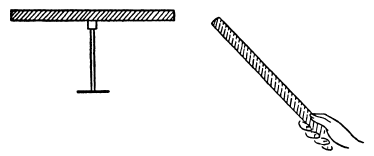
We have two long bar magnets, one suspended freely at its centre, the other
held in the hand. The ends of the two magnets are brought together in such a
way that a strong attraction is noticed between them. This can always be done.
If no attraction results, we must turn the magnet and try the other end.
Something will happen if the bars are magnetized at all. The ends of the
magnets are called their poles. To
continue with the experiment we move the pole of the magnet held in the hand
along the other magnet. A decrease in the attraction is noticed and when the
pole reaches the middle of the suspended magnet there is no evidence of any
force at all. If the pole is moved farther in the same direction a repulsion is
observed, attaining its greatest strength at the second pole of the hanging magnet.
2. The above experiment suggests another. Each magnet has two poles. Can we not isolate one of them? The idea is very simple: just break a magnet into two equal parts. We have seen that there is no force between the pole of one magnet and the middle of the other. But the result of actually breaking a magnet is surprising and unexpected. If we repeat the experiment described under 1, with only half a magnet suspended, the results are exactly the same as before! Where there was no trace of magnetic force previously, there is now a strong pole.
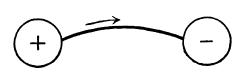
How are these facts to be explained? We can attempt to pattern a theory of magnetism after the theory of electric fluids. This is suggested by the fact that here, as in electrostatic phenomena, we have attraction and repulsion. Imagine two spherical conductors possessing equal charges, one positive and the other negative. Here “equal” means having the same absolute value; + 5 and 5, for example, have the same absolute value. Let us assume that these spheres are connected by means of an insulator such as a glass rod. Schematically this arrangement can be represented by an arrow directed from the negatively charged conductor to the positive one. We shall call the whole thing an electric dipole. It is clear that two such dipoles would behave exactly like the bar magnets in experiment 1. If we think of our invention as a model for a real magnet, we may say, assuming the existence of magnetic fluids, that a magnet is nothing but a magnet dipole, having at its ends two fluids of different kinds. This simple theory, imitating the theory of electricity, is adequate for an explanation of the first experiment. There would be attraction at one end, repulsion at the other, and a balancing of equal and opposite forces in the middle. But what of the second experiment? By breaking the glass rod in the case of the electric dipole we get two isolated poles. The same ought to hold good for the iron bar of the magnetic dipole, contrary to the results of the second experiment. Thus this contradiction forces us to introduce a somewhat more subtle theory. Instead of our previous model we may imagine that the magnet consists of very small elementary magnetic dipoles which cannot be broken into separate poles. Order reigns in the magnet as a whole, for all the elementary dipoles are directed in the same way. We see immediately why cutting a magnet causes two new poles to appear on the new ends, and why this more refined theory explains the facts of experiment 1 as well as 2.
Each magnet has two poles. Similar to the electrostatic phenomena, opposite poles attract; and like poles repel each other; but the magnetic poles cannot be isolated. Cutting a magnet causes two new poles to appear on the new ends. We theorize that the magnet consists of very small elementary magnetic dipoles directed in the same way. The elementary magnetic dipoles cannot be broken into separate poles.
For
many facts, the simpler theory gives an explanation and the refinement seems
unnecessary. Let us take an example: We know that a magnet attracts pieces of iron.
Why? In a piece of ordinary iron the two magnetic fluids are mixed, so that no
net effect results. Bringing a positive pole near acts as a “command of division”
to the fluids, attracting the negative fluid of the iron and repelling the
positive. The attraction between iron and magnet follows. If the magnet is removed,
the fluids go back to more or less their original state, depending on the
extent to which they remember the commanding voice of the external force.
The magnetic dipoles are mixed in the iron, but they manage to order themselves in the presence of a magnet.
Little
need be said about the quantitative side of the problem. With two very long
magnetized rods we could investigate the attraction (or repulsion) of their
poles when brought near one another. The effect of the other ends of the rods
is negligible if the rods are long enough. How does the attraction or repulsion
depend on the distance between the poles? The answer given by Coulomb’s
experiment is that this dependence on distance is the same as in Newton’s law
of gravitation and Coulomb’s law of electrostatics.
The dependence on distance in magnetic attraction (or repulsion)
is the same as in Newton’s law of gravitation and Coulomb’s law of
electrostatics.
We
see again in this theory the application of a general point of view: the
tendency to describe all phenomena by means of attractive and repulsive forces depending
only on distance and acting between unchangeable particles.
All phenomena may be described by means of attractive and repulsive forces depending only on distance.
One
well-known fact should be mentioned, for later we shall make use of it. The
earth is a great magnetic dipole. There is not the slightest trace of an
explanation as to why this is true. The North Pole is approximately the minus
(-) and the South Pole the plus (+) magnetic pole of the earth. The names plus
and minus are only a matter of convention, but when once fixed, enable us to
designate poles in any other case. A magnetic needle supported on a vertical
axis obeys the command of the magnetic force of the earth. It directs its (+) pole
toward the North Pole, that is, toward the (-) magnetic pole of the earth.
The earth is a great magnetic dipole.
Although
we can consistently carry out the mechanical view in the domain of electric and
magnetic phenomena introduced here, there is no reason to be particularly proud
or pleased about it. Some features of the theory are certainly unsatisfactory
if not discouraging. New kinds of substances had to be invented: two electric fluids
and the elementary magnetic dipoles. The wealth of substances begins to be overwhelming!
Here we are inventing new substances (heat, electric charges, magnetic dipoles).
The
forces are simple. They are expressible in a similar way for gravitational,
electric, and magnetic forces. But the price paid for this simplicity is high: the
introduction of new weightless substances. These are rather artificial
concepts, and quite unrelated to the fundamental substance, mass.
These weightless substances are rather artificial concepts, and quite unrelated to the fundamental substance, mass.
.
Final Comment
In this mechanical view, there are new weightless substances (heat, electric charges, magnetic dipoles) that involve forces that seem to behave very similar to the gravitational force. But gravitational force involves mass as substance.
This paper presents Chapter
II, section 1 from the book THE EVOLUTION
OF PHYSICS by A. EINSTEIN and L. INFELD. The contents are from the original
publication of this book by Simon and Schuster, New York (1942).
The paragraphs of the original
material (in black) are accompanied by brief comments (in color) based on the present
understanding. Feedback on these comments is appreciated.
The heading below is linked to
the original materials.
The
following pages contain a dull report of some very simple experiments. The
account will be boring not only because the description of experiments is
uninteresting in comparison with their actual performance, but also because the
meaning of the experiments does not become apparent until theory makes it so.
Our purpose is to furnish a striking example of the role of theory in physics.
1. A metal bar is supported on a glass base, and each end of the bar is connected by means of a wire to an electroscope. What is an electroscope? It is a simple apparatus consisting essentially of two leaves of gold foil hanging from the end of a short piece of metal. This is enclosed in a glass jar or flask and the metal is in contact only with non-metallic bodies, called insulators. In addition to the electroscope and metal bar we are equipped with a hard rubber rod and a piece of flannel.
The
experiment is performed as follows: we look to see whether the leaves hang
close together, for this is their normal position. If by chance they do not, a touch
of the finger on the metal rod will bring them together. These preliminary
steps being taken, the rubber rod is rubbed vigorously with the flannel and brought
into contact with the metal. The leaves separate at once! They remain apart
even after the rod is removed.
2.
We perform another experiment, using the same apparatus as before, again
starting with the gold leaves hanging close together. This time we do not bring
the rubbed rod into actual contact with the metal, but only near it. Again the
leaves separate. But there is a difference! When the rod is taken away without
having touched the metal, the leaves immediately fall back to their normal
position instead of remaining separated.
3. Let us change the apparatus slightly for a third experiment. Suppose that the metal bar consists of two pieces, joined together. We rub the rubber rod with flannel and again bring it near the metal. The same phenomenon occurs, the leaves separate. But now let us divide the metal rod into its two separate parts and then take away the rubber rod. We notice that in this case the leaves remain apart, instead of falling back to their normal position as in the second experiment.
It
is difficult to evince enthusiastic interest in these simple and naive
experiments. In the Middle Ages their performer would probably have been
condemned; to us they seem both dull and illogical. It would be very difficult
to repeat them, after reading the account only once, without becoming confused.
Some notion of the theory makes them understandable. We could say more: it is
hardly possible to imagine such experiments performed as accidental play,
without the pre-existence of more or less definite ideas about their meaning.
We
shall now point out the underlying ideas of a very simple and naive theory
which explains all the facts described.
There exist two electric fluids, one called positive (+) and the other negative (-). They are somewhat like substance in the sense already explained, in that the amount can be enlarged or diminished, but the total in any isolated system is preserved. There is, however, an essential difference between this case and that of heat, matter or energy. We have two electrical substances. It is impossible here to use the previous analogy of money unless it is somehow generalized. A body is electrically neutral if the positive and negative electric fluids exactly cancel each other. A man has nothing, either because he really has nothing, or because the amount of money put aside in his safe is exactly equal to the sum of his debts. We can compare the debit and credit entries in his ledger to the two kinds of electric fluids.
A property of substance is that its amount can be enlarged or diminished, but the total in any isolated system is preserved. In the case of electricity there exist two electric fluids that neutralize each other.
The next assumption of the theory is that two electric fluids of the same kind repel each other, while two of the opposite kind attract. This can be represented graphically in the following way:
Two electric fluids of the same kind repel each other, while two of the opposite kind attract.
A
final theoretical assumption is necessary: There are two kinds of bodies, those
in which the fluids can move freely, called conductors,
and those in which they cannot, called insulators.
As is always true in such cases, this division is not to be taken too
seriously. The ideal conductor or insulator is a fiction which can never be
realized. Metals, the earth, the human body, are all examples of conductors,
although not equally good. Glass, rubber, china, and the like are insulators. Air
is only partially an insulator, as everyone who has seen the described
experiments knows. It is always a good excuse to ascribe the bad results of
electrostatic experiments to the humidity of the air, which increases its
conductivity.
There are two kinds of bodies, those in which the fluids can move freely, called conductors, and those in which they cannot, called insulators.
These
theoretical assumptions are sufficient to explain the three experiments
described. We shall discuss them once more, in the same order as before, but in
the light of the theory of electric fluids.
1.
The rubber rod, like all other bodies under normal conditions, is electrically
neutral. It contains the two fluids, positive and negative, in equal amounts.
By rubbing with flannel we separate them. This statement is pure convention,
for it is the application of the terminology created by the theory to the
description of the process of rubbing. The kind of electricity that the rod has
in excess afterwards is called negative, a name which is certainly only a
matter of convention. If the experiments had been performed with a glass rod rubbed
with cat’s fur we should have had to call the excess positive, to conform with
the accepted convention. To proceed with the experiment, we bring electric fluid
to the metal conductor by touching it with the rubber. Here it moves freely,
spreading over the whole metal including the gold leaves. Since the action of negative
on negative is repulsion, the two leaves try to get as far from each other as
possible and the result is the observed separation. The metal rests on glass or
some other insulator so that the fluid remains on the conductor, as long as the
conductivity of the air permits. We understand now why we have to touch the metal
before beginning the experiment. In this case the metal, the human body, and
the earth form one vast conductor, with the electric fluid so diluted that
practically nothing remains on the electroscope.
2.
This experiment begins just in the same way as the previous one. But instead of
being allowed to touch the metal the rubber is now only brought near it. The two
fluids in the conductor, being free to move, are separated, one attracted and
the other repelled. They mix again when the rubber rod is removed, as fluids of
opposite kinds attract each other.
3.
Now we separate the metal into two parts and afterwards remove the rod. In this
case the two fluids cannot mix, so that the gold leaves retain an excess of one
electric fluid and remain apart.
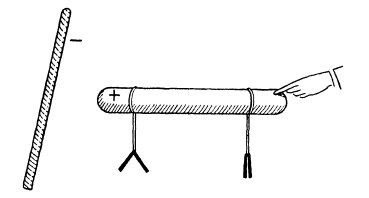
In the light of this simple theory all the facts mentioned here seem comprehensible. The same theory does more, enabling us to understand not only these, but many other facts in the realm of “electrostatics”. The aim of every theory is to guide us to new facts, suggest new experiments, and lead to the discovery of new phenomena and new laws. An example will make this clear. Imagine a change in the second experiment. Suppose I keep the rubber rod near the metal and at the same time touch the conductor with my finger. What will happen now? Theory answers: the repelled fluid (-) can now make its escape through my body, with the result that only one fluid remains, the positive. Only the leaves of the electroscope near the rubber rod will remain apart. An actual experiment confirms this prediction.
The
theory with which we are dealing is certainly naive and inadequate from the
point of view of modern physics. Nevertheless it is a good example showing the characteristic
features of every physical theory.
The above theory of electricity explains the experimental
observations.
There
are no eternal theories in science. It always happens that some of the facts
predicted by a theory are disproved by experiment. Every theory has its period
of gradual development and triumph, after which it may experience a rapid
decline. The rise and fall of the substance theory of heat, already discussed here,
is one of many possible examples. Others, more profound and important, will be
discussed later. Nearly every great advance in science arises from a crisis in
the old theory, through an endeavour to find a way out of the difficulties
created. We must examine old ideas, old theories, although they belong to the
past, for this is the only way to understand the importance of the new ones and
the extent of their validity.
Older theories are superseded by later theories based on new
observations.
In
the first pages of our book we compared the role of an investigator to that of
a detective who, after gathering the requisite facts, finds the right solution by
pure thinking. In one essential this comparison must be regarded as highly
superficial. Both in life and in detective novels the crime is given. The
detective must look for letters, fingerprints, bullets, guns, but at least he
knows that a murder has been committed. This is not so for a scientist. It
should not be difficult to imagine someone who knows absolutely nothing about electricity,
since all the ancients lived happily enough without any knowledge of it. Let
this man be given metal, gold foil, bottles, hard-rubber rod, flannel, in short,
all the material required for performing our three experiments. He may be a
very cultured person, but he will probably put wine into the bottles, use the flannel
for cleaning, and never once entertain the idea of doing the things we have
described. For the detective the crime is given, the problem formulated: who killed
Cock Robin? The scientist must, at least in part, commit his own crime, as well
as carry out the investigation. Moreover, his task is not to explain just one case,
but all phenomena which have happened or may still happen.
Scientific investigations proceed on the basis of pure
curiosity.
In
the introduction of the concept of fluids we see the influence of those
mechanical ideas which attempt to explain everything by substances and simple
forces acting between them. To see whether the mechanical point of view can be
applied to the description of electrical phenomena, we must consider the
following problem. Two small spheres are given, both with an electric charge,
that is, both carrying an excess of one electric fluid. We know that the
spheres will either attract or repel each other. But does the force depend only
on the distance, and if so, how? The simplest guess seems to be that this force
depends on the distance in the same way as gravitational force, which diminishes,
say, to one-ninth of its former strength if the distance is made three times as
great. The experiments performed by Coulomb showed that this law is really valid.
A hundred years after Newton discovered the law of gravitation, Coulomb found a
similar dependence of electrical force on distance. The two major differences between
Newton’s law and Coulomb’s law are: gravitational attraction is always present,
while electric forces exist only if the bodies possess electric charges. In the
gravitational case there is only attraction, but electric forces may either
attract or repel.
There is similarity between the laws that govern gravitational
and electrical force. Gravitational attraction is always present, while
electric forces exist only if the bodies possess electric charges. In the
gravitational case there is only attraction, but electric forces may either
attract or repel.
There
arises here the same question which we considered in connection with heat. Are
the electrical fluids weightless substances or not? In other words, is the
weight of a piece of metal the same whether neutral or charged? Our scales show
no difference. We conclude that the electric fluids are also members of the
family of weightless substances.
The electric fluids are also members of the family of weightless
substances.
Further progress in the theory of electricity requires the introduction of two new concepts. Again we shall avoid rigorous definitions, using instead analogies with concepts already familiar. We remember how essential it was for an understanding of the phenomena of heat to distinguish between heat itself and temperature. It is equally important here to distinguish between electric potential and electric charge. The difference between the two concepts is made clear by the analogy:
Two conductors, for example two spheres of different size, may have the same electric charge, that is the same excess of one electric fluid, but the potential will be different in the two cases, being higher for the smaller and lower for the larger sphere. The electric fluid will have greater density and thus be more compressed on the small conductor. Since the repulsive forces must increase with the density, the tendency of the charge to escape will be greater in the case of the smaller sphere than in that of the larger. This tendency of charge to escape from a conductor is a direct measure of its potentials. In order to show clearly the difference between charge and potential we shall formulate a few sentences describing the behaviour of heated bodies, and the corresponding sentences concerning charged conductors.
But
this analogy must not be pushed too far. An example shows the differences as
well as the similarities. If a hot body is brought into contact with a cold
one, the heat flows from the hotter to the colder. On the other hand, suppose
that we have two insulated conductors having equal but opposite charges, one
positive and the other negative. The two are at different potentials. By
convention we regard the potential corresponding to a negative charge as lower
than that corresponding to a positive charge. If the two conductors are brought
together or connected by a wire, it follows from the theory of electric fluids
that they will show no charge and thus no difference of electric potential at
all. We must imagine a “flow” of electric charge from one conductor
to the other during the short time in which the potential difference is
equalized. But how? Does the positive fluid flow to the negative body, or the negative
fluid to the positive body?
Hot and cold temperatures can be put on the same scale, but this is not so with positive and negative electricity.
In
the material presented here we have no basis for deciding between these two
alternatives. We can assume either of the two possibilities, or that the flow
is simultaneous in both directions. It is only a matter of adopting a convention,
and no significance can be attached to the choice, for we know no method of deciding
the question experimentally. Further development leading to a much more
profound theory of electricity gave an answer to this problem, which is quite
meaningless when formulated in terms of the simple and primitive theory of
electric fluids. Here we shall simply adopt the following mode of expression. The
electric fluid flows from the conductor having the higher potential to that
having the lower. In the case of our two conductors, the electricity thus flows
from positive to negative. This expression is only a matter of convention and
is at this point quite arbitrary. The whole difficulty indicates that the
analogy between heat and electricity is by no means complete.
The positive and negative potentials are arbitrarily assigned under the two fluids theory.
We
have seen the possibility of adapting the mechanical view to a description of
the elementary facts of electrostatics. The same is possible in the case of magnetic
phenomena.
.
Final Comment
Postive and negative charges represent two opposite conditions of tension that can exist in matter. When a positive charge arises in one place then an equivalent negative charge must arise at another place. Opposite charges attract each other. Like charges repel each other. When positive and negative charges come together, they neutralize each other. The amount of charge in a system can be enlarged or diminished. The total charge in any isolated system is preserved.
According to Postulate Mechanics, gravity depends on the balance of inertia and motion among a system of bodies. In this theory, the bodies follow their balanced path. Two bodies when pushed closer shall repel each other. Two bodies when pulled apart shall attract each other. There is neutralization in terms of traveling the balanced path.
Thus, there are parallels between electrical and gravitational forces, but their nature is very different.