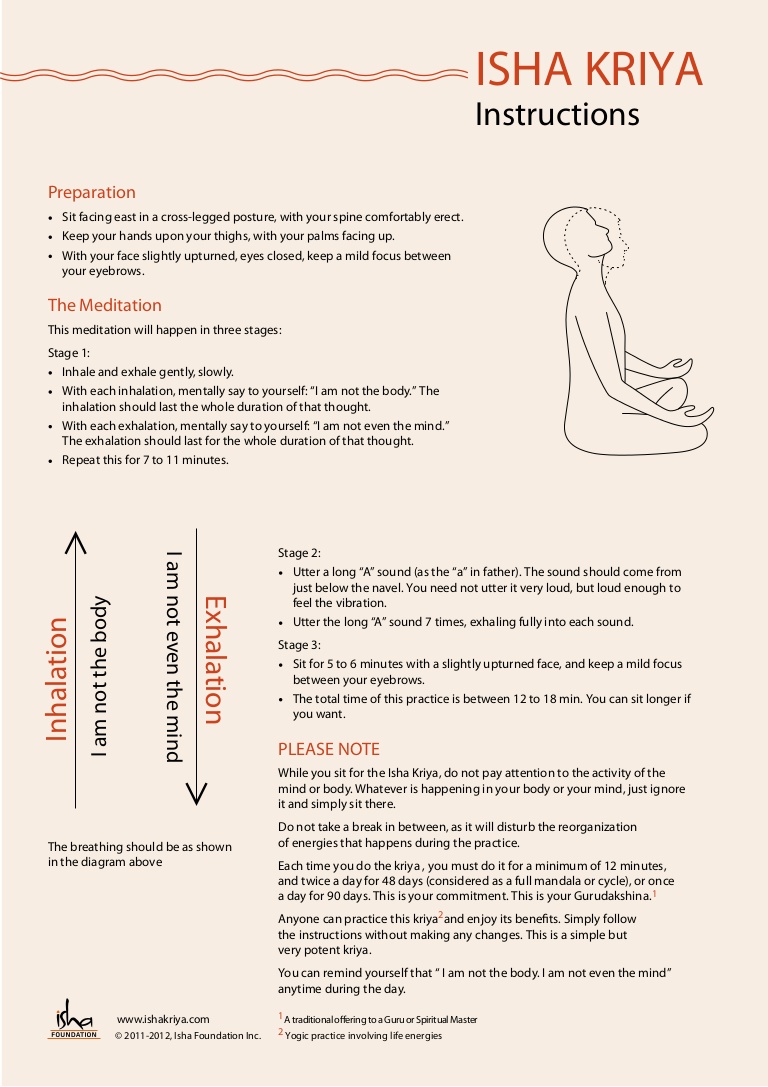
Isha Kriya of Sadhguru

Reference: Course on Subject Clearing

This exercise is taught at Sadhguru’s ISHA Foundation. Please do this exercise as instructed. If you cannot sit in a cross-legged posture comfortably then you may sit on a chair facing East (see Detachment).

This exercise requires a long commitment. During the 48 days that you would be doing Isha Kriya, find some time to study the documents under the section: The Discipline of Mindfulness.

Here is Sadhguru’s video on Isha Kriya.

.

The World of Atom (Part X)

Reference: Boorse 1966: The World of Atom

PART X – X-RAYS AND THEIR CONTRIBUTION TO THE RIDDLE OF MATTER

THE WORLD OF ATOM by Boorse

Chapter 51: Interference Phenomena (Max von Laue 1879 – 1960, Walter Friedrich 1883 – 1968, Paul Knipping 1883 – 1935)

After X-rays had been discovered by Roentgen in 1895, a considerable controversy arose as to their nature. They were unresponsive to electromagnetic forces. But X-rays were scattered from small particles in suspension the way light is scattered in a dusty medium. This and other observations convinced Max von Laue that X-Rays were electromagnetic waves. But X-rays could not be refracted or diffracted the way visible light is because of much shorter wavelength. Laue introduced a very ingenious idea: to use the regular array of atoms in the lattice structure of a crystal as the grating. Laue worked out the theory of this type of diffraction. He received the Nobel Prize for this work in 1914.

Chapter 52: Bragg’s Law (William Henry Bragg 1862 – 1942, William Lawrence Bragg 1890 – 1971)

W. L. Bragg examined the results of X-ray diffraction from Laue’s experiments done in 1812. He proceeded to show that the Laue pattern could be analyzed in a much simpler way. Bragg adopted the view that the incident X-rays consisted of a continuous spectrum extending over a wide range of wavelengths. He supposed that the atoms of the exposed crystal act as a diffraction center and radiate secondary waves, as if they are reflected from a plane made of a number of atoms. The intensity increased with the density of atoms in that plane. The research by the Braggs showed that the X-ray emission spectrum of an element is characteristic of that element, and that X-rays can be used as a powerful and precise means of crystal analysis. The 1915 Nobel Prize was awarded to the Braggs for their contribution to crystal analysis.

Chapter 53: Atomic Number (Antonius Van der Broek 1870 – 1926)

Antonius Van den Broek was the first to suggest that the number of charges in an element’s atomic nucleus is exactly equal to the element’s place on Mendeleev’s periodic table. The number of the place of an element in the periodic table at that time was not thought by most physicists to be a physical property. Simultaneous development of α-particle scattering theory and the X-ray scattering measurements suggested that the number of electrons per atom is equal to half the atomic weight of the atom. It was not until the work of Henry Moseley working with the Bohr model of the atom with the explicit idea of testing Van den Broek’s theory, that it was realized that atomic number was indeed a purely physical property (the charge of the nucleus) which could be measured, and that Van den Broek’s original guess had been correct. Henry Moseley, in his paper on atomic number and X-ray emission, mentions only the models of Rutherford and Van den Broek.

.

MAIN POINTS

  1. X-rays are not deflected by electrical or magnetic fields.
  2. X-rays are scattered from small particles in suspension the way light is scattered in a dusty medium.
  3. X-rays can excite atoms in a body to emit fluorescence radiation
  4. They are electromagnetic waves with much shorter wavelength.
  5. Ingenious idea of using the atoms forming the lattice structure of a crystal as a diffraction grating.
  6. Incident X-rays consist of a continuous spectrum extending over a wide range of wavelengths.
  7. X-ray emission spectrum of an element is characteristic of that element.
  8. X-rays can be used as a powerful and precise means of crystal analysis. 
  9. X-ray scattering measurements suggested that the number of electrons per atom is equal to half the atomic weight of the atom.
  10. To each possible intra-atomic charge corresponds a possible element.
  11. Mass deficit was accounted by protons neutralized by electrons in the nucleus.

THEORY
The number of charges in an element’s atomic nucleus is exactly equal to the element’s place on Mendeleev’s periodic table. 

.

Sadhguru: His Life

I started looking into Sadhguru only recently, since the end of August 2020. I have been researching on the interface between physics and metaphysics and I find Sadhguru’s responses in this area most insightful. Mostly I am impressed by the clarity of his responses to topics that range from common to  esoteric. I am, therefore, studying him in depth.

At first I looked him up on Wikipedia. Then I read the book Sadhguru More than a Life (2010, 242 pages) by Arundhathi Subramaniam. This is a very well-written and informative book. Here is quick time-line that may be corrected and expanded upon as I get feedback.

1957 – (September) Born as Jaggi Vasudev in Mysore in a Telugu speaking family
1970 – (Age 13) Took Yoga Lessons
1978 – Bachelor’s degree in English, Irreverent attitude to school, took to business
1982 – (Age 25) ’Spiritual experience’ on 23 Sept, then travelled extensively for a year
1983 – (Age 26) Yoga Teacher, taught his first yoga class
1984 – SSY teacher training under Guruji Rishi Prabhakar in Gommatagiiri near Mysore
1984 – (Age 27) Married Vijji
1985 – Started a center under the direction of Guruji Rishi Prabhakar in Hyderabad
1987 – Planned to start his own center in Coimbatore.
1989 – He conducted his first class in Coimbatore.
1990 – (March) Birth of daughter, Radhe
1991 – (May) Conducted a silence programme called Samyama (संयमः) for the first time
1992 – Incorporated Isha Foundation
1994 – (Age 37) Set up Isha Yoga Center and started Yoga programs
1994 – (August) Transformed from Jaggi into Sadhguru
1996 – Vijji resigned from her job in Bangalore and moved to Coimbatore.
1996 – (June) Sadhguru initiated Vijji and Bharathi into a process of intense practice
1996 – (June) Sadhguru and Vijji, along with their daughter, visited Swami Nirmalananda.
1996 – Course for the Indian Hockey Team
1996 – (Nov) the edifice of the lingam arrived in the ashram
1996 – (Dec) Sadhguru took Vijji to visit Swami Nirmalananda.
1996 – (Dec) Sadhguru took Vijji and Bharathi on a tour to places of past life.
1996 – Dhyanalinga Yogic Temple construction started
1997 – (Jan 23) Wife Vijji passed away in Mahasamadhi
1997 – Started conducting classes in USA
1998 – Dhyanalinga constructed
1998 – Conducting classes in Tamil Nadu prisons
1999 – (June 23) Dhyanalinga consecration completed
2000 – Addressed United Nation’s Millennium World Peace Summit
2007 – (Age 50) Spoke at World Economic Forum for the first time
2010 – Addressed British parliament’s House of Lords
2012 – Addressed MIT-India Conference
2012 – Addressed International Institute for Management Development, Switzerland
2015 – 21 ft statue of Adiyogi unveiled at Isha Foundation in Tennessee, USA
2017 – (Age 60) 112 ft bust of Adiyogi inaugurated at Isha Foundation in Coimbatore, India
2017 – (Age 60) Padma Vibhushan, India’s second highest civilian award
2024 – (March) Sadhguru underwent emergency brain surgery. He is recovering well.

So far my understanding of Sadhguru is as follows:

(1) From his childhood Sadhguru has never been religious. He was not even spiritual prior to having, at age 25, the mind-blowing experience where he could not tell the difference between his self and his surroundings.

(2) Prior to that point his modus operandi had simply been to give his full laser-sharp attention to things that interested him. He was quick in understanding the broad aspects of things and then he focused on details that didn’t make sense to him until he understood them.

(3) He was not interested in schooling. He just made sure that he had passing grades to move to the next class. He was interested in Yoga from age 12 but not from any spiritual perspective. Yoga simply helped him exercise his body and attention.

(4) He was fortunate to grow up in an environment where the food was nutritious and wholesome, the family was stable and caring, and he was allowed to be himself.

(5) His later spiritual approach is holistic in the sense that it focuses on practice of attention and not on thinking. This attention is to be put on both physical and mental health. It focuses on the step by step understanding of what brings about physical and mental health, and its practice.

(6) The major difference between Sadhguru’s ‘spiritual’ approach and Scientology is that Sadhguru’s entire emphasis is on attentive observation and not on messing around with one’s past memories and thoughts.

(7) In my opinion, Sadhguru’s approach may be summarized as follows: Start as broad as possible in your observation of life and situations. Grasp the details without missing anything. Practice on being “your” best in whatever you do.

I find that my practice of SUBJECT CLEARING is in tune with Sadhguru’s approach.

.

The World of Atom (Part IX)

Reference: Boorse 1966: The World of Atom

PART IX – THE NUCLEAR ATOM

THE WORLD OF ATOM by Boorse

Chapter 43: Strange Results from α-Particle Scattering (Hans Geiger 1882 – 1945, Ernest Marsden 1889 – 1970)

The discovery of the electron in 1897 by J. J. Thompson meant that the atoms have a structure. Since the atom is electrically neutral it was assumed that small discrete electrons were embedded in a jelly like viscous sphere of positive electricity. Thompson made a study based on this model. He assumed that the angle of deviation suffered by the charged particle was always caused by a large number of collisions with many atoms. When Geiger and Marsden conducted their scattering experiments, they found that a thickness of 6 x 10⁻⁵ cm of gold foil was sufficient to produce a deflection of 90 degrees or more. Rutherford contended that the large deviations observed experimentally must have been caused by single direct collisions, and he began looking for an alternative to explain the data.

Rutherford’s research gave us the nuclear atom, which is consistent with the “whirlpool” model of the atom.

Chapter 44: The Nuclear Atom (Ernest Rutherford 1871 – 1937)

Rutherford was impressed about some of the α-particles scattering back toward their source in the work of Geiger. To him this could only mean one thing: there was an enormous force in the atom, that it would take one hundred electron charges on the gold nucleus to give the observed result. He then proceeded to analyze the theory of single collisions on the basis of a model of the atom that is radically different from the Thomson model. Rutherford was particularly interested in the question, “How close to the nucleus can an alpha particle approach?” He got this answer from his theory and the measurements of the scattered α-particles. The answer, 3 x 10⁻¹⁰ cm., showed him how small and compact a nucleus is, and thus the nuclear atom was born. In this Rutherford model the positive electricity is not distributed over a large volume but instead is concentrated in a very small nucleus at the center of the atom. A model of this sort cannot be in static equilibrium, yet this kind of dynamical equilibrium was in serious contradiction with classical electrodynamics.

This contradiction with classical electrodynamics was resolved later.

Chapter 45: Atomic Structure (Niels Bohr 1885 – 1962)

Rutherford had a planetary model in mind for his nuclear atom, but he could not determine a precise orbit for the electron since the classical electrodynamic theory showed that electron would radiate energy and it must ultimately spiral into the nucleus. Bohr reasoned that if the electron can change its state of motion only in discrete steps it must then stay in a particular orbit until it emits or absorbs enough energy in one single process to go from one orbit to another. Bohr introduced Planck’s constant, imposing the condition that the electron must not radiate continuously but rather in the form of “distinctly separated emissions.” Bohr then introduced the concept of “stationary states” to describe the discrete orbits. With his assumptions Bohr obtained correct expression for the frequencies of the spectral lines in the Balmer series in the spectrum of hydrogen.

Classical electrodynamics assumes electron to be a mass particle with charge, which then makes it spiral into the nucleus. But the atom is stable, and the dynamics of an electron occur naturally. That means that the electron cannot be a mass particle with charge. It is a substance of a very different consistency, and that fact is responsible of its dynamics and charge. Quantum mechanics simply introduces this new dimension of consistency of substance that determines its energy of interaction. The geometry of orbits stratifies this consistency. Transitions among these stratifications of consistency generate the spectral lines.

Chapter 46: The Quantum Theory is Tested (James Franck 1882 – 1964, Gustav Hertz 1887 – 1975)

It was not clear from Bohr’s theory of atomic spectra alone whether the quantum theory could be applied to ordinary mechanical energy of motion, or whether it was limited to the emission and absorption of radiant energy. In 1914 James Franck collaborated with Gustav Hertz and completed basic experiments on the collision of electrons with atoms, which demonstrated that an atom could take on energy from collisions only in discrete amounts, in agreement with Bohr’s theory. These experiments demonstrated that a particle like an electron would transfer its energy in a collision only in multiples of a fundamental quantum. From this point it was clear that quantum theory would have to be taken into account in all processes.

In truth electrons are just as massless as radiant energy, the only difference is that electron’s consistency, and hence its inertia, is much higher than the consistency and inertia of radiant energy.

Chapter 47: The discovery of Isotopes (Frederick Soddy 1877 – 1956)

It was recognized that some atomic weights, such as chlorine, were by no stretch of imagination integral. There was speculation that the atoms of a given element might not be identical and that the atomic weight of an element might be the average of the weight of several unequally massive atoms having the same chemical properties. As experience with radioactivity increased, Frederick Soddy (1910) realized that the radioactive transformations produced atoms of the same chemical species but of different weights. We now recognize such chemically non-separable atoms as “isotopes.”

Chapter 48: The Positive Rays (J. J. Thomson 1856 – 1940)

The canal rays were discovered in 1886. They consisted of positively charged particles, but their composition was found to be very complex. The problem was to develop an experimental method to separate out the various particle components. In a lecture in 1913, J.J. Thomson described a simple device, involving electric and magnetic fields, that is the forerunner of the modern mass spectrometer. In this way a spectrum of the canal ray is obtained on a photographic plate. Each point on the spectrum represents a particular value of the speed and of the ratio of charge to mass. The parabola corresponding to hydrogen ions (protons) is the one that is deflected the most. Thomson was thus able to catalogue the atomic and molecular weights of the various elements and compounds in the tube.

Chapter 49: Transmutation of an Element (Ernest Rutherford 1871 – 1937)

After his basic analysis of the experiments on the scattering of α-particles by heavy nuclei, which finally led to the nuclear model of the atom and to Bohr’s theory of atomic spectra, Rutherford began a series of experiments in 1915 on the scattering of α-particles by light atoms. These experiments resulted in the first artificially induced nuclear transformation of an element in 1919. He discovered that α-particles, in passing through air, collided with nitrogen atoms and knocked protons out of these atoms. The importance of Rutherford’s results for the future of atomic physics was of a twofold nature. First, he demonstrated experimentally that nuclei of atoms contain individual protons. Second, his experiment showed that nuclei could be disrupted and changed into other nuclei; this was the first example of the artificial transmutation of chemical elements.

Chapter 50: The Diversity of Atoms (Francis William Aston 1877 – 1945)

J. J. Thomson’s positive ray apparatus opened the door in 1912 for investigations into elements for their isotopes. F.W. Aston assisted Thomson in finding the isotopes of Neon. In 1919 Aston developed a mass spectrograph as an improvement of Thomson’s parabola method. This spectrograph was used to analyze some fifty elements in the following six years, revealing the almost universal existence of isotopes. Mass spectrometers of increasing precision followed, and Aston found that neither the whole number rule nor Prout’s hypothesis could be substantiated. The addition of masses, equal to that of hydrogen, did not give the masses of the succeeding elements in the periodic table. The elemental masses as measured by the spectrograph showed a “mass defect” as compared to the sum of the masses of their free constituent particles. The greater was the mass defect the more stable was the nucleus.

.

MAIN POINTS

  1. Large deflection of α-particles from very thin gold foil gives rise to the idea of a nuclear atom.
  2. The size of the nucleus is of the order of 10-10 cm., compared to the size of the atom of 10-8 cm.
  3. The positive charge is concentrated in a very small nucleus at the center of the atom.
  4. Nuclear atom cannot be in static equilibrium, and dynamical equilibrium contradicts classical electrodynamics.
  5. This necessitates the postulate that electron can change its state of motion in discrete steps only.
  6. This then leads to discrete orbits, and transitions from one such orbit to another give rise to a discrete spectrum.
  7. This was confirmed by correct expression for the frequencies of the spectral lines for hydrogen.
  8. It was further confirmed with atoms taking on energy from collisions only in discrete amounts.
  9. The radioactive transformations produce atoms of the same chemical species but of different weights (isotopes).
  10. Particles in a ray can be separated by their masses.
  11. Nuclei of atoms contain individual protons.
  12. Nuclei can be disrupted and changed into other nuclei (artificial transmutation).
  13. The elemental masses show a “mass defect” as compared to the sum of the masses of their free constituent particles. 
  14. The greater is the mass defect the more stable is the nucleus.

THEORY
The atom consists of a small massive nucleus surrounded by a large volume of rapidly revolving electrons. The  electrons have momentum but no mass. They form discrete stationary orbits around the nucleus that have variations in consistency and energy. Exchanges among these stationary orbits generate the spectral lines. The nucleus is made up of protons but there is a mass defect as protons combine. There are isotopes and artificial transmutation can be induced.

.

The World of Atom (Part VIII)

Reference: Boorse 1966: The World of Atom

PART VIII – TWO FAR-REACHING DISCOVERIES

THE WORLD OF ATOM by Boorse

Chapter 41: The Discovery of Cosmic Rays (Viktor F. Hess 1883 – 1964)

Penetrating γ radiation from the earth’s radioactive material falls off very quickly with increasing height. Data from balloon flights showed that the intensity of the penetrating radiation increases with height. These rays appear to strike the earth in equal intensities from all directions of space, and with energies ranging up to a billion trillion electron volts, far larger than any other known energies in nature. Now we know that cosmic rays are mostly very energetic protons intermixed with small quantities of heavy positive ions and electrons and positrons. Data from the Fermi Space Telescope (2013) have been interpreted as evidence that a significant fraction of primary cosmic rays originates from the supernova explosions of stars. When these very energetic particles strike the earth’s atmosphere, they give rise to vast showers of other atomic and subatomic particles.

A large part of Cosmic Rays are protons, which are hydrogen ions. This is primary material substance stripped off of electromagnetic substance.

Chapter 42: The Cloud Chamber (Charles Thomson Rees Wilson 1869 – 1959)

The cloud chamber helps visualize the passage of ionizing radiation. It consists of a sealed environment containing a supersaturated vapor of water or alcohol. An energetic charged particle (for example, an alpha or beta particle) interacts with the gaseous mixture by knocking electrons off gas molecules via electrostatic forces during collisions, resulting in a trail of ionized gas particles. The resulting ions act as condensation centers around which a mist-like trail of small droplets form. These droplets are visible as a “cloud” track that persists for several seconds. These tracks have characteristic shapes. For example, an alpha particle track is thick and straight, while an electron track is wispy and shows more evidence of deflections by collisions. Cloud chamber played a prominent role in experimental particle physics from the 1920s to the 1950s. It led to the discoveries of the positron in 1932 and the muon in 1936.

This was an ingenious invention.

.

MAIN POINTS

  1. Cosmic rays, a large part of which are very energetic protons, fill the outer space.
  2. The cloud chamber helps visualize the passage of ionizing radiation.

THEORY
The outer space is not empty of substance.

.