VOLTAIRE: Les Délices: The Essay on Morals

Reference: The Story of Philosophy

This paper presents Chapter V Section 5 from the book THE STORY OF PHILOSOPHY by WILL DURANT. The  contents are from the 1933 reprint of this book by TIME INCORPORATED by arrangement with Simon and Schuster, Inc.

The paragraphs of the original material (in black) are accompanied by brief comments (in color) based on the present understanding.

.

V. Les Délices: The Essay on Morals

What was the cause of his new exile? That he had published in Berlin “the most ambitious, the most voluminous, the most characteristic, and the most daring of his works.” Its title was no small part of it: Essai sur les moeurs et l’esprit des Nations, et sur les principaux faits de l’histoire depuis Charlemagne jusqu’à Louis XIII—an Essay on the Morals and the Spirit of the Nations from Charlemagne to Louis XIII. He had begun it at Cirey for Mme. du Chatelet, spurred on to the task by her denunciation of history as she is writ. 

Voltaire was exiled for publishing his Essay on Morals in Berlin.

It is “an old almanac,” she had said. “What does it matter to me, a Frenchwoman living on my estate, to know that Egil succeeded Haquin in Sweden, and that Ottoman was the son of Ortogrul? I have read with pleasure the history of the Greeks and the Romans; they offered me certain pictures which attracted me. But I have never yet been able to finish any long history of our modern nations. I can see scarcely anything in them but confusion; a host of minute events without connection or sequence, a thousand battles which settled nothing. I renounced a study which overwhelms the mind without illuminating it.” 

At Cirey, Mme. du Chatelet had denounced history as it is written, and this spurred Voltaire to write this essay.

Voltaire had agreed; he had made his Ingenu say, “History is nothing more than a picture of crimes and misfortunes”; and he was to write to Horace Walpole (July 15, l768): “Truly the history of the Yorkists and Lancastrians, and many others, is much like reading the history of highway robbers.” But he had expressed to Mme. du Chatelet the hope that a way out might lie in applying philosophy to history, and endeavoring to trace, beneath the flux of political events, the history of the human mind. “Only philosophers should write history,” he said. “In all nations, history is disfigured by fable, till at last philosophy comes to enlighten man; and when it does finally arrive in the midst of this darkness, it finds the human mind so blinded by centuries of error, that it can hardly undeceive it; it finds ceremonies, facts and monuments, heaped up to prove lies.” “History,” he concludes, “is after all nothing but a pack of tricks which we play upon the dead”; we transform the past to suit our wishes for the future, and in the upshot “history proves that anything can be proved by history.” 

These remarks on history by Voltaire are brilliant. He saw history distorted by man to suit his wishes for the future.

He worked like a miner to find in this “Mississippi of falsehoods” the grains of truth about the real history of mankind. Year after year he gave himself to preparatory studies: a History of Russia, a History of Charles XII, The Age of Louis XIV, and The Age of Louis XIII; and through these tasks he developed in himself that unflagging intellectual conscience which enslaves a man to make a genius. “The Jesuit Père Daniel, who produced. a History of France, had placed before him in the Royal Library of Paris 1200 volumes of documents and manuscripts; spent an hour or so looking through them; and then, turning to Father Tournemine, the former teacher of Voltaire, dismissed the matter by declaring that all this material was ‘useless old paper which he had no need of for the purpose of writing his history.'”  Not so Voltaire: he read everything on his subject that he could lay his hands on; he pored over hundreds of volumes of memoirs; he wrote hundreds of letters to survivors of famous events; and even after publishing his works he continued to study, and improved every edition. 

Voltaire was very meticulous in studying in detail, the subject he was writing on.

But this gathering of material was only preparatory; what was needed was a new method of selection and arrangement. Mere facts would not do—even if, as so seldom happens, they were facts. “Details that lead to nothing are to history what baggage is to an army, impedimenta; we must look at things in the large, for the very reason that the human mind is so small, and sinks under the weight of minutiae.” “Facts'” should be collected by annalists and arranged in some kind of historical dictionary where one might find them at need, as one finds words. What Voltaire sought was a unifying principle by which the whole history of civilization in Europe could be woven on one thread; and he was convinced that this thread was the history of culture. He was resolved that, his history should deal, not with kings but with movements, forces, and masses; not with nations but with the human race; not with wars but with the march of the human mind. “Battles and revolutions are the smallest part of the plan; squadrons and battalions conquering or being conquered, towns taken and retaken, are common to ‘all history. … Take away the arts and the progress of the mind, and you will find nothing” in any age ”remarkable enough to attract the attention of posterity.” “I wish to write a history not of wars, but of society; and to ascertain how men lived in the interior of their families, and what were the arts which they commonly cultivated. … My object is the history of the human mind, and not a mere detail of petty facts; nor am I concerned with the history of great lords …; but I want to know what were the steps by which men passed from barbarism to civilization.” This rejection of Kings from history was part of that democratic uprising which at last rejected them from government; the Essai sur les Moeurs began the dethronement of the Bourbons. 

What Voltaire sought was a unifying principle by which the whole history of civilization in Europe could be woven on one thread; and he was convinced that this thread was the history of culture.

And so he produced the first philosophy of history—the first systematic attempt to trace the streams of natural causation in the development of the European mind; it was to be expected that such an experiment should follow upon the abandonment of supernatural explanations: history could not come into its own until theology gave way. According to Buckle, Voltaire’s book laid the basis of modern historical science; Gibbon, Niebuhr, Buckle and Grote were his grateful debtors and followers; he was the caput Nili of them all, and is still unsurpassed in the field which he first explored. 

Voltaire’s book laid the basis of modern historical science. History could not come into its own until theology gave way.

But why did his greatest book bring him exile? Because, by telling the truth, it offended everybody. It especially enraged the clergy by taking the view later developed by Gibbon, that the rapid conquest of paganism by Christianity had disintegrated Rome from within and prepared it to fall an easy victim to the invading and immigrating barbarians. It enraged them further by giving much less space than usual to Judea and Christendom, and by speaking of China, India and Persia, and of their faiths, with the impartiality of a Martian; in this new perspective a vast and novel world was revealed; every dogma faded into relativity; the endless East took on something of the proportions given it by geography; Europe suddenly became conscious of itself as the experimental peninsula of a continent and a culture greater than its own. How could it forgive a European for so unpatriotic a revelation? The King decreed that this Frenchman who dared to think of himself as a man first and a Frenchman afterward should never put foot upon the soil of France again. 

Voltaire’s greatest book bring him exile because by telling the truth, it offended everybody. In this new perspective a vast and novel world was revealed; every dogma faded into relativity; the endless East took on something of the proportions given it by geography…

.
VOLTAIRE: Potsdam and Frederick

Reference: The Story of Philosophy

This paper presents Chapter V Section 4 from the book THE STORY OF PHILOSOPHY by WILL DURANT. The  contents are from the 1933 reprint of this book by TIME INCORPORATED by arrangement with Simon and Schuster, Inc.

The paragraphs of the original material (in black) are accompanied by brief comments (in color) based on the present understanding.

.

IV. Potsdam and Frederick

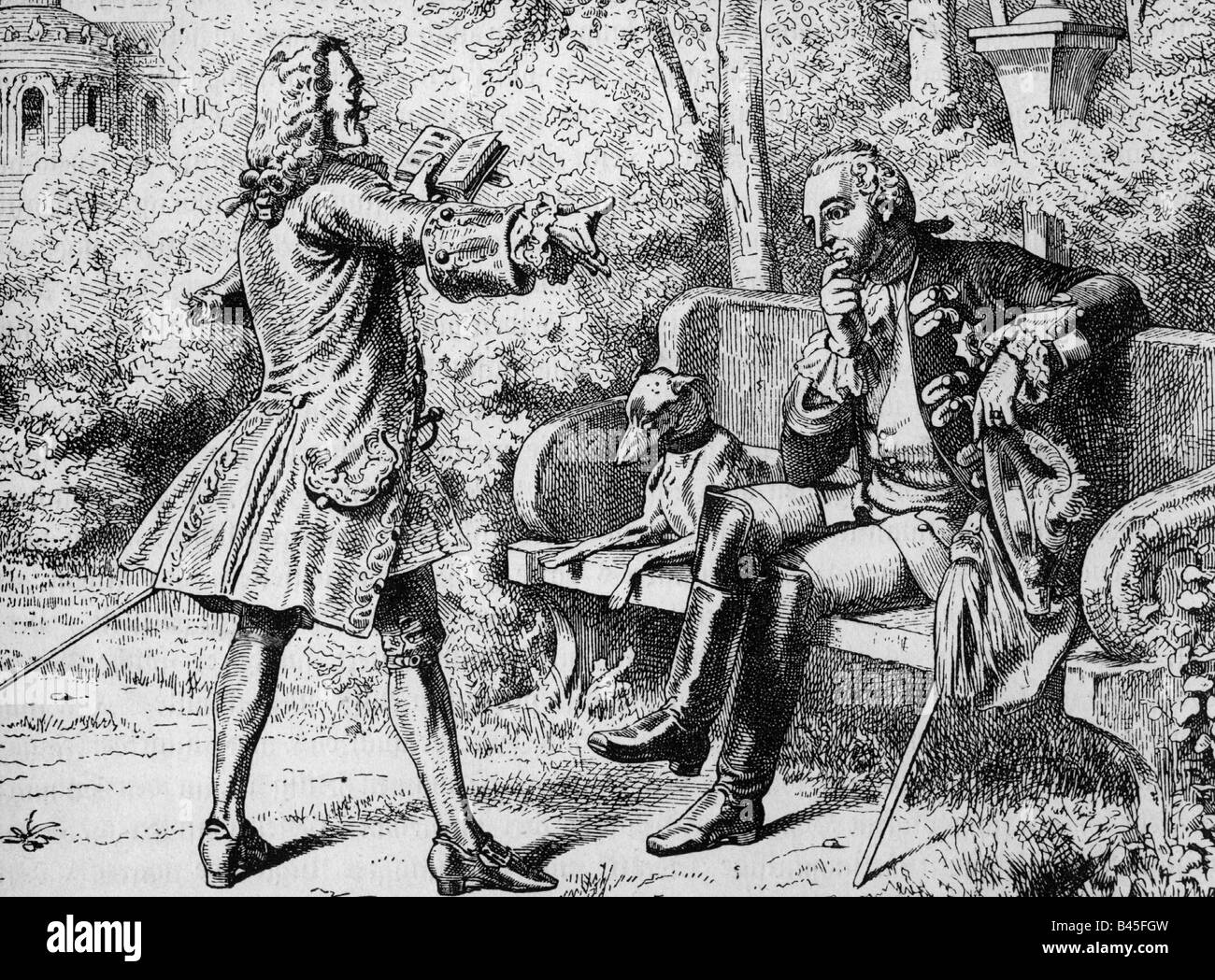
Those who could not come to him wrote to him. In 1736 began his correspondence with Frederick, then Prince, and not yet Great. Frederick’s first letter was like that of a boy to a king; its lavish flattery gives us an inkling of the reputation which Voltaire—though he had not yet written any of his masterpieces—had already won. It proclaims Voltaire as “the greatest man of France, and a mortal who does honor to language. … I count it one of the greatest honors of my life to be born the contemporary of a man of such distinguished attainments as yours. … It is not given to everyone to make the mind laugh”; and “what pleasures can surpass those of the mind?” Frederick was a free-thinker, who looked upon dogmas as a king looks upon subjects; and Voltaire had great hopes that on the throne Frederick would make the Enlightenment fashionable, while he himself, perhaps, might play Plato to Frederick’s Dionysius. When Frederick demurred to the flattery with which Voltaire answered his own, Voltaire replied: A prince who writes against flattery is as singular as a pope who writes against infallibility.” Frederick sent him a copy of the Anti-Machiavel, in which the prince spoke very beautifully of the iniquity of war, and of the duty of a king to preserve peace; Voltaire wept tears of joy over this royal pacifist. A few months later Frederick, made king, invaded Silesia and plunged Europe into a generation of bloodshed. 

Prince Frederick was very charmed by Voltaire. And Voltaire had great hopes of Frederick as King.

In 1745 the poet and his mathematician went to Paris, when Voltaire became a candidate for membership in the French Academy. To achieve this quite superfluous distinction he called himself a good Catholic, complimented some powerful Jesuits, lied inexhaustibly, and in general behaved as most of us do in such cases. He failed; but a year later he succeeded, and delivered a reception address which is one of the classics of the literature of France. For a while he lingered in Paris, flitting from salon to salon, and producing play after play. From Oedipe at eighteen to Irene at eighty-three he wrote a long series of dramas, some of them failures, most of them successes. In 1730 Brutus failed, and in 1732 Eriphyle failed; his friends urged him to abandon the drama; but in the same year he produced Zaire, which became his greateat success. Mahomet followed in 1741, Merope in 1743, Semiramis. n 1748, and Tancrede in 1760. 

Voltaire, in writing drama, had some failures but mostly successes.

Meanwhile tragedy and comedy had entered his own life. After fifteen years, his love for Mme. du Chatelet had somewhat thinned; they had even ceased to quarrel. In 1748 the Marquise fell in love with the handsome young Marquis de Saint-Lambert. When Voltaire discovered it he raged; but when Saint-Lambert asked his forgiveness he melted into a benediction. He had reached the crest of life now, and began to see death in the distance; he could not take it ill that youth should be served. “Such are women,” he said philosophically (forgetting that there are such men too): “I displaced Richelieu, Saint-Lambert turns me out! That is the order of things; one nail drives out another; so goes the world.” He wrote a pretty stanza to the third nail: 

Saint-Lambert, it is all for thee 
The flower grows; 
The rose’s thorns are all for me; 
For thee the rose. 

Then, in 1749, came the death of Mme. du Chatelet in childbirth. It was characteristic of the age that her husband and Voltaire and Saint-Lambert should meet at her death-bed with not one word of reproach, and indeed made friends by then common loss. 

Voltaire had quite a love life.

Voltaire tried to forget his bereavement in work; for a time he busied himself with his Siecle de Louis XIV; but what rescued him from despondency was the opportune renewal of Frederick’s invitation to come to his court at Potsdam. An invitation accompanied by 3000 francs for traveling expenses was irresistible. Voltaire left for Berlin in 1750. 

It soothed him to find himself assigned to a splendid suite in Frederick’s palace, and accepted on equal terms by the most powerful monarch of the age. At first his letters were full of satisfaction: writing on July 24 to d’Argental he describes 

Potsdam—“150,000 soldiers; … opera, comedy, philosophy, poetry, grandeur and graces, grenadiers and muses, trumpets and violins, the suppers of Plato, society and liberty,—who would believe it? Yet it is very true.” Years before, he had written: “Mon Dieu! … what a delightful life it would be to lodge with three or four men of letters with talents and no jealousy” (what imagination!), “to love one another, live quietly, cultivate one’s art, talk of it, enlighten ourselves mutually!—I picture to myself that I shall some day live in this little Paradise.” And here it was! 

In 1750, Voltaire moved to Potsdam at King Frederick’s invitation. At first, he found a lot of satisfaction there.

Voltaire avoided the state dinners; he could not bear to be surrounded with bristling generals; he reserved himself for the private suppers to which Frederick, later in the evening, would invite a small inner circle of literary friends; for this greatest prince of his age yearned to be a poet and a philosopher. The conversation at these suppers was always in French; Voltaire tried to learn German, but gave it up after nearly choking; and wished the Germans had more wit and fewer consonants. One who heard the conversation said that it was better than the most interesting and best-written book in the world. They talked about everything, and said what they thought. Frederick’s wit was almost as sharp as Voltaire’s; and only Voltaire dared to answer him, with that finesse which could kill without giving offense. “One thinks boldly, one is free here,” wrote Voltaire joyfully. Frederick “scratches with one hand, but caresses with the other. … I am crossed in nothing … I find a port after fifty years of storm. I find the protection of a king, the conversation of a philosopher, the charms of an agreeable man, united in one who for sixteen years consoled me in misfortune and sheltered me from my enemies. If one can be certain of anything it is of the character of the King of Prussia.” However … 

He had great company at private suppers with the King of Prussia.

In November of this same year Voltaire thought he would improve his finances by investing in Saxon bonds, despite Frederick’s prohibition of such investments. The bonds rose, and Voltaire profited; but his agent, Hirsch, tried to blackmail him by threatening to publish the transaction. Voltaire “sprang at his throat and sent him sprawling.” Frederick learned of the affair and fell into a royal rage. “I shall want him at the most another year,” he said to La Mettrie; “one squeezes the orange and throws away the rind.” La Mettrie, perhaps anxious to disperse his rivals, took care to report this to Voltaire. The suppers were resumed, “but,” wrote Voltaire, “the orange rind haunts my dreams. … The man who fell from the top of a steeple, and finding the falling through the air soft, said, ‘Good, provided it lasts,’ was not a little as I am.” 

But then he ran afoul of the King by profiting from a prohibited investment.

He half desired a break; for he was as homesick as only a Frenchman can be. The decisive trifle came in 1752. Maupertuis, the great mathematician whom Frederick had imported from France with so many others in an attempt to arouse the German mind by direct contact with the “Enlightenment,” quarreled with a subordinate mathematician, Koenig, over an interpretation of Newton. Frederick entered into the dispute on the side of Maupertuis; and Voltaire, who had more courage than caution, entered it on the side of Koenig. “Unluckily for me,” he wrote to Mme. Denis, “I am also an author, and in the opposite camp to the King. I have no scepter, but I have a pen.” About the same time Frederick was writing to his sister: “The devil is incarnate in my men of letters; there is no doing anything with them. These fellows have no intelligence except for society. … It must be a consolation to animals to see that people with minds are often no better than they.” It was now that Voltaire wrote against Maupertuis his famous “Diatribe of Dr. Akakia.” He read it to Frederick, who laughed all night over it, but begged Voltaire not to publish it. Voltaire seemed to acquiesce;· but the truth was that the thing was already sent to the printer, and the author could not bring himself to practice infanticide on the progeny of his pen. When it appeared Frederick burst into flame, and Voltaire fled from the conflagration. 

The decisive trifle came in 1752. And Voltaire fled from Potsdam.

At Frankfort, though in territory quite outside Frederick’s jurisdiction, he was overtaken and arrested by the King’s agents, and told that he could not go on until he surrendered Frederick’s poem, the Palladium, which had not been adapted for polite society, and out-Pucelled Voltaire’s Pucelle itself. But the terrible manuscript was in a trunk which had been lost on the way; and for weeks, till it came, Voltaire was kept almost in prison. A book-seller to whom he owed something thought it an opportune moment to come and press for the payment of his bill; Voltaire, furious, gave him a blow on the ear; whereupon Voltaire’s secretary, Collini, offered comfort to the man by pointing out, “Sir, you have received a box on the ear from one of the greatest men in the world.” 

Voltaire own life was quite dramatic.

Freed at last, he was about to cross the frontier into France, when word came that he was exiled. The hunted old soul hardly knew where to turn; for a time he thought of going to Pennsylvania—one may imagine his desperation. He spent the March of 1754 seeking “an agreeable tomb” in the neighborhood of Geneva, safe from the rival autocrats of Paris and Berlin; at last he bought an old estate called Les Delices; settled down to cultivate his garden and regain his health; and when his life seemed to be ebbing away into senility, entered upon the period of his noblest and greatest work. 

Exiled from France, and fleeing for Germany, he finally settled in Geneva. When his life seemed to be ebbing away into senility, entered upon the period of his noblest and greatest work. 

.

VOLTAIRE: Cirey: The Romances

Reference: The Story of Philosophy

This paper presents Chapter V Section 3 from the book THE STORY OF PHILOSOPHY by WILL DURANT. The contents are from the 1933 reprint of this book by TIME INCORPORATED by arrangement with Simon and Schuster, Inc.

The paragraphs of the original material (in black) are accompanied by brief comments (in color) based on the present understanding.  

.

III. Cirey: The Romances

Nevertheless the Regent, not knowing of this chanticleer; sent Voltaire permission, in 1729, to return to France. For five years Voltaire enjoyed again that Parisian life whose wine flowed in his veins and whose spirit flowed from his pen. And then some miscreant of a publisher, getting hold of the Letters on the English, turned them without the author’s permission into print, and sold them far and wide, to the horror of all good Frenchmen, including Voltaire. The Parliament of Paris at once ordered the book to be publicly burned as “scandalous, contrary to religion, to morals, and to respect for authority”; and Voltaire learned that he was again on the way to the Bastille. Like a good philosopher, he took to his heels–merely utilizing the occasion to elope with another man’s wife. 

Voltaire was permitted to return to France in 1729; but within five years he was in trouble again and he had to take to his heels.

The Marquise du Chatelet was twenty-eight; Voltaire, alas, was already forty. She was a remarkable woman: she had studied mathematics with the redoubtable Maupertuis, and then with Clairaut; she had written a learnedly annotated translation of Newton’s Principia; she was soon to receive higher rating than Voltaire in a contest for a prize offered by the French Academy for an essay on the physics of fire; in short she was precisely the kind of woman who never elopes. But the Marquis was so dull, and Voltaire was so interesting -“a creature lovable in every way,” she called him; “the finest ornament in France.” He returned her love with fervent admiration; called her “a great man whose only fault was being a woman”; formed from her, and from the large number of highly talented women then in France, his conviction of the native mental equality of the sexes; and decided that her chateau at Cirey was an admirable refuge from the inclement political weather of Paris. The Marquis was away with his regiment, which had long been his avenue of escape from mathematics; and he made no objection to the new arrangements. Because of the mariages de convenances which forced rich old men on young women who had little taste for senility but much hunger for romance, the morals of the day permitted a lady to add a lover to her menage, if it were done with a decent respect for the hypocrisies of mankind; and when she chose not merely a lover but a genius, all the world forgave her. 

Voltaire had moved in with Marquise du Chatelet, who was also a genius in her own right.

In the chateau at Cirey they did not spend their time billing and cooing. All the day was taken up with study and research; Voltaire had an expensive laboratory equipped for work in natural science; and for years the lovers rivaled each other in discovery and disquisition. They had many guests, but it was understood that these should entertain themselves all day long, till supper at nine. After supper, occasionally, there were private theatricals; or Voltaire would read to the guests one of his lively stories. Very soon Cirey became the Paris of the French mind; the aristocracy and the bourgeoisie joined in the pilgrimage to taste Voltaire’s wine and wit, and see him act in his own plays. He was happy to be the centre of this corrupt and brilliant world; he took nothing too seriously, and for a while made “Rire et faire rire” [“To laugh and to make laugh.”] his motto. Catherine of Russia called him “the divinity of gayety.” “If Nature had not made us a little frivolous,” he said, “we should be most wretched. It is because one can be frivolous that the majority do not hang themselves.” There was nothing of the dyspeptic Carlyle about him. “Dulce est desipere in loco.[“It is sweet to be foolish on occasion.”] Woe to philosophers who cannot laugh away their wrinkles. I look upon solemnity as a disease.” [Letter to Frederick the Great, July, 1787.] 

Soon the chateau at Cirey became the Paris of the French mind; the aristocracy and the bourgeoisie joined in the pilgrimage to taste Voltaire’s wine and wit, and see him act in his own plays.

It was now that he began to write those delightful romances—Zadig, Candide, Micromégas, L’Ingenu, Le Monde comme il va [The World as it goes], etc.—which give the Voltairean spirit in purer form than anything else in his ninety-nine volumes. They are not novels, but humoresque-picaresque novelettes; the heroes are not persons but ideas, the villains are superstitions, and the events are thoughts. Some are mere fragments, like L’Ingenu which is Rousseau before Jean Jacques. A Huron Indian comes to France with some returning explorers; the first problem to which he gives rise is that of making him a Christian. An abbe gives him a copy of the New Testament, which the Huron likes so much that he soon offers himself not only for baptism but for circumcision as well. “For,” he says, “I do not find in the book that was put into my hands a single person who was not circumcised. It is therefore evident that I must make a sacrifice to the Hebrew custom, and the sooner the better.” Hardly has this difficulty been smoothed over when he has trouble over confession; he asks where in the Gospel this is commanded, and is directed to a passage in the Epistle of St. James: “Confess your sins to one another.” He confesses; but “when he had done he dragged the abbe from the confessional chair, placed himself in the seat, and bade the abbe confess in turn. “Come, my friend; it is said, ‘We must confess our sins to one another’; I have related my sins to you, and you shall not stir till you recount yours.” He falls in love with Miss St. Yves, but is told that he cannot marry her because she has acted as godmother at his baptism; he is very angry at this little trick of the fates, and threatens to get unbaptized. Having received permission to marry her, he is surprised to find that for marriage “notaries, priests, witnesses, contracts and dispensations are absolutely necessary. … ‘You are then very great rogues, since so many precautions are required.'” And so, as the story passes on from incident to incident, the contradictions between primitive and ecclesiastical Christianity are forced upon the stage; one misses the impartiality of the scholar and the leniency of the philosopher; but Voltaire had begun his war against superstition, and in war we demand impartiality and leniency only of our foes. 

Voltaire’s wrote and acted in plays that highlighted the contradictions between primitive and ecclesiastical Christianity. He had begun his war against superstition.

Micromegas is an imitation of Swift, but perhaps richer than its model in cosmic imagination. The earth is visited by an inhabitant from Sirius; he is some 500,000 feet tall, as befits the citizen of so large a star. On his way through space he has picked up a gentleman from Saturn, who grieves because he is only a few thousand feet in height. As they walk through the Mediterranean the Sirian wets his heels. He asks hls comrade how many senses the Saturnians have and is told: “We have seventy-two, but we are daily complaining of the smaller number.” “To what age do you commonly live?” “Alas, a mere trifle; … very few on our globe survive 15,000 years. So you see that in a manner we begin to die the very moment we are born: our existence is no more than a point, our duration an instant, and our globe an atom. Scarce do we begin to learn a little when death intervenes before we can profit by experience.” As they stand in the sea they take up a ship as one might pick up some animalcule.. and the Sirian poises it on his thumb-nail, causing much commotion among the human passengers. “The chaplains of the ship repeated exorcisms, the sailors swore, and the philosophers formed a system” to explain this disturbance of the laws of gravity. The Sirian bends down like a darkening cloud and addresses them: 

“O ye intelligent atoms, in whom the Supreme Being hath been pleased to manifest his omniscience and power, without doubt your joys on this earth must be pure and exquisite; for being unencumbered with matter, and—to all appearance—little else than soul, you must spend your lives in the delights of pleasure and reflection, which are the true enjoyments of a perfect spirit. True happiness I have nowhere found; but certainly here it dwells.” 

“We have matter enough,” answered one of the philosophers, “to do abundance of mischief. … You must know, for example, that at this very moment, while I am speaking, there are 100,000 animals of our own species, covered with hats, slaying an equal number of their fellow-creatures, who wear turbans; at least they are either slaying or being slain; and this has usually been the case all over the earth from time immemorial.” 

“Miscreants!” cried the indignant Sirian; “I have a good mind to take two or three steps, and trample the whole nest of such ridiculous assassins under my feet.” 

“Don’t give yourself the trouble,” replied the philosopher; “they are industrious enough in securing their own destruction. At the end of ten years the hundredth part of these wretches will not survive. … Besides, the punishment should not be inflicted upon them, but upon those sedentary and slothful barbarians who, from their palaces, give orders for murdering a million of men, and then solemnly thank God for their success.” 

Micromagus is a hilarious play that casts the slothful kings as waging war and killing people from their palaces.

Next to Candide, which belongs to a later period of Voltaire’s life, the best of these tales is Zadig. Zadig was a Babylonian philosopher, “as wise as it is possible for men to be; … he knew as much of metaphysics as hath ever been known in any age,—that is, little or nothing at all.” “Jealousy made him imagine that he was in love with Semira.” In defending her against robbers he was wounded in the left eye.

A messenger was despatched to Memphis for the great Egyptian physician Hermes, who came with a numerous retinue. He visited Zadig, and declared that the patient would lose his eye. He even foretold the day and hour when this fatal event would happen. “Had. it been the right eye,” said he, “I could easily have cured it; but the wounds of the left eye are incurable.” All Babylon lamented the fate of Zadig, and admired the profound knowledge of Hermes. In two days the abscess broke of its own accord, and Zadig was perfectly cured. Hermes wrote a book to prove that it ought not to have healed. Zadig did not read it.

He hurried, instead, to Semira, only to find that upon hearing Hermes’ first report she had betrothed herself to another man, having, she said, “an unconquerable aversion to one-eyed men.” Zadig thereupon married a peasant woman, hoping to find in her the virtues which had been missing in the court lady Semira. To make sure of the fidelity of his wife, he arranged with a friend that he, Zadig, should pretend to die, and that the friend should make love to the wife an hour later. So Zadig had himself pronounced dead, and lay in the coffin while his friend first commiserated and then congratulated the widow, and at last proposed immediate marriage to her. She made a brief resistance; and then, “protesting she would ne’er consent, consented.” Zadig rose from the dead and fled into the woods to console himself with the beauty of nature. 

Having become a very wise man, he was made vizier to the king, to whose realm he brought prosperity, justice, and peace. But the queen fell in love with him; and the king, perceiving it, “began to be troubled. … He particularly remarked that the queen’s shoes were blue, and that Zadig’s shoes were blue; that his wife’s ribbons were yellow, and that Zadig’s bonnet was yellow.” He resolved to poison them both; but the queen discovered the plot, and sent a note to Zadig! “Fly, I conjure thee, by our mutual love and our yellow ribbonsI” Zadig again fled into the woods. 

He then represented to himself the human species, as it really is, as a parcel of insects devouring one another on a little atom of clay. This true image seemed to annihilate his misfortunes, by making him sensible of the nothingness of his own being and that of Babylon. His soul launched into infinity; and detached from the senses, contemplated the immutable order of the universe. But when, afterwards, returning to himself, … he considered that the Queen had perhaps died for him, the universe vanished from sight. 

Passing out of Babylon he saw a man cruelly beating a woman; he responded to her cries for help, fought the man, and at last, to save himself, struck a blow which killed his enemy. Thereupon he turned to the lady and asked, “What further, madam, wouldst thou have me do for thee?” “Die, villain! for thou hast killed my lover. Oh, that I were able to tear out thy heart!” 

Zadig was shortly afterward captured and enslaved; but he taught his master philosophy, and became his trusted counsellor. Through his advice the practice of suttee (by which a widow had herself buried with her husband) was abolished by a law which required that before such martyrdom the widow should spend an hour alone with a handsome man. Sent on a mission to the King of Serendib, Zadig taught him that an honest minister could best be found by choosing the lightest dancer among the applicants: he had the vestibule of the dance hall filled with loose valuables, easily stolen, and arranged that each candidate should pass through the vestibule alone and unwatched; when they had all entered, they were asked to dance. “Never had dancers performed more unwillingly or with less grace. Their heads were down, their backs bent, their hands pressed to their sides.”—And so the story rushes on. We can imagine those evenings at Cirey! 

Zadig is another hilarious story filled with satire on human nature.

.

VOLTAIRE: London: The Letters on the English

Reference: The Story of Philosophy

This paper presents Chapter V Section 2 from the book THE STORY OF PHILOSOPHY by WILL DURANT. The contents are from the 1933 reprint of this book by TIME INCORPORATED by arrangement with Simon and Schuster, Inc.

The paragraphs of the original material (in black) are accompanied by brief comments (in color) based on the present understanding.  

.

II. London: The Letters on the English

He set to work with courage to master the new language. He was displeased to find that plague had one syllable and ague two; he wished that plague would take one-half the language, and ague the other half. But soon he could read English well; and within a year he was master of the best English literature of the age. He was introduced to the literati by Lord Bolingbroke, and dined with one after another of them, even with the elusive and corrosive Dean Swift. He pretended to no pedigree, and asked none of others: when Congreve spoke of his own plays as trifles, and desired to be considered rather a gentleman of leisure than an author, Voltaire said to him sharply, “If you had had the misfortune to be only a gentleman like any other, I should never have come to see you.” 

Voltaire was quick to master the English language. He was introduced to the literati and dined with one after another of them.

What surprised him was the freedom with which Bolingbroke, Pope, Addison, and Swift wrote whatever they pleased: here was a people that had opinions of its own; a people that had remade its religion, hanged its king, imported another, and built a parliament stronger than any ruler in Europe. There was no Bastille here, and no lettres de cachet by which titled pensioners or royal idlers could send their untitled foes to jail without cause and without trial. Here were thirty religions, and not one priest. Here was the boldest sect of all, the Quakers, who astonished all Christendom by behaving like Christians. Voltaire never to the end of his life ceased to wonder at them: in the Dictionnaire Philosophique he makes one of them say: “Our God, who has bidden us love our enemies and suffer evil without complaint, assuredly has no mind that we should cross the sea to go and cut the throats of our brothers because murderers in red clothes and hats two feet high enlist citizens by making a noise with two sticks on an ass’s skin.”

Voltaire was surprised that, compared to France, there was amazing tolerance for ideas in the English society. England had a parliament stronger than any ruler in Europe.

It was an England, too, that throbbed with a virile intellectual activity. Bacon’s name was still in the air, and the inductive mode of approach was triumphing in every field. Hobbes (1588-1679) had carried out the skeptical spirit of the Renaissance, and the practical spirit of his master, into so complete and outspoken a materialism as would have won him in France the honor of martyrdom for a fallacy. Locke (1632~1704) has written a masterpiece of psychological analysis (the Essay on the Human. Understanding, 1689), without any supernatural assumptions. Collins, Tyndal and other deists were re-affirming their faith in God while calling into question every other doctrine of the established church. Newton had just died: Voltaire attended the funeral, and often recalled the impression made upon him by the national honors awarded to this modest Englishman. “Not long ago,” he writes, “a distinguished company were discussing the trite and frivolous question, who was the greatest man,—Caesar, Alexander, Tamerlane, or’ Cromwell? Some one answered that without doubt it was Isaac Newton. And rightly: for it is to him who masters our minds by the force of truth, and not to those who enslave them by violence, that we owe our reverence.” Voltaire became a patient and thorough student of Newton’s works, and was later the chief protagonist of Newton’s views in France. 

It was an England, too, that throbbed with a virile intellectual activity. Newton had just died: Voltaire attended the funeral, and often recalled the impression made upon him by the national honors awarded to this modest Englishman.

One must marvel at the quickness with which Voltaire absorbed almost all that England had to teach him—its literature, its science, and its philosophy; he took all these varied elements, passed them through the fire of French culture and the French spirit, and transmuted them into the gold of Gallic wit and eloquence. He recorded his impressions in Letters on the English, which he circulated in manuscript among his friends; he did not dare to print them, for they praised “perfidious Albion” too highly to suit the taste of the royal censor. They contrasted English political liberty and intellectual independence with French tyranny and bondage; they condemned the idle aristocracy and the tithe-absorbing clergy of France, with their perpetual recourse to the Bastille as the answer to every question and every doubt; they urged the middle classes to rise to their proper place in the state, as these classes had in England. Without quite knowing or intending it, these letters were the first cock’s crow of the Revolution. 

Voltaire absorbed almost all that England had to teach him with amazing quickness. He recorded his impressions in Letters on the English. They contrasted English political liberty and intellectual independence with French tyranny and bondage. These letters were the first cock’s crow of the Revolution. 

.

A History of Man: Chapter Ten

Reference: A History of Man

This paper presents CHAPTER TEN from the book SCIENTOLOGY: A HISTORY OF MAN by L. RON HUBBARD. The contents are from the original publication of this book in 1952.

The paragraphs of the original material (in black) are accompanied by brief comments (in color) based on the present understanding.  Feedback on these comments is appreciated.

The heading below is linked to the original materials.

.

CHAPTER TEN

THE TRANSFER is the single most important phase of TECHNIQUE 88.

It is a circumstance rather than an incident. It is a specific action of the thetan with regard to a MEST body. It is the swing of the thetan from out of the body where he belongs into the body where he is thereafter in trouble. THE TRANSFER is the action of going into the MEST body.

Except in deaths or severe accidents or operations you won’t find a transfer out. Your task in auditing is to find and run all the transfers into bodies in order to achieve a self-determined, fully alive transfer out.

The Transfer is actually the attention of a person getting fixated on the body. The transfer out is freeing of that attention.

WHERE is the thetan? Contrary to any past practice, his second-best place is just outside the MEST body monitoring it with direct contact on the MEST body’s motor controls on either side of the head. His very best place of course, is out of contact with the MEST body entirely and fully alive as “I.” His worst place is inside the MEST body.

Thetan is not a thing that has physical location. But the person has a viewpoint that can assume different locations to view from. The thetan is the intelligent upper end programming, which is the extension of the genetic DNA programming.

The thetan, in most cases, is behind and above the MEST body. In many cases he shifts position rather often even in one incident. Now and then he is found to run the body from in front of it. This causes a direction reversal on the part of the person so that he doesn’t know right from left—people can teach him continually but he will still say his right is his left and his left is his right, and so it is, for “I” in this person is the thetan and the thetan is in front, facing the MEST body and right is the thetan’s right, of course.

There are cases where the thetan is barely or hardly ever in contact with the body. These cases can be considered quite aberrated, the thetan seeing the body from across the room or the street, convinced that he is the body but unable to do anything about it. There are cases where the thetan is inside the body continually, but this is to say that he isn’t a thetan at all but degenerated into an entity—and we find this is in those low-tone wide open cases, full on but raving psychotics or nearly so.

A thetan is pretty bad off if he thinks all he can do is run a MEST body. This alone is a half-transfer. He hasn’t gone into the body yet forever thereafter, perhaps, to be an entity, but he has achieved the level of degradation where he thinks the MEST body is more important than he is and that he IS the MEST body; he has become propitiative toward the body to a point where he is a servant, where it becomes him in his eyes.

A full transfer occurs many times in the span of a thetan, but it is not permanent until he enters the body to stay in there from there on.

A person can have a fixation on the body, and, at the same time, have a viewpoint that is looking at the body from a distance. A fixation has to do with the state of the mind.

In doing a DED a thetan catches the sorrow waves of the body he is wronging, feels sorry for it and then, for one reason or another, merges into it. This is a temporary transfer. But after a few of these he will become obsessed with being the monitor of a MEST body and will devote all his time to it. Then he will suppose that his only method of perceiving is through MEST perceptics, his only method of emoting is through MEST emotions. And he comes way on down the scale, becomes a servant, feels so degraded that he is himself nothing and the MEST body everything and so tends it continually. Eventually he will merge with it in a permanent transfer and that is probably the end of the thetan, the genetic entity and company thereafter perhaps running from within, perhaps in the next life being picked up by a new thetan. Thetans are continually being pumped into the MEST line. They do not last very long. The “I” of the individual is the thetan.

As a person’s attention get increasingly fixated on the body, he thinking becomes increasingly stimulus-response. 

The foregoing paragraph contains steps which the auditor must know. This is the cycle he is trying to work out of the case.

You will find many conditions occurring in the TRANSFER. There is another type of transfer, the switch transfer wherein a thetan, to protect the body he has assumed changes in sudden moments his control to a person startling or attacking the thetan’s property. This can become very bad and very involved. It happens in families and amongst friends and when they part or somebody dies, the thetan is suddenly bereft of some of the property he was controlling and so carries on as if MEST was important.

Prior to fixation on the body, there is fixation on oneself.

The CONTROL TRANSFER is a specialized kind of transfer wherein the thetan, having devoted himself to a MEST body now begins to control the environment and other people for his body much as he controls the body. Having forgotten his skills and having many brands of aberration, whereby he will transfer permanently, at least some of his control, he yet adventures to reach out energy-wise and start to control other people than his own body and also attempt to control MEST objects and motions. He is at first very capable in this but, having aberrations which cause him to stick on things, his control of the environment becomes too extended. When he loses some of the environment he conceives that he has lost some of his ability to control. We get then a dwindling of control along all the dynamics throughout the lifetime until he finally cannot even control all the MEST body but only some small part of it. A thetan without aberration could safely enter into and control the whole environment, lose widely and reassume control. A thetan very aberrated will get restimulated when he loses some control of the environment and won’t thereafter try to control that type of thing or person again. These control transfers and their losses will be found widely in any case and are almost as important as auditing control of the first dynamic.

Even with fixation on the body, a person can still control his environment. But, over time, this control becomes less and less, until he can’t even control the body.

As you run facsimiles you will find that there are those seen by the preclear as though within himself and those seen by the preclear as though outside himself. Audit the latter to audit the thetan. Audit the former and you audit only entities.

CONFUSION OF IDENTITY is a primary problem with preclears. Now that WHO the preclear is can be established and WHERE he is can be seen by the preclear as he runs facsimiles, this confusion can be resolved. But do not expect to solve it for the preclear rapidly. And do not expect to be right yourself the first time.

TECHNIQUE 88 is an E-meter technique. It can be run without an E-meter, but this permits all manner of dodging and evading. And there are usually six or ten entirely different banks in any preclear beside his own—lots of places to dodge into. But SCIENTOLOGY 8-8008 solves all this for you.

The entities all have banks. Now these are either stolen banks (from some other thetan long ago as in BORROWING) or they are the identity of this entity. We aren’t much interested in auditing entities except when auditing one can reduce rapidly a physical somatic or physical ill— easily done for the entities hold these in present time and they will audit in present time. A thetan high enough to be outside the body to a normal control distance is not going to hold a facsimile in restimulation just to hurt or injure his body. Only an entity will do this or a thetan who has transferred all the way into the body—which makes him an entity and thereafter he will behave like one (no work, high ARC with groups in order to upset them covertly, etc., etc.)

Thetan is “self-awareness programming” that can become aware of the facsimiles as such. But entities being “artificial intelligence programming” may find themselves identified with facsimiles. As a person resolves facsimiles along with entities, he starts to establish his self-identity more clearly.

You will find an understanding of your thetan’s goals a little helpful in making sure you are auditing the thetan. He was quite old when he first fixated on the idea of controlling MEST bodies. That was not too long ago if he is still operating just outside the body (about arm’s length). One of the reasons he fixated on a MEST body was because he was terribly bored.

There is a considerable liability to being a thetan from the standpoint that one is quite immortal. Even death cycles will look good to a thetan whose aberrations have reduced him down from the goals and hopes he once had. Now he begins to have hopes for a MEST body. This body will grow and die but at least it will change. Aberrations cut this thetan down to a point where he couldn’t see any change possible, could not see his own goals would ever be attained; so he fixated on a MEST body, became involved in the pure mechanics of operating and caring for one, became more aberrated by contagion from the entities in that body and the uncertainty of life in a mortal being, lost his goals as a MEST body, finally became pretty sordidly sick of the whole thing.

Now, magically, you uncover for this thetan six or eight banks full of seventy trillion years or less of incident. The thetan is a wizard at liking to act at being somebody else. That got him into believing he himself was a MEST body. Well, it will also get him into believing he is any one of the entity banks you uncover. And he will let you audit these things until doomsday. Vicarious existence, better than a motion picture.

But ask this thetan to confront the existence which he shudderingly forsook? Never! It was boring. He’s been through all that. He actually knows what happened to him, but it was bad enough to make him wish to forget it until he forgot it. He’ll say he’s this entity or that. He’ll be happy, in preference to facing his own past, to just go on and perish as a MEST body.

There are two remedies for this. The first is the E-meter. That is an unequaled remedy. You can find out the identity of every bank in the preclear and know that the thetan isn’t any one of them. You can find out the first to last transfers. You can discover the location of every incident the thetan should run.

Now in using the E-meter you will discover something strange with regard to the thetan. At first the meter will be much more active on the entities than on the thetan himself. For one thing, the thetan should be OUTSIDE the body. For another, the thetan would rather look over and shove into view incidents he himself has never before seen. He’ll help you audit these entities endlessly.

People who keep running incidents without any recourse to an E-meter will achieve much with the body, very little with the thetan— hence there is no rise in tone although the auditing hours continue to stretch out. In people who continually self-audit without direction, the thetan is just being very propitiative toward MEST bodies and is giving the entities a wonderful work-out. The body gets better sometimes. The thetan never gets better. And he is “I.”

Hubbard’s seems to be having a lot of difficulties in auditing, because lot of auditing hours are getting wasted, and the efficiency of auditing is quite low. He is trying to resolve them by coming up with arbitrary theories.

The behavior of the thetan in the past was often copied after something he took from the entities. He found an entity role would restimulate, he became the actor and performed the role. He left his own bank alone and neglected although there were aberrations to dramatize there too. (And by the way, you will find the thetan occasionally trying to stop the body from dramatizing out of entity banks).

The thetan bank, the one you want, will give you less active needle response than the entity banks when you first start auditing. This is a sort of negative sorting. But you may have to audit an entity or two because of the way the entity has the body stuck on the track.

The point is to find the thetan bank and audit it. The conflict in this person derives from the ambitions of the thetan being balked by the laziness and stupidity and desire for death and destruction on the part of the entities. You can audit any side of this conflict you want. But by simply making the thetan sufficiently strong, the entities become cowed and won’t act up or even drop out and leave.

The other answer is to clean up present life with attention to all transfers in it, all switch transfers, all control transfers. Audit the thetan handling the body until you have the current life well up.

Hubbard is having difficulty differentiating between the thetan and the entities. Better auditing takes place when one directly addresses fixations using The Discipline of Subject Clearing instead of the E-meter.

You will find that you will have to start by giving the preclear a drill to locate where the thetan is. Simply run him up and down the track through various incidents, with good attention to attention unit running, each time locating the thetan outside the body and handling it. The preclear will get a dim concept of the handling but he will get a good concept of the location of the thetan. Now, in the current lifetime, locate the thetan being distracted from his task by noises or arguments in the environment.

Run the sympathy of the thetan for the body, the refusal of the thetan to feel sympathy at times. And run in particular antagonisms or angers from the body at other bodies, from the other bodies at the thetan’s body. Get all the DED-DEDEX computations out of the way and then audit the thetan entrance somewhere around the time of birth. It isn’t an entrance, it’s a possession of the motor controls.

This kind of auditing recommended by Hubbard, simply serves to fix the attention on the body and on the thetan. So, the person does not free himself from fixation. This is a self-defeating approach. If you take the subject clearing approach of handling the fixation directly, it keeps your attention free.

When you have this thetan in good shape for this lifetime he will be strong enough, usually, to tackle NIPS, BLANKETINGS, BORROWINGS. But don’t be amazed when you run your first of these to find that the thetan has been using an entity bank. Any borrowing, however, is good to run. Any blanketing on the second dynamic shows your preclear once and for all that he IS a theta being without a body by showing him an incident to that effect.

If the case is incapable of finding the thetan in current life, then take the youngest entity and audit it.

It generally is the thetan but transferred inside the body.

How long it will take you to audit a preclear to theta clear one cannot say. The route reaches high very quickly. Using this know-how and 80 you will attain a MEST clear in a very short time. Aside from inaccessible persons and psychotics in general, most cases should become MEST clear in a few weeks of hard auditing.

Major problem here is fixation on the thetan and not just on the body. This auditing technique is unworkable. Unfortunately, it is still part of the OT levels. More than 70 years have passed since this book was written, and we still do not have clearing occurring in a big way.

.