Spacetime and Geometry

Spacetime

  1. Motion becomes “Spacetime” when cycles are introduced.
  2. Introduction of a cycle = emergence of space and time
  3. It means that space and time form the dimensions of cyclical motion.
  4. Motion when repeated gains consistency and appears as substance.
  5. The consistency of substance provides a measure of inertia.
  6. Space becomes the extents, and time becomes the duration of substance
  7. “Location” may be defined as the extents and duration of substance.

.

Geometry

  1. The geometrical points in space actually represent discrete atoms in a field of gravity.
  2. The points or atoms form the discrete foreground.
  3. The space or the field of gravity form the continuous background. 
  4. The atom become more centered as its mass increases. The geometrical point doesn’t capture this.
  5. The field of gravity has many gradients. The geometrical space doesn’t capture this.

.

A Theoretical Model of Substance

Motion that is not cyclical is free and it has infinite range. This is represented by infinite speed as it is all over that range. On the other hand, cyclical motion means that the motion is repeating itself. The faster it repeats itself, the higher is its frequency.

This repetition puts a limitation on the freedom of motion. With increasing repetition the freedom becomes increasingly limited. This is represented by the speed of cyclical motion decreasing with increasing frequency. 

An example of cyclical motion is the oscillatory motion of a pendulum. When this pendulum moves while oscillating, the motion acquires the appearance of a wave that has a wavelength. The product of the frequency and wavelength gives a measure of its speed. The mathematical formulas for wave motion apply to the cyclical motion.

The cyclical motion means a certain fixedness because the same motion is repeating itself. As the frequency of this repetition increases it means that the motion is becoming more fixed. This fixedness appears as a consistency, which resists change.

This resistance to change is called inertia. The resistance (inertia) appears as force. This force can be felt. This is the basic nature of substance.

Underlying any substance there is force, and underlying that force is cyclical motion.

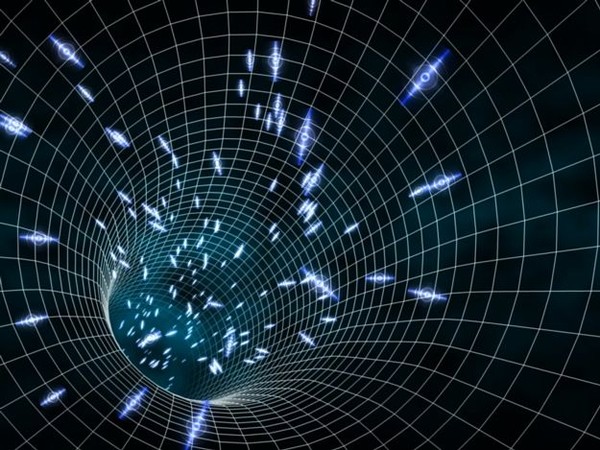
As the frequency of cyclical motion increases, it not only acquires increasing consistency, but it also acquires a curvature. This is because the range of free motion within a cycle is becoming smaller. We may say that the least cyclical motion represents the “surface” of the universe, which obviously has a curvature because it contains the universe. As one goes deeper into the universe, the motion becomes more consistent and substance-like. The overall picture of cyclical motion may appear somewhat like a “whirlpool.” This is what we see in the spiral shape of the galaxies. This we also see in the structure of atoms.

At the center of a whirlpool we have extremely dense and spinning motion. This anticipates black holes at the center of galaxies and nuclei at the center of the atoms.

The cyclical motion of a very large range, ultimately, condenses into a spinning motion of a very small range.

.

Summary

Here we have the whole spectrum of substance created out of cyclical motion. As this cyclical motion increases in frequency, it gains consistency, inertia and substance. It acquires a curvature because of its narrowing range. We thus have a shrinking circumference. This gives it a look very similar to that of a whirlpool.

From the periphery of the atom to is nucleus, we have cyclical motion that is gradually increasing in consistency and shrinking in its circumference, ending up in a dense spinning nucleus at the center.

.

Comment on Newton’s First Law 

Reference: KHTK Key Words: Dynamic 6

Please consult the above reference for the definitions of CONSISTENCY and INERTIA.

.

Inertial Frame of Reference

  1. It is a frame of uniform velocity and zero acceleration.
  2. This frame is tied to the consistency of substance.
  3. Accelerations in this frame means changes in the consistency of substance.
  4. Accelerations of mass objects means undetectable infinitesimal changes in mass.
  5. Relativistic changes in mass occur only at very high accelerations (not velocities).
  6. Elementary particles of different masses and quanta have different frames of reference.
  7. The inertial frame of reference of Newton is applicable to material particles of relatively low velocities.
  8. Einstein’s relativity points out slight changes in the inertial frame of reference due to celestial accelerations.
  9. Thus, there are Lorentz transformations of velocities of mass particles in Inertial Frame of reference.
  10. On a large scale, the paths of mass particles in uniform motion are only as straight as their motions.
  11. The lower is the consistency, the higher is the velocity, and the straighter is the path.
  12. The greater is the consistency, the slower is the velocity, and the more curved is the path.

.

Newton’s First Law

Newton’s first law of motion says,

“Every object will remain at rest or in uniform motion in a straight line unless compelled to change its state by the action of an external force.

This law may be modified slightly as follows:

“Every object will remain at rest or in uniform motion “in a curvature based on its consistency” unless compelled to change its state by the action of an external force.”

.

The Spectrum of Substance (old-4)

Reference: Fundamentals of Physics

In classical mechanics, substance is recognized by its mass. But since Einstein’s 1905 paper on “light quanta,” substance has taken a wider significance. Light has force and momentum, therefore, it is substantial. Substance is anything that is substantial enough to be sensed.

Since term “mass” is recognized only in the context of matter, we need a broader term equivalent to it in the context of substance. Such a term is “consistency.” For example, light does not have mass, but it has consistency.

MASS represents “atomic substance” only. CONSISTENCY represents both atomic and non-atomic substance. When consistency is very high, as in the nucleus of an atom, it is recognized as mass.

.

Consistency (Thickness)

The consistency of substance is defined as follows:

Consistency is the degree of substantiality of substance. It is recognized as density, firmness, or viscosity of the substance. For example, “Honey has higher consistency than water.” For radiant energy, consistency is measured per quanta, where quanta is determined by frequency. For matter, consistency is measured by the mass of its elementary particle, such as, proton or neutron, where the elementary particle is determined by its smallest discrete inertia. The quanta and the mass of elementary particle may be measured by the same unit. Thus, substance can have a gradient of consistencies.

.

Measure of Consistency

The consistency may be measured in terms of doubling of frequency as follows:

Consistency (C) = log f / log 2

We may calculate the consistency of electromagnetic substance from its frequency. This may be listed as follows:

We may assume the consistency of matter to be very close to 77.6.

The planets and stars may also have consistencies close to 77.6. But we may calculate their “relative consistency” based on their momentum as follows

De Broglie Equation,       λ = h/p,

where h is Planck’s constant, and p is momentum of the object, which is made up of many particles.

Frequency:                      f = c/λ = (c/h) p = 4.528 x 1041 p

Total Consistency:         Ctot = (log f) / (log 2) = 138.4 + 3.322 log p

Thus, knowing the mass and velocity of Earth, we may calculate its total consistency as follows,

ME = 5.972 x 1024 kg, VE = 3 x 10⁴ m/s, and  p = ME V= 1.79 x 1029

Ctot (Earth) = 138.4 + 3.322 log (1.79 x 1029) = 235.6

Similarly, we may calculate, Ctot (Sun) = 256.6

In terms of relative consistencies, we may say,

Crel (Earth) = 1

Crel (Sun) = 1.089

This means that the Sun is a bit more fixed in space than the Earth.

The Black holes may have much higher consistencies. Their absolute consistency (consistency per particle) may be higher than the consistency of the neutron. As a result they are much more fixed in space. We may, therefore, expect to find the Black holes at the center of the galaxies.

.

What is Light?

Reference: KHTK Key Words: Dynamic 6

Please consult the above reference for the definitions of CONSISTENCY and INERTIA.

.

What is Light?

A wave in pond travels within the pond. The pond itself does not move. The speed of this wave depend on the density and bulk modulus of water.

Similarly, light travels within the space. The space itself does not move. The speed of light depends on the permittivity and permeability of space.

Light is not a wave. It is only analogous to a wave. The frequency of light is very likely its consistency as a substance. The wavelength of light is probably the “tension” of the light substance in space. Velocity is probably how fast a disturbance in the tension of light spreads.

Light substance is not made up atoms. It is actually made up of force. Faraday approximated it as “lines of force.”

.

Conjectures on Motion

The measured speed of light is constant only within a certain limit of precision.The speed is limited by the inertia of the electromagnetic fields in spacetime. The spacetime represents the gravitational field.

Therefore, inertia of light comes from its interaction with the gravitational field. Absence of inertia would mean unrestrained acceleration and infinite speed.

Uniform finite velocity of light means that its acceleration is balanced with its inertia. The amount of resistance to “change in velocity” gives a sense of consistency of substance. A speed greater than ‘c’ will exist if and only if the consistency of substance is less than the consistency of light.

.

Speed of light and Inertia

On the Spectrum of Substance, the motion of substance decreases as consistency increases. We may suppose that on a very large scale motion is inversely proportional to inertia. We may check this out as follows:

Ratio of speed of light to speed of matter (approximately) = 3 x 10⁸

From Relative Consistencies of Substance:

Ratio of consistency of matter to consistency of light = consistency of proton/consistency of light

                                                                                    = 277.6 / 249

                                                                                    = 228.6

                                                                                    = 4 x 10⁸

This is of the same order of magnitude as the approximated ratio of the speeds of light and matter. This value is higher because the consistency of neutron is slightly higher than the average consistency of matter. Therefore, it is quite possible that the consistency and motion (or, inertia and speed) are inversely proportional to each other.

In other words, the product of consistency (inertia) and motion (speed) shall give us a new universal constant. This has to be worked out carefully.

.