Happiness: Precept 7-1

Reference: The Happiness Rundown

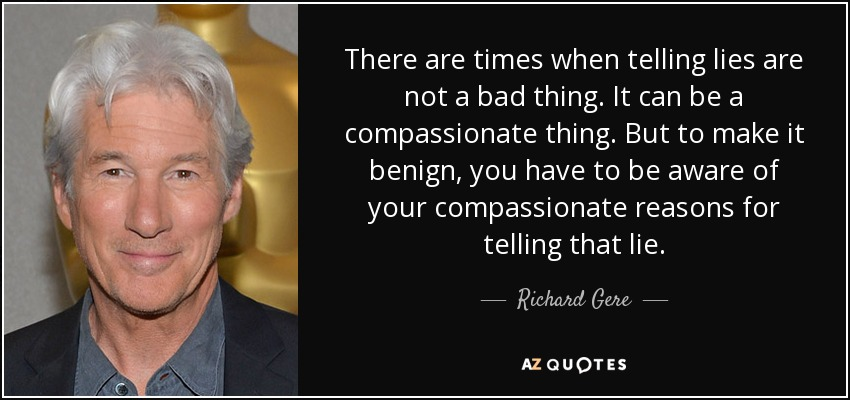
7-1. Do not tell harmful lies

Harmful lies are the product of fear, malice and envy. They can drive people to acts of desperation. They can ruin lives. They create a kind of trap into which the teller and the target can both fall. Interpersonal and social chaos can result. Many wars began because of harmful lies.

One should learn to detect them and reject them.

.

Exercise

0. Make sure you have completed the exercise section at Happiness: Precept 7. Study the precept above.

1. Check the responses to the following questions for false data (see false data steps at Happiness: Prologue).

(a) “Have you been told or taught to tell harmful lies?”
(b) “Do you have any rules or ideas contrary to not telling harmful lies?”
(c) “Have you been led to believe that you should tell harmful lies?”
(d) “Do you know of anything that conflicts with not telling harmful lies?”
(e) “Do you have any false data about harmful lies?”

.

2. Go over each of the following questions repetitively, until there are no more answers: 

(a) “How have others transgressed against the precept: ‘Do not tell harmful lies’?”
(b) “How have you transgressed against the precept: ‘Do not tell harmful lies’?”

Do a quick review to see if you did not miss any answers on this step. You should be feeling good about this step.

.

3. See if the following question definitely brings up some name you know of:

“Is there any specific person in your past who really transgressed against the precept: ‘Do not tell harmful lies’?”

If no name comes up then go to step 4. if a name has come up, then continue with step 3 as follows:

“Can you recall an exact moment when you observed ___(name)___ transgressing this precept?”

If there is a realization, go to step 4. Otherwise, continue contemplating as follows, until there is some realization.

“Is there any time when you wanted to be like ___(name)___ ?” 
“Is there any time when you decided that telling harmful lies was a good thing?”
“Did you ever do anything bad to ___(name)___ ? 
(Get all possible answers)
“Are there any differences between ___(name)___ and yourself?”
“Are there any similarities between ___(name)___  and yourself?”

.

4. Handle any anomalies that come up on the following question by looking at the anomaly more closely. 

”Do you have any reservations about not telling harmful lies?” 

If the anomaly does not resolve then review the precept as well as all the exercise steps above to see if anything was missed. Then do step 4 again. When there is no anomaly go to step 5.

.

5. Contemplate on the following question.

“Do you have any reservations about getting someone else not to tell harmful lies?” 

If any reservation comes up, then consider the following: 

“How would that be a problem?” 

Get answers to this question until there are no reservations.

.

BUDDHISM: The Image of the Crossing

Reference: Buddhism

[NOTE: In color are Vinaire’s comments.]

Once the other shore of Enlightenment is attained there is no further need for the raft that carried them across the stream. The doctrine of Buddhism is simply a tool to be cast away and forsaken once it has served the purpose for which it was made.

We have looked at three modes of transport in Buddhism: the Little Raft; the Big Raft, with special attention to Zen; and, though it sounds odd in the context of a flotilla, the Diamond Raft. These vehicles are so different that we must ask in closing whether, on any grounds other than historical lineage, they deserve to be considered aspects of a single religion. 

There are two respects in which they should be so regarded. They all revere a single founder from whom they claim their teachings derive. And all three can be subsumed under a single metaphor. This is the image of the crossing, the simple everyday experience of crossing a river on a ferryboat. 

All three aspects of Buddhism can be subsumed under a single metaphor of crossing a river on a ferryboat. 

To appreciate the force of this image we must remember the role the ferry played in traditional Asian life. In lands laced by rivers and canals, almost every considerable journey required a ferry. This routine fact underlies and inspires every school of Buddhism, as the use of the word yana by all of them attests. Buddhism is a voyage across life’s river, a transport from the common-sense shore of ignorance, grasping, and death, to the further bank of wisdom and enlightenment. Compared with this settled fact, the differences within Buddhism are no more than variations in the kind of vehicle one boards, or the stage one has reached on the journey. 

Buddhism is a voyage across life’s river, a transport from the common-sense shore of ignorance, grasping, and death, to the further bank of wisdom and enlightenment.

What are these stages?

While we are on the first bank it is in effect the world for us. Its earth underfoot is solid and reassuring. The rewards and disappointments of its social life are vivid and compelling. The opposite shore is barely visible and has no impact on our dealings. 

If, however, something prompts us to see what the other side is like, we may decide to attempt a crossing. If we are of independent bent, we may decide to make it on our own. In this case we are Theravadins; we follow the Buddha’s design for a sturdy craft, but we build ours ourself. Most of us, however, have neither the time nor the talent for a project of such proportions. We are Mahayanists and move down the bank to where a readymade ferryboat is expected. As the group of explorers clamber aboard at the landing there is an air of excitement. Attention is focused on the distant bank, still indistinct, but the voyagers are still very much like citizens of this side of the river. 

The ferry pushes off and moves across the water. The bank we are leaving behind is losing its substance. The shops and streets and ant-like figures are blending together and releasing their hold on us. Meanwhile, the shore toward which we are headed is not in focus either; it seems almost as far away as it ever was. There is an interval in the crossing when the only tangible realities are the water, with its treacherous currents, and the boat, which is stoutly but precariously contending with them. This is the moment for Buddhism’s Three Vows: I take refuge in the Buddha, the fact that there was an explorer who made this trip and proved to us that it can succeed. I take refuge in the dharma, the vehicle of transport, this boat to which we have committed our lives in the conviction that it is seaworthy. I take refuge in the sangha, the order, the crew that is navigating this ship, in whom we have confidence. The shoreline of the world has been left behind. Until we set foot on the further bank, these are the only things in which we can trust. 

During the voyage we do not have the firmness of the ground underneath our feet. Only firmness comes from Buddhism’s Three Vows: I take refuge in the Buddha, I take refuge in the dharma,  I take refuge in the sangha.

The further shore draws near, becomes real. The craft jolts onto the sand and we step onto solid ground. The land, which had been misty and unsubstantial as a dream, is now fact. And the shore that we left behind, which was so palpable and real, is now only a slender horizontal line, a visual patch, a memory without substance. 

Impatient to explore our new surroundings, we nevertheless remember our gratitude for the splendid ship and crew who have brought us safely to what promises to be a rewarding land. It will not be gratitude, however, to insist on packing the boat with us as we plunge into the woods. “Would he be a clever man,” the Buddha asked, “if out of gratitude for the raft that has carried him across the stream to safety he, having reached the other shore, should cling to it, take it on his back, and walk about with the weight of it? Would not the clever man be the one who left the raft, no longer of use to him, to the current of the stream and walked ahead without turning back to look at it? Is it not simply a tool to be cast away and forsaken once it has served the purpose for which it was made? In the same way the vehicle of the doctrine is to be cast away and forsaken once the other shore of Enlightenment has been attained.”

Once the other shore of Enlightenment is attained there is no further need for the raft that carried them across the stream. The doctrine of Buddhism is simply a tool to be cast away and forsaken once it has served the purpose for which it was made.

Here we come to the Prajnaparamita or Perfection of Wisdom sutras, which are widely considered to be the culminating texts of Buddhism. The Five Precepts and the Eightfold Path; the technical terminology of dukkha, karma, nirvana, and their like; the committed order and the person of the Buddha himself—all these are vitally important to the individual in the act of making the crossing. They lose their relevance for those who have arrived. Indeed, to the traveler who has not only reached the promised shore but who keeps moving into its interior, there comes a time when not only the raft but the river itself drops from view. When such a one turns around to look for the land that has been left behind, what appears? What of that land can appear to one who has crossed a horizon beyond which the river dividing this shore from that shore has vanished? One looks, and there is no other shore. There is no separating river. There is no raft, no ferryman. These things are not a part of the new world. 

After reaching the promised shore ones keep moving into its interior. No more is there a separating river. There is no raft, no ferryman. These things are not a part of the new world. 

Before the river was crossed the two shores, human and divine, had to appear distinct from each other, different as life and death, as day and night. But once the crossing has been made, no dichotomy remains. The realm of the gods is not a distinct place. It is where the traveler stands; and if that stance happens to be in this world, the world itself is transmuted. It is in this sense that we are to read the avowals in The Perfection of Wisdom that “this our worldly life is an activity of Nirvana itself; not the slightest distinction exists between them.” Introspection having led to a condition described positively as nirvana and negatively as Emptiness because it transcends all forms, the “stream-winner” now finds in the world itself this same Emptiness that he discovered within. “Form is emptiness, emptiness is form. Emptiness is not different from form, form is not different from emptiness.” The noisy disjunction between acceptance and rejection having been stilled, every moment is affirmed for what it actually is. It is Indra’s cosmic net, laced with jewels at every juncture. Each jewel reflects the others, together with all the reflections in the others. In such a vision the categories of good and evil disappear. “That which is sin is also Wisdom” we read; and once again, “the realm of Becoming is Nirvana.”

This earth on which we stand
is the promised Lotus Land,
And this very body
is the body of the Buddha.

The realm of the gods is not a distinct place. It is where the traveler stands; and if that stance happens to be in this world, the world itself is transmuted. The noisy disjunction between acceptance and rejection having been stilled, every moment is affirmed for what it actually is. 

This new-found shore throws light on the bodhisattva’s vow not to enter nirvana “until the grass itself be enlightened.” As grass keeps coming, does this mean that the bodhisattva will never be enlightened? Not exactly. It means, rather, that he (or she) has risen to the point where the distinction between time and eternity has lost its force. That distinction, drawn by the rational mind, is dissolved in the lightning-and-thunder insight that annihilates opposites. Time and eternity are now two aspects of the same experiential whole, two sides of the same coin. “The jewel of eternity is in the lotus of birth and death.”

The bodhisattva has risen to the point where the distinction between time and eternity has lost its force. 

From the standpoint of normal, worldly consciousness there must always remain an inconsistency between this climactic insight and worldly prudence. This, though, should not surprise us, for it would be flatly contradictory if the world looked exactly the same to those who have crossed the river of ignorance. Only they can dissolve the world’s distinctions—or, perhaps we should say, take them in their stride, for the distinctions persist, but now without difference. Where to eagle vision the river can still be seen, it is seen as connecting the two banks rather than dividing them.

Only those who have crossed the river of ignorance can dissolve the world’s distinctions—or, perhaps we should say, take them in their stride.

.

Happiness: Precept 7

Reference: The Happiness Rundown

7. SEEK TO LIVE WITH THE TRUTH

False data can cause one to make stupid mistakes. It can even block one from absorbing true data.

One can solve the problems of existence only when he has true data.

If those around one lie to him or her, one is led into making errors and his survival potential is reduced.

False data can come from many sources: academic, social, professional.

Many want you to believe things just to suit their own ends.

What is true is what is true for you.

No one has any right to force data on you and command you to believe it or else. If it is not true for you, it isn’t true.

Think your own way through things, accept what is true for you, discard the rest. There is nothing unhappier than one who tries to live in a chaos of lies.

7-1. Do not tell harmful lies. Harmful lies are the product of fear, malice and envy. They can drive people to acts of desperation. They can ruin lives. They create a kind of trap into which the teller and the target can both fall. Interpersonal and social chaos can result. Many wars began because of harmful lies.

One should learn to detect them and reject them.

7-2. Do not bear false witness. There are considerable penalties connected with swearing or testifying to untrue “facts.” It is called “perjury”: it has heavy penalties.

The way to happiness lies along the road to truth.

.

Exercise

0. Make sure you have completed the exercise section at Happiness: Precept 6. Study the precept above.

1. Check the responses to the following questions for false data (see false data steps at Happiness: Prologue).

(a) “Have you been told or taught not to live with the truth?”
(b) “Do you have any rules or ideas contrary to living with the truth?”
(c) “Have you been led to believe that you shouldn’t live with the truth?”
(d) “Do you know of anything that conflicts with living with the truth?”
(e) “Do you have any false data about living with the truth?”

.

2. Go over each of the following questions repetitively, until there are no more answers: 

(a) “How have others transgressed against the precept: ‘Seek to live with the truth’?”
(b) “How have you transgressed against the precept: ‘Seek to live with the truth’?”

Do a quick review to see if you did not miss any answers on this step. You should be feeling good about this step.

.

3. See if the following question definitely brings up some name you know of:

“Is there any specific person in your past who really transgressed against the precept: ‘Seek to live with the truth’?”

If no name comes up then go to step 4. if a name has come up, then continue with step 3 as follows:

“Can you recall an exact moment when you observed ___(name)___ transgressing this precept?”

If there is a realization, go to step 4. Otherwise, continue contemplating as follows, until there is some realization.

“Is there any time when you wanted to be like ___(name)___ ?” 
“Is there any time when you decided that the truth wasn’t a good thing?”
“Did you ever do anything bad to ___(name)___ ? 
(Get all possible answers)
“Are there any differences between ___(name)___ and yourself?”
“Are there any similarities between ___(name)___  and yourself?”

.

4. Handle any anomalies that come up on the following question by looking at the anomaly more closely. 

”Do you have any reservations about seeking to live with the truth?” 

If the anomaly does not resolve then review the precept as well as all the exercise steps above to see if anything was missed. Then do step 4 again. When there is no anomaly go to step 5.

.

5. Contemplate on the following question.

“Do you have any reservations about getting someone else to seek to live with the truth?” 

If any reservation comes up, then consider the following: 

“How would that be a problem?” 

Get answers to this question until there are no reservations.

.

BUDDHISM: The Diamond Thunderbolt

Reference: Buddhism

[NOTE: In color are Vinaire’s comments.]

The Dalai Lama is a receiving station toward which the compassion principle of Buddhism in all its cosmic amplitude is continuously channeled, to radiate thence to the Tibetan people most directly, but by extension to all sentient beings.

We have spoken of two yanas or paths in Buddhism, but we must now add a third. If Hinayana literally means the Little Way and Mahayana the Great Way, Vajrayana is the Diamond Way. 

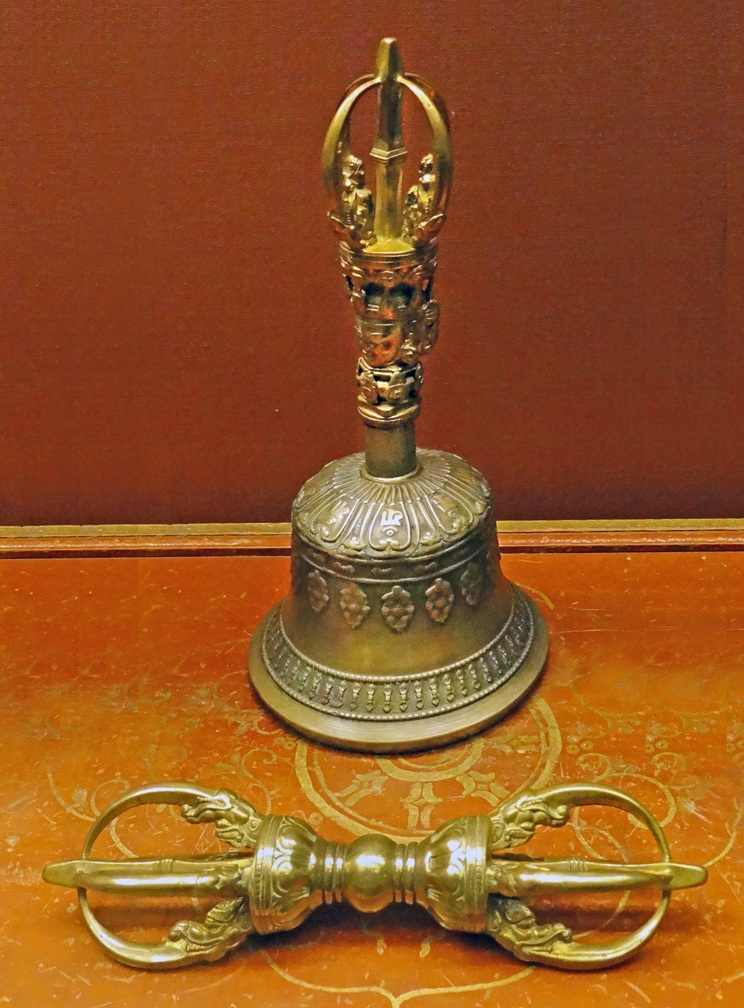
Vajra was originally the thunderbolt of Indra, the Indian Thunder God who is often mentioned in the early, Pali Buddhist texts; but when Mahayana turned the Buddha into a cosmic figure, Indra’s thunderbolt was transformed into the Buddha’s diamond scepter. We see here a telling instance of Buddhism’s capacity to accommodate itself to local ideas while revaluing them by changing the spiritual center of gravity; for the diamond transforms the thunderbolt, symbol of nature’s power, into an emblem of spiritual supremacy, while retaining the connotations of power that the thunderbolt possessed. The diamond is the hardest stone—one hundred times harder than its closest rival—and at the same time the most transparent stone. This makes the Vajrayana the way of strength and lucidity—strength to realize the Buddha’s vision of luminous compassion.

There is another way in Buddhism—the way of strength and lucidity—called Vajrayana.

We just noted that the roots of the Vajrayana can be traced back to India, and it continues to survive in Japan as Shingon Buddhism; but it was the Tibetans who perfected this third Buddhist path. For Tibetan Buddhism is not just Buddhism with Tibet’s pre-Buddhist Bon deities incorporated. Nor is it enough to characterize it as Indian Buddhism in its eighth-and ninth century heyday, moved northward to be preserved against its collapse in India. To catch its distinctiveness we must see it as the third major Buddhist yana, while adding immediately that the essence of the Vajrayana is Tantra. Tibetan Buddhism, the Buddhism here under review, is at heart Tantric Buddhism. 

The essence of the Vajrayana is Tantra.

Buddhists have no monopoly on Tantra, which first showed itself in medieval Hinduism where the word had two Sanskrit roots. One of these is “extension.” In this meaning Tantra denotes texts, many of them esoteric and secret in nature, that were added to the Hindu corpus to extend its range. This gives us only the formal meaning of the word, however. For the content of those extended texts we should look to the second etymological meaning of Tantra, which derives from the weaving craft and denotes interpenetration. In weaving, the threads of warp and woof intertwine repeatedly. The Tantras are texts that focus on the interrelatedness of things. Hinduism pioneered such texts, but it was Buddhism, particularly Tibetan Buddhism, that gave them pride of place. 

The Tantras are texts that focus on the interrelatedness of things.

The Tibetans say that their religion is nowise distinctive in its goal. What distinguishes their practice is that it enables one to reach nirvana in a single lifetime. This is a major claim. How do the Tibetans defend it? 

What distinguishes tantric buddhism is that it enables one to reach nirvana in a single lifetime.

They say that the speed-up is effected by utilizing all of the energies latent in the human make-up, those of the body emphatically included, and impressing them all into the service of the spiritual quest. 

It utilizes all of the energies latent in the human make-up for the spiritual quest. 

The energy that interests the West most is sex, so it is not surprising that Tantra’s reputation abroad has been built on its sacramental use of this drive. H. G. Wells once said that God and sex were the only two things that really interested him. If we can have both—not be forced to choose between them as in monasticism and celibacy—this is music to modern ears, so much so that in the popular Western mind Tantra and sex are almost equated. This is unfortunate. Not only does it obscure the larger world of Tantra; it distorts its sexual teachings by removing them from that world. 

Unfortunately, in the popular Western mind Tantra and sex are almost equated, for it obscure the larger world of Tantra.

Within that world Tantra’s teachings about sex are neither titillating nor bizarre: they are universal. Sex is so important—after all, it keeps life going—that it must be linked quite directly with God. It is the divine Eros of Hesiod, celebrated in Plato’s Phaedrus and in some way by every people. Even this, though, is too mild. Sex is the divine in its most available epiphany. But with this proviso: It is such when joined to love. When two people who are passionately, even madly—Plato’s divine madness—in love; when each wants most to receive what the other most wants to give;—at the moment of their mutual climax it is impossible to say whether the experience is more physical or spiritual, or whether they sense themselves as two or as one. The moment is ecstatic because at that moment they stand outside—ex, out; stasis, standing—themselves in the melded oneness of the Absolute. 

Tantra’s teachings about sex are neither titillating nor bizarre: they are universal. In Tantra’s sacramental use of this drive, correct understanding and discipline is essential.

Nothing thus far is uniquely Tantric; from the Hebrew Song of Songs to the explicit sexual symbolism in mystical marriages to Christ, the principles just mentioned turn up in all traditions. What distinguishes Tantra is the way it wholeheartedly espouses sex as a spiritual ally, working with it explicitly and intentionally. Beyond squeamishness and titillation, both, the Tantrics keep the physical and spiritual components of the love-sex splice in strict conjunction—through their art (which shows couples in coital embrace), in their fantasies (the ability to visualize should be actively cultivated), and in overt sexual engagement, for only one of the four Tibetan priestly orders is celibate. Beyond these generalizations it is not easy to go, so we shall leave the matter with a covering observation. Tantric sexual practice is pursued, not as a law-breaking revel, but under the cautious supervision of a guru, in the controlled context of a non-dualist outlook, and as the culminating festival of a long sequence of spiritual disciplines practiced through many lives. The spiritual emotion that is worked for is ecstatic, egoless, beatific bliss in the realization of transcendent identity. But it is not self-contained, for the ultimate goal of the practice is to descend from the non-dual experience better equipped to experience the multiplicity of the world without estrangement. 

What distinguishes Tantra is the way it wholeheartedly espouses sex as a spiritual ally, working with it explicitly and intentionally.

With Tantra’s sexual side thus addressed, we can move on to more general features of its practice. We have already seen that these are distinctive in the extent to which they are body-based, and the physical energies the Tantrics work with most regularly are the ones that are involved with speech, vision, and gestures. 

The physical energies the Tantrics work with most regularly are the ones that are involved with speech, vision, and gestures. 

To appreciate the difference in a religious practice that engages these faculties actively, it is useful to think back to the raja yoga of Hinduism and Zen in Buddhism. Both of these meditation programs set out to immobilize the body so that for practical purposes the mind might rise above it. A snapshot could capture the body in those practices, whereas with the Tibetans a motion picture camera would be needed, and one that is wired for sound. For, ritualistically engaged, the Tibetans’ bodies are always moving. The lamas prostrate themselves, weave stylized hand gestures, pronounce sacred syllables, and intone deep-throated chants. Audially and visually, something is always going on. 

For, ritualistically engaged, the Tibetans’ bodies are always moving. The lamas prostrate themselves, weave stylized hand gestures, pronounce sacred syllables, and intone deep-throated chants.

The rationale they invoke for engaging their bodies in their spiritual pursuits is straightforward. Sounds, sights, and motion can distract, they admit, but it does not follow that they must do so. It was the genius of the great pioneers of Tantra to discover upayas (skillful means) for channeling physical energies into currents that carry the spirit forward instead of derailing it. The most prominent of these currents relate to the sound, sight, and movement we have referred to, and the names for them all begin with the letter “m.” Mantras convert noise into sound and distracting chatter into holy formulas. Mudras choreograph hand gestures, turning them into pantomime and sacred dance. Mandalas treat the eyes to icons whose holy beauty draws the beholder in their direction. 

The rationale they invoke for engaging their bodies in their spiritual pursuits is straightforward. Sounds, sights, and motion can distract, they admit, but it does not follow that they must do so.

If we try to experience our way into the liturgy by which the Tibetans put these Tantric devices into practice, the scene that emerges is something like this. Seated in long, parallel rows; wearing headgear that ranges from crowns to wild shamanic hats; garbed in maroon robes, which they periodically smother in sumptuous vestments of silver, scarlet, and gold, gleaming metaphors for inner states of consciousness, the monks begin to chant. They begin in a deep, guttural, metric monotone, but as the mood deepens those monotones splay out into harmonics that sound like full-throated chords, though actually the monks are not singing in parts; harmony (a Western discovery) is unknown to them. By a vocal device found nowhere else in the world, they reshape their vocal cavities in ways that amplify overtones to the point where they can be heard as discrete tones in their own right. Meanwhile, their hands perform stylized gestures that kinesthetically augment the states of consciousness that are being accessed. 

Here we have a description of how the Tibetans put these Tantric devices into practice.

A final, decisive feature of this practice would be lost on observers because it is totally internal. Throughout the exercise the monks visualize the deities they are invoking—visualize them with such intensity (years of practice are required to master the technique) that, initially with closed eyes but eventually with eyes wide open, they are able to see the deities as if they were physically present. This goes a long way toward making them real, but in the meditation’s climax, the monks go further. They seek experientially to merge with the gods they have conjured, the better to appropriate their powers and their virtues. An extraordinary assemblage of artistic forms are orchestrated here, but not for art’s sake. They constitute a technology, designed to modulate the human spirit to the wavelengths of the tutelary deities that are invoked. 

Through their chanting and gestures they are able to visualize the deities they are invoking; and then they seek experientially to merge with the gods they have conjured.

To complete this profile of Tibetan Buddhism’s distinctiveness, we must add to this summary of its Tantric practice a unique institution. When in 1989 the Nobel Peace Prize was awarded to His Holiness the Dalai Lama, that institution jumped to worldwide attention. 

The Dalai Lama is not accurately likened to the pope, for it is not his prerogative to define doctrine. Even more misleading is the designation God-King, for though temporal and spiritual authority do converge in him, neither of these powers define his essential function. That function is to incarnate on earth the celestial principle of which compassion or mercy is the defining feature. The Dalai Lama is the bodhisattva who in India was known as Avalokiteshvara, in China as the Goddess of Mercy Kwan Yin, and in Japan as Kannon. As Chenrezig (his Tibetan name) he has for the last several centuries incarnated himself for the empowerment and regeneration of the Tibetan tradition. Through his person—a single person who has thus far assumed fourteen successive incarnations—there flows an uninterrupted current of spiritual influence, characteristically compassionate in its flavor. Thus in relation to the world generally, and to Tibet in particular, the office of the Dalai Lama is chiefly neither one of administration nor of teaching but an “activity of presence” that is operative independently of anything he may, as an individual, choose to do or not do. The Dalai Lama is a receiving station toward which the compassion principle of Buddhism in all its cosmic amplitude is continuously channeled, to radiate thence to the Tibetan people most directly, but by extension to all sentient beings. 

The Dalai Lama is a receiving station toward which the compassion principle of Buddhism in all its cosmic amplitude is continuously channeled, to radiate thence to the Tibetan people most directly, but by extension to all sentient beings.

Whether the Dalai Lama will reincarnate himself again after his present body is spent is uncertain, for at present the Chinese invaders are determined that there will be no distinct people for him to serve. If there are not, something important will have withdrawn from history. For as rain forests are to the earth’s atmosphere, someone has said, so are the Tibetan people to the human spirit in this time of its planetary ordeal.

For as rain forests are to the earth’s atmosphere, someone has said, so are the Tibetan people to the human spirit in this time of its planetary ordeal.

.

Happiness: Precept 6

Reference: The Happiness Rundown

6. SET A GOOD EXAMPLE

There are many people one influences. The influence’s can be good or bad. 

If one conducts his life to keep these recommendations, one is setting a good example. 

Others around one cannot help but be influenced by this, no matter what they say. 

Anyone trying to discourage you is trying to do so because they factually mean you harm or are seeking to serve their own ends. Down deep, they will respect you. 

Your own survival chances will be bettered in the long run since others, influenced, will become less of a threat. There are other benefits. 

Don’t discount the effect you can achieve on others simply by mentioning these things and setting a good example in your own right. 

The way to happiness requires that one set a good example for others.

.

Exercise

0. Make sure you have completed the exercise section at Happiness: Precept 5. Study the precept above.

1. Check the responses to the following questions for false data (see false data steps at Happiness: Prologue).

(a) “Have you been told or taught not to set a good example?”
(b) “Do you have any rules or ideas contrary to setting a good example?”
(c) “Have you been led to believe that you shouldn’t set a good example?”
(d) “Do you know of anything that conflicts with setting a good example?”
(e) “Do you have any false data about setting a good example?”

.

2. Go over each of the following questions repetitively, until there are no more answers: 

(a) “How have others transgressed against the precept: ‘Set a good example’?”
(b) “How have you transgressed against the precept: ‘Set a good example’?”

Do a quick review to see if you did not miss any answers on this step. You should be feeling good about this step.

.

3. See if the following question definitely brings up some name you know of:

“Is there any specific person in your past who really transgressed against the precept: ‘Set a good example ’?”

If no name comes up then go to step 4. if a name has come up, then continue with step 3 as follows:

“Can you recall an exact moment when you observed ___(name)___ transgressing this precept?”

If there is a realization, go to step 4. Otherwise, continue contemplating as follows, until there is some realization.

“Is there any time when you wanted to be like ___(name)___ ?” 
“Is there any time when you decided that not setting a good example was a good thing?”
“Did you ever do anything bad to ___(name)___ ? 
(Get all possible answers)
“Are there any differences between ___(name)___ and yourself?”
“Are there any similarities between ___(name)___  and yourself?”

.

4. Handle any anomalies that come up on the following question by looking at the anomaly more closely. 

”Do you have any reservations about setting a good example?” 

If the anomaly does not resolve then review the precept as well as all the exercise steps above to see if anything was missed. Then do step 4 again. When there is no anomaly go to step 5.

.

5. Contemplate on the following question.

“Do you have any reservations about getting someone else to set a good example?” 

If any reservation comes up, then consider the following: 

“How would that be a problem?” 

Get answers to this question until there are no reservations.

.