Category Archives: Physics Book

The Physics Book.

Eddington 1927: Relativity of Length

Length contraction

Reference: The Nature of the Physical World

This paper presents Chapter VII (section 2) from the book THE NATURE OF THE PHYSICAL WORLD by A. S. EDDINGTON. The contents of this book are based on the lectures that Eddington delivered at the University of Edinburgh in January to March 1927.

The paragraphs of original material are accompanied by brief comments in color, based on the present understanding.  Feedback on these comments is appreciated.

The heading below links to the original materials.

.

Relativity of Length

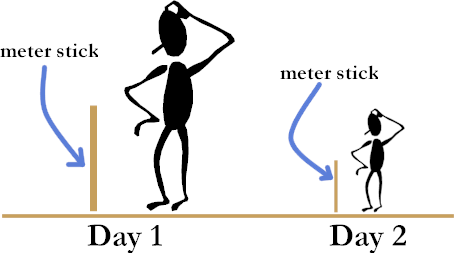
There is no such thing as absolute length; we can only express the length of one thing in terms of the length of something else.* And so when we speak of the length of the directed radius we mean its length compared with the standard metre scale. Moreover, to make this comparison, the two lengths must lie alongside. Comparison at a distance is as unthinkable as action at a distance; more so, because comparison is a less vague conception than action. We must either convey the standard metre to the site of the length we are measuring, or we must use some device which, we are satisfied, will give the same result as if we actually moved the metre rod.

* This relativity with respect to a standard unit is, of course, additional to and independent of the relativity with respect to the observer’s motion treated in chapter II.

There is no absolute unit of length. A unit of length can be as big or as small as desired. The length shall be a function of quantization. The quantization of  space is different from the quantization of matter. Currently, this difference in quantization is not taken into account for the distance between two material bodies.

Now if we transfer the metre rod to another point of space and time, does it necessarily remain a metre long? Yes, of course it does; so long as it is the standard of length it cannot be anything else but a metre. But does it really remain the metre that it was? I do not know what you mean by the question; there is nothing by reference to which we could expose delinquencies of the standard rod, nothing by reference to which we could conceive the nature of the supposed delinquencies. Still the standard rod was chosen with considerable care; its material was selected to fulfil certain conditions—to be affected as little as possible by casual influences such as temperature, strain or corrosion, in order that its extension might depend only on the most essential characteristics of its surroundings, present and past.** We cannot say that it was chosen to keep the same absolute length since there is no such thing known; but it was chosen so that it might not be prevented by casual influences from keeping the same relative length—relative to what? Relative to some length inalienably associated with the region in which it is placed. I can conceive of no other answer. An example of such a length inalienably associated with a region is the directed radius.

** In so far as these casual influences are not entirely eliminated by the selection of material and the precautions in using the rod, appropriate corrections must be applied. But the rod must not be corrected for essential characteristics of the space it is measuring. We correct the reading of a voltmeter for temperature, but it would be nonsensical to correct it for effects of the applied voltage. The distinction between casual and essential influences—those to be eliminated and those to be left in—depends on the intention of the measurements. The measuring rod is intended for surveying space, and the essential characteristic of space is “metric”. It would be absurd to correct the readings of our scale to the values they would have had if the space had some other metric. The region of the world to which the metric refers may also contain an electric field; this will be regarded as a casual characteristic since the measuring rod is not intended for surveying electric fields. I do not mean that from a broader standpoint the electric field is any less essential to the region than its peculiar metric. It would be hard to say in what sense it would remain the same region if any of its qualities were other than they actually are. This point does not trouble us here, because there are vast regions of the world practically empty of all characteristics except metric, and it is to these that the law of gravitation is applied both in theory and in practice. It has seemed, however, desirable to dwell on this distinction between essential and casual characteristics because there are some who, knowing that we cannot avoid in all circumstances corrections for casual influences, regard that as license to adopt any arbitrary system of corrections—a procedure which would merely have the effect of concealing what the measures can teach us about essential characteristics.

The long and short of it is that when the standard metre takes up a new position or direction it measures itself against the directed radius of the world in that region and direction, and takes up an extension which is a definite fraction of the directed radius. I do not see what else it could do. We picture the rod a little bewildered in its new surroundings wondering how large it ought to be—how much of the unfamiliar territory its boundaries ought to take in. It wants to do just what it did before. Recollections of the chunk of space that it formerly filled do not help, because there is nothing of the nature of a landmark. The one thing it can recognise is a directed length belonging to the region where it finds itself; so it makes itself the same fraction of this directed length as it did before.

The standard length adjusts itself to the quantization (substantialness) of space and time.

If the standard metre is always the same fraction of the directed radius, the directed radius is always the same number of metres. Accordingly the directed radius is made out to have the same length for all positions and directions. Hence we have the law of gravitation.

When we felt surprise at finding as a law of Nature that the directed radius of curvature was the same for all positions and directions, we did not realise that our unit of length had already made itself a constant fraction of the directed radius. The whole thing is a vicious circle. The law of gravitation is—a put-up job.

This explanation introduces no new hypothesis. In saying that a material system of standard specification always occupies a constant fraction of the directed radius of the region where it is, we are simply reiterating Einstein’s law of gravitation—stating it in the inverse form. Leaving aside for the moment the question whether this behaviour of the rod is to be expected or not, the law of gravitation assures us that that is the behaviour. To see the force of the explanation we must, however, realise the relativity of extension. Extension which is not relative to something in the surroundings has no meaning. Imagine yourself alone in the midst of nothingness, and then try to tell me how large you are. The definiteness of extension of the standard rod can only be a definiteness of its ratio to some other extension. But we are speaking now of the extension of a rod placed in empty space, so that every standard of reference has been removed except extensions belonging to and implied by the metric of the region. It follows that one such extension must appear from our measurements to be constant everywhere (homogeneous and isotropic) on account of its constant relation to what we have accepted as the unit of length.

The quantization is pretty much the same for all material systems.

We approached the problem from the point of view that the actual world with its ten vanishing coefficients of curvature (or its isotropic directed curvature) has a specialisation which requires explanation; we were then comparing it in our minds with a world suggested by the pure mathematician which has entirely arbitrary curvature. But the fact is that a world of arbitrary curvature is a sheer impossibility. If not the directed radius, then some other directed length derivable from the metric, is bound to be homogeneous and isotropic. In applying the ideas of the pure mathematician we overlooked the fact that he was imagining a world surveyed from outside with standards foreign to it whereas we have to do with a world surveyed from within with standards conformable to it.

The explanation of the law of gravitation thus lies in the fact that we are dealing with a world surveyed from within. From this broader standpoint the foregoing argument can be generalised so that it applies not only to a survey with metre rods but to a survey by optical methods, which in practice are generally substituted as equivalent. When we recollect that surveying apparatus can have no extension in itself but only in relation to the world, so that a survey of space is virtually a self-comparison of space, it is perhaps surprising that such a self-comparison should be able to show up any heterogeneity at all. It can in fact be proved that the metric of a two-dimensional or a three-dimensional world surveyed from within is necessarily uniform. With four or more dimensions heterogeneity becomes possible, but it is a heterogeneity limited by a law which imposes some measure of homogeneity.

I believe that this has a close bearing on the rather heterodox views of Dr. Whitehead on relativity. He breaks away from Einstein because he will not admit the non-uniformity of space-time involved in Einstein’s theory. “I deduce that our experience requires and exhibits a basis of uniformity, and that in the case of nature this basis exhibits itself as the uniformity of spatio-temporal relations. This conclusion entirely cuts away the casual heterogeneity of these relations which is the essential of Einstein’s later theory.”* But we now see that Einstein’s theory asserts a casual heterogeneity of only one set of ten coefficients and complete uniformity of the other ten. It therefore does not leave us without the basis of uniformity of which Whitehead in his own way perceived the necessity. Moreover, this uniformity is not the result of a law casually imposed on the world; it is inseparable from the conception of survey of the world from within—which is, I think, just the condition that Whitehead would demand. If the world of space-time had been of two or of three dimensions Whitehead would have been entirely right; but then there could have been no Einstein theory of gravitation for him to criticise. Space-time being four-dimensional, we must conclude that Whitehead discovered an important truth about uniformity but misapplied it.

*A. N. Whitehead, The Principle of Relativity, Preface.

The conclusion that the extension of an object in any direction in the four-dimensional world is determined by comparison with the radius of curvature in that direction has one curious consequence. So long as the direction in the four-dimensional world is space-like, no difficulty arises. But when we pass over to time-like directions (within the cone of absolute past or future) the directed radius is an imaginary length. Unless the object ignores the warning symbol √-1 it has no standard of reference for settling its time extension. It has no standard duration. An electron decides how large it ought to be by measuring itself against the radius of the world in its space-directions. It cannot decide how long it ought to exist because there is no real radius of the world in its time-direction. Therefore it just goes on existing indefinitely. This is not intended to be a rigorous proof of the immortality of the electron—subject always to the condition imposed throughout these arguments that no agency other than metric interferes with the extension. But it shows that the electron behaves in the simple way which we might at least hope to find.**

** On the other hand a quantum (see chapter IX) has a definite periodicity associated with it, so that it must be able to measure itself against a time-extension. Anyone who contemplates the mathematical equations of the new quantum theory will see abundant evidence of the battle with the intervening symbol √-1.

.
Eddington 1927: The Law of Curvature

Observable_universe_logarithmic_illustration

Reference: The Nature of the Physical World

This paper presents Chapter VII (section 1) from the book THE NATURE OF THE PHYSICAL WORLD by A. S. EDDINGTON. The contents of this book are based on the lectures that Eddington delivered at the University of Edinburgh in January to March 1927.

The paragraphs of original material are accompanied by brief comments in color, based on the present understanding.  Feedback on these comments is appreciated.

The heading below links to the original materials.

.

The Law of Curvature

Gravitation can be explained. Einstein’s theory is not primarily an explanation of gravitation. When he tells us that the gravitational field corresponds to a curvature of space and time he is giving us a picture. Through a picture we gain the insight necessary to deduce the various observable consequences. There remains, however, a further question whether any reason can be given why the state of things pictured should exist. It is this further inquiry which is meant when we speak of “explaining” gravitation in any far-reaching sense.

At first sight the new picture does not leave very much to explain. It shows us an undulating hummocky world, whereas a gravitationless world would be plane and uniform. But surely a level lawn stands more in need of explanation than an undulating field, and a gravitationless world would be more difficult to account for than a world with gravitation. We are hardly called upon to account for a phenomenon which could only be absent if (in the building of the world) express precautions were taken to exclude it. If the curvature were entirely arbitrary this would be the end of the explanation; but there is a law of curvature—Einstein’s law of gravitation—and on this law our further inquiry must be focussed. Explanation is needed for regularity, not for diversity; and our curiosity is roused, not by the diverse values of the ten subsidiary coefficients of curvature which differentiate the world from a flat world, but by the vanishing everywhere of the ten principal coefficients.

All explanations of gravitation on Newtonian lines have endeavoured to show why something (which I have disrespectfully called a demon) is present in the world. An explanation on the lines of Einstein’s theory must show why something (which we call principal curvature) is excluded from the world.

The ten principal coefficients seem to vanish for the field-substance. These must be relevant only for the material-substance. The other ten coefficients that do not vanish, must explain the field-substance.

In the last chapter the law of gravitation was stated in the form—the ten principal coefficients of curvature vanish in empty space. I shall now restate it in a slightly altered form—

The radius of spherical (Cylindrical curvature of the world has nothing to do with gravitation, nor so far as we know with any other phenomenon. Anything drawn on the surface of a cylinder can be unrolled into a flat map without distortion, but the curvature introduced in the last chapter was intended to account for the distortion which appears in our customary flat map; it is therefore curvature of the type exemplified by a sphere, not a cylinder.) curvature of every three-dimensional section of the world, cut in any direction at any point of empty space, is always the same constant length.

The ten principal coefficients, which vanish for empty space, and which are relevant only for the material substance, seem to determine gravity. The world is determined by material-substance and the gravity associated with it. Einstein seems to be saying that the distribution of matter and gravity in this world is constant in any direction.

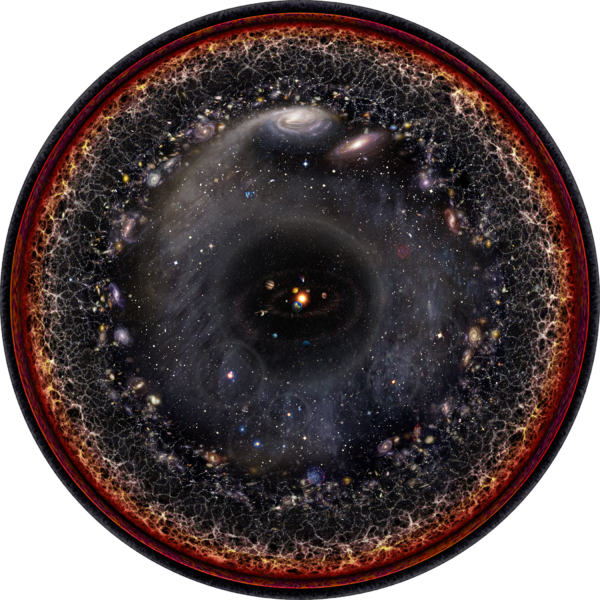
Besides the alteration of form there is actually a little difference of substance between the two enunciations; the second corresponds to a later and, it is believed, more accurate formula given by Einstein a year or two after his first theory. The modification is made necessary by our realisation that space is finite but unbounded (p. 80). The second enunciation would be exactly equivalent to the first if for “same constant length” we read “infinite length”. Apart from very speculative estimates we do not know the constant length referred to, but it must certainly be greater than the distance of the furthest nebula, say 1020 miles. A distinction between so great a length and infinite length is unnecessary in most of our arguments and investigations, but it is necessary in the present chapter.

The only significance that may be given to that length (1020) is the absolute level of inertia attributed to matter.

We must try to reach the vivid significance which lies behind the obscure phraseology of the law. Suppose that you are ordering a concave mirror for a telescope. In order to obtain what you want you will have to specify two lengths (i) the aperture, and (2) the radius of curvature. These lengths both belong to the mirror— both are necessary to describe the kind of mirror you want to purchase—but they belong to it in different ways. You may order a mirror of 100 foot radius of curvature and yet receive it by parcel post. In a certain sense the 100 foot length travels with the mirror, but it does so in a way outside the cognizance of the postal authorities. The 100 foot length belongs especially to the surface of the mirror, a two-dimensional continuum; space-time is a four-dimensional continuum, and you will see from this analogy that there can be lengths belonging in this way to a chunk of space-time—lengths having nothing to do with the largeness or smallness of the chunk, but none the less part of the specification of the particular sample. Owing to the two extra dimensions there are many more such lengths associated with spacetime than with the mirror surface. In particular, there is not only one general radius of spherical curvature, but a radius corresponding to any direction you like to take. For brevity I will call this the “directed radius” of the world. Suppose now that you order a chunk of spacetime with a directed radius of 500 trillion miles in one direction and 800 trillion miles in another. Nature replies “No. We do not stock that. We keep a wide range of choice as regards other details of specification; but as regards directed radius we have nothing different in different directions, and in fact all our goods have the one standard radius, x trillion miles.” I cannot tell you what number to put for x because that is still a secret of the firm.

The fact that this directed radius which, one would think, might so easily differ from point to point and from direction to direction, has only one standard value in the world is Einstein’s law of gravitation. From it we can by rigorous mathematical deduction work out the motions of planets and predict, for example, the eclipses of the next thousand years; for, as already explained, the law of gravitation includes also the law of motion. Newton’s law of gravitation is an approximate adaptation of it for practical calculation. Building up from the law all is clear; but what lies beneath it? Why is there this unexpected standardisation? That is what we must now inquire into.

.

Eddington 1927: Geometry and Mechanics

Hubble2

Reference: The Nature of the Physical World

This paper presents Chapter VI (section 7) from the book THE NATURE OF THE PHYSICAL WORLD by A. S. EDDINGTON. The contents of this book are based on the lectures that Eddington delivered at the University of Edinburgh in January to March 1927.

The paragraphs of original material are accompanied by brief comments in color, based on the present understanding.  Feedback on these comments is appreciated.

The heading below links to the original materials.

.

Geometry and Mechanics

The point that deserves special attention is that the proposition about time-triangles is a statement as to the behaviour of clocks moving with different velocities. We have usually regarded the behaviour of clocks as coming under the science of mechanics. We found that it was impossible to confine geometry to space alone, and we had to let it expand a little. It has expanded with a vengeance and taken a big slice out of mechanics. There is no stopping it, and bit by bit geometry has now swallowed up the whole of mechanics. It has also made some tentative nibbles at electromagnetism. An ideal shines in front of us, far ahead perhaps but irresistible, that the whole of our knowledge of the physical world may be unified into a single science which will perhaps be expressed in terms of geometrical or quasi-geometrical conceptions. Why not? All the knowledge is derived from measurements made with various instruments. The instruments used in the different fields of inquiry are not fundamentally unlike. There is no reason to regard the partitions of the sciences made in the early stages of human thought as irremovable.

Time-triangles are better described as quantization-triangles. It is not the speed of clock that slows it down, but the decrease in quantization.

But mechanics in becoming geometry remains none the less mechanics. The partition between mechanics and geometry has broken down and the nature of each of them has diffused through the whole. The apparent supremacy of geometry is really due to the fact that it possesses the richer and more adaptable vocabulary; and since after the amalgamation we do not need the double vocabulary the terms employed are generally taken from geometry. But besides the geometrisation of mechanics there has been a mechanisation of geometry. The proposition about the space-triangle quoted above was seen to have grossly material implications about the behaviour of scales which would not be realised by anyone who thinks of it as if it were a proposition of pure mathematics.

The geometry we are familiar with applies to material space and not to space that is empty of material-substance. The same consideration applies to time.

We must rid our minds of the idea that the word space in science has anything to do with void. As previously explained it has the other meaning of distance, volume, etc., quantities expressing physical measurement just as much as force is a quantity expressing physical measurement. Thus the (rather crude) statement that Einstein’s theory reduces gravitational force to a property of space ought not to arouse misgiving. In any case the physicist does not conceive of space as void. Where it is empty of all else there is still the aether. Those who for some reason dislike the word aether, scatter mathematical symbols freely through the vacuum, and I presume that they must conceive some kind of characteristic background for these symbols. I do not think any one proposes to build even so relative and elusive a thing as force out of entire nothingness.

Void as “empty space” is an erroneous concept. Space that is empty of material-substance, is there only because it is the extension characteristic of field-substance.

.

Eddington 1927: Time Geometry

Time geometry

Reference: The Nature of the Physical World

This paper presents Chapter VI (section 6) from the book THE NATURE OF THE PHYSICAL WORLD by A. S. EDDINGTON. The contents of this book are based on the lectures that Eddington delivered at the University of Edinburgh in January to March 1927.

The paragraphs of original material are accompanied by brief comments in color, based on the present understanding.  Feedback on these comments is appreciated.

The heading below links to the original materials.

.

Time Geometry

Einstein’s law of gravitation controls a geometrical quantity curvature in contrast to Newton’s law which controls a mechanical quantity force. To understand the origin of this geometrisation of the world in the relativity theory we must go back a little.

The curvature of Einstein refers to twisting of substance, which involves force at microscopic level. So curvature cannot be divorced from force.

The science which deals with the properties of space is called geometry. Hitherto geometry has not included time in its scope. But now space and time are so interlocked that there must be one science—a somewhat extended geometry—embracing them both. Three-dimensional space is only a section cut through four-dimensional space-time, and moreover sections cut in different directions form the spaces of different observers. We can scarcely maintain that the study of a section cut in one special direction is the proper subject-matter of geometry and that the study of slightly different sections belongs to an altogether different science. Hence the geometry of the world is now considered to include time as well as space. Let us follow up the geometry of time.

Space and time are not self-identified entities. They are characteristics of substance, namely, extension and duration, and that is how they are related.

You will remember that although space and time are mixed up there is an absolute distinction between a spatial and a temporal relation of two events. Three events will form a space-triangle if the three sides correspond to spatial relations—if the three events are absolutely elsewhere with respect to one another.  (This would be an instantaneous space-triangle. An enduring triangle is a kind of four-dimensional prism.) Three events will form a time-triangle if the three sides correspond to temporal relations—if the three events are absolutely before or after one another. (It is possible also to have mixed triangles with two sides time-like and one space-like, or vice versa.) A well-known law of the space-triangle is that any two sides are together greater than the third side. There is an analogous, but significantly different, law for the time-triangle, viz. two of the sides (not any two sides) are together less than the third side. It is difficult to picture such a triangle but that is the actual fact.

Time is asserted by a sequence of changes. It is absolute from the universal viewpoint. It appears relative only from local viewpoints.

Let us be quite sure that we grasp the precise meaning of these geometrical propositions. Take first the space-triangle. The proposition refers to the lengths of the sides, and it is well to recall my imaginary discussion with two students as to how lengths are to be measured (p. 23). Happily there is no ambiguity now, because the triangle of three events determines a plane section of the world, and it is only for that mode of section that the triangle is purely spatial. The proposition then expresses that “If you measure with a scale from A to B and from B to C the sum of your readings will be greater than the reading obtained by measuring with a scale from A to C.”

For a time-triangle the measurements must be made with an instrument which can measure time, and the proposition then expresses that “If you measure with a clock from A to B and from B to C the sum of your readings will be less than the reading obtained by measuring with a clock from A to C.”

In order to measure from an event A to an event B with a clock you must make an adjustment of the clock analogous to orienting a scale along the line AB. What is this analogous adjustment? The purpose in either case is to bring both A and B into the immediate neighbourhood of the scale or clock. For the clock that means that after experiencing the event A it must travel with the appropriate velocity needed to reach the locality of B just at the moment that B happens. Thus the velocity of the clock is prescribed. One further point should be noticed. After measuring with a scale from A to B you can turn your scale round and measure from B to A, obtaining the same result. But you cannot turn a clock round, i.e. make it go backwards in time. That is important because it decides which two sides are less than the third side. If you choose the wrong pair the enunciation of the time proposition refers to an impossible kind of measurement and becomes meaningless.

Dependence of space and time on the motion of the observer is subjective only.  Space and time can be seen as directly related to the quantization and inertia of substance. This view is objective and absolute.

You remember the traveller (p. 39) who went off to a distant star and returned absurdly young. He was a clock measuring two sides of a time-triangle. He recorded less time than the stay-at-home observer who was a clock measuring the third side. Need I defend my calling him a clock? We are all of us clocks whose faces tell the passing years. This comparison was simply an example of the geometrical proposition about time-triangles (which in turn is a particular case of Einstein’s law of longest track). The result is quite explicable in the ordinary mechanical way. All the particles in the traveller’s body increase in mass on account of his high velocity according to the law already discussed and verified by experiment. This renders them more sluggish, and the traveller lives more slowly according to terrestrial time-reckoning. However, the fact that the result is reasonable and explicable does not render it the less true as a proposition of time geometry.

The proposed time geometry has not been verified at all scales. A body’s inertia balances it natural motion. A material body can never travel at the speed of light because of its inertia.

Our extension of geometry to include time as well as space will not be a simple addition of an extra dimension to Euclidean geometry, because the time propositions, though analogous, are not identical with those which Euclid has given us for space alone. Actually the difference between time geometry and space geometry is not very profound, and the mathematician easily glides over it by a discrete use of the symbol √-1. We still call (rather loosely) the extended geometry Euclidean; or, if it is necessary to emphasise the distinction, we call it hyperbolic geometry. The term non-Euclidean geometry refers to a more profound change, viz. that involved in the curvature of space and time by which we now represent the phenomenon of gravitation. We start with Euclidean geometry of space, and modify it in a comparatively simple manner when the time-dimension is added; but that still leaves gravitation to be reckoned with, and wherever gravitational effects are observable it is an indication that the extended Euclidean geometry is not quite exact, and the true geometry is a non-Euclidean one—appropriate to a curved region as Euclidean geometry is to a flat region.

Euclidean geometry is valid only for the space and time corresponding to the inertia of material-substance. It is not valid for the space and time corresponding to the quantization levels of field-substance. That is represented by non-Euclidean geometry.

.

Eddington 1927: Relativity of Acceleration

motion_19

Reference: The Nature of the Physical World

This paper presents Chapter VI (section 5) from the book THE NATURE OF THE PHYSICAL WORLD by A. S. EDDINGTON. The contents of this book are based on the lectures that Eddington delivered at the University of Edinburgh in January to March 1927.

The paragraphs of original material are accompanied by brief comments in color, based on the present understanding.  Feedback on these comments is appreciated.

The heading below links to the original materials.

.

Relativity of Acceleration

The argument in this chapter rests on the relativity of acceleration. The apple had an acceleration of 32 feet per second per second relative to the ordinary observer, but zero acceleration relative to the man in the lift. We ascribe to it one acceleration or the other according to the frame we happen to be using, but neither is to be singled out and labelled “true” or absolute acceleration. That led us to reject the Newtonian conception which singled out 32 feet per second per second as the true acceleration and invented a disturbing agent of this particular degree of strength.

It will be instructive to consider an objection brought, I think, originally by Lenard. A train is passing through a station at 60 miles an hour. Since velocity is relative, it does not matter whether we say that the train is moving at 60 miles an hour past the station or the station is moving at 60 miles an hour past the train. Now suppose, as sometimes happens in railway accidents, that this motion is brought to a standstill in a few seconds. There has been a change of velocity or acceleration—a term which includes deceleration. If acceleration is relative this may be described indifferently as an acceleration of the train (relative to the station) or an acceleration of the station (relative to the train). Why then does it injure the persons in the train and not those in the station?

Much the same point was put to me by one of my audience. “You must find the journey between Cambridge and Edinburgh very tiring. I can understand the fatigue, if you travel to Edinburgh; but why should you get tired if Edinburgh comes to you?” The answer is that the fatigue arises from being shut up in a box and jolted about for nine hours; and it makes no difference whether in the meantime I move to Edinburgh or Edinburgh moves to me. Motion does not tire anybody. With the earth as our vehicle we are travelling at 20 miles a second round the sun; the sun carries us at 12 miles a second through the galactic system; the galactic system bears us at 250 miles a second amid the spiral nebulae; the spiral nebulae. … If motion could tire, we ought to be dead tired.

Similarly change of motion or acceleration does not injure anyone, even when it is (according to the Newtonian view) an absolute acceleration. We do not even feel the change of motion as our earth takes the curve round the sun. We feel something when a railway train takes a curve, but what we feel is not the change of motion nor anything which invariably accompanies change of motion; it is something incidental to the curved track of the train but not to the curved track of the earth. The cause of injury in the railway accident is easily traced. Something hit the train; that is to say, the train was bombarded by a swarm of molecules and the bombardment spread all the way along it. The cause is evident—gross, material, absolute—recognised by everyone, no matter what his frame of reference, as occurring in the train not the station. Besides injuring the passengers this cause also produced the relative acceleration of the train and station—an effect which might equally well have been produced by molecular bombardment of the station, though in this case it was not.

Velocity is relative because it requires an external reference point. This is not so with acceleration, which is referenced from the body itself. Therefore, acceleration is always absolute. It cannot be looked upon in relative terms.

The critical reader will probably pursue his objection. “Are you not being paradoxical when you say that a molecular bombardment of the train can cause an acceleration of the station—and in fact of the earth and the rest of the universe? To put it mildly, relative acceleration is a relation with two ends to it, and we may at first seem to have an option which end we shall grasp it by; but in this case the causation (molecular bombardment) clearly indicates the right end to take hold of, and you are merely spinning paradoxes when you insist on your liberty to take hold of the other.”

If there is an absurdity in taking hold of the wrong end of the relation it has passed into our current speech and thought. Your suggestion is in fact more revolutionary than anything Einstein has ventured to advocate. Let us take the problem of a falling stone. There is a relative acceleration of 32 feet per second per second—of the stone relative to ourselves or of ourselves relative to the stone. Which end of the relation must we choose? The one indicated by molecular bombardment? Well, the stone is not bombarded; it is falling freely in vacuo. But we are bombarded by the molecules of the ground on which we stand. Therefore it is we who have the acceleration; the stone has zero acceleration, as the man in the lift supposed. Your suggestion makes out the frame of the man in the lift to be the only legitimate one; I only went so far as to admit it to an equality with our own customary frame.

The idea of frame of space is flawed from “continuum of space” perspective, because there is no completely empty space. Space represents the extensions of substance, which is either material-substance or field-substance.

Your suggestion would accept the testimony of the drunken man who explained that “the paving-stone got up and hit him” and dismiss the policeman’s account of the incident as “merely spinning paradoxes”. What really happened was that the paving-stone had been pursuing the man through space with ever-increasing velocity, shoving the man in front of it so that they kept the same relative position. Then, through an unfortunate wobble of the axis of the man’s body, he failed to increase his speed sufficiently, with the result that the paving-stone overtook him and came in contact with his head. That, please understand, is your suggestion; or rather the suggestion which I have taken the liberty of fathering on you because it is the outcome of a very common feeling of objection to the relativity theory. Einstein’s position is that whilst this is a perfectly legitimate way of looking at the incident the more usual account given by the policeman is also legitimate; and he endeavours like a good magistrate to reconcile them both.

.