Category Archives: Science

Matter and Substance

There are atomic and non-atomic substances (see Emptiness, Void and Space). Matter is atomic substance. Light is a non-atomic substance.

Matter puts resistance to being pushed. That is how matter is detected. If there is no resistance, we can neither push matter nor detect it. Therefore, matter is defined by its resistance to push. Newton defined this property as innate force of matter, or “inertia”. The property of inertia makes matter substantial. That is why matter is also called “substance”.

We can detect light through our sense of vision. Light, therefore, is substantial because it interacts with our eyes. Its innate force, however, is very small compared to the inertia of matter.

Matter is atomic substance. Light is a non-atomic substance.

.

Mass and Energy

Matter has mass, but light is considered to have no mass. Science looks at light as radiant energy.

Matter has mass because it has an atomic structure with a nucleus. This structure greatly adds to the innate force of matter because of its rigidity. Therefore, mass is associated with matter and its inertia. Light has no mass because it has no rigid structure. It radiates out like a wave with a wavelength. It has kinetic energy.

Newtonian concepts of momentum and energy are defined for matter using mass in the mathematical equations. Momentum refers to the amount of motion there is, such as, in a moving log. Energy is the work done in stopping that moving log. When two billiard balls collide, their motion changes, and work is done in changing that motion. Change in momentum and energy are manifested only when there is force acting through contact.

Momentum and energy exist for light too. Since light has no mass, mathematics assumes some substance (innate force) for light without expressing it. That substance may be estimated for light from Einstein’s equation, E = mc2.

Light is an extremely fast moving, unstructured, wave-like substance.

.

Substance and Density

The density of matter depends on how densely the atoms are packed within a body. But even then, this density is averaged over the atom in which the heavy nucleus exists as a tiny speck.

The highest density of substance exists in the nucleus of an atom. The density decreases sharply farther away from the nucleus in the electronic region. The electron is 1840 times lighter than a neutron, and its volume is much larger. A photon is still much lighter, and greater in volume compared to the electron.

One may say that “pure substance” is becoming “diluted” from neutron/proton to electron to photon, and its density is decreasing. The density of photon may be estimated by its wavelength.

Light as a substance has minimum density.

.

Past Views of Light

In Newton’s time, the recognized substance was matter. He saw light as made up of particles (corpuscular theory) but these particles did not follow the laws of mechanics like matter particles did. Therefore, he did not associate inertia or innate force with them.

Einstein also viewed light to be made up of particles, which he called light quanta. He implied these particles to be packets of energy that had discrete existence in space. These particles carried enough momentum to expel electrons from the surface of certain metals. Still Einstein did not call out light as a substance with density and innate force.

In the past light has not been viewed as a dynamic substance with density and innate force.

.

Emptiness, Void and Space

In the East, void is defined as “emptiness”, which is the absence of all phenomena. In the West, however, “void” seems to be related primarily to the absence of physical phenomenon.

.

Emptiness

From the Eastern viewpoint, emptiness is the absence of all phenomena, whether real or imagined. This includes phenomena, such as, birth, death, being, non-being, increasing, decreasing, purity and defilement. These concepts apply to both physical and metaphysical phenomena.

The viewpoint of emptiness is just that. It is totally fresh. It is completely clean. There are no preconceived notions, no fixed ideas, no bias, etc. In short, the concept of emptiness is not viewed through any filters. It is simply what it is.

From a scientific viewpoint, this is the ultimate reference point from which all physical and metaphysical phenomena is perceived objectively. Emptiness has that property of being inherently understood because it denotes the absence of all phenomena. From this reference point it is possible to give an objective meaning to any phenomena. Emptiness is like the zero of a scale of phenomena. Emptiness itself is not a phenomenon, just like zero is not a value.

Emptiness is the ultimate reference point from which all phenomena can be understood objectively without any preconceived notion.

.

Void and Space

When astronomers look up at the heavens, they are basically considering physical phenomenon. They regard those regions of heaven as void where they cannot detect any physical phenomenon. Therefore, void is a narrow version of emptiness.

Physics is basically concerned with void and the physical phenomenon. The definition of physical phenomena extends to describing all physical aspects of the universe, such as, matter, energy, space and time. The physical phenomena, however, seem to center around the concept of matter.

Space is defined as absence of matter, where matter is thought of as made of solid atoms. The atom, however, is not completely solid. It is said to be over 99.99% space with a speck of solid nucleus in the center. But that space in atom consists of electronic, electromagnetic and force fields. We may categorize these fields as non-atomic substances.

Space, as vacuum, may be free of atomic substance, but it is certainly not free of non-atomic fields. In general,

Space and fields are not differentiated from each other.

.

Absolute Motion

Absolute motion is motion that does not depend on anything external to the moving object for its existence or specific nature. Thus, the motion that qualifies being absolute is acceleration. Acceleration is the change in velocity relative to the velocity of the object. The velocity of an object relative to itself is always zero.

But there is a motion (speed) that is intrinsic to an object because it depends on the density of the object. A substance can be atomic (such as, matter), or non-atomic (such as, light). [See Matter, Light and Substance]. Any substance, whether it is a particle or a quantum, has the property of density. [See Particle, Quantum and Density].

The higher is the density of a substance, the greater is its duration at a location. For example, matter that has a very high density can endure for a long time at a location, whereas, light that has almost infinitesimal density can hardy endure at that location before it moves away.

The intrinsic motion of the substance is reciprocal to its duration at a location. Therefore, we can say, the higher is the density; the lower is the intrinsic or absolute motion of substance. The following sketch gives an idea of this relationship.

Since density is three-dimensional, but motion (velocity) is linear, we may say:

Intrinsic or absolute motion = constant / cube root of density

If the density of the substance is not changing then its absolute motion is not changing either. This explains the Michelson-Morley’s Null Result. Since the density of Earth and light is constant, the difference between their absolute motion is also constant.

The change in the direction of movement of earth shall not provide different velocities of light.

This also explains why atoms agitate, which leads to Brownian motion. Atoms have intrinsic velocities and very low momentum. When a number of atoms are in close vicinity, they continually collide because of their inherent motion.

.

The Dimensions of Physical Location

In his 1920 Book, “Relativity: The Special and General Theory”, Einstein started out by questioning the axioms of Euclidean geometry (see Physical Meaning of Geometrical Propositions). Einstein says,

The concept “true” does not tally with the assertions of pure geometry, because by the word “true” we are eventually in the habit of designating always the correspondence with a “real” object; geometry, however, is not concerned with the relation of the ideas involved in it to objects of experience, but only with the logical connection of these ideas among themselves.

Einstein points out that the propositions of Euclid’s geometry have been formalized to conform to idealized logic. When these propositions are satisfied for those real things we have associated with the geometrical ideas then geometry may be treated as a branch of physics. Einstein then goes on to establish a system of co-ordinates based on rigid bodies. Rigid bodies expand and contract, and so do their space (see The System of Co-ordinates).

Physics is essentially dealing with space that acts as extents of physical substance.

We may expand on Einstein’s argument by pointing out that locations in physical space shall have dimensions, although Euclidean geometry represents locations by points that do not have any length, area, volume, or any other dimensional attribute. A location in physical space may be infinitesimal, but it is not dimensionless. It is also continuous with the surrounding space, just like irrational numbers are continuous on a number line.

Euclidean space is defined as a set that includes points as elements. The physical space, however, is continuous with the locations within it. This makes the physical space a primitive notion and not the point location.

The physical space is a primitive notion, which then allows the notion of point locations.

We may now establish a system of co-ordinates based on the concept of quantum. A quantum of space is a point location. A point location not only has extents but these extents expand and contract. As the extents contract the density of point location increases; and as they expand the density decreases. Thus, in addition to the three spatial dimensions a point location has an additional dimension of density. As density increases, the point location gains endurance. This makes the dimension of density, or duration, imply varying rigidity. Ultimate in density, or duration, is complete rigidity.

A physical location has the dimensions of length, width, height and duration (density).

This dimension of duration is not the same as the dimension of time. Duration is real and objective, whereas, time is abstract and subjective.

Einsteinian space is rigid as it is based on material substance. It assumes the infinite density and duration of the atom. The physical space, on the other hand, implies varying rigidity of the non-atomic substance. This is expressed through the dimension of duration (density). The rigidity of the atomic substance then becomes a limiting condition.

This may have some fundamental implications on the way the Relativity and Quantum theories are currently interpreted.

.

Eddington 1927: Consequences of the Contraction

Reference: The Book of Physics

Note: The original text is provided below.
Previous / Next

Summary

.

Comments

.

Original Text

This result alone, although it may not quite lead you to the theory of relativity, ought to make you uneasy about classical physics. The physicist when he wishes to measure a length—and he cannot get far in any experiment without measuring a length—takes a scale and turns it in the direction needed. It never occurred to him that in spite of all precautions the scale would change length when he did this; but unless the earth happens to be at rest a change must occur. The constancy of a measuring scale is the rock on which the whole structure of physics has been reared; and that rock has crumbled away. You may think that this assumption cannot have betrayed the physicist very badly; the changes of length cannot be serious or they would have been noticed. Wait and see.

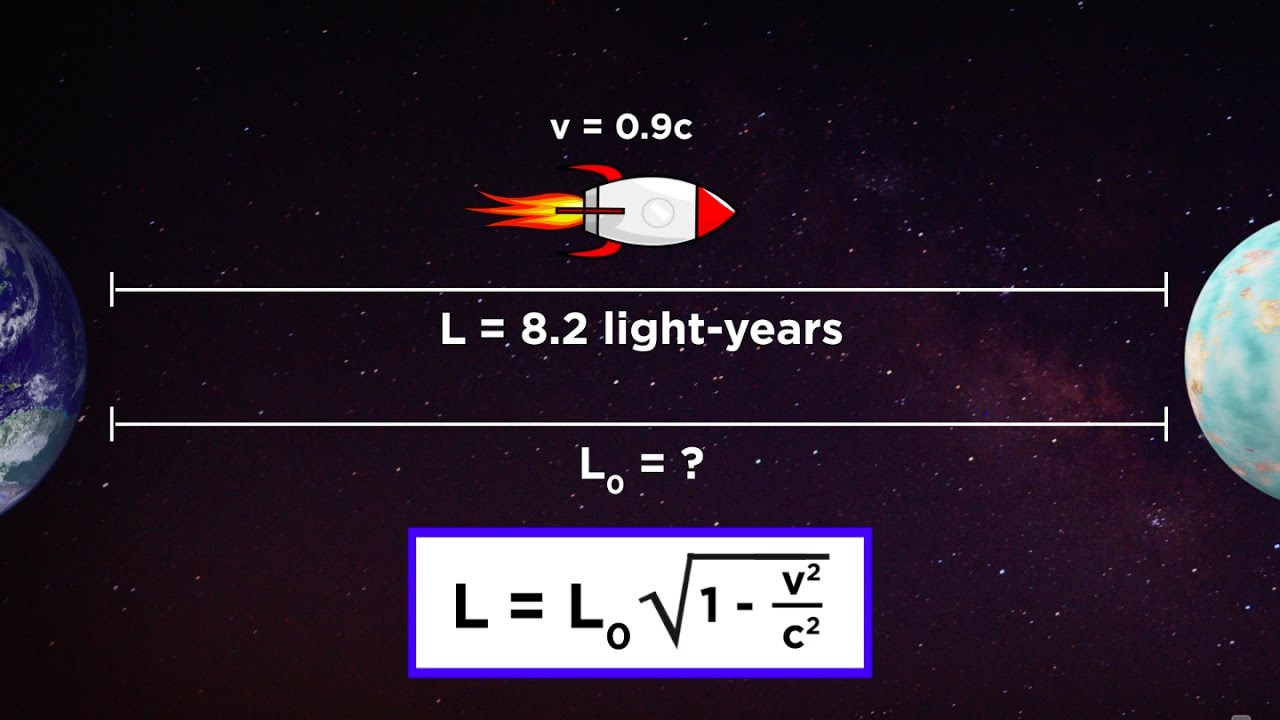
Let us look at some of the consequences of the FitzGerald contraction. First take what may seem to be a rather fantastic case. Imagine you are on a planet moving very fast indeed, say 161,000 miles a second. For this speed the contraction is one-half. Any solid contracts to half its original length when turned from across to along the line of motion. A railway journey between two towns which was 100 miles at noon is shortened to 50 miles at 6 p.m. when the planet has turned through a right angle. The inhabitants copy Alice in Wonderland; they pull out and shut up like a telescope.

I do not know of a planet moving at 161,000 miles a second, but I could point to a spiral nebula far away in space which is moving at 1000 miles a second. This may well contain a planet and (speaking unprofessionally) perhaps I shall not be taking too much license if I place intelligent beings on it. At 1000 miles a second the contraction is not large enough to be appreciable in ordinary affairs; but it is quite large enough to be appreciable in measurements of scientific or even of engineering accuracy. One of the most fundamental procedures in physics is to measure lengths with a scale moved about in any way. Imagine the consternation of the physicists on this planet when they learn that they have made a mistake in supposing that their scale is a constant measure of length. What a business to go back over all the experiments ever performed, apply the corrections for orientation of the scale at the time, and then consider de novo the inferences and system of physical laws to be deduced from the amended data! How thankful our own physicists ought to be that they are not in this runaway nebula but on a decently slow-moving planet like the earth!

But stay a moment. Is it so certain that we are on a slow-moving planet? I can imagine the astronomers in that nebula observing far away in space an insignificant star attended by an insignificant planet called Earth. They observe too that it is moving with the huge velocity of 1000 miles a second; because naturally if we see them receding from us at 1000 miles a second they will see us receding from them at 1000 miles a second. “A thousand miles a second!” exclaim the nebular physicists, “How unfortunate for the poor physicists on the Earth! The FitzGerald contraction will be quite appreciable, and all their measures with scales will be seriously wrong. What a weird system of laws of Nature they will have deduced, if they have overlooked this correction!”

There is no means of deciding which is right—to which of us the observed relative velocity of 1000 miles a second really belongs. Astronomically the galaxy of which the earth is a member does not seem to be more important, more central, than the nebula. The presumption that it is we who are the more nearly at rest has no serious foundation; it is mere self-flattery.

“But”, you will say, “surely if these appreciable changes of length occurred on the earth, we should detect them by our measurements.” That brings me to the interesting point. We could not detect them by any measurement; they may occur and yet pass quite unnoticed. Let me try to show how this happens.

This room, we will say, is travelling at 161,000 miles a second vertically upwards. That is my statement, and it is up to you to prove it wrong. I turn my arm from horizontal to vertical and it contracts to half its original length. You don’t believe me? Then bring a yard-measure and measure it. First, horizontally, the result is 30 inches; now vertically, the result is 30 half-inches. You must allow for the fact that an inch-division of the scale contracts to half an inch when the yard-measure is turned vertically.

“But we can see that your arm does not become shorter; can we not trust our own eyes?”

Certainly not, unless you remember that when you got up this morning your retina contracted to half its original width in the vertical direction; consequently it is now exaggerating vertical distances to twice the scale of horizontal distances.

“Very well”, you reply, “I will not get up. I will lie in bed and watch you go through your performance in an inclined mirror. Then my retina will be all right, but I know I shall still see no contraction.”

But a moving mirror does not give an undistorted image of what is happening. The angle of reflection of light is altered by motion of a mirror, just as the angle of reflection of a billiard-ball would be altered if the cushion were moving. If you will work out by the ordinary laws of optics the effect of moving a mirror at 161,000 miles a second, you will find that it introduces a distortion which just conceals the contraction of my arm.

And so on for every proposed test. You cannot disprove my assertion, and, of course, I cannot prove it; I might equally well have chosen and defended any other velocity. At first this seems to contradict what I told you earlier—that the contraction had been proved and measured by the Michelson-Morley and other experiments—but there is really no contradiction. They were all null experiments, just as your experiment of watching my arm in an inclined mirror was a null experiment. Certain optical or electrical consequences of the earth’s motion were looked for of the same type as the distortion of images by a moving mirror; these would have been observed unless a contraction occurred of just the right amount to compensate them. They were not observed; therefore the compensating contraction had occurred. There was just one alternative; the earth’s true velocity through space might happen to have been nil. This was ruled out by repeating the experiment six months later, since the earth’s motion could not be nil on both occasions. Thus the contraction was demonstrated and its law of dependence on velocity verified. But the actual amount of contraction on either occasion was unknown, since the earth’s true velocity (as distinct from its orbital velocity with respect to the sun) was unknown. It remains unknown because the optical and electrical effects by which we might hope to measure it are always compensated by the contraction.

I have said that the constancy of a measuring scale is the rock on which the structure of physics has been reared. The structure has also been supported by supplementary props because optical and electrical devices can often be used instead of material scales to ascertain lengths and distances. But we find that all these are united in a conspiracy not to give one another away. The rock has crumbled and simultaneously all the other supports have collapsed.

.