Category Archives: Science

The Objectivity of Physics

Reference: The Physics Book

As observed in the preface, the fundamental theories in the subject of Physics cannot be reconciled with each other. This is an anomaly.

.

Anomalies & Assumptions

An anomaly is any violation of the integrity of reality, such as, discontinuity (missing data), inconsistency (contradictory data), or disharmony (arbitrary data). An anomaly flags the presence of a hidden assumption. When the assumption is discovered it explains the anomaly, and a resolution occurs.

The above anomaly in Physics indicates that there is at least one hidden assumption in physics at the fundamental level. 

.

Physics and Philosophy

Philosophy defines “subjective” as follows:

“… relating to or of the nature of an object as it is known in the mind as distinct from a thing in itself.”

It is true that what is out there (a thing in itself) is sensed by our sensory organs. These sensations are then broken down into perceptual elements. The perceptual elements are assimilated into a mental matrix. The state of assimilation of the mental matrix provides us with the perception and knowledge of the things out there. The finer are the perceptual elements that are assimilated, the closer is the approximation in our mind to “the thing in itself.”

We improve this approximation of the “the thing in itself” by refining the perceptual elements and assimilating them in the mental matrix. This is accomplished through the discovery and resolution of anomalies.

Physics takes pride in being objective. The objective reality is that which has been tested and verified and cannot be argued with. It is the same for all people because all known anomalies have been resolved.  Therefore, the resolution of anomalies, in general, leads one from subjectivity towards objectivity.

When we say that physics is objective, we mean that physics is focused on obtaining continuity, consistency, and harmony among all its observations, interpretations and conclusions by discovering and resolving anomalies.

.

The World of Atom (Part XVI)

Reference: Boorse 1966: The World of Atom

PART XVI–HIGH ENERGY PHYSICS

THE WORLD OF ATOM by Boorse

Chapter 94: Parity and Its Ill Fortune – C. N. Yang (b. 1922) and T. D. Lee (b. 1926)

Law of Parity Conservation. In 1953 it was found that theta and tau mesons had identical masses and lifetimes, but they decay in different schemes with different parities. This led to the assumption that they were two different K-mesons, even though they were alike in all other aspects. Lee and Yang, on examining this situation, discovered that the principle of conservation of parity has never been experimentally verified for weak interactions. Lee and Yang proposed that the conservation of parity be discarded in any reaction involving neutrinos and in weak interactions in general. This was then verified experimentally. They won the 1957 Nobel Prize.

Chapter 95: Nuclei and Nucleons – R. Hofstadter (1915 – 1990) 

Structure of Nuclei and Nucleons. Hofstadter received Nobel Prize in 1961 for detailed investigation into the structure of matter. He extended the technique of previous electron-scattering studies to higher energies and discovered that nucleons consist of charged mesonic clouds. In the proton, these clouds appeared to add to the effect of their charges; in the neutron the clouds seem to cancel one another. Thus, nucleons are complex bodies of constituent mesons.

Chapter 96: Elementary Particles – H. A. Boorse (1904 – 2003) and L. Motz (1909 – 2004)

MAIN POINTS

  1. Symmetry is a property of a physical system that is unaffected by certain mathematical transformations.
  2. A particular type of symmetry in nature implies the existence of a conservation law.
  3. In nature, symmetries are everywhere forming an important part of the laws.
  4. The concept of invariance introduced by Einstein is the most important example of symmetry.
  5. Invariance is the property of remaining unchanged regardless of changes in the conditions of measurement. 
  6. Invariance is related to conservation laws; for example, conservation of energy is related to invariance over time.
  7. The existence of quantum numbers is, in a sense, a consequence of the symmetries in nature.
  8. Parity is a property of a wave function or state vector.
  9. Conservation of parity is the rule that odd wave functions must remain odd and even must remain even.
  10. It was found experimentally that the parity was not conserved in the β-decay of cobalt-60.
  11. Protons and the neutron have finite size or a structure.
  12. Both have their magnetic moment distributed over a finite radius.
  13. Proton also has its electric charge similarly distributed.
  14. Both the proton and the neutron consist of cores surrounded by clouds of mesons.
  15. In the neutron the clouds seem to cancel one another.
  16. In the proton these clouds appeared to add to the effect of their charges.
  17. Every nucleus has a core of electric charge surrounded by a thin skin in which the charge falls off to zero quite quickly. 
  18. In this nuclear core the charge density is constant.

THEORY
The atom is a vortex of condensing substance.

.

Substance, Inertia and Consistency

Reference: A Logical Approach to Theoretical Physics

The following definition is missing in physics.

Matter is a substance so condensed that it has a center of mass. Less condensed substances, like electricity and light, have no center of mass, but they have consistency.

Consistency is a dimension of a substance that is actually the subject of Quantum mechanics. The size of the quantum is determined by the consistency of the substance. Quantum is the energy involved in subatomic interactions.

The nucleus of an atom has mass, but the substance around the nucleus has consistency but no mass. Consistency also has inertia just like mass. Therefore, the electromagnetic substance, such as light, has momentum even when it is not made up of atoms.

The “mass” of an electron is actually a measure of inertia in response to enforced motion. It is the result of electron having the highest consistency among electromagnetic substances.

NOTE (Sep 15, 2021):
I have revised the above to make the definitions of “substance,” “mass,” and “consistency” more clear. It also clarifies the definition of “quantum” as “the energy involved in subatomic interactions.” It also puts the definition of “inertia” in proper perspective.

.

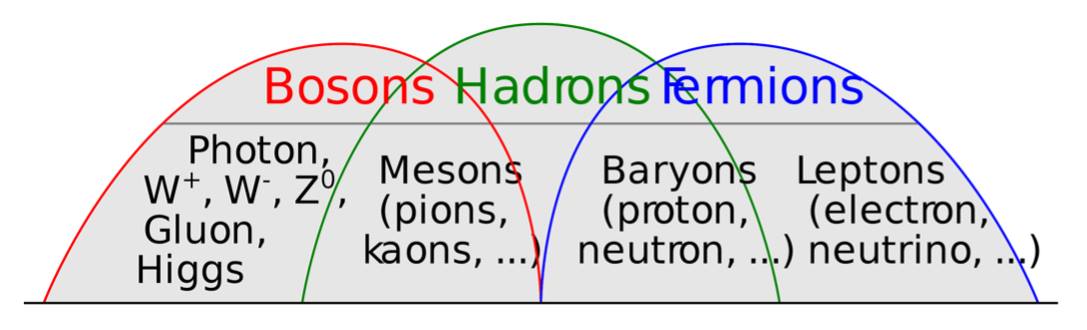
The “Particle” Physics

Elementary particle - Wikipedia

The most confusing concept pertaining to particle physics is the concept of “particle” itself. We are familiar with mass particles. Such particles have a center of mass, and momentum. A mass particle reduces to an atom. The nucleus of an atom acts as the center of mass. The rest of the atom is configured around this nucleus.

When we get beyond the atom and look at electromagnetic radiation, we are dealing with a very different kind of substance. It has momentum but no center of mass. It has fluid-like properties. This “fluid,” when it flows, have wave-like characteristics. It is not a disturbance in some other medium, which we associate with waves in the material domain.

EM substance is very different from the material substance, which is made up of atoms.

The electromagnetic substance has consistency (a degree of density, firmness, viscosity, etc.) and also a fluid-like continuity. The quantum aspect of this EM substance comes from its interaction with material substance. Such interaction involves a precise energy based on the consistency of the EM substance.

The consistency of EM substance gives it momentum and the interaction with matter gives its the quantum property. But this substance does not have the center of mass around which to generate spatial particles. The EM substance is, therefore, continuous in space.

The most confusion, therefore, comes from the use of the word “particle” in Particle Physics. These are particles based on discrete energy interactions that vary according to the consistency of the EM substance. They are not particles based on discreteness in space, which is a characteristic of material substance only.

NOTE: Electrons have the highest consistency in the EM spectrum. There is a threshold of consistency above which we have material substance. Nucleon’s consistency is about 1836 times the consistency of electrons. It qualifies as material substance. Mass is associated with material substance. It has the property of “having a center” that identifies it as a “point particle”. Electrons are not material (or point) particles. The apparent “mass” of the electrons is essentially the manifestation of its inertia. Inertia is a property of consistency and not just that of mass.

.

Einstein’s Legacy

Albert Einstein (1879 – 1955)

[In bold black are the published facts. In color are some comments.]

.

Einstein provided ground breaking physical reasoning to establish the reality of molecules, electromagnetic radiation and physical space. He proved the existence of molecules directly by relating it to the observable phenomenon of Brownian motion mathematically.

Matter, as a substance, is reducible to discrete point-particles that have momentum and inertia. Such properties are distinctive of “mass”.The “mass” of the electron is seen as increasing with velocity; but it is actually the inertia of electron that is increasing when accelerated. Electron has charge but it has no mass because it is not reducible to a point-particle.

Einstein established beyond any doubt that electromagnetic radiation has particle-like properties. In spite of its wave properties radiation was not a disturbance in some postulated ether. Radiation field could exist in space quite independently of palpable matter. Einstein visualized radiation as made up of unchanging energy-packets (quanta) distributed discontinuously in space. Einstein proved further that energy and mass are equivalent, and mechanics could no longer be maintained as the foundation of physics.

The particle-like properties of electromagnetic radiation are actually substance-like properties of momentum and inertia. Radiation is a different kind substance in that its momentum and inertia are many orders of magnitude less than that of matter, and it follows the laws of electromagnetism instead of Newton’s laws of motion. The wave-particle dilemma disappears when radiation is viewed as a fluid-like substance with a diffused consistency rather than a particle-like concentrated consistency in space. Maxwell’s model accounted for the intensity of radiation but not its unchanging consistency. The consistency naturally provides the unit of energy involved in the absorption and emission of that radiation. This is the quantum.

Einstein further established the nature of electromagnetic substance through his special theory of relativity. He determined that no observer (inertial frame) could travel at the speed of light. He postulated that the laws of nature, including the speed of light, should appear the same in all inertial frames moving with uniform speed with respect to each other. This became the basis of Einstein’s relativity. It resulted in the revision of the concepts of space and time.

The waves of electromagnetic substance are analogous to the waves of disturbance in a material medium. They are described by the same mathematics; but they are actually different in reality. The wave in a material medium is described by frequency, wave-length and period. However, the corresponding characteristics of an electromagnetic wave are best described as consistency, volume-space and duration. As frequency increases, wave-length decreases and period becomes increasingly repetitive. Similarly, as the consistency of radiation increases, its volume-space condenses and its duration at a location increases. This results in the reduction of speed. Thus, we see electron moving much slower than light. Since the consistency of light is many orders of magnitude less than the consistency of matter, the speed of light is many orders of magnitude greater than the speed of inertial frames in the material domain. Therefore, the speed of light appears to be constant for any uniformly moving coordinate system in the material domain. This is a good approximation. The mathematics of special relativity then follows. Matter and electromagnetic radiation are two different kind of substances that exist in space. Their relative motion is an expression of their relative consistency. The perception of space and time is fixed in nature through this relationship. 

Einstein also published an analysis indicating the equivalence of gravitational and inertial mass is not a mere accident of nature, but the basis of a profound physical principle that leads to a new theory of gravity. Einstein realized that mathematical descriptions of nature were to be taken as laws only if their forms remain unchanged in going from one frame of reference to any other frame by the most general type of coordinate transformation we can imagine. This became his general theory of relativity.

From matter to electromagnetic radiation the substance undergoes orders of magnitude reduction in its essential property of inertia. A similar orders of magnitude reduction takes place from electromagnetic radiation to space. The substance of space is currently recognized as the Higgs Field. As material and electromagnetic substances move through space, there is a resistance that appears as inertia. The more is the acceleration, the greater is the inertia. When the acceleration is fixed and balanced by inertia it appears as the consistency of the quantum or mass. Here we have the Higgs field converting into the quantum or mass and vice versa. Please see A New Theory of Gravitation.

.