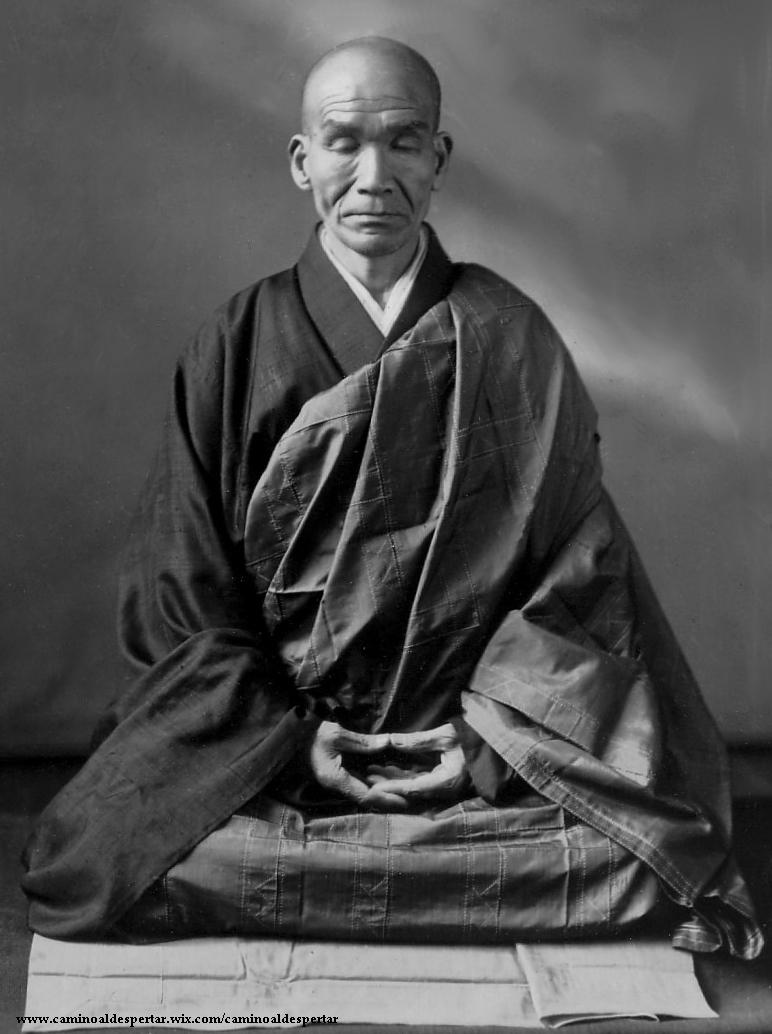
Reference: Lectures on Zen
These are Yasutani-Roshi’s introductory lectures on Zen training from THE THREE PILLARS OF ZEN by Philip Kapleau.
There is little to comment here. Any comment is to empasize a point. The comments are in color.
.
Lecture 11—Aspiration
Even while we all do zazen, our individual aspirations are not identical. These aspirations resolve themselves into four main groups or levels.
The first and shallowest level involves neither faith in Zen Buddhism nor even a cursory understanding of it. One just happens to hear about it and decides he would like to sit with a zazen group or in a sesshin. Nevertheless, that out of millions of deluded people (entirely ignorant of Buddhism) one particular individual should be led to this 2,500-year-old, unbroken line of teaching is, in the Buddhist view, not a fortuitous but a karmic circumstance and hence of vast spiritual significance.
The second level of aspiration is a level which goes no deeper than the desire to do zazen in order to improve physical or mental health or both. This, you will recall, falls into the first of the five classifications of Zen, namely, bompu (ordinary) Zen.
At the third level we find people who, no longer satisfied merely to increase their physical and mental well-being, want to tread the path of the Buddha. They recognize how exalted is the Buddhist cosmology, which views existence as not confined to one life-span but endlessly evolving lifetime after lifetime, with the circle of human destiny completed only upon the attainment of Buddhahood. More, they have established faith in the reality of the enlightenment experience, and though the resolve to attain it has not yet been awakened, the desire to pursue the Buddha’s Way is clear and real.
The fourth level comprises those determined to realize their True-self. They know this experience to be a living reality, for they have encountered people who have had it, and they are convinced they can likewise attain it. When they come before their teacher they come with an open mind and a humble heart, ready to follow whatever course he prescribes, secure in the knowledge that by so doing they can realize their goal in the shortest time.
I will now quickly recapitulate these four classes of aspirants: those who, having no particular faith in Zen, come to it through fortunate karmic circumstances; those who practice zazen through a desire only to add to their physical or mental health or both; those who practice Zen out of belief in the exalted nature of the Buddha’s teaching; and those who have a strong determination to become enlightened.
Hereafter you will come before me one by one and I will ask you what you feel to be the nature of your aspiration, that is, into which of the four classes you fall. Tell me your feelings honestly. Do not add anything through pride, and do not subtract anything out of false modesty. Depending upon what you tell me, I will assign you the zazen most appropriate for you.
There is no definitive practice which applies to everyone. Generally speaking, one who puts himself in the first class is assigned the practice of counting his breaths; one in the second category, the following of his breaths; in the third class, shikan-taza; and in the fourth, a koan, usually Mu.
When students come before me individually for the first time, they make all manner of curious replies. Some say: “I think I belong between the first and second classes.” Others tell me: “I have a chronically bad stomach, so would you assign me a type of zazen that will help this condition?” Or sometimes a person will say: “I am somewhat neurotic; what kind of zazen would be good for that?”
Depending on the type of person and the strength of his determination, I prescribe what I believe to be a suitable practice. With a stolid individual it is usually desirable to spur him on with the kyosaku, whereas a somewhat nervous or sensitive person can do better zazen without it. Only if your appraisal of your feelings is frank can I select for you the most effective practice.
.