Category Archives: Buddhism

Exploring the Words of the Buddha

Reference: Course on Subject Clearing

Abbreviations:
MN = Majjhima_Nikaya (Middle Length Discourses of the Buddha)
SN = Saṃyutta Nikāya (Connected Discourses of the Buddha)
AN = Aṅguttara Nikāya (Numerical Discourses of the Buddha)
DN = Dīgha Nikāya (Long Discourses of the Buddha)

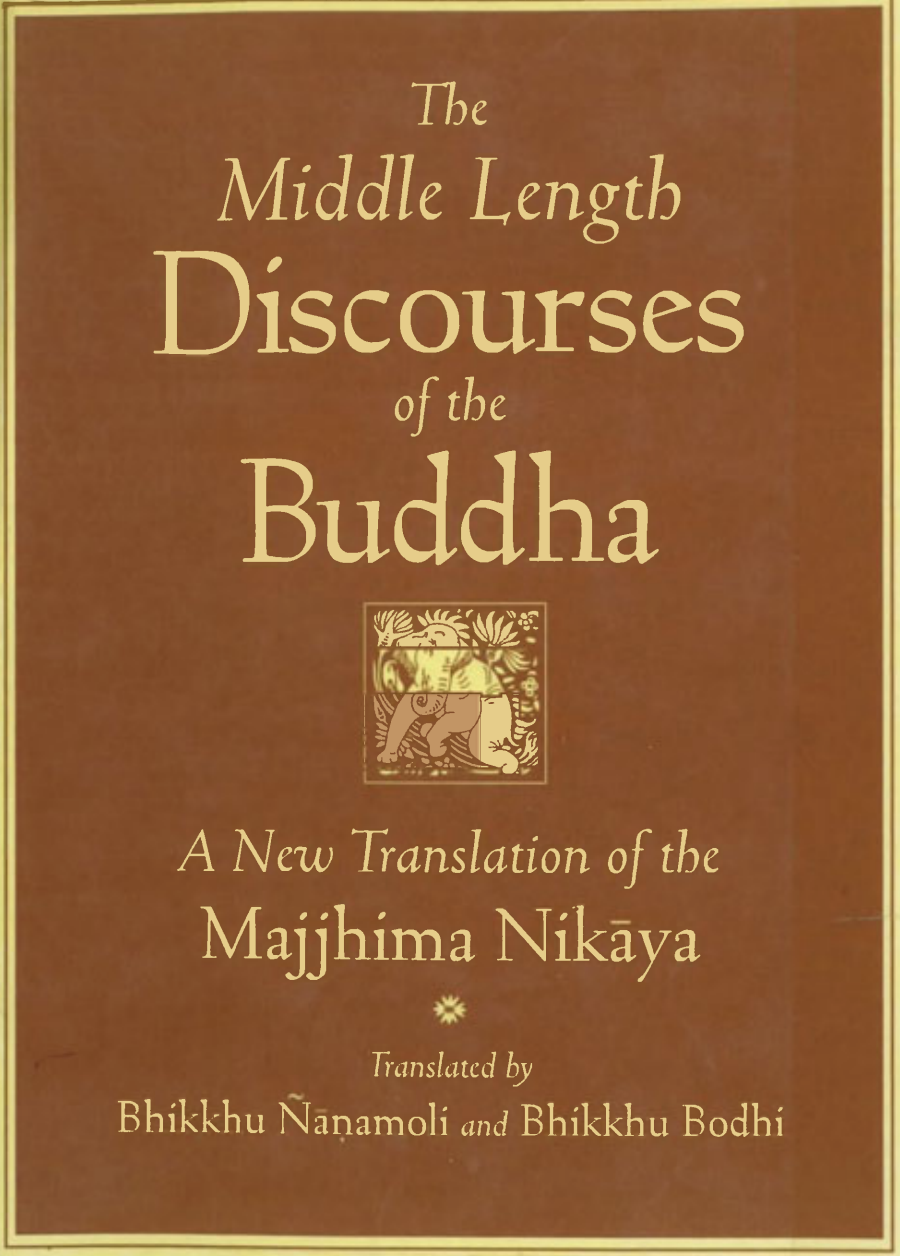
The following course on Buddhism is based on the text The Middle Length Discourses of the Buddha: A New Translation of the Majjhima Nikaya. This course was recently suggested to me by my old friend Chuck Beatty. I plan to subject clear this course and record my thoughts.

In doing this course, it is important to have the following references handy.

TEXT: Majjhima_Nikaya

  1. Contents
  2. List of Abbreviations
  3. Summary of Sutta
  4. Notes on Sutta
  5. Glossary

.

The Course

A Systematic Study of the Majjhima Nikaya

MN 26:13 = Majjhima Nikaya Sutta 26 Section 13
MN 26 (1 – 4) = MN 26:1 to MN 26:4

I.  The Buddha’s Enlightenment

II. Approaching the Dhamma

  1. Making wise choices
  2. Test the Buddha himself
    • MN 47 The Inquirer 
  3. Faith, practice, and attainment
    • MN 95 With Cankī

III.  The Ethical Life

  1. Four ways of life
    • MN 46 The Greater Discourse on Ways of Undertaking Things
  2. Karma and its results
    • MN 57 The Dog-Duty Ascetic
    • MN 135 The Shorter Exposition of Action (handout)
  3. The path to a higher rebirth
    • MN 41 The Brahmins of Sālā
    • MN 120 Reappearance by Aspiration
  4. Right speech and patience
    • MN 61 Advice to Rāhula at Ambalaṭṭhikā
    • MN 21 The Simile of the Saw

IV. Deepening One’s Perspective on the World

  1. The faults of the worldly life
    • MN 13 The Greater Discourse on the Mass of Suffering
  2. The shortcomings in sensual pleasures
    • MN 54 To Potaliya
    • MN 75 To Māgandiya
  3. The misery of saṃsāra
    • SN 15 Connected Discourses on Without Discoverable Beginning (handout)
  4. Raṭṭhapāla and the call to renunciation
    • MN 82 On Raṭṭhapāla

V.  The Path to Liberation (General)

  1. The purpose of the spiritual life
    • MN 63 The Shorter Discourse to Mālunkyāputta
    • MN 29 The Greater Discourse on the Simile of the Heartwood
  2. The gradual training
    • MN 27 The Shorter Discourse on the Simile of the Elephant’s Footprint (handout-1,handout-2,handout-3)
    • MN 39 The Greater Discourse at Assapura
  3. What makes one a monk?
    • MN 40 The Shorter Discourse at Assapura
  4. The benefits of virtue
    • MN 6 If a Bhikkhu Should Wish
  5. Purifying the mind
    • MN 19 Two Kinds of Thought
    • MN 20 The Removal of Distracting Thoughts
    • MN 7 The Simile of the Cloth (handout)
    • MN 8 Effacement
  6. Eliminating the taints

VI. The Practice in Detail

  1. The Noble Eightfold Path
    • MN 117 The Greater Forty
  2. The way of mindfulness
  3. Mindfulness of breathing
    • MN 118 Mindfulness of Breathing
  4. The aids to enlightenment, etc.
    • MN 77 The Greater Discourse to Sakuludāyin

VII.  The Cultivation of Wisdom

  1. Right view
    1. MN 9 Right View (handout)
    2. MN 11 The Shorter Discourse on the Lion’s Roar
    3. MN 22 The Simile of the Snake
    4. MN 38 The Greater Discourse on the Destruction of Craving (handout)
  2. Penetrative insight
    1. MN 148 The Six Sets of Six
    2. MN 146 Advice from Nandaka
    3. MN 149 The Great Sixfold Base
    4. MN 28 The Greater Discourse on the Simile of the Elephant’s Footprint
    5. MN 64 The Greater Discourse to Mālunkyāputta
  3. Final realization
    1. MN 52 The Man from Aṭṭhakanāgara (handout-1handout-2)
    2. MN 140 The Exposition of the Elements
  4. A typology of persons
    1. MN 1 The Root of All Things (handout)
  5. A typology of noble disciples
    1. MN 70 At Kīṭāgiri (part) (handout)

VIII.  The Tathāgata

  1. MN 12 The Greater Discourse on the Lion’s Roar

IX. Life in the Sangha

  1. Monks living in harmony
    • MN 31 The Shorter Discourse on Gosinga
  2. The ideal monk
    • MN 32 The Greater Discourse on Gosinga
  3. A recalcitrant monk
    • MN 65 To Bhaddāli
  4. Guidelines for future harmony
    • MN 104 At Sāmagāma
  5. After the Buddha’s parinibbāna
    • MN 108 With Gopaka Moggallāna

.

SUMMATION

  1. Introduction to Comments
  2. Grade Chart of Buddhism

.

BUDDHISM: The Confluence of Buddhism and Hinduism in India

Reference: Buddhism

[NOTE: In color are Vinaire’s comments.]

It is a paradox that Buddhism triumphs in the world at large, only (it would seem) to forfeit the land of its birth. This surface appearance is deceptive. The deeper fact is that in India Buddhism was not so much defeated by Hinduism as accommodated within it.

Among the surface paradoxes of Buddhism—this religion that began by rejecting ritual, speculation, grace, mystery, and a personal God and ended by bringing them all back into the picture—there is a final one. Today Buddhists abound in every Asian land except India; only recently, after a thousand-year absence, are they beginning in small numbers to reappear. Buddhism triumphs in the world at large, only (it would seem) to forfeit the land of its birth. 

It is a paradox that Buddhism triumphs in the world at large, only (it would seem) to forfeit the land of its birth. 

This surface appearance is deceptive. The deeper fact is that in India Buddhism was not so much defeated by Hinduism as accommodated within it. Up to around the year 1000, Buddhism persisted in India as a distinct religion. To say that the Muslim invaders then wiped it out will not do, for Hinduism survived. The fact is that in the course of its 1,500 years in India, Buddhism’s differences with Hinduism softened. Hindus admitted the legitimacy of many of the Buddha’s reforms, and in imitation of the Buddhist sangha orders of Hindu sadhus (wandering ascetics) came into existence. From the other side, Buddhist teachings came to sound increasingly like Hindu ones as Buddhism opened into the Mahayana, until in the end Buddhism sank back into the source from which it had sprung. 

This surface appearance is deceptive. The deeper fact is that in India Buddhism was not so much defeated by Hinduism as accommodated within it.

Only if one assumes that Buddhist principles left no mark on subsequent Hinduism can the merger be considered a Buddhist defeat. Actually, almost all of Buddhism’s affirmative doctrines found their place or parallel. Its contributions, accepted by Hindus in principle if not always practice, included its renewed emphasis on kindness to all living things, on non-killing of animals, on the elimination of caste barriers in matters religious and their reduction in matters social, and its strong ethical emphasis generally. The bodhisattva ideal seems to have left its mark in prayers like the following by Santi Deva in the great Hindu devotional classic, the Bhagavatam:

The bodhisattva ideal seems to have left its mark in prayers like the following by Santi Deva in the great Hindu devotional classic, the Bhagavatam:

I desire not of the Lord the greatness which comes by the attainment of the eightfold powers, nor do I pray him that I may not be born again; my one prayer to him is that I may feel the pain of others, as if I were residing within their bodies, and that I may have the power of relieving their pain and making them happy.

Buddhism brings sensitivity to the pain of others and the measures to relieve it and bring happiness.

All in all, the Buddha was reclaimed as “a rebel child of Hinduism”; he was even raised to the status of a divine incarnation. The goal of Theravada Buddhism was acknowledged to be substantially that of non-dual Hinduism, and even the Prajnaparamita’s contention that eternity is not other than the present moment found its Hindu counterpart:

This very world is a mansion of mirth;
Here I can eat, here drink and make merry.

(Ramakrishna)

The goal of Theravada Buddhism was acknowledged to be substantially that of non-dual Hinduism.

Especially in Hindu Tantric schools, disciples were brought to the point where they could see meat, wine, and sex—things that had formerly appeared as the most formidable barriers to the divine—as but varying forms of God. “The Mother is present in every house. Need I break the news as one breaks an earthen pot on the floor.”

Things that had formerly appeared as most formidable barriers to the divine were now seen as but varying forms of God.

.

BUDDHISM: The Image of the Crossing

Reference: Buddhism

[NOTE: In color are Vinaire’s comments.]

Once the other shore of Enlightenment is attained there is no further need for the raft that carried them across the stream. The doctrine of Buddhism is simply a tool to be cast away and forsaken once it has served the purpose for which it was made.

We have looked at three modes of transport in Buddhism: the Little Raft; the Big Raft, with special attention to Zen; and, though it sounds odd in the context of a flotilla, the Diamond Raft. These vehicles are so different that we must ask in closing whether, on any grounds other than historical lineage, they deserve to be considered aspects of a single religion. 

There are two respects in which they should be so regarded. They all revere a single founder from whom they claim their teachings derive. And all three can be subsumed under a single metaphor. This is the image of the crossing, the simple everyday experience of crossing a river on a ferryboat. 

All three aspects of Buddhism can be subsumed under a single metaphor of crossing a river on a ferryboat. 

To appreciate the force of this image we must remember the role the ferry played in traditional Asian life. In lands laced by rivers and canals, almost every considerable journey required a ferry. This routine fact underlies and inspires every school of Buddhism, as the use of the word yana by all of them attests. Buddhism is a voyage across life’s river, a transport from the common-sense shore of ignorance, grasping, and death, to the further bank of wisdom and enlightenment. Compared with this settled fact, the differences within Buddhism are no more than variations in the kind of vehicle one boards, or the stage one has reached on the journey. 

Buddhism is a voyage across life’s river, a transport from the common-sense shore of ignorance, grasping, and death, to the further bank of wisdom and enlightenment.

What are these stages?

While we are on the first bank it is in effect the world for us. Its earth underfoot is solid and reassuring. The rewards and disappointments of its social life are vivid and compelling. The opposite shore is barely visible and has no impact on our dealings. 

If, however, something prompts us to see what the other side is like, we may decide to attempt a crossing. If we are of independent bent, we may decide to make it on our own. In this case we are Theravadins; we follow the Buddha’s design for a sturdy craft, but we build ours ourself. Most of us, however, have neither the time nor the talent for a project of such proportions. We are Mahayanists and move down the bank to where a readymade ferryboat is expected. As the group of explorers clamber aboard at the landing there is an air of excitement. Attention is focused on the distant bank, still indistinct, but the voyagers are still very much like citizens of this side of the river. 

The ferry pushes off and moves across the water. The bank we are leaving behind is losing its substance. The shops and streets and ant-like figures are blending together and releasing their hold on us. Meanwhile, the shore toward which we are headed is not in focus either; it seems almost as far away as it ever was. There is an interval in the crossing when the only tangible realities are the water, with its treacherous currents, and the boat, which is stoutly but precariously contending with them. This is the moment for Buddhism’s Three Vows: I take refuge in the Buddha, the fact that there was an explorer who made this trip and proved to us that it can succeed. I take refuge in the dharma, the vehicle of transport, this boat to which we have committed our lives in the conviction that it is seaworthy. I take refuge in the sangha, the order, the crew that is navigating this ship, in whom we have confidence. The shoreline of the world has been left behind. Until we set foot on the further bank, these are the only things in which we can trust. 

During the voyage we do not have the firmness of the ground underneath our feet. Only firmness comes from Buddhism’s Three Vows: I take refuge in the Buddha, I take refuge in the dharma,  I take refuge in the sangha.

The further shore draws near, becomes real. The craft jolts onto the sand and we step onto solid ground. The land, which had been misty and unsubstantial as a dream, is now fact. And the shore that we left behind, which was so palpable and real, is now only a slender horizontal line, a visual patch, a memory without substance. 

Impatient to explore our new surroundings, we nevertheless remember our gratitude for the splendid ship and crew who have brought us safely to what promises to be a rewarding land. It will not be gratitude, however, to insist on packing the boat with us as we plunge into the woods. “Would he be a clever man,” the Buddha asked, “if out of gratitude for the raft that has carried him across the stream to safety he, having reached the other shore, should cling to it, take it on his back, and walk about with the weight of it? Would not the clever man be the one who left the raft, no longer of use to him, to the current of the stream and walked ahead without turning back to look at it? Is it not simply a tool to be cast away and forsaken once it has served the purpose for which it was made? In the same way the vehicle of the doctrine is to be cast away and forsaken once the other shore of Enlightenment has been attained.”

Once the other shore of Enlightenment is attained there is no further need for the raft that carried them across the stream. The doctrine of Buddhism is simply a tool to be cast away and forsaken once it has served the purpose for which it was made.

Here we come to the Prajnaparamita or Perfection of Wisdom sutras, which are widely considered to be the culminating texts of Buddhism. The Five Precepts and the Eightfold Path; the technical terminology of dukkha, karma, nirvana, and their like; the committed order and the person of the Buddha himself—all these are vitally important to the individual in the act of making the crossing. They lose their relevance for those who have arrived. Indeed, to the traveler who has not only reached the promised shore but who keeps moving into its interior, there comes a time when not only the raft but the river itself drops from view. When such a one turns around to look for the land that has been left behind, what appears? What of that land can appear to one who has crossed a horizon beyond which the river dividing this shore from that shore has vanished? One looks, and there is no other shore. There is no separating river. There is no raft, no ferryman. These things are not a part of the new world. 

After reaching the promised shore ones keep moving into its interior. No more is there a separating river. There is no raft, no ferryman. These things are not a part of the new world. 

Before the river was crossed the two shores, human and divine, had to appear distinct from each other, different as life and death, as day and night. But once the crossing has been made, no dichotomy remains. The realm of the gods is not a distinct place. It is where the traveler stands; and if that stance happens to be in this world, the world itself is transmuted. It is in this sense that we are to read the avowals in The Perfection of Wisdom that “this our worldly life is an activity of Nirvana itself; not the slightest distinction exists between them.” Introspection having led to a condition described positively as nirvana and negatively as Emptiness because it transcends all forms, the “stream-winner” now finds in the world itself this same Emptiness that he discovered within. “Form is emptiness, emptiness is form. Emptiness is not different from form, form is not different from emptiness.” The noisy disjunction between acceptance and rejection having been stilled, every moment is affirmed for what it actually is. It is Indra’s cosmic net, laced with jewels at every juncture. Each jewel reflects the others, together with all the reflections in the others. In such a vision the categories of good and evil disappear. “That which is sin is also Wisdom” we read; and once again, “the realm of Becoming is Nirvana.”

This earth on which we stand
is the promised Lotus Land,
And this very body
is the body of the Buddha.

The realm of the gods is not a distinct place. It is where the traveler stands; and if that stance happens to be in this world, the world itself is transmuted. The noisy disjunction between acceptance and rejection having been stilled, every moment is affirmed for what it actually is. 

This new-found shore throws light on the bodhisattva’s vow not to enter nirvana “until the grass itself be enlightened.” As grass keeps coming, does this mean that the bodhisattva will never be enlightened? Not exactly. It means, rather, that he (or she) has risen to the point where the distinction between time and eternity has lost its force. That distinction, drawn by the rational mind, is dissolved in the lightning-and-thunder insight that annihilates opposites. Time and eternity are now two aspects of the same experiential whole, two sides of the same coin. “The jewel of eternity is in the lotus of birth and death.”

The bodhisattva has risen to the point where the distinction between time and eternity has lost its force. 

From the standpoint of normal, worldly consciousness there must always remain an inconsistency between this climactic insight and worldly prudence. This, though, should not surprise us, for it would be flatly contradictory if the world looked exactly the same to those who have crossed the river of ignorance. Only they can dissolve the world’s distinctions—or, perhaps we should say, take them in their stride, for the distinctions persist, but now without difference. Where to eagle vision the river can still be seen, it is seen as connecting the two banks rather than dividing them.

Only those who have crossed the river of ignorance can dissolve the world’s distinctions—or, perhaps we should say, take them in their stride.

.

BUDDHISM: The Diamond Thunderbolt

Reference: Buddhism

[NOTE: In color are Vinaire’s comments.]

The Dalai Lama is a receiving station toward which the compassion principle of Buddhism in all its cosmic amplitude is continuously channeled, to radiate thence to the Tibetan people most directly, but by extension to all sentient beings.

We have spoken of two yanas or paths in Buddhism, but we must now add a third. If Hinayana literally means the Little Way and Mahayana the Great Way, Vajrayana is the Diamond Way. 

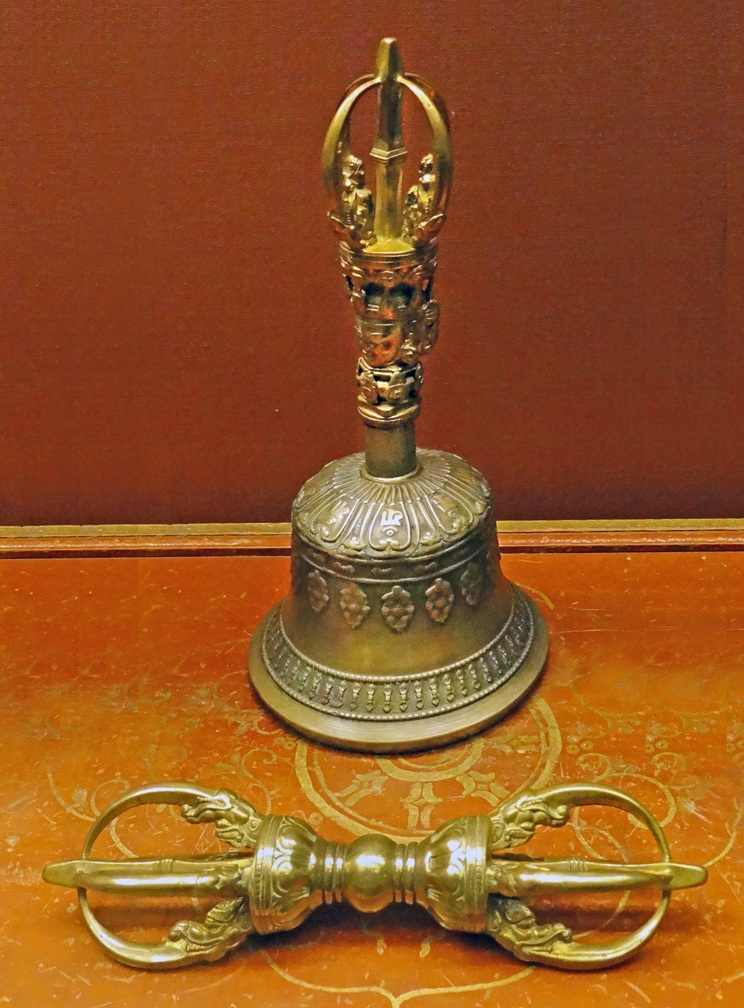
Vajra was originally the thunderbolt of Indra, the Indian Thunder God who is often mentioned in the early, Pali Buddhist texts; but when Mahayana turned the Buddha into a cosmic figure, Indra’s thunderbolt was transformed into the Buddha’s diamond scepter. We see here a telling instance of Buddhism’s capacity to accommodate itself to local ideas while revaluing them by changing the spiritual center of gravity; for the diamond transforms the thunderbolt, symbol of nature’s power, into an emblem of spiritual supremacy, while retaining the connotations of power that the thunderbolt possessed. The diamond is the hardest stone—one hundred times harder than its closest rival—and at the same time the most transparent stone. This makes the Vajrayana the way of strength and lucidity—strength to realize the Buddha’s vision of luminous compassion.

There is another way in Buddhism—the way of strength and lucidity—called Vajrayana.

We just noted that the roots of the Vajrayana can be traced back to India, and it continues to survive in Japan as Shingon Buddhism; but it was the Tibetans who perfected this third Buddhist path. For Tibetan Buddhism is not just Buddhism with Tibet’s pre-Buddhist Bon deities incorporated. Nor is it enough to characterize it as Indian Buddhism in its eighth-and ninth century heyday, moved northward to be preserved against its collapse in India. To catch its distinctiveness we must see it as the third major Buddhist yana, while adding immediately that the essence of the Vajrayana is Tantra. Tibetan Buddhism, the Buddhism here under review, is at heart Tantric Buddhism. 

The essence of the Vajrayana is Tantra.

Buddhists have no monopoly on Tantra, which first showed itself in medieval Hinduism where the word had two Sanskrit roots. One of these is “extension.” In this meaning Tantra denotes texts, many of them esoteric and secret in nature, that were added to the Hindu corpus to extend its range. This gives us only the formal meaning of the word, however. For the content of those extended texts we should look to the second etymological meaning of Tantra, which derives from the weaving craft and denotes interpenetration. In weaving, the threads of warp and woof intertwine repeatedly. The Tantras are texts that focus on the interrelatedness of things. Hinduism pioneered such texts, but it was Buddhism, particularly Tibetan Buddhism, that gave them pride of place. 

The Tantras are texts that focus on the interrelatedness of things.

The Tibetans say that their religion is nowise distinctive in its goal. What distinguishes their practice is that it enables one to reach nirvana in a single lifetime. This is a major claim. How do the Tibetans defend it? 

What distinguishes tantric buddhism is that it enables one to reach nirvana in a single lifetime.

They say that the speed-up is effected by utilizing all of the energies latent in the human make-up, those of the body emphatically included, and impressing them all into the service of the spiritual quest. 

It utilizes all of the energies latent in the human make-up for the spiritual quest. 

The energy that interests the West most is sex, so it is not surprising that Tantra’s reputation abroad has been built on its sacramental use of this drive. H. G. Wells once said that God and sex were the only two things that really interested him. If we can have both—not be forced to choose between them as in monasticism and celibacy—this is music to modern ears, so much so that in the popular Western mind Tantra and sex are almost equated. This is unfortunate. Not only does it obscure the larger world of Tantra; it distorts its sexual teachings by removing them from that world. 

Unfortunately, in the popular Western mind Tantra and sex are almost equated, for it obscure the larger world of Tantra.

Within that world Tantra’s teachings about sex are neither titillating nor bizarre: they are universal. Sex is so important—after all, it keeps life going—that it must be linked quite directly with God. It is the divine Eros of Hesiod, celebrated in Plato’s Phaedrus and in some way by every people. Even this, though, is too mild. Sex is the divine in its most available epiphany. But with this proviso: It is such when joined to love. When two people who are passionately, even madly—Plato’s divine madness—in love; when each wants most to receive what the other most wants to give;—at the moment of their mutual climax it is impossible to say whether the experience is more physical or spiritual, or whether they sense themselves as two or as one. The moment is ecstatic because at that moment they stand outside—ex, out; stasis, standing—themselves in the melded oneness of the Absolute. 

Tantra’s teachings about sex are neither titillating nor bizarre: they are universal. In Tantra’s sacramental use of this drive, correct understanding and discipline is essential.

Nothing thus far is uniquely Tantric; from the Hebrew Song of Songs to the explicit sexual symbolism in mystical marriages to Christ, the principles just mentioned turn up in all traditions. What distinguishes Tantra is the way it wholeheartedly espouses sex as a spiritual ally, working with it explicitly and intentionally. Beyond squeamishness and titillation, both, the Tantrics keep the physical and spiritual components of the love-sex splice in strict conjunction—through their art (which shows couples in coital embrace), in their fantasies (the ability to visualize should be actively cultivated), and in overt sexual engagement, for only one of the four Tibetan priestly orders is celibate. Beyond these generalizations it is not easy to go, so we shall leave the matter with a covering observation. Tantric sexual practice is pursued, not as a law-breaking revel, but under the cautious supervision of a guru, in the controlled context of a non-dualist outlook, and as the culminating festival of a long sequence of spiritual disciplines practiced through many lives. The spiritual emotion that is worked for is ecstatic, egoless, beatific bliss in the realization of transcendent identity. But it is not self-contained, for the ultimate goal of the practice is to descend from the non-dual experience better equipped to experience the multiplicity of the world without estrangement. 

What distinguishes Tantra is the way it wholeheartedly espouses sex as a spiritual ally, working with it explicitly and intentionally.

With Tantra’s sexual side thus addressed, we can move on to more general features of its practice. We have already seen that these are distinctive in the extent to which they are body-based, and the physical energies the Tantrics work with most regularly are the ones that are involved with speech, vision, and gestures. 

The physical energies the Tantrics work with most regularly are the ones that are involved with speech, vision, and gestures. 

To appreciate the difference in a religious practice that engages these faculties actively, it is useful to think back to the raja yoga of Hinduism and Zen in Buddhism. Both of these meditation programs set out to immobilize the body so that for practical purposes the mind might rise above it. A snapshot could capture the body in those practices, whereas with the Tibetans a motion picture camera would be needed, and one that is wired for sound. For, ritualistically engaged, the Tibetans’ bodies are always moving. The lamas prostrate themselves, weave stylized hand gestures, pronounce sacred syllables, and intone deep-throated chants. Audially and visually, something is always going on. 

For, ritualistically engaged, the Tibetans’ bodies are always moving. The lamas prostrate themselves, weave stylized hand gestures, pronounce sacred syllables, and intone deep-throated chants.

The rationale they invoke for engaging their bodies in their spiritual pursuits is straightforward. Sounds, sights, and motion can distract, they admit, but it does not follow that they must do so. It was the genius of the great pioneers of Tantra to discover upayas (skillful means) for channeling physical energies into currents that carry the spirit forward instead of derailing it. The most prominent of these currents relate to the sound, sight, and movement we have referred to, and the names for them all begin with the letter “m.” Mantras convert noise into sound and distracting chatter into holy formulas. Mudras choreograph hand gestures, turning them into pantomime and sacred dance. Mandalas treat the eyes to icons whose holy beauty draws the beholder in their direction. 

The rationale they invoke for engaging their bodies in their spiritual pursuits is straightforward. Sounds, sights, and motion can distract, they admit, but it does not follow that they must do so.

If we try to experience our way into the liturgy by which the Tibetans put these Tantric devices into practice, the scene that emerges is something like this. Seated in long, parallel rows; wearing headgear that ranges from crowns to wild shamanic hats; garbed in maroon robes, which they periodically smother in sumptuous vestments of silver, scarlet, and gold, gleaming metaphors for inner states of consciousness, the monks begin to chant. They begin in a deep, guttural, metric monotone, but as the mood deepens those monotones splay out into harmonics that sound like full-throated chords, though actually the monks are not singing in parts; harmony (a Western discovery) is unknown to them. By a vocal device found nowhere else in the world, they reshape their vocal cavities in ways that amplify overtones to the point where they can be heard as discrete tones in their own right. Meanwhile, their hands perform stylized gestures that kinesthetically augment the states of consciousness that are being accessed. 

Here we have a description of how the Tibetans put these Tantric devices into practice.

A final, decisive feature of this practice would be lost on observers because it is totally internal. Throughout the exercise the monks visualize the deities they are invoking—visualize them with such intensity (years of practice are required to master the technique) that, initially with closed eyes but eventually with eyes wide open, they are able to see the deities as if they were physically present. This goes a long way toward making them real, but in the meditation’s climax, the monks go further. They seek experientially to merge with the gods they have conjured, the better to appropriate their powers and their virtues. An extraordinary assemblage of artistic forms are orchestrated here, but not for art’s sake. They constitute a technology, designed to modulate the human spirit to the wavelengths of the tutelary deities that are invoked. 

Through their chanting and gestures they are able to visualize the deities they are invoking; and then they seek experientially to merge with the gods they have conjured.

To complete this profile of Tibetan Buddhism’s distinctiveness, we must add to this summary of its Tantric practice a unique institution. When in 1989 the Nobel Peace Prize was awarded to His Holiness the Dalai Lama, that institution jumped to worldwide attention. 

The Dalai Lama is not accurately likened to the pope, for it is not his prerogative to define doctrine. Even more misleading is the designation God-King, for though temporal and spiritual authority do converge in him, neither of these powers define his essential function. That function is to incarnate on earth the celestial principle of which compassion or mercy is the defining feature. The Dalai Lama is the bodhisattva who in India was known as Avalokiteshvara, in China as the Goddess of Mercy Kwan Yin, and in Japan as Kannon. As Chenrezig (his Tibetan name) he has for the last several centuries incarnated himself for the empowerment and regeneration of the Tibetan tradition. Through his person—a single person who has thus far assumed fourteen successive incarnations—there flows an uninterrupted current of spiritual influence, characteristically compassionate in its flavor. Thus in relation to the world generally, and to Tibet in particular, the office of the Dalai Lama is chiefly neither one of administration nor of teaching but an “activity of presence” that is operative independently of anything he may, as an individual, choose to do or not do. The Dalai Lama is a receiving station toward which the compassion principle of Buddhism in all its cosmic amplitude is continuously channeled, to radiate thence to the Tibetan people most directly, but by extension to all sentient beings. 

The Dalai Lama is a receiving station toward which the compassion principle of Buddhism in all its cosmic amplitude is continuously channeled, to radiate thence to the Tibetan people most directly, but by extension to all sentient beings.

Whether the Dalai Lama will reincarnate himself again after his present body is spent is uncertain, for at present the Chinese invaders are determined that there will be no distinct people for him to serve. If there are not, something important will have withdrawn from history. For as rain forests are to the earth’s atmosphere, someone has said, so are the Tibetan people to the human spirit in this time of its planetary ordeal.

For as rain forests are to the earth’s atmosphere, someone has said, so are the Tibetan people to the human spirit in this time of its planetary ordeal.

.

BUDDHISM: The Secret of the Flower

Reference: Buddhism

[NOTE: In color are Vinaire’s comments.]

Zen refuses to lock itself into a verbal casing; it is not founded on written words, and is outside the established teachings. Zen is not interested in theories about enlightenment; it wants the real thing. 

After Buddhism split into Theravada and Mahayana, Theravada continued as a fairly unified tradition, whereas Mahayana divided into a number of denominations or schools. The most popular of these, the Pure Land Sect, resembles the Pauline strand in Christianity in relying on faith—in its case faith in the “other power” of one of the Buddhas—to carry devotees to the Pure Land of the Western Paradise. In its popular reading this paradise bears many resemblances to the Christian heaven, though both admit of subtler interpretations in which paradise is regarded as an experiential state rather than a geographical place. Another important Mahayana school (Ti’en Tai in Chinese; Tendai in Japanese) introduced into Buddhism the Confucian predilections for learning and social harmony. It sought to find a place for all the Buddhist schools in a culminating treatise, The Lotus Sutra. We shall not go into these and smaller sects of Mahayana Buddhism; we shall reserve our space for, first, the Buddhism that Taoism profoundly influenced, namely Ch’an (Zen in Japanese), and second, the Buddhism that evolved in Tibet. The selection is partly determined by the fact that these are the branches of Buddhism that have attracted the most attention in the West, but there is the added advantage that they will take us to two quite different lands in which Buddhism has flourished. 

After Buddhism split into Theravada and Mahayana, Theravada continued as a fairly unified tradition, whereas Mahayana divided into a number of denominations or schools. 

Because the Communist takeover of China disrupted its religious life, we shall pursue the Ch’an/Zen sect in its Japanese guise. Like other Mahayanist sects, this one claims to trace its perspective back to Gautama himself. His teachings that found their way into the Pali Canon, it holds, were those the masses seized upon. His more perceptive followers heard in his message a higher, subtler teaching. The classic instance of this is reported in the Buddha’s Flower Sermon. Standing on a mountain with his disciples around him, the Buddha did not on this occasion resort to words. He simply held aloft a golden lotus. No one understood the meaning of this eloquent gesture save Mahakasyapa, whose quiet smile, indicating that he had gotten the point, caused the Buddha to designate him as his successor. The insight that prompted the smile was transmitted in India through twenty-eight patriarchs and carried to China in A.D. 520 by Bodhidharma. Spreading from there to Japan in the twelfth century, it contains the secret of Zen.

The Zen sect of Mahayana Buddhism claims to trace its perspective back to Buddha’s Flower Sermon. The Buddha did not on this occasion resort to words. He simply held aloft a golden lotus. 

Entering Zen is like stepping through Alice’s looking glass. One finds oneself in a topsy-turvy wonderland where everything seems quite mad—charmingly mad for the most part, but mad all the same. It is a world of bewildering dialogues, obscure conundrums, stunning paradoxes, flagrant contradictions, and abrupt non sequiturs, all carried off in the most urbane, cheerful, and innocent style imaginable. Here are some examples: 

A master, Gutei, whenever he was asked the meaning of Zen, lifted his index finger. That was all. Another kicked a ball. Still another slapped the inquirer. 

A novice who makes a respectful allusion to the Buddha is ordered to rinse his mouth out and never utter that dirty word again. 

Someone claiming to understand Buddhism writes the following stanza:

The body is the Bodhi-Tree;
The mind is like the mirror bright.
Take heed to keep it always clean,
And let no dust collect upon it.

He is at once corrected by an opposite quatrain, which becomes accepted as the true Zen position:

Bodhi (True Wisdom) is not a tree;
The mind is not a mirror shining.
As there is nothing from the first,
Why talk of wiping off the dust?

A monk approaches a master saying, “I have just come to this monastery. Would you kindly give me some instruction?” The master asks, “Have you eaten your breakfast yet?” “I have.” “Then go wash your bowls.” The inquirer acquired the understanding he was seeking through this exchange. 

A group of Zen masters, gathered for conversation, have a great time declaring that there is no such thing as Buddhism, or Enlightenment, or anything even remotely resembling nirvana. They set traps for one another, trying to trick someone into an assertion that might imply the contrary. Practiced as they are, they always artfully elude traps and pitfalls, whereupon the entire company bursts into glorious, room-shaking laughter.

What goes on here? Is it possible to make any sense out of what at first blush looks like Olympian horseplay, if not a direct put-on? Can they possibly be serious in this kind of spiritual doubletalk, or are they simply pulling our legs? 

The answer is that they are completely serious, though it is true that they are rarely solemn. And though we cannot hope to convey their perspective completely, it being of Zen’s essence that it cannot be impounded in words, we can give some hint as to what they are up to. 

Zen’s essence is that it cannot be impounded in words. It is simply a presentation of anomalies to be resolved.

Let us admit at the outset that even this is going to be difficult, for we shall have to use words to talk about a position that is acutely aware of their limitations. Words occupy an ambiguous place in life. They are indispensable to our humanity, for without them we would be but howling yahoos. But they can also deceive, or at least mislead, fabricating a virtual reality that fronts for the one that actually exists. A parent can be fooled into thinking it loves its child because it addresses the child in endearing terms. A nation can assume that the phrase “under God” in its Pledge of Allegiance shows that its citizens believe in God when all it really shows is that they believe in believing in God. With all their admitted uses, words have three limitations. At worst they construct an artificial world wherein our actual feelings are camouflaged and people are reduced to stereotypes. Second, even when their descriptions are reasonably accurate, descriptions are not the things described—menus are not the meal. Finally, as mystics emphasize, our highest experiences elude words almost entirely. 

Words have limitations in describing the reality. Zen’s anomalies serve to keep the attention focused while unrestrained mindfulness meditation occurs in the mind leading to realizations.

Every religion that has developed even a modicum of semantic sophistication recognizes to some extent the way words and reason fall short of reality when they do not actually distort it. However much the rationalist may begrudge the fact, paradox and the transrational are religion’s life blood, and that of art as well. Mystics in every faith report contacts with a world that startles and transforms them with its dazzling darkness. Zen stands squarely in this camp, its only uniqueness being that it makes breaking the language barrier its central concern. 

Zen makes breaking the language barrier its central concern. 

Only if we keep this fact in mind have we a chance of understanding this outlook, which in ways is the strangest expression of mature religion. It was the Buddha himself, according to Zen tradition, who first made the point by refusing (in the Flower Sermon we have already alluded to) to equate his experiential discovery with any verbal expression. Bodhidharma continued in this tradition by defining the treasure he was bringing to China as “a special transmission outside the scriptures.” This seems so out of keeping with religion as usually understood as to sound heretical. Think of Hinduism with its Vedas, Confucianism with its Classics, Judaism with its Torah, Christianity with its Bible, Islam with its Koran. All would happily define themselves as special transmissions through their scriptures. Zen, too, has its texts; they are intoned in its monasteries morning and evening. In addition to the Sutras, which it shares with other branches of Buddhism, it has its own texts: the Hekigan Roku, the Mumonkan, and others. But one glance at these distinctive texts will reveal how unlike other scriptures they are. Almost entirely they are given to pressing home the fact that Zen cannot be equated with any verbal formula whatsoever. Account after account will depict disciples interrogating their masters about Zen, only to receive a roared “Ho!” for answer. For the master sees that through such questions, seekers are trying to fill the lack in their lives with words and concepts instead of realizations. Indeed, students will be lucky if they get off with verbal rebuffs. Often a rain of blows will be the retort as the master, utterly uninterested in the disciples’ physical comfort, resorts to the most forceful way he can think of to pry the questioner out of his mental rut.

Zen has its own texts, in addition to the sutras, which are almost entirely given to pressing home the fact that Zen cannot be equated with any verbal formula whatsoever. 

As we might expect, this unique stance toward scripture is duplicated in Zen’s attitude toward creeds. In contrast to most religions, which pivot around a creed of some sort, Zen refuses to lock itself into a verbal casing; it is “not founded on written words, and [is] outside the established teachings,” to return to Bodhidharma’s putting of the point. Signposts are not the destination, maps are not the terrain. Life is too rich and textured to be fitted into pigeonholes, let alone equated with them. No affirmation is more than a finger pointing to the moon. And, lest attention turn to the finger, Zen will point, only to withdraw its finger at once. Other faiths regard blasphemy and disrespect for God’s word as sins, but Zen masters may order their disciples to rip their scriptures to shreds and avoid words like Buddha or nirvana as if they were smut. They intend no disrespect. What they are doing is straining by every means they can think of to blast their novices out of solutions that are only verbal. “Not everyone who says to me, ‘Lord, Lord,’ will enter the kingdom of heaven” (Matthew 7:21). Zen is not interested in theories about enlightenment; it wants the real thing. So it shouts, and buffets, and reprimands, without ill-will entering in the slightest. All it wants to do is force the student to crash the wordbarrier. Minds must be sprung from their verbal bonds into a new mode of apprehending. 

Zen refuses to lock itself into a verbal casing; it is not founded on written words, and is outside the established teachings. Zen is not interested in theories about enlightenment; it wants the real thing. 

Every point can be overstated, so we should not infer from what has been said that Zen forgoes reason and words entirely. To be sure, it is no more impressed with the mind’s attempts to mirror ultimate reality than was Kierkegaard with Hegel’s metaphysics; no amount of polishing can enable a brick to reflect the sun. But it does not follow that reason is worthless. Obviously, it helps us make our way in the everyday world, a fact that leads Zennists in the main to be staunch advocates of education. But more. Working in special ways, reason can actually help awareness toward its goal. If the way that it is employed to do this seems at times like using a thorn to remove a thorn, we should add that reason can also play an interpretive role, serving as a bridge to join a newly discovered world to the world of common sense. For there is not a Zen problem whose answer, once discovered, does not make good sense within its own frame of reference; there is no experience that the masters are unwilling to try to describe or explain, given the proper circumstance. The point regarding Zen’s relation to reason is simply a double one. First, Zen logic and description make sense only from an experiential perspective radically different from the ordinary. Second, Zen masters are determined that their students attain the experience itself, not allow talk to take its place.

But it does not follow that reason is worthless. Working in special ways, reason can actually help awareness toward its goal. 

Nowhere is Zen’s determination on this latter point more evident than in the method it adopted for its own perpetuation. Whereas on the tricky matter of succession other religions turned to institutionalized mandates, papal succession, or creedal dicta, Zen trusted its future to a specific state of consciousness that was to be transmitted directly from one mind to another, like flame passed from candle to candle, or water poured from cup to cup. It is this “transmission of Buddha-mind to Buddha-mind” that constitutes the “special transmission” Bodhidharma cited as Zen’s essence. For a number of centuries this inward transmission was symbolized by the handing down of the Buddha’s robe and bowl from patriarch to patriarch, but in the Eighth Century the Sixth Patriarch in China concluded that even this simple gesture was a step toward confounding form with essence and ordered it discontinued. So here is a tradition that centers in a succession of teachers, each of whom has in principle inherited from his master a mindstate analogous to the one Gautama awakened in Mahakasyapa. Practice falls short of this principle, but the following figures suggest the steps that are taken to keep it in place. The master of the teacher under whom the author of this book studied estimated that he had given personal instruction to some nine hundred probationers. Of these, thirteen completed their Zen training, and four were given the inka—which is to say, they were confirmed as roshis (Zen masters) and authorized to teach.

It is this “transmission of Buddha-mind to Buddha-mind” that constitutes the “special transmission” Bodhidharma cited as Zen’s essence. 

And what is the training by which aspirants are brought toward the Buddha-mind that has been thus preserved? We can approach it by way of three key terms: zazen, koan, and sanzen

Zazen literally means “seated meditation.” The bulk of Zen training takes place in a large meditation hall. Visitors to these are struck by the seemingly endless hours the monks devote to sitting silently on two long, raised platforms that extend the length of the hall on either side, their faces toward the center (or to the walls, depending on which of the two main lineages of Zen the monastery is attached to). Their position is the lotus posture, adopted from India. Their eyes are half closed as their gaze falls unfocused on the tawny straw mats they are sitting on. 

Zazen literally means “seated meditation.” The bulk of Zen training takes place in a large meditation hall. 

Thus they sit, hour after hour, day after day, year after year, seeking to waken the Buddha-mind so they may later relate it to their daily lives. The most intriguing feature of the process is the use they make of one of the strangest devices for spiritual training anywhere to be encountered—the koan

In a general way koan means problem, but the problems Zen devises are fantastic. At first glance they look like nothing so much as a cross between a riddle and a shaggy dog story. For example:

A master, Wu Tsu, says, “Let me take an illustration from a fable. A cow passes by a window. Its head, horns, and the four legs all pass by. Why did not the tail pass by?” 

Or again: What was the appearance of your face before your ancestors were born? 

Another: We are all familiar with the sound of two hands clapping. What is the sound of one hand clapping? (If you protest that one hand can’t clap, you go to the foot of the class.) 

One more: Li-ku, a high-ranking officer in the Tang dynasty, asked a famous Ch’an master: “A long time ago a man kept a goose in a bottle. It grew larger and larger until it could not get out of the bottle any more. He did not want to break the bottle, nor did he wish to harm the goose. How would you get it out? 

The master was silent for a few moments, then shouted, “O Officer!” 
“Yes.” 
“It’s out!”

In a general way koan means problem, but the problems Zen devises are fantastic. Anyway, Zen is a direct practice of how to resolve anomalies. You let the answer form itself from deep inside you.

Our impulse is to dismiss these puzzles as absurd, but the Zen practitioner is not permitted to do this. He or she is ordered to direct the full force of the mind upon them, sometimes locking logic with them, sometimes dropping them into the mind’s deep interior to wait till an acceptable answer erupts, a project that on a single koan may take as long as a doctoral dissertation. 

During this time the mind is intently at work, but it is working in a very special way. We in the West rely on reason so fully that we must remind ourselves that in Zen we are dealing with a perspective that is convinced that reason is limited and must be supplemented by another mode of knowing. 

Beyond reason is letting the answer to deep questions simply bubble up.

For Zen, if reason is not a ball and chain, anchoring mind to earth, it is at least a ladder too short to reach to truth’s full heights. It must, therefore, be surpassed, and it is just this surpassing that koans are designed to assist. If they look scandalous to reason, we must remember that Zen is not trying to placate the mundane mind. It intends the opposite: to upset the mind—unbalance it and eventually provoke revolt against the canons that imprison it. But this puts the matter too mildly. By forcing reason to wrestle with what from its normal point of view is flat absurdity; by compelling it to conjoin things that are ordinarily incompatible, Zen tries to drive the mind to a state of agitation wherein it hurls itself against its logical cage with the desperation of a cornered rat. By paradox and non sequitur Zen provokes, excites, exasperates, and eventually exhausts the mind until it sees that thinking is never more than thinking about, or feeling more than feeling for. Then, having gotten the rational mind where it wants it—reduced to an impasse—it counts on a flash of sudden insight to bridge the gap between secondhand and firsthand life.

Light breaks on secret lots….
Where logics die
The secret grows through the eye.

Zen is not trying to placate the mundane mind. It intends the opposite: to upset the mind—unbalance it and eventually provoke revolt against the canons that imprison it. 

Before we dismiss this strange method as completely foreign, it is well to remember that Kierkegaard regarded meditation on the paradox of the Incarnation—the logical absurdity of the Infinite becoming finite, God becoming man—as the most rewarding of all Christian exercises. The koan appears illogical because reason proceeds within structured perimeters. Outside those perimeters the koan is not inconsistent; it has its own logic, a “Riemannian” logic we might say. Once the mental barrier has been broken, it becomes intelligible. Like an alarm clock, it is set to awaken the mind from its dream of rationality. A higher lucidity is at hand. 

There is a higher lucidity than rationality.

Struggling with his koan, the Zen monk is not alone. Books will not avail, and koans that are being worked on are not discussed with fellow monks, for this could only produce secondhand answers. Twice a day, though, on average, the monk confronts the master in private “consultation concerning meditation”—sanzen in Rinzai and dokusan in the Soto sect. These meetings are invariably brief. The trainee states the koan in question and follows it with his or her answer to date. The role of the master is then threefold. In the happy event that the answer is correct, he validates it, but this is his least important role, for a right answer usually comes with a force that is self-validating. A greater service is rendered in rejecting inadequate answers, for nothing so helps the student to put these permanently to one side as the master’s categorical rejection of them. This aspect of sanzen is fittingly described in the ninth-century Rules of Hyakujo as affording “the opportunity for the teacher to make a close personal examination of the student, to arouse him from his immaturity, to beat down his false conceptions and to rid him of his prejudices, just as the smelter removes the lead and quicksilver from the gold in the smelting-pot, and as the jade-cutter, in polishing the jade, discards every possible flaw.” The master’s other service is, like that of any exacting examiner, to keep the student energized and determined during the long years the training requires.

A right answer usually comes with a force that is self-validating. 

And to what does this zazen, koan training, and sanzen lead? The first important breakthrough is an intuitive experience called kensho or satori. Though its preparation may take years, the experience itself comes in a flash, exploding like a silent rocket deep within the subject and throwing everything into a new perspective. Fearful of being seduced by words, Zennists waste little breath in describing satoris, but occasionally accounts appear.

Ztt! I entered. I lost the boundary of my physical body. I had my skin, of course, but I felt I was standing in the center of the cosmos. I saw people coming toward me, but all were the same man. All were myself. I had never known this world before. I had believed that I was created, but now I must change my opinion: I was never created; I was the cosmos. No individual existed.

This explanation is beautiful.

From this and similar descriptions we can infer that satori is Zen’s version of the mystical experience, which, wherever it appears, brings joy, at-one-ment, and a sense of reality that defies ordinary language. But whereas the tendency is to relate such experiences to the zenith of the religious quest, Zen places them close to the point of departure. In a very real sense Zen training begins with satori. For one thing, there must be further satoris as the trainee learns to move with greater freedom in this realm. But the important point is that Zen, drawing half its inspiration from the practical, common-sense, this-worldly orientation of the Chinese to balance the mystical other-worldly half it derived from India, refuses to permit the human spirit to withdraw—shall we say retreat?—into the mystical state completely. Once we achieve satori, we must

get out of the sticky morass in which we have been floundering, and return to the unfettered freedom of the open fields. Some people may say: “If I have [achieved satori] that is enough. Why should I go further?” The old masters lashed out at such persons, calling them “earthworms living in the slime of self-accredited enlightenment.”

A Satori is not the end-all of enlightenment. There are many satoris ahead.

The genius of Zen lies in the fact that it neither leaves the world in the less-than-ideal state in which it finds it, nor withdraws from the world in aloofness or indifference. Zen’s object is to infuse the temporal with the eternal—to widen the doors of perception so that the wonder of the satori experience can flood the everyday world.

Zen’s object is to infuse the temporal with the eternal.

“What,” asks the student, “is the meaning of Bodhidharma’s coming from the West?” The master answers, “The cypress tree standing in the garden.” Being’s amazingness must be directly realized, and satori is its first discernment. But until—through recognizing the interpenetration and convertibility of all phenomena—its wonder spreads to objects as common as the tree in your backyard and you can perform your daily duties with the understanding that each is equally a manifestation of the infinite, Zen’s business has not been completed. 

But until you can perform your daily duties with the understanding that each is equally a manifestation of the infinite, Zen’s business has not been completed. 

With the possible exception of the Buddha himself, in no one is that business ever completely finished. Yet by extrapolating hints in the Zen corpus we can form some idea of what the condition of “the man who has nothing further to do” would be like. 

First, it is a condition in which life seems distinctly good. Asked what Zen training leads to, a Western student who had been practicing for seven years in Kyoto answered, “No paranormal experiences that I can detect. But you wake up in the morning and the world seems so beautiful you can hardly stand it.” 

There is a continuing sense of world’s beauty and life’s goodness.

Along with this sense of life’s goodness there comes, secondly, an objective outlook on one’s relation to others; their welfare impresses one as being as important as one’s own. Looking at a dollar bill, one’s gaze may be possessive; looking at a sunset, it cannot be. Zen attainment is like looking at the sunset. Requiring (as it does) awareness to the full, issues like “whose awareness?” or “awareness of what?” do not arise. Dualisms dissolve. As they do there comes over one a feeling of gratitude to the past and responsibility to things present and future. 

Zen attainment is like looking at the sunset. Requiring (as it does) awareness to the full, issues like “whose awareness?” or “awareness of what?” do not arise. 

Third, the life of Zen (as we have sought to emphasize) does not draw one away from the world; it returns one to the world—the world robed in new light. We are not called to worldly indifference, as if life’s object were to spring soul from body as piston from syringe. The call is to discover the satisfaction of full awareness even in its bodily setting. “What is the most miraculous of all miracles?” “That I sit quietly by myself.” Simply to see things as they are, as they truly are in themselves, is life enough. It is true that Zen values unity, but it is a unity that is simultaneously empty (because it erases lines that divide) and full (because it replaces those lines with ones that connect). Stated in the form of a Zen algorithm, “All is one, one is none, none is all.” Zen wears the air of divine ordinariness: “Have you eaten? Then wash your bowls.” If you cannot find the meaning of life in an act as simple as that of doing the dishes, you will not find it anywhere.

My daily activities are not different,
Only I am naturally in harmony with them.
Taking nothing, renouncing nothing,
In every circumstance no hindrance, no conflict…
Drawing water, carrying firewood,
This is supernatural power, this the marvelous activity.

The life of Zen does not draw one away from the world; it returns one to the world—the world robed in new light. 

With this perception of the infinite in the finite there comes, finally, an attitude of generalized agreeableness. “Yesterday was fair, today it is raining”; the experiencer has passed beyond the opposites of preference and rejection. As both pulls are needed to keep the relative world turning, each is welcomed in its proper turn. 

There is a poem by Seng Ts’an on “Trust in the Heart,” that stands as the purest expression of this ideal of total acceptance.

The perfect way knows no difficulties
Except that it refuses to make preferences;
Only when freed from hate and love
Does it reveal itself fully and without disguise;
A tenth of an inch’s difference,
And heaven and earth are set apart.
If you wish to see it before your own eyes
Have no fixed thoughts either for or against it.
To set up what you like against what you dislike—
That is the disease of the mind.
The Way is perfect like unto vast space,
With nothing wanting, nothing superfluous.
It is due to making choices
That its Suchness is lost sight of.
The One is none other than the All, the All none other than the One.
Take your stand on this, and the rest will follow of its own accord;
I have spoken, but in vain, for what can words tell
Of things that have no yesterday, tomorrow, or today?

Even truth and falsity look different. “Do not seek after truth. Merely cease to hold opinions.” 

Fifth, as the dichotomies between self and other, finite and infinite, acceptance and rejection are transcended, even the dichotomy between life and death disappears.

When this realization is completely achieved, never again can one feel that one’s individual death brings an end to life. One has lived from an endless past and will live into an endless future. At this very moment one partakes of Eternal Life—blissful, luminous, pure. 

The dichotomies between self and other, finite and infinite, acceptance and rejection are transcended. Even the dichotomy between life and death disappears.

As we leave Zen to its future we may note that its influence on the cultural life of Japan has been enormous. Though its greatest influence has been on pervasive life attitudes, four ingredients of Japanese culture carry its imprint indelibly. In sumie or black ink landscape painting, Zen monks, living their simple lives close to the earth, have rivaled the skill and depth of feeling of their Chinese masters. In landscape gardening Zen temples surpassed their Chinese counterparts and raised the art to unrivaled perfection. Flower arrangement began in floral offerings to the Buddha, but developed into an art that until recently was a part of the training of every refined Japanese girl. Finally, there is the celebrated tea ceremony, in which an austere but beautiful setting, a few fine pieces of old pottery, a slow, graceful ritual, and a spirit of utter tranquility combine to epitomize the harmony, respect, clarity, and calm that characterize Zen at its best.

There is the celebrated tea ceremony, in which an austere but beautiful setting, a few fine pieces of old pottery, a slow, graceful ritual, and a spirit of utter tranquility combine to epitomize the harmony, respect, clarity, and calm that characterize Zen at its best.

.