Category Archives: Postulate Mechanics

Critical Thinking

Reference: Essays on Substance

Critical Thinking

Critical thinking means that you can see both similarities and differences and do not just think in identities. The bug in human mind is the identity thinking.

The ultimate identity thinking would by when one assigns God to be the cause of everything and thinks no further.

When one starts to move away from identity thinking, he first thinks in black and white and does not recognize any shade of gray. To him, everything that Newton said is right; and everything that Einstein said is wrong. Christianity is good; all other religions are bad. God is good; Man is evil. This kind of thinking is very close to identity thinking.

A more flexible thinking starts to recognize some shades of gray. He starts to think in terms of categories, but such categories are few and strictly defined. They are limited in their scope. Here we have an abundance of fixed ideas, and an unwillingness to look beyond those fixed ideas. They cannot think creatively. They cannot accept a new idea because their ability to evaluate is quite primitive.

The above is the “identity thinking” end of the scale of logic. At the other end is thinking that recognizes differences and similarities appropriately. This is the thinking of scientists. They think in terms of infinite categories. These categories can subdivide and their numbers can grow indefinitely. They balance the information belonging to these infinite categories using the first Law of Thought.

FIRST LAW OF THOUGHT: All thought related to a subject must be continuous, consistent and harmonious.

At this end of the logic scale resides Critical Thinking.

Understanding of subjects, such as, physics and Nuclear Physics cannot occur without critical thinking.

.

Providing Proof

Reference: Essays on Substance

Providing Proof

I am told again and again by some people on this site that I have no proof for the theory of Substance, and that I must provide proof to be credible. For such people proof means “agreement from lot of people.” If the theory is new and not many people are aware of it to agree with it, then whatever proof you give them will never be satisfactory.

Such people have no understanding of the proof of what Newton and Einstein laid down in their theories. All they know is that lot of people agree with their theories so they must be right. In other words, their criterion of proof is,

AGREEMENT = PROOF

This is the same mindset as of people, who under the influence of Church believed that it is the Sun that goes around Earth, and anybody who contradicts it must be condemned. This is just mental conditioning.

Such people cannot think critically and cannot follow the mathematical or logical flow of the theory. They believe a theory only when it is published in a respectable journal. The chances are that theory is correct. But the point I am making is that such people have no clue of the “proof” even when it is staring at their face. If you try to explain your theory, it is all wrong because it contradicts what they fixedly believe.

So, when somebody asks for proof, it is best to tell him to study the theory. If they can’t do that, and don’t have anything intelligent to say, it is best to leave them to their devices, and move on.

.

Inertia and Absolute Motion

Reference: Essays on Substance

Inertia and Absolute Motion

Newton saw the planets moving against an unchanging background of star-studded skies, and so he conceived the idea of absolute motion. Absolute motion required a reference to a fixed, unmoving background. Newton conceived this reference as absolute space and gave it an abstract definition. An abstract space cannot be visualized as something real, and that is where Newton’s definition of absolute motion fell apart.

But Newton was not too far from the truth. What made star-studded skies a fixed, unmoving background was not space but the stars that maintained unchanging configurations. The unchanging configuration came about because stars had a high inertia (both linear and rotational) that kept them pinned to a location in space.

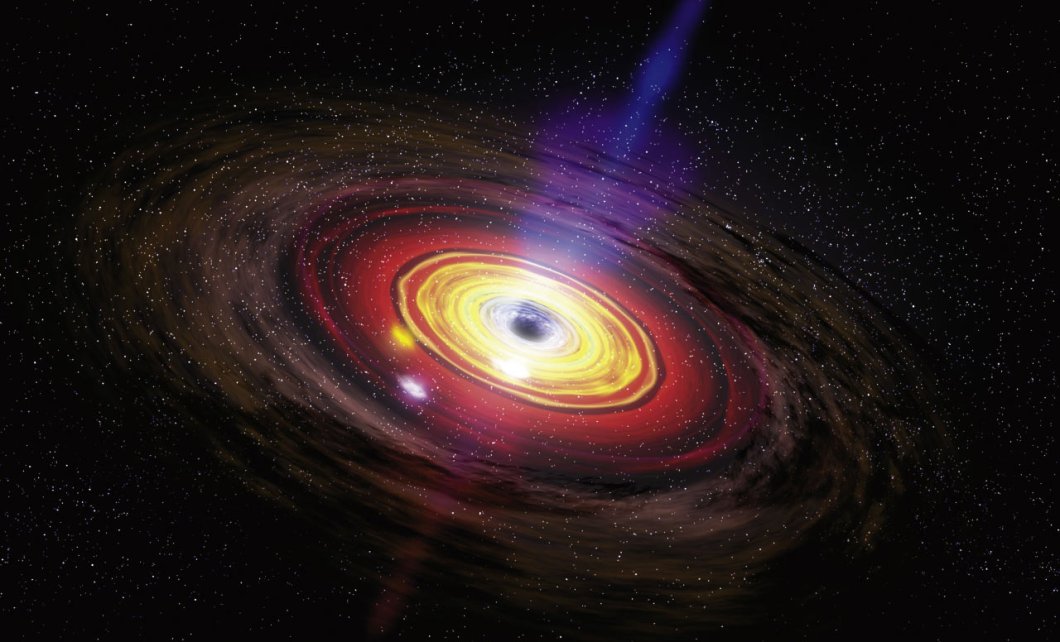
We can easily visualize an object of infinite inertia to provide a fixed, unmoving reference point. For example, the back hole at the center of a galaxy has higher inertia than any other individual star in the galaxy. It, therefore, provides a fixed, unmoving reference point for rest of the galaxy. The motion of a body with respect to such a fixed, unmoving reference point, may then be plotted on an absolute scale of motion.

The inertia of Earth is much less than the inertia of the black hole at the center of galaxy. Therefore, Earth will have a measure of absolute motion with respect to the center of galaxy. Similarly, light will have absolute motion with respect to the center of galaxy; but this motion will be very large because light hardly has any inertia. Thus, it is possible to have a scale of absolute motion, which would be inverse of the scale of inertia.

In the post, Michelson-Morley’s Null Resultwe made a rough calculation of the drift speed of Earth based on its estimated inertia. That drift speed was found to be much smaller than the speed of Earth relative to the Sun. This was because the calculated drift speed of Earth represented the absolute motion of Earth in space. By conceiving motion as inverse of inertia, and taking into account the gravitational effects, we can find the absolute motion of particles in space.

The above reasoning also provides an insight into why light has extremely large but finite speed. It is because light has a very small but finite inertia. This gives rise to the following postulate of the Theory of Substance:

The velocity of a particle in free space is constant because its motion is balanced by the inertia of its mass, or consistency. The motion increases as the mass, or consistency, decreases.

.

Michelson-Morley’s Null Result

Reference: Essays on Substance

Michelson-Morley’s Null Result

The prevailing aether theory at the time of the Michelson-Morley experiment in 1887 was that a hypothetical medium called luminiferous aether permeated all of space. This theory posited that:

  1. Aether was a stationary substance that filled empty space.
  2. Light waves required this aether as a medium to propagate, similar to how water waves need water and sound waves need air.
  3. The Earth was believed to move through this stationary aether as it orbited the Sun.

This theory predicted that the Earth’s motion through the aether would create an “aether wind,” which would affect the speed of light in different directions relative to Earth’s movement. The Michelson-Morley experiment was designed to detect this aether wind by measuring potential differences in the speed of light traveling in perpendicular directions. 

The expected difference between the speed of light in the direction of movement through the presumed aether, and the speed at right angles, was found not to exist. The null results from Michelson-Morley experiment initiated a line of research that eventually led to Einstein’s theory of Special Relativity. The special relativity then ruled out a stationary aether, and postulated the velocity of light to be absolute.

According to the theory of Substance, there has to be substance filling existing space. In the absence of matter and energy, it has to be some undefined substance, which we may call aether. The consistency of this aether is very likely many orders of magnitude lesser than the consistency of light. Therefore, it would offer no resistance to the movement of either light or Earth.

Earth is made of solid particles (atoms), whereas, light is made of gaseous particles (not waves in some medium). The only resistance that Earth and light would encounter is due to their respective inertia. Newton defined inertia  as follows:

“The vis insita, or innate force of matter, is a power of resisting by which every body, as much as in it lies, endeavours to preserve its present state, whether it be of rest or of moving uniformly forward in a straight line.”

The inertia balances the respective motions of Earth and light, such that, their respective velocities are constant. Therefore, the ratio of their velocities shall be the inverse of the ratio of their inertia or consistencies. According to The Spectrum of Substance, the consistency of light is around 49, and the consistency of Earth (average per particle) is around 80. 

The difference in their consistencies is 31, which gives us a ratio of 231 or about 109. The Earth’s drift speed in space is 10-9 times the speed of light, or less than half a meter per second.

The Michelson-Morley’s experiment is then required to detect a velocity difference of less than half a meter per second in the velocity of light (3 x 10⁸ m/s) due to the difference in motions of the Earth. This would be a shift in fringes of the order of 10-9 meters. That is of the order of the size of an atom. This explains the null result produced by Michelson-Morley experiment.

NOTE: The consistency of earth may be underestimated here. It may require much greater precision than 10-9 meters to detect a shift in the fringes obtained.

.

An Analysis of Special Relativity (SR)

Reference: Essays on Substance

An Analysis of SR

Einstein made the postulate that the velocity of light is absolute. To maintain that postulate, Einstein had to abandon the classical notions of absolute time and space. He introduced the concept of spacetime, where time is relative and can dilate (pass more slowly) based on an object’s motion, while the space contracts in the direction of motion. The mathematics also led to mass and energy being interchangeable. This approach resolved the apparent contradictions between classical mechanics and electromagnetism.

However, Einstein’s postulate applies only to inertial frames of reference. The inertia relates to matter only. Matter has a very limited range of velocities. This whole range is very small compared to the velocity of light. Therefore, SR applies only to a small range of velocities observed for matter.

To obtain relative velocity, the velocities of matter that are not too different can simply be added or subtracted. This is the Newtonian formula for relative velocities. It works because the corresponding mass/inertia are not very different.

The Newtonian formula does not work well when the velocities are very different. This is because the associated mass/inertia is also significantly different. In this case, the relative velocity cannot be obtained by simple addition/subtraction. SR provides a better approximation.

.

According to the theory of Substance,

The velocity of a particle in free space is constant because its motion is balanced by the inertia of its mass (consistency). The motion increases as the consistency decreases.

SR seems to take into account this balance of motion and inertia indirectly, within the range of motion for matter. But this is not obvious; as SR tries to explain it through time dilation compensating space contraction.

According to the theory of Substance, a faster moving object in space has a greater reduction of inertia than a slower moving object, and this needs to be taken into account. The reduced inertia is accompanied by increased wavelength and reduced frequency. So the space of the object expands instead of contracting; and the frequency of the object, that determines the time of the clock, slightly decreases. The idea of time dilation only means reduction in clock’s ticking.

Please note that the larger velocities for matter, closer to the velocity of light, are meaningless because at those velocities the wavelength has increased so much, and the frequency has decreased so much, that matter has literally transformed into energy.

SR produces results because the velocity of light is so very large compared to applicable range of velocities for matter that it remains constant.

.