Category Archives: Philosophy

Tertium Organum, Chapter 3 (Space)

pillars


Reference: Tertium Organum

.

Chapter 3: Space


What may we learn about the fourth dimension by a study of the geometrical relations within our space? What should be the relation between a three-dimensional body and one of four dimensions? The four-dimensional body as the tracing of the movement of a three-dimensional body in the direction which is not confined within it. A four-dimensional body as containing an infinite number of three-dimensional bodies. A three-dimensional body as a section of a four-dimensional one. Parts of bodies and entire bodies in three and in four dimensions. The incommensurability of a three-dimensional and a four-dimensional body. A material atom as a section of a four-dimensional line.

.

In another of his books, “The Fourth Dimension,” Hinton makes an interesting remark about the method by which we may approach the question of the higher dimensions. This is what he says:

Our space itself bears within it relations through which we can establish relations to other (higher) spaces. 

For within space are given the conception of point and line, line and plane, which really involve the relation of space to a higher space. 

If we concentrate upon this thought, and consider the very great difference between the point and the line, between the line and the surface, surface and solid, we shall indeed come to understand how much of the new and inconceivable the fourth dimension holds for us. 

As in the point it is impossible to imagine the line and the laws of the line; as in the line it is impossible to imagine the surface and the laws of the surface; as in the surface it is impossible to imagine the solid and the laws of the solid, so in our space it is impossible to imagine the body having more than three dimensions, and impossible to understand the laws of the existence of such a body. 

But studying the mutual relations between the point, the line, the surface, the solid, we begin to learn something about the fourth dimension, i.e., of four-dimensional space. We begin to learn what it can be in comparison with our three-dimensional space, and what it cannot be.

The three dimensions of space specify the three independent directions in which the extents of an inflexible solid object may be measured. This is a space filled by a inflexible solid object.

This last we learn first of all. And it is especially important, because it saves us from many deeply inculcated illusions, which are very detrimental to right knowledge. 

We learn what cannot be in four-dimensional space, and this permits us to set forth what can be there

Let us consider these relations within our space, and let us see what conclusions we can derive from their investigation. 

We know that our geometry regards the line as a tracing of the movement of a point; the surface as a tracing of the movement of a line; and the solid as a tracing of the movement of a surface. On these premises we put to ourselves this question: Is it not possible to regard the “four-dimensional body” as a tracing of the movement of a three-dimensional one? 

But what is this movement, and in what direction? 

The point, moving in space, and leaving the tracing of its movement, a line, moves in a direction not contained in it, because in a point there is no direction whatsoever. 

The line, moving in space, and leaving the tracing of its movement, the surface, moves in a direction not contained in it because, moving in a direction contained in it, a line will continue to be a line.

The surface, moving in space, and leaving a tracing of its movement, the solid, moves also in a direction not contained in it. If it should move otherwise, it would remain always the surface. In order to leave a tracing of itself as a “solid,” or three-dimensional figure, it must set off from itself, move in a direction which in itself it has not. 

A dimension need not depend on a physical direction. The next higher dimensional object may be obtained by extending the lower dimensional object in a dimension not contained in the object.

In analogy with all this, the solid, in order to leave as the tracing of its movement, the four-dimensional figure (hypersolid) shall move in a direction not confined in it; or in other words it shall come out of itself, set off from itself, move in a direction which is not present in it. Later on it will be shown in what manner we shall understand this. 

But for the present we can say that the direction of the movement in the fourth dimension lies out of all those directions which are possible in a three-dimensional figure

There is no fourth physical direction in reality. One may try to visualize a fourth physical direction mathematically. But mathematics only provides an abstract pattern.

We consider the line as an infinite number of points; the surface as an infinite number of lines; the solid as an infinite number of surfaces.

In analogy with this it is possible to consider that it is necessary to regard a four-dimensional body as an infinite number of three-dimensional ones, and four-dimensional space as an infinite number of three-dimensional spaces. 

Moreover, we know that the line is limited by points, that the surface is limited by lines, that the solid is limited by surfaces. 

It is possible that a four-dimensional body is limited by three-dimensional bodies

Or it is possible to say that the line is a distance between two points; the surface a distance between two lines; the solid—between two surfaces. 

Or again, that the line separates two points or several points from one another (for the straight line is the shortest distance between two points) ; that the surface separates two or several lines from each other; that the solid separates several surfaces one from another; so the cube separates six flat surfaces one from another—its faces. 

The line binds several separate points into a certain whole (the straight, the curved, the broken line) ; the surface binds several lines into something whole (the quadrilateral, the triangle); the solid binds several surfaces into something whole (the cube, the pyramid).

It is possible that four-dimensional space is the distance between a group of solids, separating these solids, yet at the same time binding them into some to us inconceivable whole, even though they seem to be separate from one another. 

Time has long been considered as the fourth dimension. The same object in a different time is a different version of it. Comparing different versions of an object at different points in time may produce an interesting four-dimensional object. The “time line” of a three­-dimensional object may provide a “linear” four-dimensional object.

Moreover, we regard the point as a section of a line; the line as a section of a surface; the surface as a section of a solid. 

By analogy, it is possible to regard the solid (the cube, sphere, pyramid) as a section of a four-dimensional body, and our entire three-dimensional space as a section of a four-dimensional space. 

If every three-dimensional body is the section of a four-dimensional one, then every point of a three-dimensional body is the section of a four-dimensional line. It is possible to regard an “atom” of a physical body, not as something material, but as an intersection of a four-dimensional line by the plane of our consciousness.

The view of a three-dimensional body as the section of a four-dimensional one leads to the thought that many (for us) separate bodies may be the sections of parts of one four-dimensional body.

A simple example will clarify this thought. If we imagine a horizontal plane, intersecting the top of a tree, and parallel to the surface of the earth, then upon this plane the sections of branches will seem separate, and not bound to one another. Yet in our space, from our standpoint, these are sections of branches of one tree, comprising together one top, nourished from one root, casting one shadow.

Or here is another interesting example expressing the same idea, given by Mr. Leadbeater, the theosophical writer, in one of his books. If we touch the surface of a table with our finger tips, then upon the surface will be just five circles, and from this plane presentment it is impossible to construe any idea of the hand, and of the man to whom this hand belongs. Upon the table’s surface will be five separate circles. How from them is it possible to imagine a man, with all the richness of his physical and spiritual life? It is impossible. Our relation to the four-dimensional world will be analogous to the relation of that consciousness which sees five circles upon the table to a man. We see just “finger tips;” to us the fourth dimension is inconceivable. 

We know that it is possible to represent a three-dimensional body upon a plane, that it is possible to draw a cube, a polyhedron or a sphere. This will not be a real cube or a real sphere, but the projection of a cube or of a sphere on a plane. We may conceive of the three-dimensional bodies of our space somewhat in the nature of images in our space of to us incomprehensible four-dimensional bodies.

In reality, there is no fourth geometrical direction. But time naturally occurs as the fourth dimension. Mathematics points to patterns only. Looking at time as a dimension of space is novel idea, but it fits the mathematical pattern. The only difference is that time is a mental dimension. All higher dimensions of space are, more likely, going to be perceived mentally. Substantiality of space (as discussed in Chapter 2) may be regarded as another physical dimension though.

.

Tertium Organum, Chapter 2 (Existence)

pillars

Reference: Tertium Organum

.

Chapter 2: Existence

A new view of the Kantian problem. The Ideas of Hinton. The “space sense” and its evolution. A system for the development of a sense of the fourth dimension by exercises with colored cubes. The geometrical conception of space. Three perpendiculars—why three? Can everything existing be measured by three perpendiculars? Facts physical and metaphysical. The indices of existence. Reality of ideas. Insufficient evidence of the existence of matter and motion. Matter and motion are only logical concepts, like “good” and “evil.”

.

As already stated, Kant propounded the problem, but gave no solution of it, nor did he point the way to a solution. And not one of the known commentators, interpreters, followers or adversaries of Kant has found a solution, nor the way to it.

I find the first flashes of a right understanding of the Kantian problem, and the first suggestions in regard to a possible way toward its solution in the writings of C. H. Hinton, author of the books, “A New Era of Thought” and “The Fourth Dimension.” 

These books contain interesting synopses of many things previously written about problems of higher dimensions, together with ideas of the author’s own which have a bearing upon the subject under discussion here.

Hinton notes that in commenting upon Kantian ideas, only their negative side is usually insisted upon, namely, the fact that we can cognize things in a sensuous way, in terms of space and time only, is regarded as an obstacle, hindering us from seeing what things in themselves really are, preventing the possibility of cognizing them as they are, imposing upon them that which is not inherent in them, shutting them off from us.

Kant proposed things-in-themselves to be the causes of sensations which are then perceived in terms of space and time. This is thought of as space and time hindering us from seeing what things-in-themselves really are.

But [says Hinton] if we take Kant’s statement simply as it is—not seeing in the spatial conception a hindrance to right receptivity—that we apprehend things by means of space—then it is equally allowable to consider our space sense not as a negative condition, hindering our perception of the world, but as a positive means by which the mind grasps its experiences, i.e., by which we cognize the world.

There is, in so many books in which the subject is treated, a certain air of despondency—as if this space apprehension were a kind of veil which shut us off from nature. But there is no need to adopt this feeling. The first postulate of this book is a full recognition of the fact that it is by means of space that we apprehend what is. 

Space is the instrument of the mind.

Very often a statement which seems to be very deep and abstruse and hard to grasp, is simply the form into which deep thinkers have thrown a very simple and practical observation. And for the present let us look on Kant’s great doctrine of space from a practical point of view, and it comes to this—it is important to develop the space sense, for it is the means by which we think about real things. 

Now according to Kant [Hinton goes on to say] the space sense, or the intuition of space, is the most fundamental power of the mind. But I do not find anywhere a systematic and thorough-going education of the space sense. It is left to be organized by accident. Yet the special development of the space sense makes us acquainted with a whole series of new conceptions.

Fichte, Schelling, Hegel, have developed certain tendencies and have written remarkable books, but the true successors of Kant are Gauss and Lobachevsky. 

For if our intuition of space is the means whereby we apprehend, then it follows that there may be different kinds of intuitions of space. Who can tell what the absolute space intuition is? This intuition of space must be colored, so to speak, by the conditions (of psychical activity) of the being which uses it. 

By a remarkable analysis the great geometers above mentioned have shown that space is not limited as ordinary experience would seem to inform us, but that we are quite capable of conceiving different kinds space. [A New Era of Thought]

Hinton invented a complicated system for the education and development of the space sense by means of exercises with groups of cubes of different colors. The books above mentioned are devoted to the exposition of this system. In my opinion Hinton’s exercises are interesting from a theoretical standpoint, but they are practically valuable only for such as have the same turn of mind as Hinton’s own. 

Exercises of the mind according to his system must first of all lead to the development of the ability to imagine objects, not as the eye sees them, i.e., in perspective, but as they are geometrically—to learn to imagine the cube, for example, simultaneously from all sides. Moreover, such a development of the imagination as overcomes the illusions of perspective results in the expansion of the limits of consciousness, thus creating new conceptions and augmenting the faculty for perceiving analogies.

Any exercise should help assimilate the dimensions that are applied to sensations. The dimensions may derive initially from the categories of Kant.

.

Kant established the fact that the development of knowledge under the existing conditions of receptivity will not bring us any closer to things in themselves. But Hinton asserts that it is possible, if desired, to change the very conditions of receptivity, and thus to approach the true substance of things. 

Our space as we ordinarily think of it is conceived as limited—not in extent, but in a certain way which can only be realized when we think of our ways of measuring space objects. It is found that there are only three independent directions in which a body can be measured—it must have height, length and breadth, but it has no more than these dimensions, if any other measurement be taken in it, this new measurement will be found to be compounded of the old measurements. 

It is impossible to find a point in the body which could not be arrived at by traveling in combinations of the three directions already taken. 

But why should space be limited to three independent directions? 

Geometers have found that there is no reason why bodies which we can measure should be thus limited. As a matter of fact all the bodies which we can measure are thus limited. So we come to this conclusion, that the space which we use for conceiving ordinary objects in the world is limited to three dimensions. But it might be possible for there to be beings living in a world such that they would conceive a space of four dimensions.

It is possible to say a great deal about space of higher dimensions than our own, and to work out analytically many problems which suggest themselves. But can we conceive four-dimensional space in the same way in which we can conceive our own space? Can we think of a body in four dimensions as a unit having properties in the same way as we think of a body having a definite shape in the space with which we are familiar? 

There is really no more difficulty in conceiving four-dimensional shapes, when we go about it in the right way, than in conceiving the idea of solid shapes, nor is there any mystery at all about it. 

When the faculty to apprehend in four dimensions is acquired—or rather when it is brought into consciousness, for it exists in everyone in imperfect form—a new horizon opens. The mind acquires a development of power, and in this use of ampler space as a mode of thought, a path is opened by using that very truth which, when first stated by Kant, seemed to close the mind within such fast limits. Our perception is subject to the condition of being in space. But space is not limited as we at first think.

The next step after having formed this power of conception in ampler space, is to investigate nature and see what phenomena are to be explained by four-dimensional relations. 

The thought of past ages has used the conception of a three-dimensional space, and by that means has classified many phenomena and has obtained rules for dealing with matters of great practical utility. The path which opens immediately before us in the future is that of applying the conception of four-dimensional space to the phenomena of nature, and of investigating what can be found out by this new means of apprehension…

For development of knowledge it is necessary to separate the self elements, i.e., the personal element which we put in everything cognized by us from that which is cognized, in order that our attention may not be distracted (upon ourselves) from the properties which we, in substance, perceive. 

Only by getting rid of the self elements in our receptivity do we put ourselves in a position in which we can propound sensible questions. Only by getting rid of the notion of a circular motion of the sun around the earth (i.e., around us—self-element) do we prepare our way to study the sun as it really is. 

But the worst about a self element is that its presence is never dreamed of till it is got rid of. 

In order to understand what the self element in our receptivity means, imagine ourselves to be translated suddenly to another part of the universe, and to find there intelligent beings and to hold conversation with them. If we told them that we came from this world, and were to describe the sun to them, saying that it was a bright, hot body which moved around us, they would reply: “You have told us something about the sun, but you have also told us something about yourselves.” 

Therefore, desiring to tell something about the sun, we shall first of all get rid of the self element which is introduced into our knowledge of the sun by the movement of the earth, upon which we are, round it…

One of our serious pieces of work will be to get rid of the self elements in the knowledge of the arrangement of objects. 

The relations of our universe or our space with regard to the wider universe of four-dimensional space are altogether undetermined. The real relationship will require a great deal of study to apprehend, and when apprehended will seem as natural to us as the position of the earth among the other planets seems to us now. 

I would divide studies of arrangement into two classes: those which create the faculty of arrangement, and those which use it and exercise it. Mathematics exercises it, but I do not think it creates it; and unfortunately, in mathematics as it is now often taught, the pupil is launched into a vast system of symbols: the whole use and meaning of symbols, (namely, as means to acquire a clear grasp of facts) is lost to him…

Of the possible units which will serve for the study of arrangement, I take the cube; and I have found that whenever I took any other unit I got wrong, puzzled, and lost my way. With the cube one does not get along very fast, but everything is perfectly obvious and simple, and builds up into a whole of which every part is evident… 

Our work then will be this: a study, by means of cubes, of the facts of arrangement; and the process of learning will be an active one of actually putting up the cubes. Thus we will bring our minds into contact with nature. [A New Era of Thought]

Mathematics can postulate infinite dimensions of “space” that are independent of each other; but, in reality, all such dimensions would be aspects of consciousness made of thought. In practical terms, all dimensions may be attributed to the universe. They would have to be assimilated for the universe to be perceived more accurately.

.

I shall return again to Hinton’s books several times, but meanwhile it is necessary to establish our relation to the ideas which Kant’s problem touches. 

What is space? 

Taken as object, that is, perceived by our consciousness, space is for us the form of the universe or the form of the matter in the universe. 

Space possesses an infinite extension in all directions. But it can be measured in only three directions independent of one another; in length, breadth, and height; these directions we call the dimensions of space, and we say that our space has three dimensions: it is three-dimensional. 

By independent direction we mean in this case a line at right angles to another line. 

Our geometry, (or the science of measurement of the earth, or matter in space) knows only three such lines, which are mutually at right angles to one another and not parallel among themselves. 

Should we mean by independent direction the line which is not at right angles, i.e., which does not form with the others an angle of 90 degrees, but an angle, say, of 30 degrees, then we would have the number of dimensions not three, but nine. 

It is seen from this that the three-dimensionality of our space is simply a geometrical condition, and depends upon the fact that we are using right angles as a unit of measurement. 

But at the same time, in our space and our universe we know only three perpendiculars, i.e., only three independent right angles. 

But why three only, and not ten or fifteen? 

This we do not know.

And here is another very significant fact: either because of some mysterious property of the universe, or because of some mental limitation, we cannot even imagine to ourselves more than three independent directions. 

But we speak of the universe as infinite, and because the first condition of infinity is infinity in all directions and in all possible relations, so we must presuppose in space an infinite number of dimensions: that is, we must presuppose an infinite number of lines perpendicular and not parallel to each other: and yet out of these lines we know, for some reason, only three

It is usually in some such guise that the question of higher dimensionality appears to normal human consciousness. 

Since we cannot construct more than three mutually independent perpendiculars, and if the three-dimensionality of our space is conditional upon this, we are forced to admit the indubitable fact of the limitedness of our space in relation to geometrical possibilities: though of course if the properties of space are created by some limitation of consciousness, then the limitedness lies in ourselves. 

No matter what this limitedness depends on, it is a fact that it exists. 

A given point can be the vertex of only eight independent tetrahedrons. Through a given point it is possible to draw only three perpendicular and not parallel straight lines. 

Upon this as a basis, we define the dimensionality of space by the number of lines it is possible to draw in it which are mutually at right angles one with another. 

The line upon which there cannot be a perpendicular, that is, another line, constitutes linear, or one-dimensional space. 

Upon the surface two perpendiculars are possible. This is superficial, or two-dimensional space. 

In “space” three perpendiculars are possible. This is solid, or three-dimensional space. 

The idea of the fourth dimension arose from the assumption that in addition to the three dimensions known to our geometry there exists still a fourth, for some reason unknown and inaccessible to us, i.e., that in addition to the three known to us, a mysterious fourth perpendicular is possible. 

This assumption is practically founded on the consideration that there are things and phenomena in the world undoubtedly really existing, but quite incommensurable in terms of length, breadth and thickness, and lying as it were outside of three-dimensional space.

.

By really existing we understand that which produces definite action, which possesses certain functions, which appears to be the cause of something else. 

That which does not exist cannot produce any action, has no function, cannot be a cause. 

But there are different modes of existence. There is physical existence, recognized by certain sorts of actions and functions, and there is metaphysical existence, recognized by its actions and its functions. 

A house exists, and the idea of good and evil exists. But they do not exist in like manner. One and the same method of proof of existence does not suffice for the proof of the existence of a house and for the proof of the existence of an idea. A house is a physical fact, an idea is a metaphysical fact. Physical and metaphysical facts exist, but they exist differently. 

In order to prove the idea of a division into good and evil, i.e., a metaphysical fact, I have only to prove its possibility. This is already sufficiently established. But if I should prove that a house, i.e., a physical fact, may exist, it does not at all mean that it exists really. If I prove that a man may own the house it is no proof that he owns it. 

Our relation to an idea and to a house are quite different. It is possible by a certain effort to destroy a house—to burn, to wreck it. The house will cease to exist. But suppose you attempt to destroy, by an effort, an idea. The more you try to contest, argue, refute, ridicule, the more the idea is likely to spread, grow, strengthen. And contrarywise, silence, oblivion, non-action, “nonresistance” will exterminate, or in any case will weaken the idea. Silence, oblivion, will not wreck a house, will not hurt a stone. It is clear that the existence of a house and that of an idea are quite different existences. 

Of such different existences we know very many. A book exists, and also the contents of a book. Notes exist, and so does the music that the notes combine to make. A coin exists, and so does the purchasing value of a coin. A word exists, and the energy which it contains.

We discern on the one hand, a whole series of physical facts, and on the other hand, a series of metaphysical facts

As facts of the first kind exist, so also do facts of the second kind exist, but differently. 

From the usual positivist point of view it will seem naive in the highest degree to speak of the purchasing value of a coin separately from the coin: of the energy of a word separately from the word: of the contents of a book separately from the book, and so on. We all know that these are only “what people say,” that in reality purchasing value, energy of a word, and contents of a book do not exist, that by these conceptions we only denote a series of phenomena in some way linked with coin, word, book, but in substance quite separate from them. 

But is it so? 

We decided to accept nothing as given, consequently we shall not negate anything as given. 

We see in things, in addition to what is external, something internal. We know that this internal element in things constitutes a continuous part of things, usually their principal substance. And quite naturally we ask ourselves, where is this internal element, and what does it represent in and by itself. We see that it is not embraced within our space. We begin to conceive of the idea of a “higher space” possessing more dimensions than ours. Our space then appears to be somehow a part of higher space, i.e., we begin to believe that we know, feel, and measure only part of space, that part which is measurable in terms of length, width and height.

The division of dimensions into external and internal is arbitrary. All dimensions are part of space. The substantiality of existence may be considered the “fourth dimension” of space.

.

As was said before, we usually regard space as a form of the universe, or as a form of the matter of the universe. To make this clear it is possible to say that a “cube” is the form of the matter in a cube; a “sphere” is the form of the matter in a sphere; “space”—an infinite sphere—is the form of the entire matter of the universe. 

H. P. Blavatsky, in “The Secret Doctrine” has this to say about space: 

The superficial absurdity of assuming that Space itself is measurable in any direction is of little consequence. The familiar phrase (the fourth dimension of space) can only be an abbreviation of the fuller form—the “Fourth dimension of Matter in Space” … The progress of evolution may be destined to introduce us to new characteristics of matter…”

But the formula defining “space” as “the form of matter in the universe” suffers from this deficiency, that there is introduced in it the concept of “matter,” i.e., the unknown

I have already spoken of that “dead end siding,” x = y, y = x, to which all attempts at the physical definition of matter inevitably lead. 

Psychological definitions lead to the same thing. 

In a well known book, “The Physiology of the Soul,” A. I. Gerzen says:

We call matter everything which directly or indirectly offers resistance to motion, directly or indirectly produced by us, manifesting a remarkable analogy with our passive states. 

And we call force (motion) that which directly or indirectly communicates movement to us or to other bodies, thus manifesting the greatest similitude to our active states.

Consequently, “matter” and “motion” are something like projections of our passive and active states. It is clear that it is possible to define the passive state only in terms of the active, and the active in terms of the passive—again two unknowns, defining one another. 

Substance is sensed because it resists motion. This property is called inertia. Both motion and inertia are simply the characteristics of all substance (matter, radiation and thought) that complement each other.

E. Douglas Fawcett, in an article entitled “Idealism and the Problem of Nature” in “The Quest” (April, 1910), discusses matter from this point of view.

Matter (like force) does not give us any trouble. We know all about it, for the very good reason that we invented it. By “matter” we think of sensuous objects. It is mental change of concrete, but too complicated facts, which are difficult to deal with. 

Strictly speaking, matter exists only as a concept. Truth to tell, the character of matter, even when treated only as a conception, is so unobvious that the majority of persons are unable to tell us exactly what they mean by it.

An important fact is here brought to light: matter and force are just logical concepts, i.e., only words accepted for the designation of a lengthy series of complicated facts. It is difficult for us, educated almost exclusively along physical lines, to understand this clearly, but in substance it may be stated as follows: Who has seen matter and force, and when? We see things, see phenomena. Matter, independently of the substance from which a given thing is made, or of which it consists, we have never seen and never will see; but the given substance is not quite matter, this is wood, or iron or stone. Similarly, we shall never see force separately from motion. What does this mean? It means that “matter” and “force” are just such abstract conceptions, as “value” or “labor,” as “the purchasing value of a coin” or the “contents” of a book; it means that matter is “such stuff as dreams are made of.” And because we can never touch this “stuff” and can see it only in dreams, so we can never touch physical matter, nor see, nor hear, nor photograph it, separately from the object. We cognize things and phenomena which are bad or good, but we never cognize “matter” and “force” separately from things and phenomena

Matter is as much an abstract conception as are truth, good and evil.

It is as impossible to put matter or any part of matter into a chemical retort or crucible as it is impossible to sell “Egyptian darkness” in vials. However as it is said that “Egyptian darkness” is sold as a black powder in Athos, therefore perhaps even matter, somewhere, by some one, has been seen.

In order to discuss questions of this order a certain preparation is necessary, or a high degree of intuition; but unfortunately it is customary to consider fundamental questions of cosmogony very lightly. 

A man easily admits his incompetency in music, dancing, or higher mathematics, but he always maintains the privilege of having an opinion and being a judge of questions relating to “first principles.”

It is difficult to discuss with such men. 

For how will you answer a man who looks at you in perplexity, knocks on the table with his finger and says, “This is matter. I know it; feel! How can it be an abstract conception?” To answer this is as difficult as to answer the man who says: “I see that the sun rises and sets!”

.

Returning to the consideration of space, we shall under no circumstances introduce unknown quantities in the definition of it. We shall define it only in terms of those two data which we decided to accept at the very beginning. 

The world and consciousness are the facts which we decided to recognize as existing.

By the world we mean the combination of unknown causes of our sensations. 

By the material world we mean the combination of unknown causes of a definite series of sensations, those of sight, hearing, touch, smell, taste, sensations of weight, and so on. 

Space is either a property of the world or a property of our knowledge of the world. 

Three-dimensional space is either a property of the material world or a property of our receptivity of the material world. 

Our inquiry is confined to the problem : how shall we approach the study of space?

Existence depends on sensations. Sensations are caused by “unknown causes”, but we are able to perceive these causes, as sensations get assimilated. The better is the assimilation, the clearer is the perception of the unknown cause.

The world is objective, but consciousness is considered to be subjective. This subjectivity is there because we identify self with consciousness. The inclusion of this self element generates a limitation. We can get rid of this limitation by recognizing that consciousness is made up of thought, and thought is also a substance.

Thus, consciousness can be seen as part of the objective world that is sensed as matter, radiation and thought. It is only upon the assimilation of these sensations that we start to perceive those “unknown causes” more clearly.

.

Tertium Organum, Chapter 1 (Knowledge)

pillars

Reference: Tertium Organum

.

Chapter 1: Knowledge

What do we know and what do we not know? Our data, and the things for which we seek. The unknown mistaken for the known. Matter and motion. What does the positive philosophy come to? Identity of the unknown: x = y. y = x. What do we really know? The existence of consciousness in us, and of the world outside of us. Dualism or monism? Subjective and objective knowledge. Where do the causes of the sensations lie? Kant’s system. Time and Space. Kant and the “ether.” Mach’s observation. With what does the physicist really deal?

“Learn to discern the real from the false” ~THE VOICE OF THE SILENCE, H. P. B.

.

The most difficult thing is to know what we do know, and what we do not know.

Therefore, desiring to know anything, we shall before all else determine WHAT we accept as given, and WHAT as demanding definition and proof: that is, determine WHAT we know already, and WHAT we wish to know.

In relation to the knowledge of the world and of ourselves, the conditions would be ideal could we venture to accept nothing as given, and count all as demanding definition and proof. In other words, it would be best to assume that we know nothing, and make this our point of departure.

But unfortunately such conditions are impossible to create. Knowledge must start from some foundation, something must be recognized as known, or we shall be obliged always to define one unknown by means of another.

When searching for knowledge, we must start with some postulate as the foundation. This postulate may get modified as knowledge develops.

Looking at the matter from another point of view, we shall hesitate to accept as the known things—as the given ones—those in the main completely unknown, only presupposed, and therefore the things sought for. Should we do this, we are likely to fall into such a dilemma as that in which positive philosophy now finds itself. For a long time this was founded on the idea of the existence of matter (materialism), and now it is founded on the conception of the existence of energy: that is, of a force, or motion (energeticism), though in reality matter and motion were always the unknown x and y, and were defined by means of one another.

It must be perfectly clear to everyone that it is impossible to accept the thing sought as the given; and impossible to define one unknown by means of another. The result is nothing but the identity of the unknown: x = y, y = x.

This identity of the unknown is the ultimate conclusion to which positive philosophy comes.

Matter is that in which proceed the changes called motion: and motions are those changes which proceed in matter.

Positive philosophy assumes matter and motion to be known quantities. But, there are postulates underlying them that are unknown.

.

But what do we know ? 

We know that with the very first awakening of self-consciousness, man is confronted with two obvious facts:

The existence of the world in which he lives; and the existence of consciousness in himself. 

Neither of these can he prove or disprove, but they are facts: they constitute reality for him.

It is possible to meditate upon the mutual correlation of these facts. It is possible to try to reduce them to one; that is, to regard consciousness as a part, or function of the world, or the world as a part, or function of consciousness. But such a procedure constitutes a departure from facts, and all such considerations of the world and of the self, to the ordinary non-philosophical mind, will not have the character of obviousness. On the contrary the sole obvious fact remains the antithesis of I and Not-I—consciousness and the world.

Further on we shall return to this fundamental thesis. But thus far we have no basis on which to found a contradiction of the obvious fact of the existence of ourselves—i. e., of our consciousness—and of the world in which we live. This we shall therefore accept as the given.

This however is the only thing that we have the right to accept as given: all the rest demands proof and definition in terms of these two given data.

Space, with its extension; time, with the idea of before, now, after; quantity, mass, substantiality; number, equality and inequality; identity and difference; cause and effect, the ether, atoms, electrons, energy, life, death—all things that form the foundation of our so-called knowledge: these are the unknown things. 

The existence of consciousness in us, and the existence of the world outside of us—from these two fundamental data immediately proceed our common and clearly understood division of everything that we know into subjective and objective

Everything that we accept as a property of the world, we call objective; and everything that we accept as a property of consciousness, we call subjective. 

The subjective world we recognize directly: it is in ourselves—we are one with it. 

The objective world we picture to ourselves as existing somewhere outside of us—we and it are different things.

It seems to us that if we should close our eyes, then the objective world would continue to exist, such as we just saw it; and if consciousness were to cease, and our “I” to disappear, so would the subjective world disappear—yet the objective world would exist as before, as it existed at the time when we were not; when our subjective world was not. 

We identify ourselves with the consciousness and call it subjective. We see the world as existing outside of us and call it objective. The objective world and subjective consciousness appear to exist independent of each other.

Our relation to the objective world is most exactly defined by the fact that we perceive it as existing in time and space; otherwise, out of these conditions, we can neither conceive nor imagine it. In general, we say that the objective world consists of things and phenomena, i. e., things and changes in states of things. The PHENOMENA exist for us in time; the THINGS, in space. 

The objective world is changing and we see it as existing in space and time.

But such a division of the subjective and objective world does not satisfy us. 

By means of reasoning we can establish the fact that in reality we know only our own sensations, perceptions and conceptions, and we cognize the objective world by projecting outside of ourselves the causes of our sensations, presupposing them to contain these causes. 

Then we find that our knowledge of the subjective and of the objective world as well, can be true and false, correct and incorrect. 

We know the subjective world by our sensations. We know the objective world by our perceptions and conceptions. And this can be correct or incorrect.

The criterion for the definition of correctness or incorrectness of our knowledge of the subjective world is the form of the relations of one sensation to others, and the force and character of the sensation itself. In other words, the correctness of one sensation is verified by the comparison of it with another of which we are more sure, or by the intensity and “taste” of a given sensation.

The criterion for the definition of correctness or incorrectness of our knowledge of the objective world is the very same. It seems to us that we define the things and phenomena of the objective world by means of comparing them among themselves; and we think we find the laws of their existence outside of us, and independent of our perception of them. But it is an illusion. We know nothing about things separately from us; and we have no other means of verifying the correctness of our knowledge of the objective world but BY SENSATIONS.

The criterion for determining the correctness or incorrectness of our cognition of the subjective and objective worlds seems to depend upon the relationships among the sensations.

COMMENTS: Please see The Primary Arbitrary.

.

Since the remotest antiquity the question of our relation to the true causes of our sensations constituted the main subject of philosophical research. Men have always had some discussion of this question, some answer for it. And these answers have vacillated between two poles, from the full negation of the causes themselves, and the assertion that the causes of sensations are contained within ourselves and not in anything outside of us—up to the recognition that we know these causes, that they are embodied in the phenomena of the outer world, that these phenomena constitute the cause of sensations; and that the cause of all observed phenomena lies in the movement of “atoms”, and the oscillations of the “ether”. It is believed that if we cannot observe these motions and oscillations it is only because we have not sufficiently powerful instruments, and that when such instruments are at our disposal we shall be able to see the movements of atoms as well as we see, through powerful telescopes, stars the very existence of which were never guessed.

Causes of our sensations is not really known with certainty. This has led to speculations, hypotheses, theories, etc. The most critical of these is the system of Kant.

.

In modern philosophy Kant’s system occupies a middle position in relation to this problem of the causes of sensations, not sharing either of these extreme views. Kant proved that the causes of our sensations are in the outside world, but that we cannot know these causes through any sensuous approach—that is, by such means as we know phenomena—and that we can not know these causes, and will never know them.

Kant established that the causes of our sensations are beyond sensations; and, therefore, they can never be sensed or perceived.

Kant established the fact that everything that is known through the senses is known in terms of time and space, and that out of time and space we cannot know anything by way of the senses; that time and space are necessary conditions of sensuous receptivity (i. e., receptivity by means of the five organs of sense). Moreover, what is most important, he established the fact that extension in space and existence in time are not properties appertaining to things, but just the properties of our sensuous receptivity; that in reality, apart from our sensuous knowledge of them, things exist independently of time and space, but we can never perceive them out of time and space, and perceiving things and phenomena thus sensuously, by virtue of it we impose upon them the conditions of time and space, as belonging to our form of perception.

Thus space and time, defining everything that we cognize by sensuous means, are in themselves just forms of consciousness, categories of our intellect, the prism through which we regard the world—or in other words space and time do not represent properties of the world, but just properties of our knowledge of the world gained through our sensuous organism. Consequently the world, until by these means we come into relation to it, has neither extension in space nor existence in time; these are properties which we add to it. 

Cognitions of space and time arise in our intellect during its touch with the external world by means of the organs of sense, and do not exist in the external world apart from our contact with it.

According to Kant, space and time provide the subjective framework within which whatever affects us appears.


Space and time are categories of intellect, i. e., properties which are ascribed by us to the external world. They are signal posts, signs put up by ourselves because we cannot picture the external world without their help. They are graphics by which we represent the world to ourselves. Projecting outside of ourselves the causes of our sensations, we are designing mentally (and only mentally) those causes in space, and we picture continuous reality to ourselves as a series of moments of time following one another. This is necessary for us because a thing having no definite extension in space, not occupying a certain part of space and not lasting a certain length of time does not exist for us at all. That is, a thing not in space, divorced from the idea of space, and not included in the category of space, will not differ from some other thing in any particular; it will occupy the very same place, will coincide with it. Also, all phenomena not in time, divorced from the idea of time, not taken in this or that fashion from the standpoint of before, now, after, would proceed for us as though they were simultaneously moving among themselves, and our weak intellect would not be able to distinguish one moment in the infinite variety. 

Kant basically provides a subjective framework consisting of space, time and twelve categories that provides meaning to what we sense. For details please see: Kant’s Subjective Framework

Therefore our consciousness segregates out of a chaos of impressions, separate groups, as we construct in space and time the perceptions of things according to these groups of impressions. 

It is necessary for us to divide things somehow, and we divide them into the categories of space and time. 

But we should remember that these divisions exist only in us, in our knowledge of things, and not in the things themselves; that we do not know the true relations of things among themselves, and the real things we do not know, but only phantoms, visions of things—we do not know the relations existing among the things in reality. At the same time we quite definitely know that our division of things into the categories of space and time does not at all correspond to the division of things in themselves, independently of our receptivity of them; and we quite definitely know that if there exists any division at all among things in themselves, it will in no case be a division in terms of space and time, because these are not a property of things, but of our knowledge of things gained through the senses. Moreover, we do not know if it is even possible to distinguish those divisions which we see, i. e., in space and time, if things are looked at not through human eyes, not from the human standpoint. In point of fact we do not know but that our world would present an entirely different aspect for a differently built organism. 

We cannot perceive things as images outside of the categories of space and time, but we constantly think of them outside of space and time. 

When we say that table, we picture the table to ourselves in space and time; but when we say an object made of wood, not meaning any definite thing, but speaking generally, it will relate to all things made of wood throughout the world, and in all ages. An imaginative person could conceive that we are referring to some great thing made of wood, composed of all objects whenever and wherever wooden things existed, these forming its constituent atoms, as it were. 

We do not comprehend all these matters quite clearly, but in general it is plain that we think in space and time by perceptions only; but by concepts we think independently of space and time.

Kant’s subjective framework is basically a set of postulates that are used to interpret what we sense. However, the postulates in this set must be integrated together to make the resulting perceptions consistent. For details, please see: Kantian Framework Integrated.

.

Kant named his views critical idealism, in contradistinction to dogmatic idealism, of which Berkeley was a representative. 

According to dogmatic idealism, all the world, all things—i. e., the true causes of our sensations—do not exist except in our consciousness: they exist only so far as we know them. The entire world perceived by us is just a reflection of ourselves. 

Kantian idealism recognizes a world of causes outside of us, but asserts that we cannot know the world by means of sensuous perception, and everything that we perceive, generally speaking, is of our own creation—the product of a cognizing being

So, according to Kant, everything that we find in things is put in them by ourselves. Independently of ourselves, we do not know what the world is like. And our cognition of things has nothing in common with the things as they are outside of us—that is, in themselves. Furthermore, and most important, our ignorance of things in themselves does not depend upon our insufficient knowledge, but it is due to the fact that by means of sensuous perception we cannot know the world correctly at all. That is to say, we cannot truly declare that although now we perhaps know little, presently we shall know more, and at length shall come to a correct understanding of the world. It is not true because our experimental knowledge is not a confused perception of a real world. It is a very acute perception of an entirely unreal world appearing round about us at the moment of our contact with the world of true causes, to which we cannot find the way because we are lost in an unreal “material” world.—For this reason the extension of the objective sciences does not bring us any nearer to the knowledge of things in themselves, or of true causes.

All that we know is generated from what we sense. This is the baseline of our reality because we can never know the cause of these sensations. The thing in itself is the ideal conceptualization of the cause when the assimilation is total.

.


In “A Critique of Pure Reason” Kant affirms that: 

Nothing which is intuited in space is a thing in itself, and space is not a form which belongs as a property to things; but objects are quite un known to us in themselves, and what we call outward objects are nothing else but mere representations of our sensibility, whose form is space, but whose real correlated thing in itself is not known by means of these representations, nor ever can be, but respecting which, in experience, no inquiry is ever made.

The things which we intuit are not in themselves the same as our representation of them in intuition, nor are their relations in themselves so constituted as they appear to us; and if we take away the subject, or even only the subjective constitution of our senses in general, then not only the nature and relations of objects in space and time disappear, but even space and time themselves. 

What may be the nature of objects considered as things in themselves and without reference to the receptivity of our sensibility is quite unknown to us. We know nothing more than our own mode of perceiving them, which is peculiar to us and which though not of necessity pertaining to every animated being, is so to the whole human race. 

Supposing that we should carry our empirical intuition even to the very highest degree of clearness we should not thereby advance one step nearer to the constitution of objects as things in themselves. 

To say then that our sensibility is nothing but the confused representation of things containing exclusively that which belongs to them as things in themselves, and this under an accumulation of characteristic marks and partial representations which we cannot distinguish in consciousness, is a falsification of the conception of sensibility and phenominization, which renders our whole doctrine thereof empty and useless. The difference between a confused and clear representation is merely logical, and has nothing to do with content.

.

Up to the present time Kant’s propositions have remained in the very form that he left them. Despite the multiplicity of new philosophical systems which appeared during the nineteenth century, and despite the number of philosophers who have particularly studied, commented upon, and interpreted Kant’s writings Kant’s principal propositions have remained quite undeveloped primarily because most people do not know how to read Kant at all, and they therefore dwell upon the unimportant and nonessential, ignoring the substance. 

Yet really Kant only just put the question, threw to the world the problem, demanding the solution but not pointing the way toward it. 

This fact is usually omitted when speaking of Kant. He propounded the riddle, but did not give the solution of it. 

And to the present day we repeat Kant’s propositions, we consider them incontrovertible, but in the main we represent them to our understanding very badly, and they are not correlated with other departments of our knowledge. All our positive science—physics (with chemistry) and biology—is built upon hypotheses CONTRADICTORY to Kant’s propositions.

Moreover, we do not realize how we ourselves impose upon the world the properties of space, i. e., extension; nor do we realize how the world—earth, sea, trees, men—cannot possess such extension. 

We do not understand how we can see and measure that extension if it does not exist—nor what the world represents in itself, if it does not possess extension. 

But does the world really exist?—Or, as a logical conclusion from Kant’s ideas, shall we recognize the validity of Berkeley’s idea, and deny the existence of the world itself except in imagination?

Kant’s propositions pose certain anomalies. His categories that assign meaning to sensations to generate perception need to be assimilated better as pointed out in Kantian Framework Integrated.

The following two postulates are proposed:

FIRST POSTULATE
The first postulate is that both consciousness and the world are substantial. The substance of the world is matter and radiation; and the substance of the inner sense is thought. The natural extension of substance appears as Space; and the natural duration of substance appears as Time.

SECOND POSTULATE
The second postulate is that the the goal of both consciousness and the world is integration toward a oneness (continuity, consistency and harmony) of form. This appears as chaos converting into order.

.

Positive philosophy stands in a very ambiguous relation to Kant’s views. It accepts them and it does not accept them: it accepts, and considers them correct in their relation to the direct experience of the organs of sense—what we see, hear, touch. That is, positive philosophy recognizes the subjectivity of our receptivity, and recognizes everything that we perceive in objects as imposed upon them by ourselves—but this in relation to the direct experience of the senses only. 

When it concerns itself with “scientific experience” however, in which precise instruments and calculations are used, positive philosophy evidently considers Kant’s view in relation to that invalid, assuming that “scientific experience” makes known to us the very substance of things, the true causes of our sensations—or if it does not do so now, it brings us closer to the truth of things, and can inform us later. 

Such dualism in the fundamental ideas of knowledge moves the physicist, for example, to recognize the subjectivity of those color impressions by which we perceive the world by means of the eye i. e., sensuously—at the same time that he attributes a real existence to the vibrations of the ether, and calculates the number of vibrations corresponding to this or that color. The fact of etheric vibrations—a definite number of vibrations for every color—seems to him as established quite independently of the sensuous receptivity of colors by means of the eye, its affiliated nerves, and so on. Consequently, green light, as it is perceived by the eye, is regarded as subjective, i. e., as the product of a perceiving person; but the very same green light, investigated by the physicist, who calculates the number of etheric vibrations corresponding to green light, is considered as existing really and objectively. The physicist is sure that a certain number of etheric vibrations produces the subjective sensation of the color green, and is entirely unwilling to allow that the sole reality in all this concatenation is that very subjective sensation of green color, and that the definition of green as an etheric vibration is nothing less than the solution of an equation containing two unknown quantities: color, and green, with the help of two other unknown quantities: ether, and vibration. By such a method, of course, it is easily possible to solve any equation whatsoever: but the method can only be called a change of variables. All “positivism” is in substance the substitution of one set of variables by another. 

Nevertheless, contrary to Kant, the positivists are sure that “more clear knowledge of phenomena makes them acquainted with things-in-themselves.” They think that looking upon physical phenomena as the motions of the ether, or electrons, and calculating their motions, they begin to know the very substance of things; that is, they believe exactly in the possibility of what Kant denied—the comprehension of the true substance of things by means of the investigation of phenomena. Moreover many physicists do not consider it necessary even to know Kant; and they could not themselves exactly define in what relation they stand toward him. Of course it is possible not to know Kant, but it is impossible to controvert him. Every description of physical phenomena, by its every word, is related to the problems set forth by Kant—remains in this or that relation to them. 

For to accept the theory of etheric vibration, or the activity of electrons, it is necessary to recognize space and time as existing outside of us, to recognize them as real properties of the world and not alone as properties of our sensuous receptivity; to assume that space and time are not imposed upon the world by us, but are perceived by us from without as something inherent in the world. 

In general, the position of “science” in regard to this question of “subjectively imposed” or “objectively cognized” is more than tottering, and in order to form its conclusions “science” is forced to accept many purely hypothetical suppositions as things known—as indubitable data, not demanding proof. 

This fact is usually lost sight of, and the definition of physical phenomena as the vibrations of the ether, or the development of electronic energy, has come into such universal use that we count it almost as a fact, and we forget that everything is just hypothesis all the way through. We are so used to the “ether” and its “vibrations” or oscillations; to “electrons” and their energy, that we cannot dispense with them, and even forget to examine into the relation these hypotheses bear to the problem of space and time as set forth by Kant. We are simply “not thinking” that one excludes the other, and that these hypotheses—i.e., hypotheses of the “ether” or electrons—and Kant’s hypothesis are impossible when taken in conjunction. 

The scientific theories and Kant’s theory must be assimilated together. The better is the assimilation the closer the perception is to the “thing-in-itself.”

Moreover, physicists forget one very significant fact: in his book, “Analysis of Sensations” Mach says: 

In the investigation of purely physical processes we generally employ concepts of so abstract a character that as a rule we think only cursorily, or not at all, of the sensations (elements) that lie at their base… The foundation of all purely physical operations is based upon an almost unending series of sensations, particularly if we take into consideration the adjustment of the apparatus which must precede the actual experiment. Now it can easily happen to the physicist who does not study the psychology of his operations, that he does not (to reverse a well-known saying) see the trees for the wood, that he overlooks the sensory element at the foundation of his work… Psychological analysis has taught us that this is not surprising, since the physicist is always operating with sensations.

Mach here calls attention to a very important thing. Physicists do not consider it necessary to know psychology and to deal with it in their conclusions. 

But when they know psychology and take it into consideration, then they hold the most fantastic duality of opinion, as in the case of the man of orthodox belief who tries to reconcile the dogmas of faith with the arguments of reason, and who is obliged to believe simultaneously in the creation of the world in seven days, seven thousand years ago, and in geological periods hundreds of thousands of years long, and in the evolutionary theory. He is thus forced to resort to sophisms, and demonstrate that by seven days is meant seven periods. But why seven, exactly, he is unable to explain. For physicists the role of the “creation of the world” is played by the atomic theory and the ether, with its wave-like vibrations, and further by the electrons, and the energetic, or electro-magnetic theory of the world. 

Or sometimes it is even worse, for the physicist in the depth of his soul knows where the truth lies—knows what all atomic and energetic theories are worth in reality, but fears to hang in the air, as it were; to take refuge in mere negation. He has no definite system in place of that whose falsity he already knows; he is afraid to make a plunge into mere emptiness. Lacking sufficient courage to declare that he believes in nothing at all, he accoutres himself in all materialistic theories, as in an official uniform, only because with this uniform are bound up certain rights and privileges, outer as well as inner, consisting of a certain confidence in himself and in his surroundings, to forego which he has no strength and determination. The “unbelieving materialist”—this is the tragic figure of our times, analogous to the “atheist” or “unbelieving priest” of the times of Voltaire. 

Out of this abhorrence of a vacuum come all dualistic theories which recognize “spirit” and “matter” existing simultaneously and independently of one another.

Physicists must realize that psychology also plays are part in all scientific observations. Thought is no less a substance. At the bottom of all physical reality there are metaphysical postulates.

In general, to a disinterested observer, the state of our con- temporary science should be of great psychological interest. In all branches of scientific knowledge we are absorbing an enormous number of facts destructive of the harmony of existing systems. And these systems can maintain themselves only by reason of the heroic attempts of scientific men who are trying to close their eyes to a long series of new facts which threatens to submerge everything in an irresistible stream. If in reality we were to collect these system-destroying facts they would be so numerous in every department of knowledge as to exceed those upon which existing systems are founded. The systematization of that which we do not know may yield us more for the true understanding of the world and the self than the systematization of that which in the opinion of “exact science” we do know.

The primary resistance that exists among pysicists is accepting thought as a substance, because that is what psychology deals with.

.

Tertium Organum (old)

pillars

Reference: Tertium Organum

Please see Chapter 1: Knowledge

Ouspensky: “The most difficult thing is to know what we do know and what we do not know.”

We know things that we become aware of through direct perception. Then, based on such things, we assume things that we do not quite know. It then becomes difficult to see the difference between these two categories of things.

.

Ouspensky: “Therefore, if we wish to know something, we must first of all establish what we accept as data, and what we consider requires definition and proof, that is, we must determine what we know already, and what we wish to know.”

When we wish to know something, we must first establish what we know through direct perception, and which cannot be questioned. And then we establish the consistency with it of what we wish to consider.

.

Ouspensky: “In relation to our cognition of the world and of ourselves the conditions would be ideal if it were possible to accept nothing as data and regard everything as requiring definition and proof. In other words, it would be best to assume that we know nothing, and take this as our starting point.”

To understand the world and ourselves, it would be best to start with least bit of assumptions, and show all our considerations as arising from, and consistent with, direct perceptions.

.

Ouspensky: “Unfortunately, however, it is impossible to create such conditions. Something has to be laid down as a foundation, something must be accepted as known; otherwise we shall be constantly forced to define one unknown by means of another.”

We, therefore, start with direct perceptions (seeing things as they are) as the foundation for what we know. And then we establish its consistency with all that we consider.

.

Ouspensky: “On the other hand, we must be chary of accepting as known – as data ­ things that, actually, are completely unknown and merely presupposed – the sought for. We have to be careful not to find ourselves in the position occupied by positivist philosophy in the nineteenth century. For a long time the basis of this philosophy was the recognition of the existence of matter (materialism); and later, of energy, i.e. force or motion (energetics), although in actual fact matter and motion always remained the unknown quantities, x and y, and were always denned by means of one another.

We must be careful not to accept the presuppositions as something that is directly perceived. Such confusion has been the case with positivist philosophy of materialism that presupposes as its basis the existence of matter.

.

Ouspensky: “It is perfectly clear that it is impossible to accept the thing sought for as the thing known; and that we cannot define one unknown by means of another unknown. The result is nothing but the identity of two unknowns: x = y, y = x.”

We cannot accept as known what has only been presupposed. So we cannot define a presupposition in terms of another presupposition.

.

Ouspensky: “It is precisely this identity of unknown quantities which represents the ultimate conclusion arrived at by positivist philosophy. Matter is that in which the changes called motion take place: and motion is those changes which take place in matter.”

In Positivist philosophy, matter is that in which the changes called motion take place: and motion is those changes which take place in matter. Matter and motion are presuppositions defined in terms of each other. So, they still remain unknown.

.

Ouspensky: “What then do we know? We know that, from the very first step towards cognition, a man is struck by two obvious facts: The existence of the world in which he lives, and the existence of consciousness in himself. Neither the one nor the other can he prove or disprove, but both of them are facts for him, they are reality.

Direct perception tells us that there is a world that we are conscious of. This is the foundation of reality that we can start from.

.

Note added April 24, 2015:

I have revised all my comments to more closely reflect my understanding of Ouspensky. I have no disagreement with what he has outlined.

Though Ouspensky does not state it, he seems to be starting with direct perception as his foundation. This is the foundation that Buddha recommends. So I have explicitly laid down ‘direct perception’ as the foundation. 

There is the possibility that a presupposition may be confused with direct perception. That may not be obvious at first, but it will ultimately lead to some inconsistency. That would be a red flag demanding a closer look at what we may have mistakenly taken as direct perception.

.

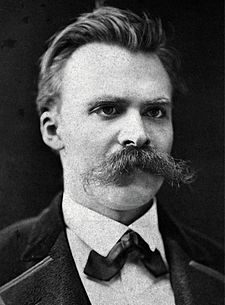
Übermensch of Nietzsche

Reference: Friedrich Nietzsche

Basically, Nietzsche was very dissatisfied with the current morality and the condition of man. He dreamed of evolution of man toward Übermensch, a state that transcended the current state of man. Nietzsche was looking for coherency and consistency in nature.

.

“While Nietzsche injects myriad ideas into the book, a few recurring themes stand out. The overman (Übermensch), a self-mastered individual who has achieved his full power, is an almost omnipresent idea in Thus Spoke Zarathustra. Man as a race is merely a bridge between animals and the overman. Nietzsche also makes a point that the overman is not an end result for a person, but more the journey toward self-mastery.” ~ Wikipedia

The word “self-mastery” is the key to understanding the above passage correctly. Übermensch was not created by adding, training or inculcating “desirable” characteristics in man. Übermensch was an evolution brought about by reducing man to his natural state.

To Nietzsche, Übermensch was a state in which man was congruent with his natural self.

.

“The eternal recurrence, found elsewhere in Nietzsche’s writing, is also mentioned. ‘Eternal recurrence’ is the possibility that all events in one’s life will happen again and again, infinitely. The embrace of all of life’s horrors and pleasures alike shows a deference and acceptance of fate, or Amor Fati. The love and acceptance of one’s path in life is a defining characteristic of the overman. Faced with the knowledge that he would repeat every action that he has taken, an overman would be elated as he has no regrets and loves life. Opting to change any decision or event in one’s life would indicate the presence of resentment or fear; contradistinctly the overman is characterized by courage and a Dionysian spirit.” ~ Wikipedia

We may understand the character of Übermensch by looking at self per A Model of Self.

A self is made up of a multi-dimensional matrix of “definitions and logics.” This matrix was distorted as social, cultural, and moral contexts were forced in place. Such distortions then reduced the potential of man and made him behave irrationally. This was the current state of man. By resolving such inconsistencies man could be propelled toward the state of Übermensch.

For Nietzsche, a resolution of the social, cultural, and moral contexts was necessary to evolve man toward Übermensch.

.