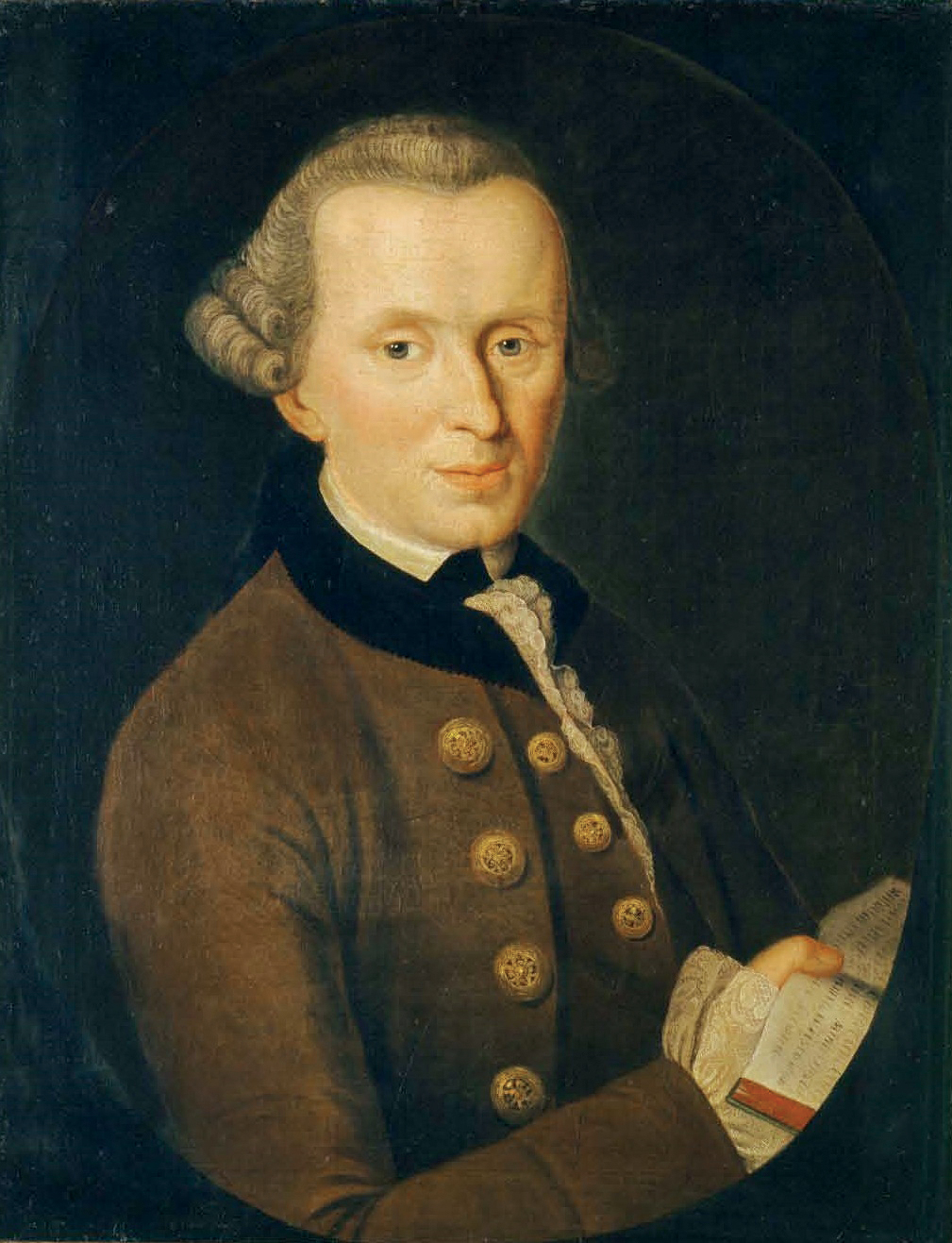
Category Archives: Philosophy

KANT: Transcendental Esthetic

Reference: The Story of Philosophy

This paper presents Chapter VI, Immanuel Kant and German Idealism, Section 3 (part 1) from the book THE STORY OF PHILOSOPHY by WILL DURANT. The contents are from the 1933 reprint of this book by TIME INCORPORATED by arrangement with Simon and Schuster, Inc.

The paragraphs of the original material (in black) are accompanied by brief comments (in color) based on the present understanding.  Feedback on these comments is appreciated.

The heading below is linked to the original materials.

.

Transcendental Esthetic

The effort to answer this question, to study the inherent structure of the mind, or the innate laws of thought, is what Kant calls “transcendental philosophy,” because it is a problem transcending sense-experience. “I call knowledge transcendental which is occupied not so much with objects, as with our a priori concepts of objects.” [Critique of Pure Reason, p. 10.] –with our modes of correlating our experience into knowledge. There are two grades or stages in this process of working up the raw material of sensation into the finished product of thought. The first stage is the coordination of sensations by applying to them the forms of perception—space and time; the second stage is the coordination of the perceptions so developed, by applying to them the forms of conception—the “categories” of thought. Kant, using the word esthetic in its original and etymological sense, as connoting sensation or feeling, calls the study of the first of these stages ‘Transcendental Esthetic”; and using the word logic as meaning the science of the forms of thought, he calls the study of the second stage ‘Transcendental Logic.” These are terrible words, which will take meaning as the argument proceeds; once over this hill, the road to Kant will be comparatively clear.

Kant’s “transcendental philosophy” studies the inherent structure of the mind. Such a structure is unknowable because it precedes knowledge. It can only be theorized based on how sensations are converted into perceptions and thought. The conversion occurs in two stages.

Now just what is meant by sensations and perceptions?—and how does the mind change the former into the latter? By itself a sensation is merely the awareness of a stimulus; we have a taste on the tongue, an odor in the nostrils, a sound in the ears, a temperature on the skin, a flash of light on the retina, a pressure on the fingers: it is the raw, crude beginning of experience; it is what the infant has in the early days of its groping mental life; it is not yet knowledge. But let these various sensations group themselves about an object in space and time –say this apple; let the odor in the nostrils, and the taste on the tongue, the light on the retina, the shape-revealing pressure on the fingers and the hand, unite and group themselves about this “thing”: and there is now an awareness not so much of a stimulus as of a specific object; there is a perception. Sensation has passed into knowledge.

By itself a sensation is merely the response of the sense organ to some stimulus. But as these sensations unite and group themselves they acquire a meaningful awareness. This is perception.

But again, was this passage, this grouping, automatic? Did the sensations of themselves, spontaneously and naturally, fall into a cluster and an order, and so become perception? Yes, said Locke and Hume; not at all, says Kant.

For these varied sensations come to us through varied channels of sense, through a thousand “afferent nerves” that pass from skin and eye and ear and tongue into the brain; what a medley of messengers they must be as they crowd into the chambers of the mind, calling for attention! No wonder Plato spoke of “the rabble of the senses.” And left to themselves, they remain rabble, a chaotic “manifold,” pitifully impotent, waiting to be ordered into meaning and purpose and power. As readily might the messages brought to a general from a thousand sectors of the battle-line weave themselves unaided into comprehension and command. No; there is a law-giver for this mob, a directing and coordinating power that does not merely receive, but takes these atoms of sensation and moulds them into sense.

But this uniting and grouping of sensations is not automatic. There is a directing and coordinating power, which moulds sensation into perception.

Observe, first, that not all of the messages are accepted. Myriad forces play upon your body at this moment; a storm of stimuli beats down upon the nerve-endings which, amoeba-like, you put forth to experience the external world: but not all that call are chosen; only those sensations are selected that can be moulded into perceptions suited to your present purpose, or that bring those imperious messages of danger which are always relevant. The clock is ticking, and you do not hear it; but that same ticking, not louder than before, will be heard at once if your purpose wills it so. The mother asleep at her infant’s cradle is deaf to the turmoil of life about her; but let the little one move, and the mother gropes her way back to waking attention like a diver rising hurriedly to the surface of the sea. Let the purpose be addition, and the stimulus “two and three” brings the response, “five”; let the purpose be multiplication, and the same stimulus, the same auditor)’ sensations, “two and three,” bring the response, “six.” Association of sensations or ideas is not merely by contiguity in space or time, nor by similarity, nor recency, frequency or intensity of experience; it is above all determined by the purpose of the mind. Sensations and thoughts are servants, they await our call, they do not come unless we need them. There is an agent of selection and direction that uses them and is their master. In addition to the sensations and the ideas there is the mind.

There is an agent of selection and direction that picks only those sensations that can be moulded into perceptions suited to the existing purpose.

This agent of selection and coordination, Kant thinks, uses first of all two simple methods for the classification of the material presented to it: the sense of space, and the sense of time. As the general arranges the messages brought him according to the place for which they come, and the time at which they were written, and so finds an order and a system for them all; so the mind allocates its sensations in space and time, attributes them to this object here or that object there, to this present time or to that past. Space and time are not things perceived, but modes of perception, ways of putting sense into sensation; space and time are organs of perception.

According to Kant, the sense of space and time is applied for such a selection.

They are a priori, because all ordered experience involves and presupposes them. Without them, sensations could never grow into perceptions. They are a priori because it is inconceivable that we should ever have any future experience that will not also involve them. And because they are a priori, their laws, which are the laws of mathematics, a priori, absolute and necessary, world without end. It is not merely probable, it is certain that we shall never find a straight line that is not the shortest distance between two points. Mathematics, at least, is saved from the dissolvent scepticism of David Hume.

The criterion that is applied is a priori, absolute and necessary.

Can all the sciences be similarly saved? Yes, if their basic principle, the law of causality that a given cause must always be followed by a given effect can be shown, like space and time, to be so inherent in all the processes of understanding that no future experience can be conceived that would violate or escape it. Is causality, too, a priori, an indispensable prerequisite and condition of all thought?

A similar criterion may be applied to all sciences that consist of a priori cause and effect.

.

Final Comments

.

KANT: The Critique of Pure Reason

Reference: The Story of Philosophy

This paper presents Chapter VI, Immanuel Kant and German Idealism, Section 3 (beginning only) from the book THE STORY OF PHILOSOPHY by WILL DURANT. The contents are from the 1933 reprint of this book by TIME INCORPORATED by arrangement with Simon and Schuster, Inc.

The paragraphs of the original material (in black) are accompanied by brief comments (in color) based on the present understanding.  Feedback on these comments is appreciated.

The heading below is linked to the original materials.

.

The Critique of Pure Reason

[A word about what to read. Kant himself is hardly intelligible to the beginner, because his thought is insulated with a bizarre and intricate terminology (hence the paucity of direct quotation in this chapter). Perhaps the simplest introduction is Wallace’s Kant, in the Blackwood Philosophical Classics. Heavier and more advanced is Paulsen’s Immanuel Kant. Chamberlain’s Immanuel Kant (2 vols.; New York, 1914) is interesting but erratic and digressive. A good criticism of Kant may be found in Schopenhauer’s World as Will and Idea; vol. ii. pp. 1-159. But caveat emptor.]

What is meant by this title? Critique is not precisely a criticism, but a critical analysis; Kant is not attacking “pure reason,” except, at the end, to show its limitations; rather he hopes to show its possibility, and to exalt it above the impure knowledge which comes to us through the distorting channels of sense. For “pure” reason is to mean knowledge that does not come through our senses, but is independent of all sense experience; knowledge belonging to us by the inherent nature and structure of the mind.

At the very outset, then, Kant flings down a challenge to Locke and the English school: knowledge is not all derived from the senses. Hume thought he had shown that there is no soul, and no science; that our minds are but our ideas in procession and association; and our certainties but probabilities in perpetual danger of violation. These false conclusions, says Kant, are the result of false premises: you assume that all knowledge comes from “separate and distinct” sensations; naturally these cannot give you necessity, or invariable sequences of which you may be forever certain; and naturally you must not expect to “see” your soul, even with the eyes of the internal sense. Let us grant that absolute certainty of knowledge is impossible if all knowledge comes from sensation, from an independent external world which owes us no promise of regularity of behavior. But what if we have knowledge that is independent of sense-experience, knowledge whose truth is certain to us even before experience—a priori? Then absolute truth, and absolute science, would become possible, would it not? Is there such absolute knowledge? This is the problem of the first Critique. “My question is, what we can hope to achieve with reason, when all the material and assistance of experience are taken away.” [Critique of Pure Reason, pref. p. xxiv.] The Critique becomes a detailed biology of thought, an examination of the origin and evolution of concepts, an analysis of the inherited structure of the mind. This, as Kant believes, is the entire problem of metaphysics. “In this book I have chiefly aimed at completeness; and I venture to maintain that there ought not to be one single metaphysical problem that has not been solved here, or to the solution of which the key at least has not here been supplied.” [Critique of Pure Reason, pref. p. xxiii.] Exegi monumentum aere perennius! With such egotism nature spurs us on to creation.

Kant maintains that knowledge is not all derived from the senses. This is true because the basis of knowledge is the postulate structure of the mind. This is the unknowable “soul”. The science is the assimilation, because knowledge does not all come from “separate and distinct” sensations.

In his “Critique of Pure Reason” Kant poses the question, “What can we hope to achieve with reason, when all the material and assistance of experience are taken away?” He examines the origin and evolution of concepts. He makes an analysis of the inherited structure of the mind.

The Critique comes to the point at once. “Experience is by no means the only field to which our understanding can be confined. Experience tells us what is, but not that it must be necessarily what it is and not otherwise. It therefore never gives us any really general truths; and our reason, which is particularly anxious for that class of knowledge, is roused by it rather than satisfied. General truths, which at the same time bear the character of an inward necessity, must be independent of experience—clear and certain in themselves.” [Critique of Pure Reason, pref. p. 1.] That is to say, they must be true no matter what our later experience may be; true even before experience; true a priori. “How far we can advance independently of all experience, in a priori knowledge, is shown by the brilliant example of mathematics.” [Critique of Pure Reason, pref. p. 4.] Mathematical knowledge is necessary and certain; we cannot conceive of future experience violating it. We may believe that the sun will “rise” in the west tomorrow, or that some day, in some conceivable asbestos world, fire will not burn stick; but we cannot for the life of us believe that two times two will ever make anything else than four. Such truths are true before experience; they do not depend on experience past, present, or to come. Therefore they are absolute and necessary truths; it is inconceivable that they should ever become untrue. But whence do we get this character of absoluteness and necessity? Not from experience; for experience gives us nothing but separate sensations and events, which may alter their sequence in the future. [“Radical empiricism” (James, Dewey, etc.) enters the controversy at this point, and argues, against both Hume and Kant, that experience gives us relations and sequences as well as sensations and events.] These truths derive their necessary character from the inherent structure of our minds, from the natural and inevitable manner in which our minds must operate. For the mind of man (and here at last is the great thesis of Kant) is not passive wax upon which experience and sensation write their absolute and yet whimsical will; nor is it a mere abstract name for the series or group of mental states; it is an active organ which moulds and coordinates sensations into ideas, an organ which transforms the chaotic multiplicity of experience into the ordered unity of thought.

But how?

.

Final Comments

.

KANT: Kant Himself

Reference: The Story of Philosophy

This paper presents Chapter VI, Immanuel Kant and German Idealism, Section 2 from the book THE STORY OF PHILOSOPHY by WILL DURANT. The contents are from the 1933 reprint of this book by TIME INCORPORATED by arrangement with Simon and Schuster, Inc.

The paragraphs of the original material (in black) are accompanied by brief comments (in color) based on the present understanding.  Feedback on these comments is appreciated.

The heading below is linked to the original materials.

.

Kant Himself

He was born at Konigsberg, Prussia, in 1724. Except for a short period of tutoring in a nearby village, this quiet little professor, who loved so much to lecture on the geography and ethnology of distant lands, never left his native city. He came of a poor family, which had left Scotland some hundred years before Immanuel’s birth. His mother was a Pietist, i.e., a member of a religious sect which, like the Methodists of England, insisted on the full strictness and rigor of religious practice and belief. Our philosopher was so immersed in religion from morning to night that on the one hand he experienced a reaction which led him to stay away from church all through his adult life; and on the other hand he kept to the end the sombre stamp of the German Puritan, and felt, as he grew old, a great longing to preserve for himself and the world the essentials, at least, of the faith so deeply inculcated in him by his mother.

Kant [1724 – 1804]. He grew up with the full strictness and rigor of religious practice and belief of Pietism.

But a young man growing up in the age of Frederick and Voltaire could not insulate himself from the sceptical current of the time. Kant was profoundly influenced even by the men whom later he aimed to refute, and perhaps most of all by his favorite enemy, Hume; we shall see later the remarkable phenomenon of a philosopher transcending the conservatism of his maturity and returning in almost his last work, and at almost the age of seventy, to a virile liberalism that would have brought him martyrdom had not his age and his fame protected him. Even in the midst of his work of religious restoration we hear, with surprising frequency, the tones of another Kant whom we might almost mistake for a Voltaire. Schopenhauer thought it “not the least merit of Frederick the Great, that under his government Kant could develop himself, and dared to publish his Critique of Pure Reason. Hardly under any other government would a salaried professor” (therefore, in Germany, a government employee) “have ventured such a thing. Kant was obliged to promise the immediate successor of the great King that he would write no more.” [The World as Will and Idea, London,1883; vol. ii, p. 133.] It was in appreciation of this freedom that Kant dedicated the Critique to Zedlitz, Frederick’s far-sighted and progressive Minister of Education.

Kant’s last work was quite controversial in his time.

In 1755 Kant began his work as private lecturer at the University of Konigsberg. For fifteen years he was left in this lowly post; twice his applications for a professorship were refused. At last, in 1770, he was made professor of logic and metaphysics. After many years of experience as a teacher, he wrote a text-book of pedagogy, of which he used to say that it contained many excellent precepts, none of which he had ever applied. Yet he was perhaps a better teacher than writer; and two generations of students learned to love him. One of his practical principles was to attend most to those pupils who were of middle ability; the dunces, he said, were beyond all help, and the geniuses would help themselves.

Kant was very much liked as a teacher.

Nobody expected him to startle the world with a new metaphysical system; to startle anybody seemed the very last crime that this timid and modest professor would commit. He himself had no expectations in that line; at the age of forty-two he wrote: “I have the fortune to be a lover of metaphysics; but my mistress has shown me few favors as yet.” He spoke in those days of the “bottomless abyss of metaphysics,” and of metaphysics as “a dark ocean without shores or lighthouse,” strewn with many a philosophic wreck. [In Paulsen, Immanuel Kant; New York, 1910; p. 82.] He could even attack the metaphysicians as those who dwelt on the high towers of speculation, “where there is usually a great deal of wind.” [In Paulsen, Immanuel Kant; New York, 1910; p. 56.] He did not foresee that the greatest of all metaphysical tempests was to be of his own blowing.

Kant loved the subject of metaphysics, but found it to be very confusing.

During these quiet years his interests were rather physical than metaphysical. He wrote on planets, earthquakes, fire, winds, ether, volcanoes, geography, ethnology, and a hundred other things of that sort, not usually confounded with metaphysics. His Theory of the Heavens (1755) proposed something very similar to the nebular hypothesis of Laplace, and attempted a mechanical explanation of all sidereal motion and development. All the planets, Kant thought, have been or will be inhabited; and those that are farthest from the sun, having had the longest period of growth, have probably a higher species of intelligent organisms than any yet produced on our planet. His Anthropology (put together in 1798 from the lectures of a life-time) suggested the possibility of the animal origin of man. Kant argued that if the human infant, in early ages when man was still largely at the mercy of wild animals, had cried as loudly upon entering the world as it does now, it would have been found out and devoured by beasts of prey; that in all probability, therefore, man was very different at first from what he had become under civilization. And then Kant went on, subtly: “How nature brought about such a development, and by what causes it was aided, we know not. This remark carries us a long way. It suggests the thought whether the present period of history, on the occasion of some great physical revolution, may not be followed by a third, when an orangutan or a chimpanzee would develop the organs which serve for walking, touching, speaking, into the articulated structure of a human being, with a central organ for the use of understanding, and gradually advance under the training of social institutions.”  Was this use of the future tense Kant’s cautiously indirect way of putting forth his view of how man had really developed from the beast?  [So Wallace suggests: Kant, Philadelphia, 1882,; p. 115.]

Kant’s earlier work has not been about Metaphysics.

So we see the slow growth of this simple little man, hardly five feet tall, modest, shrinking, and yet containing in his head, or generating there, the most far-reaching revolution in modern philosophy. Kant’s life, says one biographer, passed like the most regular of regular verbs. “Rising, coffee-drinking, writing, lecturing, dining, walking,” says Heine,– “each had its set time. And when Immanuel Kant, in his gray coat, cane in hand, appeared at the door of his house, and strolled towards the small avenue of linden trees which is still called ‘The Philosopher’s Walk,’ the neighbors knew it was exactly half-past-three by the clock. So he promenaded up and down, during all seasons; and when the weather was gloomy, or the gray clouds threatened rain, his old servant Lampe was seen plodding anxiously after, with a large umbrella under his arm, like a symbol of Prudence.”

Kant had a strict daily schedule.

He was so frail in physique that he had to take severe measures to regimen himself; he thought it safer to do this without a doctor; so he lived to the age of eighty. At seventy he wrote an essay “On the Power of the Mind to Master the Feeling of Illness by Force of Resolution.” One of his favorite principles was to breathe only through the nose, especially when out-doors; hence, in autumn, winter and spring, he would permit no one to talk to him on his daily walks; better silence than a cold. He applied philosophy even to holding up his stockings by bands passing up into his trousers’ pockets, where they ended in springs contained in small boxes. [“Introd. to Kant’s Critique of Practical Reason; London, 1909; p. xiii.] He thought everything out carefully before acting; and therefore remained a bachelor all his life long. Twice he thought of offering his hand to a lady; but he reflected so long that in one case the lady married a bolder man, and in the other the lady removed from Konigsberg before the philosopher could make up his mind. Perhaps he felt, like Nietzsche, that marriage would hamper him in the honest pursuit of truth; “a married man,’ Talleyrand used to say, “will do anything for money.” And Kant had written, at twenty-two, with all the fine enthusiasm of omnipotent youth: “I have already fixed upon the line which I am resolved to keep. I will enter on my course, and nothing shall prevent me from pursuing it.” [Wallace,p.100.]

And so he persevered, through poverty and obscurity, sketching and writing and rewriting his magnum opus for almost fifteen years; finishing it only in 1781, when he was fifty-seven years old. Never did a man mature so slowly; and then again, never did a book so startle and upset the philosophic world.

.

Final Comments

Kant was a small, frail, and a very private man, who taught and lectured about subjects other than metaphysics. He wrote about metaphysics only after great thought as his final work.

.

KANT: Roads to Kant

Reference: The Story of Philosophy

This paper presents Chapter VI, Section 1 (Immanuel Kant and German Idealism) from the book THE STORY OF PHILOSOPHY by WILL DURANT. The contents are from the 1933 reprint of this book by TIME INCORPORATED by arrangement with Simon and Schuster, Inc.

The paragraphs of the original material (in black) are accompanied by brief comments (in color) based on the present understanding.  Feedback on these comments is appreciated.

The heading below is linked to the original materials.

.

Roads to Kant

Never has a system of thought so dominated an epoch as the philosophy of Immanuel Kant dominated the thought of the nineteenth century. After almost three-score years of quiet and secluded development, the uncanny Scot of Konigsberg roused the world from its “dogmatic slumber,” in 1781, with his famous Critique of Pure Reason; and from that year to our own the “critical philosophy” has ruled the speculative roost of Europe. The philosophy of Schopenhauer rose to brief power on the romantic wave that broke in 1848; the theory of evolution swept everything before it after 1859; and the exhilarating iconoclasm of Nietzsche won the center of the philosophic stage as the century came to a close. But these were secondary and surface developments; underneath them the strong and steady current of the Kantian movement flowed on, always wider and deeper; until today its essential theorems are the axioms of all mature philosophy. Nietzsche takes Kant for granted, and passes on; [The Will to Power, vol. ii, part I.] Schopenhauer calls the Critique “the most important work in German literature,” and considers any man a child until he has understood Kant; [The World as Will and Idea, London, 1883; vol. ii, p. 30.] Spencer could not understand Kant, and for precisely that reason, perhaps, fell a little short of the fullest philosophic stature. To adapt Hegel’s phrase about Spinoza: to be a philosopher, one must first have been a Kantian.

Kant wrote his Critique of Pure Reason in 1781.

Therefore let us become Kantians at once. But it cannot be done at once, apparently; for in philosophy, as in politics, the longest distance between two points is a straight line. Kant is the last person in the world whom we should read on Kant. Our philosopher is like and unlike Jehovah; he speaks through clouds, but without the illumination of the lightning-flash. He disdains examples and the concrete; they would have made his book too long, he argued. [The Critique of Pure Reason, London, 1881; vol. ii, p. xxvii. All subsequent references are to volume two.] (So abbreviated, it contains some 800 pages). Only professional philosophers were expected to read him; and these would not need illustrations. Yet when Kant gave the MS. of the Critique to his friend Herz, a man much versed in speculation, Herz returned it half read, saying he feared insanity if he went on with it. What shall we do with such a philosopher?

Kant is quite difficult to understand.

Let us approach him deviously and cautiously, beginning at a safe and respectful distance from him; let us start at various points on the circumference of the subject, and then grope our way towards that subtle centre where the most difficult of all philosophies has its secret and its treasure.

.

1. FROM VOLTAIRE TO KANT

The road here is from theoretical reason without religious faith, to religious faith without theoretical reason. Voltaire means the Enlightenment, the Encyclopedia, the Age of Reason. The warm enthusiasm of Francis Bacon had inspired all Europe (except Rousseau) with unquestioning confidence in the power of science and logic to solve at last all problems, and illustrate the “infinite perfectibility” of man. Condorcet, in prison, wrote his Historical Tableau of the Progress of the Human Spirit (1793), which spoke the sublime trust of the eighteenth century in knowledge and reason, and asked no other key to Utopia than universal education. Even the steady Germans had their Aufklarung, their rationalist, Christian Wolff, and their hopeful Lessing. And the excitable Parisians of the Revolution dramatized this apotheosis of the intellect by worshipping the “Goddess of Reason’ impersonated by a charming lady of the streets.

Voltaire’s was the age of reason and enlightenment. In this age a transformation took place from religious faith to scientific reasoning.

In Spinoza this faith in reason had begotten a magnificent structure of geometry and logic: the universe was a mathematical system, and could be described a priori, by pure deduction from accepted axioms. In Hobbes the rationalism of Bacon had become an uncompromising atheism and materialism; again nothing was to exist but “atoms and the void.” From Spinoza to Diderot the wrecks of faith lay in the wake of advancing reason: one by one the old dogmas disappeared; the Gothic cathedral of medieval belief, with its delightful details and grotesques, collapsed; the ancient God fell from his throne along with the Bourbons, heaven faded into mere sky, and hell became only an emotional expression. Helvetius and Holbach made atheism so fashionable in the salons of France that even the clergy took it up; and La Mettrie went to peddle it in Germany, under the auspices of Prussia’s king. When, in 1784, Lessing shocked Jacobi by announcing himself a follower of Spinoza, it was a sign that faith had reached its nadir, and that Reason was triumphant.

From Spinoza to Diderot, the wrecks of faith lay in the wake of advancing reason.

David Hume, who played so vigorous a role in the Enlightenment assault on supernatural belief, said that when reason is against a man, he will soon turn against reason. Religious faith and hope, voiced in a hundred thousand steeples rising out of the soil of Europe everywhere, were too deeply rooted in the institutions of society and in the heart of man, to permit their ready surrender to the hostile verdict of reason; it was inevitable that this faith and this hope, so condemned, would question the competence of the judge, and would ‘call for an examination of reason as well as of religion. What was this intellect that proposed to destroy with a syllogism the beliefs of thousands of years and millions of men? Was it infallible? Or was it one human organ like any other, with strictest limits to its functions and its powers? The time had come to judge this judge, to examine this ruthless Revolutionary Tribunal that was dealing out death so lavishly to every ancient hope. The time had come for a critique of reason.

Then it was the turn of reason itself to be examined closely.

.

2. FROM LOCKE TO KANT

The way had been prepared for such an examination by the work of Locke, Berkeley and Hume; and yet, apparently, their results too were hostile to religion.

John Locke (1632-1704) had proposed to apply to psychology the inductive tests and methods of Francis Bacon; in his great Essay on Human Understanding (1689) reason, for the first time in modern thought, had turned in upon itself, and philosophy had begun to scrutinize the instrument which it so long had trusted. This introspective movement in philosophy grew step by step with the introspective novel as developed by Richardson and Rousseau; just as the sentimental and emotional color of Clarissa Harlowe and La Nouvelle Heloise had its counterpart in the philosophic exaltation of instinct and feeling above intellect and reason.

Instinct and feeling were examined side by side with intellect and reason.

How does knowledge arise? Have we, as some good people suppose, innate ideas, as, for example, of right and wrong, and God, ideas inherent in the mind from birth, prior to all experience? Anxious theologians worried lest belief in the Deity should disappear because God had not yet been seen in any telescope, had thought that faith and morals might be strengthened if their central and basic ideas were shown to be inborn in every normal soul. But Locke, good Christian though he was, ready to argue most eloquently for “The Reasonableness of Christianity,” could not accept these suppositions; he announced, quietly, that all our knowledge comes from experience and through our senses that “there is nothing in the mind except what was first in the senses.” The mind is at birth a clean sheet, a tabula rasa; and sense-experience writes upon it in a thousand ways, until sensation begets memory and memory begets ideas. All of which seemed to lead to the startling conclusion that since only material things can affect our sense, we know nothing but matter, and must accept a materialistic philosophy. If sensations are the stuff of thought, the hasty argued, matter must be the material of mind.

It was argued that all our knowledge comes from experience and through our senses.

Not at all, said Bishop George Berkeley (1684-1753); this Lockian analysis of knowledge proves rather that matter does not exist except as a form of mind. It was a brilliant idea to refute materialism by the simple expedient of showing that we know of no such thing as matter; in all Europe only a Gaelic imagination could have conceived this metaphysical magic. But see how obvious it is, said the Bishop: has not Locke told us that all our knowledge is derived from sensation? Therefore all our knowledge of anything is merely our sensations of it, and the ideas derived from these sensations. A “thing” is merely a bundle of perceptions i.e., classified and interpreted sensations. You protest that your breakfast is much more substantial than a bundle of perceptions; and that a hammer that teaches you carpentry through your thumb has a most magnificent materiality. But your breakfast is at first nothing but a congeries of sensations of sight and smell and touch; and then of taste; and then of internal comfort and warmth. Likewise, the hammer is a bundle of sensations of color, size, shape, weight, touch, etc.; its reality for you is not in its materiality, but in the sensations that come from your thumb. If you had no senses, the hammer would not exist for you at all; it might strike your dead thumb forever and yet win from you not the slightest attention. It is only a bundle of sensations, or a bundle of memories; it is a condition of the mind. All matter, so far as we know it, is a mental condition; and the only reality that we know directly is mind. So much for materialism.

Therefore all our knowledge of anything is merely our sensations of it, and the ideas derived from these sensations. A “thing” is merely a bundle of perceptions i.e., classified and interpreted sensations.

But the Irish Bishop had reckoned without the Scotch sceptic. David Hume (1711-1776) at the age of twenty-six shocked all Christendom with his highly heretical Treatise on Human Nature, one of the classics and marvels of modern philosophy. We know the mind, said Hume, only as we know matter: by perception, though it be in this case internal. Never do we perceive any such entity as the “mind”; we perceive merely separate ideas, memories, feelings, etc. The mind is not a substance, an organ that has ideas; it is only an abstract name for the series of ideas; the perceptions, memories and feelings are the mind; there is no observable “soul” behind the processes of thought. The result appeared to be that Hume had as effectually destroyed mind as Berkeley had destroyed matter. Nothing was left; and philosophy found itself in the midst of ruins of its own making. No wonder that a wit advised the abandonment of the controversy, saying: “No matter, never mind.”

It was then argued that we know the mind only as we know matter: by perception of separate ideas, memories, feelings, etc. There is no observable “soul” behind the processes of thought. There is neither matter nor mind—just perceptions.

But Hume was not content to destroy orthodox religion by dissipating the concept of soul; he proposed also to destroy science by dissolving the concept of law. Science and philosophy alike, since Bruno and Galileo, had been making much of natural law, of “necessity” in the sequence of effect upon cause; Spinoza had reared his majestic metaphysics upon this proud conception. But observe, said Hume, that we never perceive causes, or laws; we perceive events and sequences, and infer causation and necessity; a law is not an eternal and necessary decree to which events are subjected, but merely a mental summary and shorthand of our kaleidoscopic experience; we have no guarantee that the sequences hitherto observed will re-appear unaltered in future experience. “Law” is an observed custom in the sequence of events; but there is no “necessity” in custom.

Furthermore, we never perceive causes, or laws; we perceive events and sequences, and infer causation and necessity. “Law” is an observed custom in the sequence of events; but there is no “necessity” in custom.

Only mathematical formulas have necessity they alone are inherently and unchangeably true; and this merely because such formulae are tautological the predicate is already contained in the subject; “3X3=9” is an eternal and necessary truth only because “3X3” and “9” are one and the same thing differently expressed; the predicate adds nothing to the subject. Science, then, must limit itself strictly to mathematics and direct experiment; it cannot trust to unverified deduction from “laws.” “When we run though libraries, persuaded of these principles” writes our uncanny sceptic, “what havoc must we make! If we take in our hands any volume of school metaphysics, for instance, let us ask, ‘Does it contain any abstract reasoning concerning quantity or number?’ No. ‘Does it contain any experimental reasoning concerning matter of fact and existence?’ No. Commit it then to the flames, for it can contain nothing but sophistry and illusion.” [Quoted in Royce, The Spirit of Modern Philosophy, Boston, 1892; p. 98.]

Only tautologies are true. The predicate is already contained in the subject. Science must limit itself strictly to mathematics and direct experiment; it cannot trust to unverified deduction from “laws.”

Imagine how the ears of the orthodox tingled at these words. Here the epistemological tradition the inquiry into the nature, sources, and validity of knowledge had ceased to be a support to religion; the sword with which Bishop Berkeley had slain the dragon of materialism had turned against the immaterial mind and the immortal soul; and in the turmoil science itself had suffered severe injury. No wonder that when Immanuel Kant, in 1775, read a German translation of the works of David Hume, he was shocked by these results, and was roused, as he said, from the “dogmatic slumber” in which he had assumed without question the essentials of religion and the bases of science. Were both science and faith to be surrendered to the sceptic? What could be done to save them?

Both science and faith were surrendered to the sceptic

.

3. FROM ROUSSEAU TO KANT

To the argument of the Enlightenment, the reason makes for materialism, Berkeley had essayed the answer that matter does not exist. But this had led, in Hume, to the retort that by the same token mind does not exist either. Another answer was possible that reason is no final test. There are some theoretical conclusions against which our whole being rebels; we have no right to presume that these demands of our nature must be stifled at the dictates of a logic which is after all but the recent construction of a frail and deceptive part of us. How often our instincts and feelings push aside the little syllogisms which would like us to behave like geometrical figures, and make love with mathematical precision! Sometimes, no doubt, and particularly in the novel complexities and artificialities of urban life, reason is the better guide; but in the great crises of life, and in the great problems of conduct and belief, we trust to our feelings rather than to our diagrams. If reason is against religion, so much the worse for reason!

It was then argued that that reason is no final test. Sometimes, no doubt, and particularly in the novel complexities and artificialities of urban life, reason is the better guide; but in the great crises of life, and in the great problems of conduct and belief, we trust to our feelings rather than to our diagrams.

Such, in effect, was the argument of Jean Jacques Rousseau (1712-1778), who almost alone, in France, fought the materialism and atheism of the Enlightenment. What a fate for a delicate and neurotic nature, to have been cast amidst the robust rationalism and the almost brutal hedonism [The doctrine that all behavior is motivated by the pursuit of pleasure.] of the Encyclopedists! Rousseau had been a sickly youth, driven into brooding and introversion by his physical weakness and the unsympathetic attitude of his parents and teachers; he had escaped from the stings of reality into a hothouse world of dreams, where the victories denied him in life and love could be had for the imagining. His Confessions reveal an unreconciled complex of the most refined sentimentality with an obtuse sense of decency and honor; and through it all an unsullied conviction of his moral superiority. [CF. Confessions, bk. X; vol. ii, p. 184.]

In 1749 the Academy of Dijon offered a prize for an essay on the question, “Has the Progress of the Sciences and the Arts Contributed to Corrupt, or to Purify, Morals?” Rousseau’s essay won the prize. Culture is much more of an evil than a good, he argued with all the intensity and sincerity of one who, finding culture out of his reach, proposed to prove it worthless. Consider the frightful disorders which printing has produced in Europe. Wherever philosophy arises, the moral health of the nation decays. “It was even a saying among the philosophers themselves that since learned men had appeared, honest men were nowhere to be found.” “I venture to declare that a state of reflection is contrary to nature; and that a thinking man” (an “intellectual,” as we would now say) “is a depraved animal.” It would be better to abandon our over-rapid development of the intellect, and to aim rather at training the heart and the affections. Education does not make a man good, it only makes him clever usually for mischief. Instinct and feeling are more trustworthy than reason.

A tirade against reason arose. It would be better to abandon our over-rapid development of the intellect, and to aim rather at training the heart and the affections. Instinct and feeling are more trustworthy than reason.

In his famous novel, La Nouvelle Heloise (1761), Rousseau illustrated at great length the superiority of feeling to intellect; sentimentality became the fashion among the ladies of the aristocracy, and among some of the men; France was for a century watered with literary, and then with actual, tears; and the great movement of the European intellect in the eighteenth century gave way to the romantic emotional literature of 1789-1848. The current carried with it a strong revival of religious feeling; the ecstasies of Chateaubriand’s Genie du Christianisme (1802) were merely an echo of the “Confession of Faith of the Savoyard Vicar” which Rousseau included in his epochal essay on education Emile (1762). The argument of the “Confession” was briefly this: that though reason might be against belief in God and immortality, feeling was overwhelmingly in their favor; why should we not trust in instinct here, rather than yield to the despair of an arid scepticism?

The great movement of the European intellect in the eighteenth century gave way to the romantic emotional literature of 1789-1848. The current carried with it a strong revival of religious feeling. The argument became: that though reason might be against belief in God and immortality, feeling was overwhelmingly in their favor; why should we not trust in instinct here, rather than yield to the despair of an arid scepticism?

When Kant read Emile he omitted his daily walk under the linden trees, in order to finish the book at once. It was an event in his life to find here another man who was groping his way out of the darkness of atheism, and who boldly affirmed the priority of feeling over theoretical reason in these supra-sensual concerns. Here at last was the second half of the answer to irreligion; now finally all the scoffers and doubters would be scattered. To put these threads of argument together, to unite the ideas of Berkeley and Hume with the feelings of Rousseau, to save religion from reason, and yet at the same time to save science from scepticism this was the mission of Immanuel Kant.

Kant was handed over the mission to save religion from reason, and yet at the same time to save science from scepticism.

But who was Immanuel Kant?

.

Final Comments

It was argued that all our knowledge comes from experience and through our senses, and all the ideas and “laws” are inferred, and so is the “soul” behind the processes of thought. To the skeptic anything inferred did not really exist. Only tautologies were considered to be true.

.

Note: Here is a list of people mentioned in the above section:

Giordano Bruno (1548 – 1600) died at age 52… Laws of nature
Francis Bacon (1561 – 1626) 65… Power of Science and Logic
Galileo (1564 – 1642) 77… Laws of nature
Thomas Hobbes (1588 – 1679) 91… uncompromising atheism and materialism
Baruch Spinoza (1632 – 1677) 44… magnificent structure of geometry and logic
John Locke (1632 – 1704) 72… Sensation begets memory and memory begets ideas
Christian Wolff (1679 1754) 75
George Berkeley (1685 – 1753) 67… Matter does not exist except as a form of mind
Voltaire (1694 – 1778) 83
La Mettrie (1709 – 1751) 42… peddled atheism
David Hume (1711 – 1776) 65… We know the mind only as we know matter, no observable “soul” behind thought
Rousseau (1712 – 1778) 66… exception
Denis Diderot  (1713 1784) 70
Helvétius (1715 1771) 56… made atheism fashionable
Holbach (1723 1789) 65… made atheism fashionable
Immanuel Kant (1724 – 1804) 79
Gotthold Lessing (1729 – 1781) 52
Condorcet (1743 1794) 50
Jacobi (1804 – 1851) 46

Kant was responding to David Hume. He showed how God was the Unknowable that expressed itself as the law of thought, which actively ordered the universe. This law of thought is identified in the KHTK philosophy as the Principle of Oneness.

.

Tertium Organum, Chapter 9 (Assimilation)

animal-size-comparison-11

Reference: Tertium Organum

.

Chapter 9 (Assimilation)

The receptivity of the world by a man and by an animal. Illusions of the animal and its lack of control of the receptive faculties. The world of moving planes. Angles and curves considered as motion. The third dimension as motion. The animal’s two-dimensional view of our three-dimensional world. The animal as a real two-dimensional being. Lower animals as one-dimensional beings. The time and space of a snail. The time sense as an imperfect space sense. The time and space of a dog. The change in the world coincident with a change in the psychic apparatus. The proof of Kant’s problem. The three-dimensional world—an illusionary perception.

.

We have established the enormous difference existing between the psychology of a man and of an animal. This difference undoubtedly profoundly affects the receptivity of the outer world by the animal. But how and in what? This is exactly what we do not know, and what we shall try to discover. 

To this end we shall return to our receptivity of the world, investigate in detail the nature of that receptivity, and then imagine how the animal, with its more limited psychic equipment, receives its impression of the world. 

Let us note first of all that we receive the most incorrect impressions of the world as regards its outer form and aspect. We know that the world consists of solids, but we see and touch only surfaces. We never see and touch a solid. The solid—this is indeed a concept, composed of a series of perceptions, the result of reasoning and experience. For immediate sensation, surfaces alone exist. Sensations of gravity, mass, volume, which we mentally associate with the “solid,” are in reality associated with the sensations of surfaces. We only know that the sensation comes from the solid, but the solid itself we never sense. Perhaps it would be possible to call the complex sensation of surfaces, weight, mass, density, resistance, “the sensation of a solid,” but rather do we combine mentally all these sensations into one, and call that composite sensation a solid. We sense directly only surfaces; the weight and resistance of the solid, as such, we never separately sense.

But we know that the world does not consist of surfaces: we know that we see the world incorrectly, and that we never see it as it is, not alone in the philosophical meaning of the expression, but in the most simple geometrical meaning. We have never seen a cube, a sphere, etc., but only their surfaces. Knowing this, we mentally correct that which we see. Behind the surfaces we think the solid. But we can never even represent the solid to ourselves. We cannot imagine the cube or the sphere seen, not in perspective, but simultaneously from all sides. 

It is clear that the world does not exist in perspective; nevertheless we cannot see it otherwise. We see everything only in perspective; that is, in the very act of receptivity the world is distorted in our eye, and we know that it is distorted. We know that it is not such as it appears, and mentally we are continuously correcting that which the eye sees, substituting the real content for those symbols of things which sight reveals. 

Our sight is a complex faculty. It consists of visual sensations plus the memory of sensations of touch. The child tries to feel with its finger-tips everything that it sees—the nose of its nurse, the moon, the reflection of sun rays from the mirror on the wall. Only gradually does it learn to discern the near and the distant by means of sight alone. But we know that even in mature age we are easily subject to optical illusions. 

We see distant objects as flat, even more incorrectly, because relief is after all a symbol revealing a certain property of objects. A man at a long distance is pictured to us in silhouette. This happens because we never feel anything at a long distance, and the eye has not been taught to discern the difference in surfaces which at short distances are felt by the finger-tips.*

[* In this connection, there have been some interesting observations made upon the blind who are just beginning to see. In the magazine Slepetz (The Blind, 1912) there is a description from direct observation of how those born blind learn to see after the operation which restored their sight. This is how a seventeen-year old youth, who recovered his sight after the removal of a cataract, describes his impressions. On the third day after the operation he was asked what he saw. He answered that he saw an enormous field of light and misty objects moving upon it. These objects he did not discern. Only after four days did he begin to discern them, and after an interval of two weeks, when his eyes were accustomed to the light, he started to use his sight practically, for the discernment of objects. He was shown all the colors of the spectrum and he learned to distinguish them very soon, except yellow and green, which he confused for a long time. The cube, sphere and pyramid, when placed before him seemed to him like the square, the flat disc, and the triangle. When the flat disc was put alongside the sphere he distinguished no difference between them. When asked what impression both kinds of figures produced on him just at first, he said that he noticed at once the difference between the cube and the sphere, and understood that they were not drawings, but was unable to deduce from them their relation to the square and to the circle, until he felt in his fingertips the desire to touch these objects. When he was allowed to take the cube, sphere and pyramid in his hands he at once identified these solids by the sense of touch, and wondered very much that he was unable to recognize them by sight. He lacked the perception of space, perspective. All objects seemed flat to him: though he knew that the nose protrudes, and that the eyes are located in cavities, the human face seemed flat to him. He was delighted with his recovered vision, but in the beginning it fatigued him to exercise it: the impressions oppressed and exhausted him. For this reason, though possessing perfect sight, he sometimes turned to the sense of touch as to repose.]

We can never see, even in the minute, any part of the outer world as it is, that is, as we know it. We can never see the desk or the wardrobe all at once, from all sides and inside. Our eye distorts the outside world in a certain way, in order that, looking about, we may be able to define the position of objects relatively to ourselves. But to look at the world from any other standpoint than our own is impossible for us, nor can we ever see it correctly, without distortion by our sight. 

Relief and perspective—these constitute the distortions of the object by our eye. They are optical illusions, delusions of sight. The cube in perspective is but a conventional sign of the three-dimensional cube, and all that we see is the conditional image of that conditionally real three-dimensional world with which our geometry deals, and not that world itself. On the basis of what we see we surmise that it exists in reality. We know that what we see is incorrect, and we think of the world as other than it appears. If we had no doubt about the correctness of our sight, if we knew that the world were such as it appears, then obviously we would think of the world in the manner in which we see it. In reality we are constantly engaged in making corrections. 

It is clear that the ability to make corrections in that which the eye sees demands, undoubtedly, the possession of the concept, because the corrections are made by a process of reasoning, which is impossible without concepts. Deprived of the faculty to make corrections in that which the eye sees we should have a different outlook on the world, i.e., much of that which is we should see incorrectly ; we should not see much of that which is, but we should see much of that which does not exist in reality at all. First of all, we should see an enormous number of non-existent motions. Every motion of ours in our direct sensation of it, is bound up with the motion of everything around us. We know that this motion is an illusory one, but we see it as real. Objects turn in front of us, run past us, overtake one another. If we are riding slowly past houses, these turn slowly, if we are riding fast they turn quickly; also, trees grow up before us unexpectedly, run away and disappear.

This seeming animation of objects, coupled with dreams, has always inspired, and still inspires the fairy tale. 

The “motions” of objects, to a person in motion, are very complex indeed. Observe how strangely the field of wheat behaves just beyond the window of the car in which you are riding. It runs to the very window, stops, turns slowly around itself and runs away. The trees of the forest run apparently at differ- ent speeds, overtaking one another. The entire landscape is one of illusory motion. Behold also the sun, which even up to the present time “rises” and “sets” in all languages—this “motion” having been in the past so passionately defended!

This is all seeming, and though we know that these motions are illusory, we see them nevertheless, and sometimes we are deluded. To how many more illusions should we be subject had we not the power of mentally analyzing their determining causes, but were obliged to believe that everything exists as it appears? 

I see it; therefore this exists. 

This affirmation is the principal source of all illusions. To be true, it is necessary to say:

I see it; therefore this does not exist—or at least I see it; therefore this is not so. 

Although we can say the last, the animal cannot, for to its apprehension things are as they appear. It must believe what it sees. 

How does the world appear to the animal? 

The world appears to it as a series of complicated moving surfaces. The animal lives in a world of two dimensions. Its universe has for it the properties and appearance of a surface. And upon this surface transpire an enormous number of different motions of a most fantastic character. 

Why should the world appear to the animal as a surface? 

First of all, because it appears as a surface to us

But we know that the world is not a surface, and the animal cannot know it. It accepts everything just as it appears. It is powerless to correct the testimony of its eyes—or it cannot do so to the same extent that we do. 

We are able to measure in three mutually independent directions: the nature of our mind permits us to do this. The animal can measure simultaneously in two directions only—it can never measure in three directions at once. This is due to the fact that not possessing concepts, it is unable to retain in the mind the idea of the first two directions, for measuring the third.

Let me explain this more exactly. 

Suppose we imagine that we are measuring the cube

In order to measure the cube in three directions, it is necessary while measuring in one direction, to keep in mind two others—to remember. But it is possible to keep them in mind as concepts only, that is, associating them with different concepts—pasting upon them different labels. So, pasting upon the first two directions the labels of length and breadth, it is possible to measure the height. It is impossible otherwise. As perceptions, the first two measurements of the cube are completely identical, and assuredly will mingle into one in the mind. The animal, without the aid of concepts, cannot paste upon the first two measurements the labels of length and breadth. Therefore, at the moment when it begins to measure the height of the cube, the first two measurements will be confused in one. The animal attempting to measure the cube by means of perceptions only without the aid of concepts, will be like a cat I once observed. Her kittens—five or six in number—she dragged asunder into different rooms, and could not then collect them together. She seized one, put it beside another, ran for a third and brought it to the first two, but then she seized the first and carried it away to another room, putting it beside the fourth ; after that she ran back and seized the second and dragged it to the room containing the fifth, and so on. For a whole hour the cat had no rest with her kittens, she suffered severely, and could accomplish nothing. It is clear that she lacked the concepts which would enable her to remember how many kittens she had altogether. 

It is in the highest degree important to understand the relation of the animal consciousness to the measuring of bodies. 

The great point is that the animal sees surfaces only. (We may say this with complete assurance, because we ourselves see surfaces only). Thus seeing only surfaces the animal can imagine but two dimensions. The third dimension, in contradistinction to the other two, can only be thought; that is, this dimension must be a concept; but animals do not possess concepts. The third dimension like the others appears as a perception. Therefore, at the moment of its appearance, the first two will inevitably mingle into one. The animal is capable of perceiving the difference between two dimensions: the difference between three it cannot perceive. This difference must be known beforehand, and to know it concepts are necessary.

Identical perceptions mix into one for the animal, just as we ourselves confuse two simultaneous, similar phenomena proceeding from the same point. For the animal it will be one phenomenon, just as for us all similar, simultaneous phenomena, proceeding from a single point will be one phenomenon

Therefore the animal will see the world as a surface, and will measure this surface in two directions only. 

But how is it possible to explain the fact that the animal, inhabiting a two-dimensional world, or rather, perceiving itself as in a two-dimensional world, is perfectly oriented in our three-dimensional world? How explain the fact that the bird flies up and down, sideways and straight ahead—in all three directions; that the horse jumps over ditches and barriers; that the dog and cat appear to understand the properties of depth and height simultaneously with those of length and breadth? 

In order to explain these things it is necessary to return to the fundamental principles of animal psychology. It has been previously shown that many properties of objects remembered by us as general properties of genus, class, species, are remembered by animals as individual properties of objects. To orientate in this enormous reserve of individual properties preserved in the memory, animals are assisted by the emotional tone which is linked up in them with each perception and each remembered sensation. 

For example, an animal knows two roads as two entirely separate phenomena having nothing in common; that is, one road consists of a series of definite perceptions colored by definite emotional tones; the other phenomenon—the other road consists of another series of definite perceptions colored with other tones. We say that this, that, and the other are roads. One leads to one place, a second to another. For an animal the two roads have nothing in common. But it remembers in their proper sequence all the emotional tones which are linked with the first road and with the second one, and it therefore remembers both roads with their turns, ditches, fences, etc. 

Thus the remembering of definite properties of observed objects helps the animal to orient itself in the world of phenomena. But as a rule before new phenomena an animal is much more helpless than a man.

An animal sees two dimensions; the third dimension it senses constantly, but does not see. It senses the third dimension as something transient, just as we sense time

The surfaces which an animal sees possess for it many strange properties, first of all, numerous and various motions. 

As has been said already, all those illusory motions which seem to us real, but which we know to be illusory, are entirely real to the animal, the turning about of the houses as we ride past, the growth of a tree out of some corner, the passing of the moon between clouds, etc., etc. 

But in addition to all this, many motions must exist for the animal of which we have no suspicion. The fact is that innumerable objects quite immobile for us—properly all objects—must seem to the animal to be in motion. AND THE THIRD-DIMRNSION OF SOLIDS WILL APPEAR TO IT IN THESE MOTIONS; I. E., THE THIRD-DIMENSION OF SOLIDS WILL APPEAR TO IT AS A MOTION. 

.

Let us try to imagine how the animal perceives the objects of the outer world. 

Suppose it is confronted with a large disc, and simultaneously with a large sphere of the same diameter. 

Standing directly opposite them at a certain distance, the animal will see two circles. Beginning to walk around them, it will observe that the sphere remains a circle, while the disc gradually narrows, transforming itself into a narrow strip. On moving farther around, the strip begins to expand and gradually transforms itself into a circle. The sphere will not change during this circumambulation. But when the animal approaches toward it certain strange phenomena ensue. 

Let us try to understand how the animal will perceive the surface of the sphere as contrasted with the surface of the disc. 

One thing is sure: it will perceive the spherical surface differently from us. We perceive convexity or sphericality as a common property of many surfaces. The animal, on the contrary, because of the very properties of its psychic apparatus, will perceive that sphericality as an individual property of a given sphere. Now how will this sphericality as an individual property of a given sphere appear to it?

We may declare with complete assurance that the sphericality will appear to the animal as a movement on the surface which it sees. 

During the approach of the animal toward the sphere something like the following must happen: the surface which the animal sees starts to move quickly; its center spreads out, and all of the other points run away from the center with a velocity proportional to their distance from the center (or the square of their distance from the center). 

It is in this way that the animal senses the spherical surface—much as we sense sound

At a certain distance from the sphere the animal perceives it as a plane. Approaching or touching some point on the sphere it sees that all other points have changed with relation to this particular point, they have all altered their position on the plane—have moved to one side, as it were. Touching another point, it sees that all the rest have moved in similar fashion. 

This property of the sphere will appear as its motion, its “vibration.” The sphere will actually resemble a vibrating, oscillating surface, in the same way that each angle of an immobile object will appear to the animal as a motion

The animal can see an angle of a three-dimensional object only while moving past it, and during the time it takes, the object will seem to the animal to have turned—a new side has appeared, and the side first seen has disappeared or moved away. The angle will be perceived as rotation, as the motion of the object, i.e., as something transient, temporal, as a change of state in the object. Remembering the angles which it has seen before seen as the motion of bodies—the animal will consider that they have ceased, have ended, have disappeared—that they are in the past

Of course the animal cannot reason in this way, but it acts as though it had thus reasoned. 

Could the animal think about those phenomena which have not yet entered into its life (i.e., angles and curved surfaces) it would undoubtedly imagine them in time only: it could not prefigure for them any real existence at the present moment when they have not yet appeared. And were it able to express an opinion on this subject, it would say that angles exist in potentiality, that they will be, but that for the present they do not exist. 

The angle of a house past which a horse runs every day is a phenomenon, repeating under certain circumstances, but nevertheless a phenomenon proceeding in time, and not a spatial and constant property of the house. 

For the animal an angle will be a temporal phenomenon and not a spatial one, as it is for us. 

Thus we see that the animal will perceive the properties of our third dimension as motions, and will refer these properties to time, i.e., to the past or future, or to the present—the momentof the transition of the future into the past. 

This circumstance is in the highest degree important, for therein lies the key to our own receptivity of the world; we shall therefore examine into it more in detail.

.


Up to the present time we have taken into consideration only the higher animals: the dog, the cat, the horse. Let us now try the lower: let us take the snail. We know nothing about its inner life, but undoubtedly its receptivity resembles ours scarcely at all. In all probability the snail possesses some obscure sensations of its environments. Probably it feels heat, cold, light, darkness, hunger—and it instinctively (i.e., urged by pleasure-pain guidance) strives to reach the uneaten edge of the leaf on which it rests, and instinctively avoids the dead leaf. Its movements are guided by pleasure-pain: it constantly strives toward the one, and away from the other. It always moves upon a single line, from the unpleasant to the pleasant, and in all probability except for this line it is not conscious of anything and does not sense anything. This line is its entire world. All sensations, entering from the outside, the snail senses upon this line of its motion, and these come to it out of time—from the potential they become the present. For the snail our entire universe exists in the future and in the past—i.e., in time. In space only one line exists. All the rest is time. It is more than probable that the snail is not conscious of its movements. Making efforts with its entire body it moves forward to the fresh edge of the leaf, but it seems as though the leaf were coming to it, appearing at that moment, coming out of time as the morning comes to us.

The snail is a one-dimensional being. 

The higher animals—the dog, cat, and horse—are two-dimensional beings. To the higher animal all space appears as a surface, as a plane. Everything out of this plane lives for it in time. 

Thus we see that the higher animal—the two-dimensional being as compared with the one-dimensional—extracts or captures from time one more dimension. 

The world of a snail has one dimension; our second and third dimensions are for it in time. 

The world of a dog is two-dimensional; our third dimension is for it in time. 

An animal can remember all “phenomena” which it has observed, i.e., all properties of three-dimensional solids with which it has come in contact, but it cannot know that the (for it) recurring phenomenon is a constant property of the three-dimensional solid—an angle, curvature, or convexity. 

Such is the psychology of the receptivity of the world by a two-dimensional being. 

For such a being a new sun will rise every day. Yesterday’s sun is gone, and will not appear again; tomorrow’s does not yet exist. 

Rostand did not understand the psychology of “Chantecler.” The cock could not think that he woke up the sun by his crowing. To him the sun does not go to sleep, it goes into the past, disappears, suffers annihilation, ceases to be. If it comes on the morrow it will be a new sun, just as for us with every new year comes a new spring. In order to be the sun shall not wake up, but arise, be born. The cock (if it could think without losing its characteristic psychology) could not believe in the appearance to-day of the same sun which was yesterday. This is purely human reasoning. 

For the animal a new sun rises every morning, just as for us a new morning comes with every day and a new spring with every year. 

The animal is not in a position to understand that the sun is the same yesterday and today, EXACTLY IN THE SAME WAY THAT WE PROBABLY CANNOT UNDERSTAND THAT THE MORNING IS THE SAME AND THE SPRING IS THE SAME. 

The motion of objects which is not illusory, even for us, but a real motion, like that of a revolving wheel, a passing carriage, and so on, will differ for the animal very much from that motion which it sees in all objects which are for us immobile—i.e., from that motion in which the third dimension of solids is as it were revealed to it. The first mentioned motion (real for us) will seem to the animal arbitrary, alive.

And these two kinds of motion will be incommensurable for it. 

The animal will be in a position to measure an angle or a convex surface, though not understanding their true nature, and though regarding them as motion. But true motion, i.e., that which is true motion to us, it will never be in a position to measure, because for this it is necessary to possess our concept of time, and to measure all motions with reference to some one more constant motion, i.e., to compare all motions with some one. Without concepts the animal is powerless to do this. Therefore the (for us) real motions of objects will be incommensurable for it, and being incommensurable, will be incommensurable with other motions which are real and measurable for it, but which are illusory for us—motions which in reality represent the third dimension of solids. 

This last conclusion is inevitable. If the animal apprehends and measures as motion that which is not motion, clearly it cannot measure by one and the same standard that which is motion, and that which is not motion. 

But this does not mean that it cannot know the character of motions going on in the world and cannot conform itself to them. On the contrary, we see that the animal orientates itself perfectly among the motions of the objects of our three-dimensional world. Here comes into play the aid of instinct, i.e., the ability, developed by millenniums of selection, to act expediently without consciousness of purpose. Moreover, the animal discerns perfectly the motions going on around it. 

But discerning two kinds of phenomena, two kinds of motion, the animal will explain one of them by means of some incomprehensible inner property of objects, i.e., in all probability it will regard this motion as the result of the animation of objects, and the moving objects as animated beings

The kitten plays with the ball or with its tail because ball and tail are running away from it. 

The bear will fight with the beam which threatens to throw him off the tree, because in the swinging beam he divines something alive and hostile.

The horse is frightened by the bush because the bush unexpectedly turned and waved a branch. 

In the last case the bush need not even to have moved at all, for the horse was running, and it seemed therefore as though the bush moved, and consequently that it was animated. In all probability all movement is thus animated for the animal. Why does the dog bark so desperately at the passing carriage? This is not entirely clear to us for we do not realize that to the eyes of the dog the carriage is turning, twisting, grimacing all over. It is alive in every part—the wheels, the top, the mud-guards, seats, passengers— all these are moving, turning. 

Because of the same law an animal can never understand a picture. The picture is immobile, while for the animal the world is always moving, never coming to a state of rest and immobility. 

.

Now let us draw certain conclusions from all of the foregoing. 

We have established the fact that man possesses sensations, perceptions and concepts; that the higher animals possess sensation and perceptions, and the lower animals sensations only. The conclusion that animals have no concepts we deduced from the fact that they have no speech. Next we have established that having no concepts, animals cannot comprehend the third dimension, but see the world as a surface; i.e., they have no means—no instrument— for the correction of their incorrect sensations of the world. Furthermore, we have found that seeing the world as a surface, animals see upon this surface many motions which for us are non-existent. That is, all those properties of solids which we regard as the properties of three-dimensionality, animals represent to themselves as motions. Thus the angle and the spherical surface appear to them as the movements of a plane. After that we came to the conclusion that everything which we regard as constant in the region of the third dimension, animals regard as transient things which happen to objects—temporal phenomena. 

Thus in all its relations to the world the animal is quite analogous to the imagined, unreal two-dimensional being living upon a plane. All our world appears to the animal as the plane through which phenomena are passing, moving upon time, or in time.

And so we may say that we have established the following: that under certain limitations of the psychic apparatus for receiving the outer world, for the subject possessing this apparatus, the entire aspect and all properties of the world will suffer change. And two subjects, living side by side, but possessing different psychic apparatus, will inhabit different worlds—the properties of the extension of the world will be different for them. And we observed the conditions, not invented for the purpose, not concocted in imagination, but really existing in nature; that is, the psychic conditions governing the lives of animals, under which the world appears as a plane or as a line. 

That is to say, we have established that the three-dimensional extension of the world depends upon the properties of our psychic apparatus. 

Or, that the three-dimensionality of the world is not its property, but a property of our receptivity of the world. 

In other words, the three dimensionality of the world is a property of its reflection in our consciousness.

If all this is so, then it is obvious that we have really proved the dependence of space upon the space-sense. And if we have proven the existence of a space-sense lower in comparison with ours, by this we have proven the possibility of a space-sense higher in comparison with ours. 

And we shall grant that if in us there develops the fourth unit of reasoning, as different from the concept as the concept is different from perception, so simultaneously with it will appear for us in the surrounding world a fourth characteristic which we may designate geometrically as the fourth direction or the fourth perpendicular, because in this characteristic will be included the properties of objects perpendicular to all properties known to us, and not parallel to any of them. In other words, we will see, or we will feel ourselves in a space not of three, but of four dimensions; and in the objects surrounding us, and in our own bodies, will appear common properties of the fourth dimension which we did not notice before, or which we regarded as individual properties of objects (or their motion), just as animals regard the extension of objects in the third dimension as their motion. 

And when we shall see or feel ourselves in the world of four dimensions we shall see that the world of three dimensions does not really exist and has never existed: that it was the creation of our own fantasy, a phantom host, an optical delusion, a delusion—anything one pleases excepting only reality. 

And all this is not an “hypothesis,” not a supposition, but exact metaphysical fact, just such a fact as the existence of infinity. For positivism to insure its existence it was necessary to annihilate infinity somehow, or at least to call it an “hypothesis” which may or may not be true. Infinity however is not an hypothesis, but a fact and such a fact is the multi-dimensionality of space and all that it implies, namely, the unreality of everything three-dimensional.

.