Category Archives: Philosophy

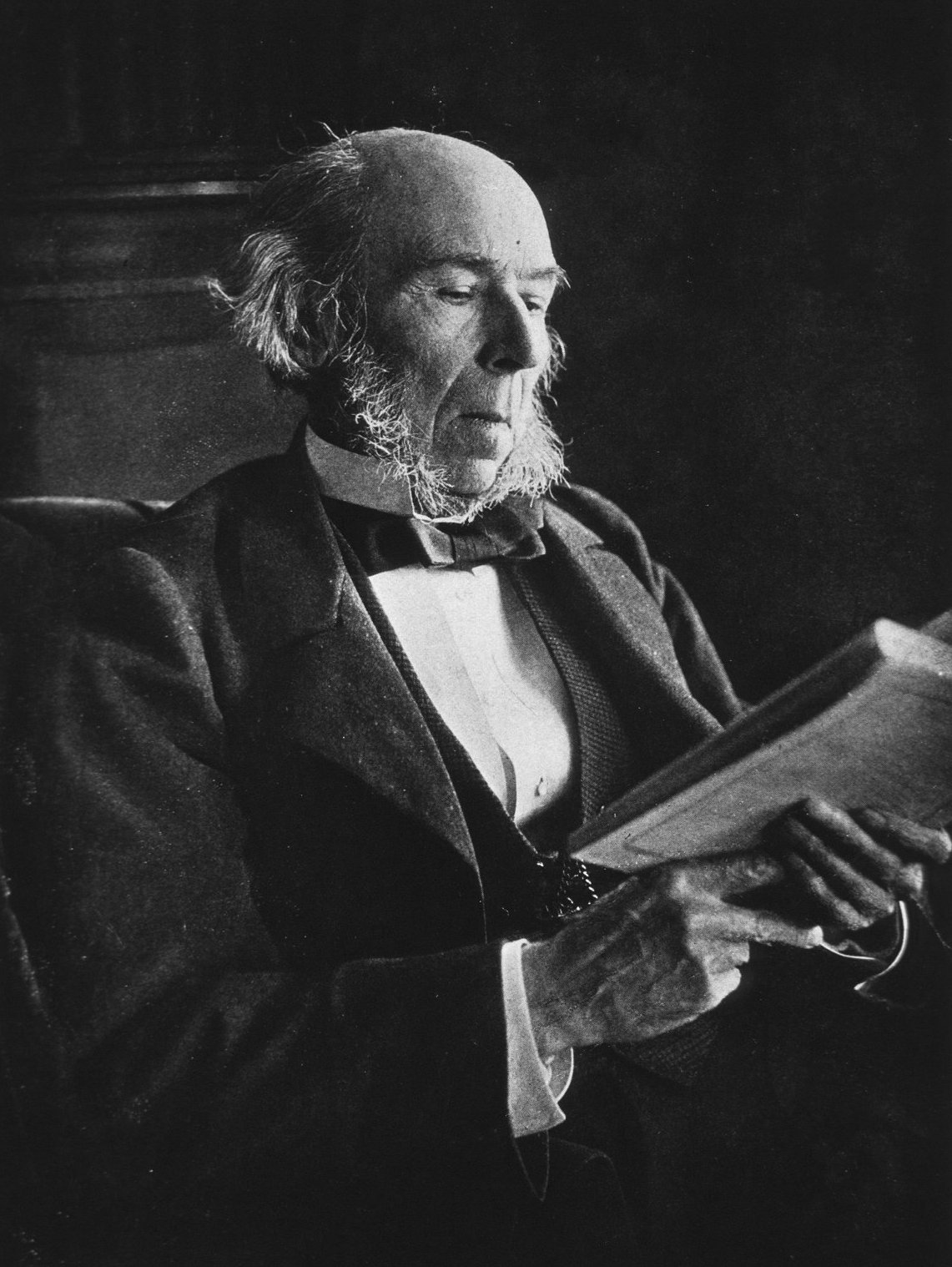
HERBERT SPENCER: The Development of Spencer

Reference: The Story of Philosophy

This paper presents Chapter VIII Section 2 from the book THE STORY OF PHILOSOPHY by WILL DURANT. The  contents are from the 1933 reprint of this book by TIME INCORPORATED by arrangement with Simon and Schuster, Inc.

The paragraphs of the original material (in black) are accompanied by brief comments (in color) based on the present understanding.

.

II. The Development of Spencer

He was born at Derby in 1820. In both lines his ancestors were Non-conformists or Dissenters. His father’s mother had been a devoted follower of John Wesley; his father’s brother, Thomas, though an Anglican clergyman, led a Wesleyan movement within the Church, never attended a concert or a play, and took an active part in movements for political reform. This drive to heresy became stronger in the father, and culminated in the almost obstinate individualism of Herbert Spencer himself. The father never used the supernatural to explain anything; he was described by one acquaintance (though Herbert considered this an exaggeration) as “without faith or religion whatever, so far as one could see.” He was inclined to science, and wrote an Inventional Geometry. In politics he was an individualist like his son and “would never take off his hat to anyone, no matter of what rank.” “If he did not understand some question my mother put, he would remain silent; not asking what the question was, and letting it go unanswered. He continued this course all through his life, notwithstanding its futility; there resulted no improvement.” One is reminded (except for the silence) of Herbert Spencer’s resistance, in his later years, to the extension of State functions.

In both lines Spencer’s ancestors were Non-conformists or Dissenters. This drive to heresy became stronger in the father, and culminated in the almost obstinate individualism of Herbert Spencer himself.

The father, as well as an uncle and the paternal grandfather, were teachers of private schools; and yet the son, who was to be the most famous English philosopher of his century, remained till forty an uneducated man. Herbert was lazy, and the father was indulgent. At last, when he was thirteen, Herbert was sent to Hinton to study under his uncle, who had a reputation for severity. But Herbert promptly ran away from the uncle, and trudged all the way back to the paternal home at Derby—48 miles the first day, 47 the next, and 20 the third, all on a little bread and beer. Nevertheless he returned to Hinton after a few weeks, and stayed for three years. It was the only systematic schooling that he ever received. He could not say, later, just what it was he learned there; no history, no natural science, no general literature. He says, with characteristic pride: “That neither in boyhood nor youth did I receive a single lesson in English, and that I have remained entirely without formal knowledge of syntax down to the present hour, are facts which should be known; since their implications are at variance with assumptions universally accepted.” At the age of forty he tried to read the Iliad, but “after reading some six books I felt what a task it would be to go on—felt that I would rather give a large sum than read to the end.” Collier, one of his secretaries, tells us that Spencer never finished any book of science. Even in his favorite fields he received no systematic instruction. He burnt his fingers and achieved a few explosions in chemistry; he browsed entomologically among the bugs about school and home; and he learned something about strata and fossils in his later work as a civil engineer; for the rest he picked his science casually as he went along. Until he was thirty he had no thought at all of philosophy. Then he read Lewes, and tried to pass on to Kant; but finding, at the outset, that Kant considered space and time to be forms of sense-perception rather than objective things, he decided that Kant was a dunce, and threw the book away. His secretary tells us that Spencer composed his first book, Social Statics, “having read no other ethical treatise than an old and now forgotten book by Jonathan Dymond.” He wrote his Psychology after reading only Hume, Mansel and Reid; his Biology after reading only Carpenter’s Comparative Physiology (and not the Origin of Species) ; his Sociology without reading Comte or Tylor; his Ethics without reading Kant or Mill or any other moralist than Sedgwick. What a contrast to the intensive and relentless education of John Stuart Mill! 

Spencer had little formal education. He never finished any book of science. Even in his favorite fields he received no systematic instruction. He picked his science casually as he went along.

Where, then, did he find those myriad facts with which he propped up his thousand arguments? He “picked them up,” for the most part, by direct observation rather than by reading. “His curiosity was ever awake, and he was continually directing the attention of his companion to some notable phenomenon … until then seen by his eyes alone.”. At the Athenaeum Club he pumped Huxley and his other friends almost dry of their expert knowledge; and he ran through the periodicals at the Club as he had run through those that passed through his father’s hands for the Philosophical Society at Derby, “lynx-eyed for every fact that was grist to his mill.” Having determined what he wanted to do, and having found the central idea, evolution, about which all his work would turn, his brain became a magnet for relevant material, and the unprecedented orderliness of his thought classified the material almost automatically as it came. No wonder the proletaire and the business man heard him gladly; here was just such a mind as their own—a stranger to book learning, innocent of “culture” and yet endowed with the natural, matter-of-fact knowledge of the man who learns as he works and lives. 

Having determined what he wanted to do, and having found the central idea, evolution, his brain became a magnet for relevant material, and the unprecedented orderliness of his thought classified the material almost automatically as it came.

For he was working for his living: and his profession intensified the practical tendency of his thought. He was surveyor, supervisor and designer of railway lines and bridges, and in general an engineer. He dripped inventions at every turn; they all failed, but he looked back upon them, in his Autobiography, with the fondness of a father for a wayward son; he sprinkled his reminiscent pages with patent salt-cellars, jugs, candle-extinguishers, invalid-chairs, and the like. As most of us do in youth, he invented new diets too; for a time he was vegetarian; but he abandoned it when he saw a fellow-vegetarian develop anemia, and himself losing strength; “I found that I had to rewrite what I had written during the time I was a vegetarian, because it was so wanting in vigor.” He was ready in those days to give everything a trial; he even thought of migrating to New Zealand, forgetting that a young country has no use for philosophers. It was characteristic of him that he made parallel lists of reasons for and against the move, giving each reason a numerical value. The sums being 110 points for remaining in England and 301 for going, he remained. 

Spencer worked for his living as a surveyor, supervisor and designer of railway lines and bridges, and in general as an engineer. He was ready in those days to give everything a trial.

His character had the defects of its virtues. He paid for his resolute realism and practical sense by missing the spirit and zest of poetry and art. The only poetical touch in his twenty volumes was due to a printer who made Spencer speak of “the daily versification of scientific predictions.” He had a fine persistence whose other side was an opinionated obstinacy; he could sweep the entire universe for proofs of his hypotheses, but he could not see with any insight another’s point of view; he had the egotism that bears up the non-conformer, and he could not carry his greatness without some conceit. He had the limitations of the pioneer: a dogmatic narrowness accompanying a courageous candor and an intense originality; sternly resisting all flattery, rejecting proffered governmental honors, and pursuing his painful work for forty years in chronic ill-health and modest seclusion; and yet marked, by some phrenologist who gained access to him—“Self-esteem very large.” The son and grandson of teachers, he wielded the ferule in his books, and struck a high didactic tone. “I am never puzzled,” he tells us. His solitary bachelor life left him lacking in the warmly human qualities, though he could be indignantly humane. He had an affair with that great Englishman, George Eliot, but she had too much intellect to please him. He lacked humor, and had no subtlety or nuances in his style. When he lost at his favorite game of billiards, he denounced his opponent for devoting so much time to such a game as to have become an expert in it. In his Autobiography he writes reviews of his own early books, to show how it should have been done.”

Spencer paid for his resolute realism and practical sense by missing the spirit and zest of poetry and art. He had a fine persistence whose other side was an opinionated obstinacy. He lacked humor, and had no subtlety or nuances in his style. 

Apparently the magnitude of his task compelled him to look upon life with more seriousness than it deserves. “I was at the Fete of St. Cloud on Sunday,” he writes from Paris; “and was much amused by the juvenility of the adults. The French never entirely cease to be boys; I saw gray-haired people riding on whirligigs such as we have at our own fairs.” He was so busy analyzing and describing life that he had no time to live it. After seeing Niagara Falls he jotted down in his diary: “Much what I had expected.” He describes the most ordinary incidents with the most magnificent pedantry—as when he tells us of the only time he ever swore.* He suffered no crises, felt no romance (if his memoirs record him well); he had some intimacies, but he writes of them almost mathematically; he plots the curves of his tepid friendships without any uplifting touch of passion. A friend said of himself that he could not write well when dictating to a young woman stenographer; Spencer said that it did not bother him at all. His secretary says, “The passionless thin lips told of a total lack of sensuality, and the light eyes betrayed a lack of emotional depth.” Hence the monotonous levelness of his style: he never soars, and needs no exclamation-points; in a romantic century he stands like a sculptured lesson in dignity and reserve.

*Tyndall once said of him what a much better fellow he would be if he had a good swear now and again. 

Spencer was so busy analyzing and describing life that he had no time to live it. He suffered no crises, felt no romance. In a romantic century he stands like a sculptured lesson in dignity and reserve.


He had an exceptionally logical mind; he marshalled his à prioris and his à posterioris with the precision of a chess player. He is the clearest expositor of complex subjects that modern history can show; he wrote of difficult problems in terms so lucid that for a generation all the world was interested in philosophy. “It has been remarked,” he says, “that I have an unusual faculty of exposition—set forth my data and reasonings and conclusions with a clearness and coherence not common.” He loved spacious generalizations, and made his works interesting rather with his hypotheses than with his proofs. Huxley said that Spencer’s idea of a tragedy was a theory killed by a fact; and there were so many theories in Spencer’s mind that he was bound to have a tragedy every day or two. Huxley, struck by the feeble and undecided gait of Buckle, said of him to Spencer: “Ah, I see the kind of man; he is top-heavy.” “Buckle,” Spencer adds, “had taken in a much larger quantity of matter than he could organize.” With Spencer it was the other way: he organized much more than he had taken in. He was all for coordination· and synthesis; he depreciated Carlyle for lacking a similar turn. The fondness for order became in him an enslaving passion; a brilliant generalization over-mastered him. But the world was calling for a mind like his; one who could transform the wilderness of facts with sunlit clarity into civilized meaning; and the service which Spencer performed for his generation entitled him to the failings that made him human. If he has been pictured here rather frankly, it is because we love a great man better when we know his faults, and suspiciously dislike him when he shines in unmitigated perfection. 

Spencer had an exceptionally logical mind. He is the clearest expositor of complex subjects that modern history can show. He could transform the wilderness of facts with sunlit clarity into civilized meaning.

“Up to this date,” wrote Spencer at forty, “my life might fitly have been characterized as miscellaneous.” Seldom has a philosopher’s career shown such desultory vacillation. “About this time” (age twenty-three) “my attention turned to the construction of watches.” But gradually he found his field, and tilled it with honest husbandry. As early as 1842 he wrote, for the Non-conformist (note the medium be chose), some letters on “The Proper Sphere of Government,” which contained his later laissez-faire philosophy in ovo [in the egg]. Six years later he dropped engineering to edit The Economist. At the age of thirty, when he spoke disparagingly of Jonathan Dymond’s Essays on the Principles of Morality, and his father challenged him to do as well with such a subject, he took the dare, and wrote his Social Statics. It had only a small sale, but it won him access to the magazines. In 1852 his essay on “The Theory of Population” (one of the many instances of Malthus’ influence on the thought of the nineteenth century) suggested that the struggle for existence leads to a survival of the fittest, and coined those historic phrases. In the same year his essay on “The Development Hypothesis” met the trite objection—that the origin of new species by progressive modification of older ones had never been seen—by pointing out that the same argument told much more strongly against the theory of the “special creation” of new species by God; and it went on to show that the development of new species was no more marvelous or incredible than the development of a man from ovum and sperm, or of a plant from a seed. In 1855 his second book, The Principles of Psychology, undertook to trace the evolution of mind. Then, in 1857, came an essay on “Progress, Its Law and Cause,” which took up Von Baer’s idea of the growth of all living forms from homogeneous beginnings to heterogeneous developments, and lifted it into a general principle of history and progress. In short Spencer had grown with the spirit of his age, and was ready now to become the philosopher of universal evolution. 

Spencer had grown with the spirit of his age, and was ready now to become the philosopher of universal evolution. 

When, in 1858, he was revising his essays for collective publication, he was struck by the unity and sequence of the ideas he had expressed; and the notion came to him, like a burst of sunlight through opened doors, that the theory of evolution might be applied in every science as well as in biology; that it could explain not only species and genera but planets and strata, social and political history, moral and esthetic conceptions. He was fired with the thought of a series of works in which he would show the evolution of matter and mind from nebula to man, and from savage to Shakespeare. But he almost despaired when he thought of his nearly forty years. How could one man, so old, and an invalid, traverse all the sphere of human knowledge before his death? Only three years back he had had a complete break-down; for eighteen months he had been incapacitated, broken in mind and courage, wandering aimlessly and hopelessly from place to place. The consciousness of his latent powers made his weakness a bitter thing to him. He knew that he would never be quite healthy again, and that he could not bear mental work for more than an hour at a time. Never was a man so handicapped for the work he chose, and never did a man choose, so late in life, so great a work. 

In 1858, a notion came to Spencer, like a burst of sunlight through opened doors, that the theory of evolution might be applied in every science as well as in biology; that it could explain not only species and genera but planets and strata, social and political history, moral and esthetic conceptions.

He was poor. He had not given much thought to getting a living. “I don’t mean to get on,” he said; “I don’t think getting on is worth the bother.” He had resigned the editorship of The Economist on receiving $2,500 as bequest from an uncle; but his idleness had consumed this gift. It occurred to him now that he might seek advance subscriptions for his intended volumes, and so live from hand to mouth, and pay his way as he went. He prepared an outline, and submitted it to Huxley, Lewes, and other friends; they secured him an imposing list of initial subscribers whose names might adorn his prospectus: Kingsley, Lyell, Hooker, Tyndall, Buckle, Froude, Bain, Herschel and others. Published in 1860, this prospectus brought 440 subscriptions from Europe; and 200 from America; the total promising a modest $1,500 a year. Spencer was satisfied, and set to work with a will. 

Spencer was poor. He had not given much thought to getting a living. It occurred to him now that he might seek advance subscriptions for his intended volumes, and so live from hand to mouth, and pay his way as he went.

But after the publication of First Principles, in 1862, many subscribers withdrew their names because of the famous “Part One,” which, attempting to reconcile science and religion, offended bishops and pundits alike. The way of the peacemaker is hard. First Principles and The Origin of Species became the center of a great Battle of the Books, in which Huxley served as generalissimo for the forces of Darwinism and agnosticism. For a time the evolutionists were severely ostracized by respectable people; they were denounced as immoral monsters, and it was thought good form to insult them publicly. Spencer’s subscribers fell away with every installment, and many defaulted on payments due for installments received. Spencer went on as long as he could, paying out of his pocket the deficit which every issue involved. At last his funds and his courage were exhausted, and he issued to the remaining subscribers an announcement that he could no longer continue his work. 

When Spencer attempted to reconcile science and religion, it offended bishops and pundits alike. His subscribers fell away with every installment. Spencer went on as long as he could. At last his funds and his courage were exhausted.

Then came one of the encouraging incidents of history. Spencer’s greatest rival, who had held the field of English philosophy before the publication of First Principles, and now saw himself superseded by the philosopher of evolution, wrote to him as follows on February 4, 1866: 

Dear Sir:
On arriving here last week, I found the December livraison of your Biology, and I need hardly say how much I regretted the announcement in the paper annexed to it. … I propose that you should write the next of your treatises, and that I should guarantee the publisher against loss. … I beg that you will not consider this proposal in the light of a personal favor, though even if it were I should still hope to be permitted to offer it. But it is nothing of the kind—it is a simple proposal of cooperation for an important public purpose, for which you give your labor and have given your health. I am, Dear Sir, 

Very truly yours,
J. S. Mill

Spencer courteously refused; but Mill went out among his friends and persuaded several of them to subscribe for 250 copies each. Spencer again objected, and could not be moved. Then suddenly came a letter from Prof. Youmans, saying that Spencer’s American admirers had bought, in his name, $7000 of public securities, of which the interest or dividends were to go to him. This time he yielded. The spirit of the gift renewed his inspiration; he resumed his task; and for forty years he kept his shoulder to the wheel, until all the Synthetic Philosophy had arrived safely into print. This, triumph of mind and will over illness and a thousand obstacles is one of the sunny spots in the book of man. 

Spencer was then offered financial help, while he gave his labor and health. The spirit of the gift renewed his inspiration; he resumed his task; and for forty years he kept his shoulder to the wheel, until all the Synthetic Philosophy had arrived safely into print.

.

HERBERT SPENCER: Comte and Darwin

Reference: The Story of Philosophy

This paper presents Chapter VIII Section 1 from the book THE STORY OF PHILOSOPHY by WILL DURANT. The  contents are from the 1933 reprint of this book by TIME INCORPORATED by arrangement with Simon and Schuster, Inc.

The paragraphs of the original material (in black) are accompanied by brief comments (in color) based on the present understanding.

.

I. Comte and Darwin

The Kantian philosophy which announced itself as “prolegomena to all future metaphysics,” was, by malicious intent, a murderous thrust at traditional modes of speculation; and, contrary to intent, a damaging blow to all metaphysics whatsoever. For metaphysics had meant, throughout the history of thought, an attempt to discover the ultimate nature of reality; now men learned, on the most respectable authority, that reality could never be experienced; that it was a “noumenon,” conceivable but not knowable; and that even the subtlest human intelligence could never pass beyond phenomena, could never pierce the veil of Maya. The metaphysical extravagances of Fichte, Hegel and Schelling, with their various readings of the ancient riddle, their Ego and Idea and Will, had canceled one another into zero; and by the eighteen-thirties the universe was generally conceded to have guarded its secret well. After a generation of Absolute intoxication, the mind of Europe reacted by taking a pledge against metaphysics of any kind. 

The Kantian philosophy determined that reality could never be experienced; that it was a “noumenon,” conceivable but not knowable. After a generation of Absolute intoxication, the mind of Europe reacted by taking a pledge against metaphysics of any kind. 

Since the French had made a specialty of skepticism, it was natural that they should produce the founder (if there are such persons in philosophy, where every idea is hallowed with years) of the “positivist” movement. Auguste Comte—or, as his parents called him, Isidore Auguste Marie Francois Xavier Comte—was born at Montpellier in 1798. The idol of his youth was Benjamin Franklin, whom he called the modern Socrates. “You know that at five-and-twenty he formed the design of becoming perfectly wise, and that he fulfilled his design. I have dared to undertake the same thing, though I am not yet twenty.” He made a fair start by becoming secretary to the great Utopian, Saint-Simon, who passed on to him the reforming enthusiasm of Turgot and Condorcet, and the idea that social, like physical phenomena, might be reduced to laws and science, and that all philosophy should be focused upon the moral and political improvement of mankind. But, like most of us who set out to reform the world, Comte found it difficUlt enough to manage his own home; in 1827, after two years of marital infelicity, he suffered a mental breakdown, and attempted suicide in the Seine. To his rescuer, therefore, we owe something of the five volumes of Positive Philosophy which appeared between 1830 and 1842, and the four volumes of Positive Polity which appeared between 1851 and 1854. 

Auguste Comte (1798 – 1857) started the “positivist” movement with the idea that social, like physical phenomena, might be reduced to laws and science, and that all philosophy should be focused upon the moral and political improvement of mankind. 

This was an undertaking which, in scope and patience, was second in modern times only to Spencer’s “Synthetic Philosophy.” Here the sciences were classified according to the decreasing simplicity and generality of their subject matter: mathematics, astronomy, physics, chemistry, biology, and sociology; each rested on the results of all the sciences before it; therefore sociology was the apex of the sciences, and the others had their reason for existence only in so far as they could provide illumination for the science of society. Science, in the sense of exact knowledge, had spread from one subject matter to another in the order given; and it was natural that the complex phenomena of social life should be the last to yield to scientific method. In each field of thought the historian of ideas could observe a Law of Three Stages: at first the subject was conceived in the theological fashion, and all problems were explained by the will of some deity—as when the stars were gods, or the chariots of gods; later, the same subject reached the metaphysical, stage, and was explained by metaphysical abstractions—as when the stars moved in circles because circles were the must perfect figure; finally the subject was reduced to positive science by precise observation, hypothesis, and experiment, and its phenomena were explained though the regularities of natural cause and effect. The ”Will of God” yields to such airy entities as Plato’s “Ideas” or Hegel’s “Absolute Idea,” and these in turn yield to the laws of science. Metaphysics is a stage of arrested development: the time had come, said Comte, to abandon these puerilities. Philosophy was not something different from science; it was the coordination of all the sciences with a view to the improvement of human life. 

Ideas developed in three stage: (a) theological, where all problems were explained by the will of some deity; (b) metaphysical, where a subject was explained by metaphysical abstractions; and (c) positive, where a subject was reduced to science by precise observation, hypothesis, and experiment. Philosophy was the coordination of all the sciences with a view to the improvement of human life. 

There was a certain dogmatic intellectualism about this positivism which perhaps reflected the disillusioned and isolated philosopher. When, in 1845, Mme. Clotilde de Vaux (whose husband was spending his life in jail) took charge of Comte’s heart, his affection for her warmed and colored his thought, and led to a reaction in which he placed feeling above intelligence as a reforming force, and concluded that the world could be redeemed only by a new religion, whose function it should be “to nourish and strengthen the feeble altruism of human nature by exalting Humanity as the object of a ceremonial worship. Comte spent his old age devising for this Religion of Humanity an intricate system of priesthood, sacraments, prayers, and discipline; and proposed a new calendar in which the names of pagan deities and medieval saints should be replaced by the heroes of human progress. As a wit put it, Comte offered the world all of Catholicism except Christianity. 

In his later life Comte placed feeling above intelligence as a reforming force, and concluded that the world could be redeemed only by a new religion that exalted Humanity as the object of a ceremonial worship. 

The positivist movement fell in with the flow of English thought, which took its spirit from a life of industry and trade, and looked up to matters of fact with a certain reverence. The Baconian tradition had turned thought in the direction of things, mind in the direction of matter; the materialism of Hobbes, the sensationalism of Locke, the skepticism of Hume, the utilitarianism of Bentham, were so many variations on the theme of a practical and busy life. Berkeley was an Irish discord in this domestic symphony. Hegel laughed at the English habit of honoring physical and chemical equipment with the name of “philosophical instruments”; but such a term came naturally to men who agreed with Comte and Spencer in defining philosophy as a generalization of the results of all the sciences. So it was that the positivist movement found more adherents in England than in the land of its birth; adherents perhaps not so fervent as the generous Littré, but endowed with that English tenacity which kept John Stuart Mill (1806-73) and Frederick Harrison (1831-1923) faithful all their lives to Comte’s philosophy, while their English caution kept them aloof from his ceremonious religion. 

The positivist movement fell in with the flow of English thought, which took its spirit from a life of industry and trade, and looked up to matters of fact with a certain reverence, while the English caution kept them aloof from Comte’s ceremonious religion.

Meanwhile the Industrial Revolution, born of a little science, was stimulating science in return. Newton and Herschel had brought the stars to England, Boyle and Davy had opened the treasures of chemistry, Faraday was making the discoveries that would electrify the world, Rumford and Joule were demonstrating the transformability and equivalence of force and the conservation of energy. The sciences were reaching a stage of complexity which would make a bewildered world welcome a synthesis. But above all these intellectual influences that stirred England in the youth of Herbert Spencer was the growth of biology, and the doctrine of evolution. Science had been exemplarily international in the development of this doctrine: Kant had spoken of the possibility of apes becoming men; Goethe had written of “the metamorphosis of plants; Erasmus Darwin and Lamarck had propounded the theory that species had evolved from simpler forms by the inheritance of the effects of use and disuse; and in 1830 St. Hilaire shocked Europe, and gladdened old Goethe, by almost triumphing against Cuvier in that famous debate on evolution which seemed like another Ernani, another revolt against classic ideas of changeless rules and orders in a changeless world.

Meanwhile the Industrial Revolution, born of a little science, was stimulating science in return. But above all these intellectual influences was the growth of biology, and the doctrine of evolution.

In the eighteen-fifties evolution was in the air. Spencer expressed the idea, long before Darwin, in an essay on “The Development Hypothesis” (1852), and in his Principles of Psychology’ (1855). In 1858 Darwin and Wallace read their famous papers before the Linnaean Society; and in 1859 the old world, as the good bishops thought, crashed to pieces with the publication of the Origin of Species. Here was no mere vague notion of evolution, of higher species evolving somehow from lower ones; but a detailed and richly documented theory of the actual mode and process of evolution “by means of natural selection, or the preservation of favored races in the struggle for life.” In one decade all the world was talking about evolution. What lifted Spencer to the crest of this wave of thought was the clarity of mind which suggested the application of the evolution idea to every field of study, and the range of mind which brought almost all knowledge to pay tribute to his theory. As mathematics had dominated philosophy in the seventeenth century, giving to the world Descartes, Hobbes, Spinoza, Leibnitz and Pascal; and as psychology had written philosophy in Berkeley and Hume and Condillac and Kant; so in the nineteenth century, in Schelling and Schopenhauer, in Spencer and Nietzsche and Bergson, biology was the background of philosophic thought. In each case the epochal ideas were the piece-meal production of separate men, more or less obscure; but the ideas are attached to the men who coordinated and clarified them, as the New World took the name of Amerigo Vespucci because he drew a map. Herbert Spencer was the Vespucci of the age of Darwin, and something of its Columbus too. 

In the eighteen-fifties evolution was in the air. Biology was the background of philosophic thought. Spencer provided the clarity of mind which suggested the application of the evolution idea to every field of study. 

.

SCHOPENHAUER: Criticism

Reference: The Story of Philosophy

This paper presents Chapter VII Section 8 from the book THE STORY OF PHILOSOPHY by WILL DURANT. The  contents are from the 1933 reprint of this book by TIME INCORPORATED by arrangement with Simon and Schuster, Inc.

The paragraphs of the original material (in black) are accompanied by brief comments (in color) based on the present understanding.

.

VIII. Criticism 

The natural response to such a philosophy is a medical diagnosis, of the age and of the man. 

Let us realize again that we have here a phenomenon akin to that which, in the days after Alexander and after Caesar, brought first to Greece and then to Rome a flood of Oriental faiths and attitudes. It is characteristic of the East to see the external Will in nature as so much more powerful than the will in man, and to come readily to a doctrine of resignation and despair. As the decay of Greece brought the pallor of Stoicism and the hectic flush of Epicureanism upon the cheeks of Hellas, so the chaos of the Napoleonic wars brought into the soul of Europe that plaintive weariness which made Schopenhauer its philosophic voice. Europe had a terrible headache in 1815.*

*Compare the apathy and despondency of Europe today (1924), and the popularity of such books as Spengler’s Downfall of the Western World. 

It is characteristic of the East to see the external Will in nature as so much more powerful than the will in man, and to come readily to a doctrine of resignation and despair. The chaos of the Napoleonic wars brought into the soul of Europe that plaintive weariness which made Schopenhauer its philosophic voice. 

The personal diagnosis can take its lead from Schopenhauer’s admission that a man’s happiness depends on what he is, rather than on external circumstance. Pessimism is an indictment of the pessimist. Given a diseased constitution and a neurotic mind, a life of empty leisure and gloomy ennui, and there emerges the proper physiology for Schopenhauer’s philosophy. One must have leisure to be a pessimist; an active life almost always brings good spirits in body and in mind. Schopenhauer admires the serenity that comes of modest aims and a steady life, but he could hardly speak of these from personal experience. Difficilis in otio quies [tranquility is difficult if one has leisure], truly; he had money enough for continuous leisure, and he found continuous leisure to be more intolerable than continuous work. Perhaps the tendency of philosophers toward melancholy is due to the unnaturalness of sedentary occupations; too often an attack upon life is merely a symptom of the lost art of excretion. 

Given a diseased constitution and a neurotic mind, a life of empty leisure and gloomy ennui, and there emerges the proper physiology for Schopenhauer’s philosophy.

Nirvana is the ideal of a listless man, a Childe Harold or a Rene, who has begun by desiring too much, by staking all on one passion, and then, having lost, spends the remainder of his life in a passionless and petulant boredom. If intellect arises as the servant of will, it is quite likely that the particular product of the intellect which we know as the philosophy of Schopenhauer was the cover and apology of a diseased and indolent will. And no doubt his early experiences with women and with men developed an abnormal suspiciousness and sensitivity, as it did in Stendhal and Flaubert and Nietzsche. He became cynical and solitary. He writes: “A friend in need is not a friend indeed; he is merely a borrower”; and, “Do not tell a friend anything that you would conceal from an enemy.” He advises a quiet, monotonous, hermit life; he fears society, and has no sense of the values or joys of human association. But happiness dies when it is not shared. 

Nirvana is the ideal of a listless man, who has begun by desiring too much, by staking all on one passion, and then, having lost, spends the remainder of his life in a passionless and petulant boredom. This was Schopenhauer, whose early experiences with women and with men developed an abnormal suspiciousness and sensitivity.

There is, of course, a large element of egotism in pessimism: the world is not good enough for us, and we turn up our philosophic noses to it. But this is to forget Spinoza’s lesson, that our terms of moral censure and approbation are; merely human judgments, mostly irrelevant when applied to the cosmos as a whole. Perhaps our supercilious disgust with existence is a cover for a secret disgust with ourselves: we have botched and bungled our lives, and we cast the blame upon the “environment,” or the “world,” which have no tongues to utter a defense. The mature man accepts the natural limitations of life; he does not expect Providence to be prejudiced in his favor; he does not ask for loaded dice with which to play the game of life. He knows, with Carlyle, that there is no sense in vilifying the sun because it will not light our cigars. And perhaps, if we are clever enough to help it, the sun will do even that; and this vast neutral cosmos may turn out to be a pleasant place enough if we bring a little sunshine of our own to help it out. In truth the world is neither with us nor against us; it is but raw material in our hands, and can be heaven or hell according to what we are. 

There is, of course, a large element of egotism in pessimism: the world is not good enough for us, and we turn up our philosophic noses to it. In truth the world is neither with us nor against us; it is but raw material in our hands, and can be heaven or hell according to what we are. 

Part of the cause of pessimism, in Schopenhauer and his contemporaries, lay in their romantic attitudes and expectations. Youth expects too much of the world; pessimism is the morning after optimism, just as 1815 had to pay for 1789. The romantic exaltation and liberation of feeling, instinct and will, and the romantic contempt for intellect, restraint, and order, brought their natural penalties; for “the world,” as Horace Walpole said, “is a comedy for those who think, but a tragedy for those who feel.” “Perhaps no movement has been so prolific of melancholy as emotional romanticism. … When the romanticist discovers that his ideal of happiness works out into actual unhappiness, he does not blame his ideal. He simply assumes that the world is unworthy of a being so exquisitely organized as himself. How could a capricious universe ever satisfy a capricious soul?

Part of the cause of pessimism, in Schopenhauer and his contemporaries, lay in their romantic attitudes and expectations. The romantic exaltation and liberation of feeling, instinct and will, and the romantic contempt for intellect, restraint, and order, brought their natural penalties.

The spectacle of Napoleon’s rise to empire. Rousseau’s denunciation—and Kant’s critique—of the intellect, and his own passionate temperament and experiences, conspired to suggest to Schopenhauer the primacy and ultimacy of the will. Perhaps, too, Waterloo and St. Helena helped to develop a pessimism born, no doubt, of bitter personal contact with the stings and penalties of life. Here was the most dynamic individual will in all history, imperiously commanding continents; and yet its doom was as certain and ignominious as that of the insect to which the day of its birth brings in-enviable death. It never occurred to Schopenhauer that it was better to have fought and lost than never to have fought at all; he did not feel, like the more masculine and vigorous Hegel, the glory and desirability of strife; he longed for peace, and lived in the midst of war. Everywhere he saw strife; he could not see, behind the strife, the friendly aid of neighbors; the rollicking joy of children and young men, the dances of vivacious girls, the willing sacrifices of parents and lovers, the patient bounty of the soil, and the renaissance of spring.

It never occurred to Schopenhauer that, for Napoleon, it was better to have fought and lost than never to have fought at all. Everywhere he saw strife; he could not see, behind the strife, the friendly aid of neighbors; the rollicking joy of children and young men, and the dances of vivacious girls.

And what if desire, fulfilled, leads only to another desire? Perhaps it is better that we should never be content. Happiness, says an old lesson, lies rather in achievement than in possession or satiation. The healthy man asks not so much for happiness as for an opportunity to exercise his capacities; and if he must pay the penalty of pain for this freedom and this power he makes the forfeit cheerfully; it is not too great a price. We need resistance to raise us, as it raises the airplane or the bird; we need obstacles against which to sharpen our strength and stimulate our growth. Life without tragedy would be unworthy of a man.*

*Schopenhauer himself: “To have no regular work, no set sphere of activity,—what a miserable thing it is! … Effort, struggles with difficulties! that is as natural to a man as grubbing in the ground is to a mole. To have all his wants satisfied is something intolerable—the feeling of stagnation which comes from pleasures that last too long. To overcome difficulties is to experience the full delight of existence.” One would like to know more of what the maturer Schopenhauer thought of the brilliant philosophy of his youth. 

Life without tragedy would be unworthy of a man. We need resistance to raise us, as it raises the airplane or the bird; we need obstacles against which to sharpen our strength and stimulate our growth.


Is it true that “he that increaseth knowledge increaseth sorrow,” and that it is the most highly organized beings that suffer most? Yes; but it is also true that the growth of knowledge increases joy as well as sorrow, and that the subtlest delights, as well as the keenest pains, are reserved for the developed soul. Voltaire rightly preferred the Brahmin’s ”unhappy” wisdom to the blissful ignorance of the peasant woman; we wish to experience life keenly and deeply, even at the cost of pain; we wish to venture into its innermost secrets, even at the cost of disillusionment.* Virgil, who had tasted every pleasure, and knew the luxuries of imperial favor, at last “tired of everything except the joys of understanding.” When the senses cease to satisfy, it is something to have won access, however arduously, to comradeship with those artists, poets and philosophers whom only the mature mind can comprehend. Wisdom is a bitter-sweet delight, deepened by the very discords that enter into its harmony. 

*Anatole France (Voltaire’s last avatar) has dedicated one of his masterpieces—The Human Tragedy—to the task of showing that though “the joy of understanding is a sad joy,” yet “those who have once tasted it would not exchange it for all the frivolous gaieties and empty hopes of the vulgar herd.” 

We wish to experience life keenly and deeply, even at the cost of pain; we wish to venture into its innermost secrets, even at the cost of disillusionment. Wisdom is a bitter-sweet delight, deepened by the very discords that enter into its harmony. 

Is pleasure negative? Only a sorely wounded soul, drawing itself in from contact with the world, could have uttered so fundamental a blasphemy against life. What is pleasure but the harmonious operation of our instincts?—and how can pleasure be negative except where the instinct at work makes for retreat rather than for approach? The pleasures of escape and rest, of submission and security, of solitude and quiet are no doubt negative, because the instincts that impel us to them are essentially negative—forms of flight and fear; but shall we say the same of the pleasures that come when positive instincts are in command—instincts of acquisition and possession, of pugnacity and mastery, of action and play, of association and love? Is the joy of laughter negative, or the romping of the child, or the song of the mating bird, or the crow of Chanticleer, or the creative ecstasy of art? Life itself is a positive force, and every normal function of it holds some delight. 

Is pleasure negative? Only a sorely wounded soul, drawing itself in from contact with the world, could have uttered so fundamental a blasphemy against life. Life itself is a positive force, and every normal function of it holds some delight. 

It remains true, no doubt, that death is terrible. Much of its terror disappears if one has lived a normal life; one must have lived well in order to die well. And would deathlessness delight us? Who envies the fate of Ahasuerus, to whom immortal life was sent as the heaviest punishment that could be inflicted upon man? And why is death terrible if not because life is sweet? We need not say with Napoleon that all who fear death are atheists at heart; but we may surely say that a man who lives to three-score years and ten has survived his pessimism. No man, said Goethe, is a pessimist after thirty. And hardly before twenty; pessimism is a luxury of self-conscious and self-important youth; youth that comes out of the warm: bosom of the communistic family into the cold atmosphere of individualistic competition and greed, and then yearns back to its mother’s breast; youth that hurls itself madly against the windmills and evils of the world, and sadly sheds utopias and ideals with every year. But before twenty is the joy of the body, and after thirty is the joy of the mind; before twenty is the pleasure of protection and security; and after thirty, the joy of parentage and home.

It remains true, no doubt, that death is terrible. Much of its terror disappears if one has lived a normal life; one must have lived well in order to die well.

How should a man avoid pessimism who has lived almost all his life in a boarding-house? And who abandoned his only child to illegitimate, anonymity? At the bottom of Schopenhauer’s unhappiness was his rejection of the normal life,—his rejection of women and marriage and children. He finds in parentage the greatest of evils, where a healthy man finds in it the greatest of life’s satisfactions. He thinks that the stealthiness of love is due to shame in continuing the race—could anything be more pedantically absurd? Hesees in love only the sacrifice of the individual to the race, and ignores the delights with which the instinct repays the sacrifice,—delights so great that they have inspired most of the poetry of the world.* He knows woman only as shrew and as sinner, and he imagines that there are no other types. He thinks that the man who undertakes to support a wife is a fool; but apparently such men are not much more unhappy than our passionate apostle of single infelicity; and (as Balzac said) it costs as much to support a vice as it does to support a family. He scorns the beauty of woman,—as if there were any forms of beauty that we could spare, and that we should not cherish as the color and fragrance of life. What hatred of women one mishap had generated in this unfortunate soul! 

*Again, Schopenhauer himself: “It is just this not seeking of one’s own things (which is everywhere the stamp of greatness) that gives to passionate love the touch of sublimity.”

At the bottom of Schopenhauer’s unhappiness was his rejection of the normal life,—his rejection of women and marriage and children. He knows woman only as shrew and as sinner, and he imagines that there are no other types.

There are other difficulties, more technical and less vital, in this remarkable and, stimulating philosophy. How can suicide ever occur in a world where the only real force is the will to live? How can the intellect, begotten and brought up as servant of the will, ever achieve independence and objectivity? Does genius lie in knowledge divorced from will, or does it contain, as its driving force, an immense power of will, even a large alloy of personal ambition and conceit? Is madness connected with genius in general, or rather with only the “romantic” type of genius (Byron, Shelley, Poe, Heine, ,Swinburne, Strindberg, Dostoievski, etc.) ; and is not the “classic” and profounder type of genius exceptionally sound (Socrates, Plato, Spinoza, Bacon, Newton, Voltaire, Goethe, Darwin, Whitman, etc.)? What if the proper function of intellect and philosophy is not the denial of the will but the coordination of desires into a united and harmonious will? What if “will” itself, except as the unified product of such coordination, is a mythical abstraction, as shadowy as “force”?

Schopenhauer is looking at only the reactive aspect of will, the will that is corrupted. Uncorrupted will is analytical and positive that is enjoying life to its utmost.

Nevertheless there is about this philosophy a blunt honesty by the side of which most optimistic creeds appear as soporific hypocrisies. It is all very well to say, with Spinoza, that good and bad are subjective terms, human prejudices; and yet we are compelled to judge this world not from any “impartial” view, but from the standpoint of actual human sufferings and needs. It was well that Schopenhauer should force philosophy to face the raw reality of evil, and should point the nose of thought to the human tasks of alleviation. It has been harder, since his day, for philosophy to live in the unreal atmosphere of a logic-chopping metaphysics; thinkers begin to realize that thought without action is a disease. 

But philosophy cannot ignore the human sufferings and needs, and it must face the evil that corrupts the human will. Schopenhauer’s contribution is to force philosophy to face this evil.

After all, Schopenhauer opened the eyes of psychologists to the subtle depth and omnipresent force of instinct. Intellectualism—the conception of man as above all a thinking animal, consciously adapting means to rationally chosen ends—fell sick with Rousseau, took to its bed with Kant, and died with Schopenhauer. After two centuries of introspective analysis philosophy found, behind thought, desire;· and behind the intellect; instinct;—just as, after a century of materialism, physics finds, behind matter, energy. We owe it to Schopenhauer that he revealed our secret hearts to us, showed us that our desires are the axioms of our philosophies, and cleared the way to an understanding of thought as no mere abstract calculation of impersonal events, but as a flexible instrument of action and desire. 

Neither intellect is subject to will nor will is subject to intellect. A corruption of one leads to the corruption of the other. There is nothing wrong with having desires. But the evil that corrupts human will, intellect and desire needs to be discovered and handled. 

Finally, and despite exaggerations, Schopenhauer taught us again the necessity of genius, and the value of art. He saw that the ultimate good is beauty, and that the ultimate joy lies in the creation or cherishing of the beautiful. He joined with Goethe and Carlyle in protest against the attempt of Hegel and Marx and Buckle to eliminate genius as a fundamental factor in human history; in an age when all the great seemed dead he preached once more the ennobling worship of heroes. And with all his faults he succeeded in adding another name to theirs.

Schopenhauer did make a major and fundamental contribution to philosophy, in spite of his eccentricities. The East should not outright condemn desire, but find and handle the source that corrupts desire.

.

SCHOPENHAUER: The Wisdom of Death

Reference: The Story of Philosophy

This paper presents Chapter VII Section 7 from the book THE STORY OF PHILOSOPHY by WILL DURANT. The  contents are from the 1933 reprint of this book by TIME INCORPORATED by arrangement with Simon and Schuster, Inc.

The paragraphs of the original material (in black) are accompanied by brief comments (in color) based on the present understanding.

.

VII. The Wisdom of Death 

And yet, something more is needed. By Nirvana the individual achieves the peace of will-Iessness, and finds salvation; but after the individual? Life laughs at the death of the individual; it will survive him in his offspring, or in the offspring of others; even if his little stream of life runs dry there are a thousand other streams that grow broader and deeper with every generation. How can Man be saved? Is there a Nirvana for the race as well as for the individual?

There is Nirvana for the individual, but is there a Nirvana for the race as well?

Obviously, the only final and radical conquest of the will must lie in stopping up the source of life—the will to reproduce. “The satisfaction of the reproductive impulse is utterly and intrinsically reprehensible because it is the strongest affirmation of the lust for life.” What crime have these children committed that they should be born?

If, now, we contemplate the turmoil of life, we behold all occupied with its want and misery, straining all their powers to satisfy its infinite needs and to ward off its multifarious sorrows, yet without daring to hope for anything else than simply the preservation of this tormented existence for a short span of time. In between, however, and in the midst of this tumult, we see the glance of two lovers meet longingly; yet why so secretly, fearfully, and stealthily? Because these lovers are the traitors who seek to perpetuate the whole want and drudgery which would otherwise speedily reach an end; … here lies the profound reason for the shame connected with the process of generation.

Obviously, the only final and radical conquest of the will must lie in stopping up the source of life—the will to reproduce. 

It is woman that is the culprit here; for when knowledge has reached to will-Iessness, her thoughtless charms allure man again into reproduction. Youth has not intelligence enough to see how brief these charms must be; and when the intelligence comes, it is too late. 

With young girls Nature seems to have had in view what, in the language of the drama; is called a striking effect; as for a few years she dowers them with a wealth of beauty and is lavish in her gift of charm, at the expense of all the rest of their lives; so that during those years they may capture the fancy of some man to such a degree that he is hurried away into undertaking the honorable care of them … as long as they live—a step for which there would not seem to be any sufficient warrant if only reason directed man’s thoughts. … Here, as elsewhere, Nature proceeds with her usual economy; for just as the female ant, after fecundation, loses her wings, which are then superfluous, nay, actually a danger to the business of breeding; so, after giving birth to one or two children, a woman generally loses her beauty; probably, indeed, for similar reasons.

A women’s brief and thoughtless charms allure man into reproduction.

Young men ought to reflect that “if the object which inspires them today to write madrigals and sonnets had been born eighteen years earlier, it would scarcely have won a glance from them.” After all, men are much more beautiful in body than women. 

It is only a man whose intellect is clouded by his sexual impulse that could give the name of the fair sex to that undersized, narrow-shouldered, broad-hipped, and short-legged race; for the whole beauty of the sex is bound up with this impulse. Instead of calling them beautiful there would be more warrant for describing women as the unesthetic sex. Neither for music, nor for poetry, nor for the fine arts, have they really and truly any sense of susceptibility; it is a mere mockery if they make a pretense of it in order to assist their endeavor to please. … They are incapable of taking a purely objective interest in anything. … The most distinguished intellects among the whole sex have never managed to produce a single achievement in the fine arts that is really genuine and original; or given to the world any work of permanent value in any sphere.

The whole beauty of the sex is bound up with this sexual impulse. Women are, otherwise, unesthetic and incapable of taking a purely objective interest in anything.

This veneration of women is a product of Christianity and of German sentimentality; and it is in turn a cause of that Romantic movement which exalts feeling, instinct and will above the intellect. The Asiatics know better, and frankly recognize the inferiority of woman. “When the laws gave women equal rights with men, they ought also to have endowed them with masculine intellects.” Asia again shows a finer honesty than ours in its marriage institutions; it accepts as normal and legal the custom of polygamy, which, though so widely practiced among us, is covered with the fig-leaf of a phrase. “Where are there any real monogamists?”—And how absurd it is to give property-rights to women! “All women are, with rare exceptions, inclined to extravagance,” because they live only in the present, and their chief out-door sport is shopping. “Women think that it is men’s business to earn money, and theirs to spend it”; this is their conception of the division of labor. “I am therefore of opinion that women should never be allowed altogether to manage their own concerns, but should always stand under actual male supervision, be it of father, of husband, of son, or of the state—as is the case in Hindostan; and that consequently they should never be given full power to dispose of any property they have not themselves acquired.”* It was probably the luxury and extravagance of the women of Louis XIII’s court that brought on the general corruption of government which culminated in the French Revolution.

*An echo of Schopenhauer’s dissatisfaction with his mother’s extravagance.

Schopenhauer is very critical of womenkind and looks down upon them.

The less we have to do with women, then, the better. They are not even a “necessary evil”; life is safer and smoother without them. Let men recognize the snare that lies in women’s beauty, and the absurd comedy of reproduction will end. The development of intelligence will weaken or frustrate the will to reproduce, and will thereby at last achieve the extinction of the race. Nothing could form a finer denouement to the insane tragedy of the restless will;—why should the curtain that has just fallen upon defeat and death always rise again upon a new life, a new, struggle, and a new defeat? How long shall we be lured into this much-ado-about-nothing, this endless pain that leads only to a painful end? When shall we have the courage to fling defiance into the face of the Will,—to tell it that the loveliness of life is a lie, and that the greatest boon of all is death? 

According to Schopenhauer, the nirvana of the race lies in the extinction of the race. The loveliness of life is a lie, and that the greatest boon of all is death.

.

SCHOPENHAUER: Religion

Reference: The Story of Philosophy

This paper presents Chapter VII Section 6.4 from the book THE STORY OF PHILOSOPHY by WILL DURANT. The  contents are from the 1933 reprint of this book by TIME INCORPORATED by arrangement with Simon and Schuster, Inc.

The paragraphs of the original material (in black) are accompanied by brief comments (in color) based on the present understanding.

.

VI. The Wisdom of Life 

(4) Religion

It dawned upon Schopenhauer’s maturity that his theory of art—as the withdrawal of the will, and the contemplation of the eternal and universal—was also a theory of religion. In youth he had received very little religious training; and his temper did not incline him to respect the ecclesiastical organizations of his time. He despised theologians: “As ultima ratio,” or the final argument, “of theologians we find among many nations the stake”; and he described religion as “the metaphysics of the masses.” But in later years he began to see a profound significance in certain religious practices and dogmas. “The controversy which is so perseveringly carried on in our own day between supernaturalists and rationalists rests on the failure to recognize the allegorical nature of all religion.” Christianity, for example, is a profound philosophy of pessimism; “the doctrine of original sin (assertion of the will) and of salvation (denial of the will) is the great truth which constitutes the essence of Christianity.” Fasting is a remarkable expedient for weakening those desires that lead never to happiness but either to disillusionment or to further desire. “The power by virtue of which Christianity was able to overcome first Judaism, and then the heathenism of Greece and Rome, lies solely in its pessimism, in the confession that our state is both exceedingly wretched and sinful, while Judaism and heathenism were both optimistic”: they thought of religion as a bribe to the heavenly powers for aid towards earthly success; Christianity thought of religion as a deterrent from the useless quest of earthly happiness. In the midst of worldly luxury and power it has held up the ideal of the saint, the Fool in Christ, who refuses to fight, and absolutely overcomes the individual will.” 

It dawned upon Schopenhauer’s maturity that his theory of art—as the withdrawal of the will, and the contemplation of the eternal and universal—was also a theory of religion. Christianity thought of religion as a deterrent from the useless quest of earthly happiness.

Buddhism is profounder than Christianity, because it makes the destruction of the will the entirety of religion, and preaches Nirvana as the goal of all personal development. The Hindus were deeper than the thinkers of Europe, because their interpretation of the world was internal and intuitive, not external and intellectual; the intellect divides everything, intuition unites everything; the Hindus saw that the “I” is a delusion; that the individual is merely phenomenal, and that, the only reality is the Infinite One—“That art thou.” “Whoever is able to say this to himself, with regard to every being with whom he comes in contact,”—whoever is clear-eyed and clear-souled enough to see that we are all members of one organism, all of us little currents in an ocean of will,—he “is certain of all virtue and blessedness, and is on the direct road to salvation.” Schopenhauer does not think that Christianity will ever displace Buddhism in the East: “it is just the same as if we fired a bullet against a cliff.” Rather, Indian philosophy streams into Europe, and will profoundly alter our knowledge and our thought. “The influence of the Sanskrit literature will penetrate not less deeply than did the revival of Greek letters in the fifteenth century.”* 

*Perhaps we are witnessing a fulfillment of this prophecy in the growth of theosophy and similar faiths.

Buddhism is profounder than Christianity, because it makes the destruction of the will the entirety of religion, and preaches Nirvana as the goal of all personal development. The Hindus saw that the “I” is a delusion; that the individual is merely phenomenal, and that, the only reality is the Infinite One.

The ultimate wisdom, then, is Nirvana: to reduce one’s self to a minimum of desire and will. The world-will is stronger than ours; let us yield at once. “The less the will is excited, the less we suffer.” The great masterpieces of painting have always represented countenances in which “we see the expression of the completest knowledge, which is not directed to particular things, but has … become the quieter of all will.” “That peace which is above all reason, that perfect calm of the spirit, that deep rest, that inviolable confidence and serenity, … as Raphael and Correggio have represented it, is an entire and certain gospel; only knowledge remains, the will has vanished.” 

The ultimate wisdom, then, is Nirvana: to reduce one’s self to a minimum of desire and will. To Schopenhauer, the will or self is the same thing as the Reactive Mind of Hubbard.

.