Category Archives: Philosophy

HERBERT SPENCER: Conclusion

Reference: The Story of Philosophy

This paper presents Chapter VIII Section 9 from the book THE STORY OF PHILOSOPHY by WILL DURANT. The  contents are from the 1933 reprint of this book by TIME INCORPORATED by arrangement with Simon and Schuster, Inc.

The paragraphs of the original material (in black) are accompanied by brief comments (in color) based on the present understanding.

.

IX. Conclusion

First Principles made Spencer almost at once the most famous philosopher of his time. It was soon translated into most of the languages of Europe; even in Russia, where it had to face and defeat a government prosecution. He was accepted as the philosophic exponent of the spirit of the age; and not only did his influence pass everywhere into the thought of Europe, but it strongly affected the realistic movement in literature and art; In 1869 he was astounded to find that First Principles had been adopted as a text-book at Oxford. More marvelous still, his books began, after 1870, to bring him returns that made him financially secure. In some cases admirers sent him substantial gifts, which he always returned. When Czar Alexander II visited London, and expressed to Lord Derby a desire to meet the distinguished savants of England, Derby invited Spencer, Huxley, Tyndall, etc. The others attended, but Spencer declined. He associated with only a few intimates. “No man is equal to his book,” he wrote. “All the best products of his mental activity go into his book, where they come separated from the mass of inferior products with which they are mingled in his daily talk.” When people insisted on coming to see him he inserted stopping into his ears, and listened placidly to their conversation.

First Principles made Spencer almost at once the most famous philosopher of his time. 

Strange to say, his fame vanished almost as suddenly as it had come. He outlived the height of his own repute, and was saddened, in his last years, by seeing what little power his tirades had had to stop the tide of “paternalistic” legislation. He had become unpopular with almost every class. Scientific specialists whose privileged fields he had invaded damned him with faint praise, ignoring his contributions and emphasizing his errors; and bishops of all creeds united in consigning him to an eternity of punishment. Laborites who liked his denunciations of war turned from him in anger when he spoke his mind on socialism and on trade-union politics; while conservatives who liked his views on socialism shunned him because of his agnosticism. “I am more Tory than any Tory and more radical than any Radical,” he said, wistfully. He was incorrigibly sincere, and offended every group by speaking candidly on every subject: after sympathizing with the workers as victims of their employers, he added that the workers would be as domineering if positions were reversed; and after sympathizing with women as victims of men, he did not fail to add that men were the victim of women so far as the women could manage it. He grew old alone.

Spencer’s fame vanished almost as suddenly as it had come. He was incorrigibly sincere, and offended every group by speaking candidly on every subject.

As he aged he became more gentle in opposition, and more moderate in opinion. He had always laughed at England’s ornamental king, but now he expressed the view that it was no more right to deprive the people of their king than it was to deprive a child of its doll. So in religion he felt it absurd and unkind to disturb the traditional faith where it seemed a beneficent and cheering influence. He began to realize that religious beliefs and political movements are built upon needs and impulses beyond the reach of intellectual attack; and he reconciled himself to seeing the world roll on without much. heeding the heavy books he hurled in its direction. Looking back over his arduous career, he thought himself foolish for having sought literary fame instead of the simpler pleasures of life. When he died, in 1903, he had come to think that his work had been done in vain.

As he aged Spencer became more gentle in opposition, and more moderate in opinion. He began to realize that religious beliefs and political movements are built upon needs and impulses beyond the reach of intellectual attack. When he died, in 1903, he had come to think that his work had been done in vain.

We know now, of course, that it was not so. The decay of his repute was part of the English-Hegelian reaction against positivism; the revival of liberalism will raise him again to his place as the greatest English philosopher of his century. He gave to philosophy a new contact with things, and brought to it a realism which made German philosophy seem, beside it, weakly pale and timidly abstract. He summed up his age as no man had ever summed up any age since Dante; and he accomplished so masterly a coordination of so vast an area of knowledge that criticism is almost shamed into silence by his achievement. We are standing now on heights which his struggles and his labors won for us; we seem to be above him because he has raised us on his shoulders. Some day, when the sting of his opposition is forgotten, we shall do him better justice.

But Spencer summed up his age as no man had ever summed up any age since Dante; and he accomplished so masterly a coordination of so vast an area of knowledge that criticism is almost shamed into silence by his achievement.

.

HERBERT SPENCER: Criticism: Sociology and Ethics

Reference: The Story of Philosophy

This paper presents Chapter VIII Section 8.3 from the book THE STORY OF PHILOSOPHY by WILL DURANT. The  contents are from the 1933 reprint of this book by TIME INCORPORATED by arrangement with Simon and Schuster, Inc.

The paragraphs of the original material (in black) are accompanied by brief comments (in color) based on the present understanding.

.

VIII. 3. Criticism: Sociology and Ethics

Magnificent as the Sociology is, its 2000 pages give many an opening for attack. Running through it is Spencer’s usual assumption that evolution and progress are synonymous, whereas it may well be that evolution will give to insects and bacteria the final victory in their relentless war with man. It is not quite evident that the industrial state is either more pacific or more moral than the “militant” feudalism that preceded it. Athens’ most destructive wars came long after her feudal lords had yielded power to a commercial bourgeoisie; and the countries of modern Europe seem to make war with blithe indifference as to whether they are industrial or not; industrial imperialism may be as militaristic as land-hungry dynasties. The most militaristic of modern states was one of the two leading industrial nations of the world. Further, the rapid industrial development of Germany seems to have been aided, rather than impeded, by state control of certain phases of transport and trade. Socialism is obviously a development not of militarism but of industrialism. Spencer wrote at a time when the comparative isolation of England made her pacifist (in Europe), and when her supremacy in commerce and industry made her a firm believer in free trade; he would have been shocked had he lived to see how readily the free trade theory would disappear along with commercial and industrial supremacy, and how the pacifism would disappear as soon as Germany’s assault on Belgium threatened English isolation. And of course Spencer exaggerated the virtues of the industrial regime; he was almost blind to the brutal exploitation that flourished in England before the state interfered to mitigate it; all that he could see “in the middle of our century, especially in England,” was “a degree of individual freedom greater than ever before existed.”* No wonder that Nietzsche reacted in disgust from industrialism, and exaggerated, in his turn, the virtues of the military life.

*The Study of Sociology, p. 335: “The testimony is that higher wages commonly result only in more extravagant living or in drinking to greater excess.”

An industrial state does not necessarily resolve the problem of a militaristic state.

The analogy of the social organism would have driven Spencer into state socialism had his logic been more powerful than his feelings; for state socialism represents, in a far higher degree than a laissez-faire society, the integration of the heterogeneous. By the yard-stick of his own formula Spencer would have been compelled to acclaim Germany as the most highly evolved of modern states. He tried to meet this point by “arguing that heterogeneity involves the freedom of the parts, and that such freedom implies a minimum of government; but this is quite a different note than that which we heard in “coherent heterogeneity.” In the human body integration and evolution leave rather little freedom to the parts. Spencer replies that in a society consciousness exists only in the parts, while in the body consciousness exists only in the whole. But social consciousness—consciousness of the interests and processes of the group—is as centralized in society as personal consciousness is in the individual; very few of us have any “sense of the state.” Spencer helped to save us from a regimental state socialism, but only by the sacrifice of his consistency and his logic.

Spencer helped to save us from a regimental state socialism, but only by the sacrifice of his consistency and his logic.

And only by individualistic exaggerations. We must remember that Spencer was caught between two eras; that his political thinking had been formed in the days of laissez-faire, and under the influence of Adam Smith; while his later years were lived in a period when England was struggling to correct, by social control, the abuses of her industrial regime. He never tired of reiterating his arguments against state-interference; he objected to state-financed education, or to governmental protection of citizens against fraudulent finance ; at one time he argued that even the management of war should be a private, and not a state, concern; he wished, as Wells put it, “to raise public shiftlessness to the dignity of a national policy.” He carried his MSS. to the printer himself, having too little confidence in a government institution to entrust them to the Post Office. He was a man of intense individuality, irritably insistent on being let alone; and every new act of legislation seemed to him an invasion of his personal liberty. He could not understand Benjamin Kidd’s argument, that since natural selection operates more and more upon groups, in class and international competition, and less and less upon individuals, a widening application of the family principle (whereby the weak are aided by the strong) is indispensable for the maintenance of group unity and power. Why a state should protect its citizens from unsocial physical strength and refuse protection against unsocial economic strength is a point which Spencer ignores. He scorned as childish the analogy of government and citizen with parent and child; but the real analogy is with brother helping brother. His politics were more Darwinian than his biology.

Spencer was caught between two eras; that his political thinking had been formed in the days of laissez-faire, and under the influence of Adam Smith; while his later years were lived in a period when England was struggling to correct, by social control, the abuses of her industrial regime.

But enough of these criticisms. Let us turn back to the man again, and see in fairer perspective the greatness of his work.

,

HERBERT SPENCER: Criticism: Biology and Psychology

Reference: The Story of Philosophy

This paper presents Chapter VIII Section 8.2 from the book THE STORY OF PHILOSOPHY by WILL DURANT. The  contents are from the 1933 reprint of this book by TIME INCORPORATED by arrangement with Simon and Schuster, Inc.

The paragraphs of the original material (in black) are accompanied by brief comments (in color) based on the present understanding.

.

VIII. 2. Criticism: Biology and Psychology

In a foot-note to his essay on “Progress,” Spencer candidly confesses that his ideas of evolution were based on Lamarck’s theory of the transmissibility of acquired characters, and were not really an anticipation of Darwin, whose essential idea was the theory of natural selection. He is rather the philosopher of Lamarckianism, then, than the philosopher of Darwinism. He was almost forty when the Origin of Species appeared; and at forty, one’s categories are hardened into immutability.

Spencer believed in the transmissibility of acquired characters rather than the theory of natural selection.

Aside from lesser difficulties, like the failure to reconcile his illuminating principle—that reproduction decreases as development advances—with such facts as the higher rate of reproduction in civilized Europe, as compared with savage peoples, the major defects of his biological theory are his reliance on Lamarck and his failure to find a dynamic conception of life. When he confesses that life “cannot be conceived in physico-chemical terms,” the “admission is fatal to his formula of evolution, to his definition of life, and to the coherence of the Synthetic Philosophy.” The secret of life might better have been sought in the power of mind to adjust external to internal relations than in the almost passive adjustment of the organism to the environment. On Spencer’s premises, complete adaptation would be death.

The major defects of Spencer’s biological theory are his reliance on Lamarck and his failure to find a dynamic conception of life.

The volumes on psychology formulate rather than inform. What we knew is reshaped into an almost barbarously complex terminology, which obscures where it should clarify. The reader is so fatigued with formulas and definitions and questionable reductions of psychological facts to neural structures that he may fail to observe that the origin of mind and consciousness is left quite unexplained. It is true that Spencer tries to cover up this gaping chasm in his system of thought by arguing that mind is the subjective accompaniment of nerve processes evolved mechanically, somehow, out of the primeval nebula; but why there should be this subjective accompaniment in addition to the neural mechanism, he does not say. And that, of course, is just the point of all psychology.

Spencer tries to cover up this gaping chasm of omitted origin of mind and consciousness by arguing that mind is the subjective accompaniment of nerve processes evolved mechanically, somehow, out of the primeval nebula.

.

HERBERT SPENCER: Criticism: First Principles

Reference: The Story of Philosophy

This paper presents Chapter VIII Section 8.1 from the book THE STORY OF PHILOSOPHY by WILL DURANT. The  contents are from the 1933 reprint of this book by TIME INCORPORATED by arrangement with Simon and Schuster, Inc.

The paragraphs of the original material (in black) are accompanied by brief comments (in color) based on the present understanding.

.

VIII.1. Criticism: First Principles

The intelligent reader, in the course of this brief analysis,* will have perceived certain difficulties in the argument, and will need no more than some scattered reminders as to where the imperfections lie. Negative criticism is always unpleasant, and most so in the face of a great achievement; but it is part of our task to see what time has done to Spencer’s synthesis.

*The analysis, of course, is incomplete. “Space forbids” a discussion of the Education, the Essays, and large sections of the Sociology. The lesson of the Education has been too well learned; and we require today some corrective of Spencer’s victorious assertion of the claims of science as against letters and the arts. Of the essays, the best are those on style, laughter, and music. Hugh Elliott’s Herbert Spencer is an admirable exposition.

How have Spencer’s ideas fared over time?

The first obstacle, of course, is the Unknowable. We may cordially recognize the probable limitations of human knowledge; we cannot quite fathom that great sea of existence of which we are merely a transient wave. But we must not dogmatize on the subject, since in strict logic the assertion that anything is unknowable already implies some knowledge of the thing. Indeed, as Spencer proceeds through his ten volumes, he shows “a prodigious knowledge of the unknowable.” As Hegel put it: to limit reason by reasoning is like trying to swim without entering the water. And all this logic-chopping about “inconceivability”—how far away that seems to us now, how like those sophomoric days when to be alive was to debate! And for that matter, an unguided machine is not much more conceivable than a First Cause, particularly if, by this latter phrase, we mean the sum total of all causes and forces in the world. Spencer, living in a world of machines, took mechanism for granted; just as Darwin, living in an age of ruthless individual competition, saw only the struggle for existence.

To me, Spencer’s Unknowable simply means that nothing in this universe can be known with absolute certainty.

What shall we say of that tremendous definition of evolution? Does it explain anything? “To say, ‘first there was the simple, and then the complex was evolved out of it,’ and so on, is not to explain nature.” Spencer, says Bergson, re-pieces, he does not. explain; he misses, as he at last perceives, the vital element in the world. The critics, evidently, have been irritated by the definition: its Latinized English is especially arresting in a man who denounced the study of Latin, and defined a good style as that which requires the least effort of understanding. Something must be conceded to Spencer, however; no doubt he chose to sacrifice immedIate clarity to the need of concentrating in a brief statement the flow of all existence. But in truth he is a little too fond of his definition; he rolls it over his tongue like a choice morsel, and takes it apart and puts it together again interminably. The weak point of the definition lies in the supposed “instability of the homogeneous.” Is a whole composed of like parts more unstable, more subject to change, than a whole composed of unlike parts? The heterogeneous, as more complex, would presumably be more unstable than the homogeneously simple. In ethnology and politics it is taken for granted that heterogeneity makes for instability, and that the fusion of immigrant stocks into one national type would strengthen a society. Tarde thinks that civilization results from an increase of similarity among the members of a group through generations of mutual imitation; here the movement of evolution is conceived as a progress towards homogeneity. Gothic architecture is surely more complex than that of the Greeks; but not necessarily a higher stage of artistic evolution. Spencer was too quick to assume that what was earlier in time was simpler in structure; he underrated the complexity of protoplasm, and the intelligence of primitive man. Finally, the definition fails to mention the very item which in most minds today is inalienably associated with the idea of evolution—namely, natural selection. Perhaps (imperfect though this too would be) a description of history as a struggle for existence and a survival of the fittest—of the fittest organisms, the fittest societies, the fittest moralities, the fittest languages, ideas, philosophies—would be more illuminating than the formula of incoherence and coherence, of homo- and heterogeneity, of dissipation and integration?

I see evolution in terms of increasing order among chaotic elements. Evolution would involve both integration and dissipation.

“I am a bad observer of humanity in the concrete,” says Spencer, “being too much given to wandering into the abstract.” This is dangerous honesty. Spencer’s method, of course, was too deductive and a priori, very different from Bacon’s ideal or the actual procedure of scientific thought. He had, says his secretary, “an inexhaustible faculty of developing a priori and a posteriori, inductive and deductive, arguments in support of any imaginable proposition;” and the a priori arguments were probably prior to the others. Spencer began, like a scientist, with observation; he proceeded, like a scientist, to make hypotheses; but then, unlike a scientist, he resorted not to experiment, nor to impartial observation, but to the selective accumulation of favorable data. He had no nose at all for “negative instances.” Contrast the procedure of Darwin, who, when he came upon data unfavorable to his theory, hastily made note of them, knowing that they had a way of slipping out of the memory a little more readily than the welcome facts!

Spencer began, like a scientist, with observation; he proceeded, like a scientist, to make hypotheses; but then, unlike a scientist, he resorted not to experiment, nor to impartial observation, but to the selective accumulation of favorable data. 

.

HERBERT SPENCER: Ethics: The Evolution of Morals

Reference: The Story of Philosophy

This paper presents Chapter VIII Section 7 from the book THE STORY OF PHILOSOPHY by WILL DURANT. The  contents are from the 1933 reprint of this book by TIME INCORPORATED by arrangement with Simon and Schuster, Inc.

The paragraphs of the original material (in black) are accompanied by brief comments (in color) based on the present understanding.

.

VII. Ethics: The Evolution of Morals

So important does this problem of industrial reconstruction seem to Spencer that he devotes to it again the largest section. of The Principles of Ethics (1893)—“this last part of my task … to which I regard all the preceding parts as subsidiary.” As a man with all the moral severity of the mid-Victorian, Spencer was especially sensitive to the problem of finding a new and natural ethic to replace the moral code which had been associated with the traditional faith. “The supposed supernatural sanctions of right conduct do not, if rejected, leave a blank. There exist natural sanctions no less pre-emptory, and covering a much wider field.” 

There exist natural sanctions no less pre-emptory, and covering a much wider field.

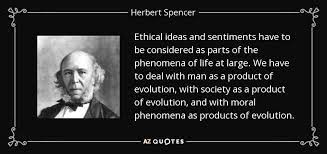
The new morality must be built upon biology. “Acceptance of the doctrine of organic evolution determines certain ethical conceptions.” Huxley, in his Romanes lectures at Oxford in 1893, argued that biology could not be taken as an ethical guide; that “nature red in tooth and claw” (as Tennyson was phrasing it) exalted brutality and cunning rather than justice and love; but Spencer felt that a moral code which could not meet the tests of natural selection and the struggle for existence, was from the beginning doomed to lip-service and futility. Conduct, like anything else, should he called good or bad as it is well adapted, or mal-adapted, to the ends of life; “the highest conduct is that, which conduces to the greatest length, breadth, and completeness of life.” Or, in terms of the evolution formula, conduct is moral according as it makes the individual or the group more integrated and coherent in the midst of a heterogeneity of ends. Morality; like art, is the achievement of unity in diversity; the highest type of man is he who effectively unites in himself the widest variety, complexity, and completeness of life. 

Spencer felt that a moral code which could not meet the tests of natural selection and the struggle for existence, was from the beginning doomed to lip-service and futility. Conduct, like anything else, should he called good or bad as it is well adapted, or mal-adapted, to the ends of life.

This is a rather vague definition, as it must be; for nothing varies so much, from place to place and from time to time, as the specific necessities of adaptation, and therefore the specific content of the idea of good. It is true that certain forms of behavior have been stamped as good—as adapted, in the large, to the fullest life—by the sense of pleasure which natural selection has attached to these preservative, and expansive actions. The complexity of modern life has multiplied exceptions, but normally, pleasure indicates biologically useful, and pain indicates biologically dangerous, activities. Nevertheless, within the broad bounds of this principle, we find the most diverse, and apparently the most hostile, conceptions of the good. There is hardly any item of our Western moral code which is not somewhere held to be immoral; not only polygamy, but suicide, murder of one’s own countrymen, even of one’s parents, finds in one people or another a lofty moral approbation. 

The wives of the Fijian chiefs consider it a sacred duty to suffer strangulation on the death of their husbands. A woman who had been rescued by Williams ‘escaped during the night, and, swimming across the river, and presenting herself to her own people, insisted on the completion of the sacrifice which she had in a moment of weakness reluctantly consented to forego’; and Wilkes tells of another who loaded her rescuer ‘with abuse,’ and ever afterwards manifested the most deadly hatred towards him.” “Livingstone says of the Makololo women, on the shores of the Zambesi, that they were quite shocked to hear that in England a man had only one wife: to have only one was not ‘respectable.’ So, too, in Equatorial Africa, according to Reade, ‘If a man marries, and his wife thinks that he can afford another spouse, she pesters him to marry again; and calls him a “stingy fellow” if he declines to do so.’  

The complexity of modern life has multiplied exceptions, but normally, pleasure indicates biologically useful, and pain indicates biologically dangerous, activities. Nevertheless, within the broad bounds of this principle, we find the most diverse, and apparently the most hostile, conceptions of the good.

Such facts, of course, conflict with the belief that there is an inborn moral sense which tells each man what is right and what is wrong. But the association of pleasure and pain, on the average, with good or evil conduct, indicates a measure of truth in the idea; and it may very well be that certain moral conceptions, acquired by the race, become hereditary with the individual. Here Spencer uses his favorite formula to reconcile the intuitionist and the utilitarian, and falls back once more upon the inheritance of acquired characters. 

The association of pleasure and pain, on the average, with good or evil conduct, indicates a measure of truth in the idea that there is an inborn moral sense which tells each man what is right and what is wrong.

Surely, however, the innate moral sense, if it exists, is in difficulties today; for never were ethical notions more confused. It is notorious that the principles which we apply in our actual living are largely opposite to those which we preach in our churches and our books. The professed ethic of Europe and America is a pacifistic Christianity; the actual ethic is the militaristic code of the marauding Teutons from whom the ruling strata, almost everywhere in Europe, are derived. The practice of dueling, in Catholic France and Protestant Germany, is a tenacious relic of the original Teutonic code. Our moralists are kept busy apologizing for these contradictions, just as the moralists of a later monogamic Greece and India were hard put to it to explain the conduct of gods who had been fashioned in a semi-promiscuous age.

However, the innate moral sense, if it exists, is in difficulties today; for never were ethical notions more confused. It is notorious that the principles which we apply in our actual living are largely opposite to those which we preach in our churches and our books.

Whether a nation develops its citizens on the lines of Christian morality or the Teutonic code depends on whether industry or war is its dominant concern. A militant society exalts certain virtues and condones what other peoples might call crimes; aggression and robbery and treachery are not so unequivocally denounced among peoples accustomed to them by war, as among peoples who have learned the value of honesty and non-aggression through industry and peace. Generosity and humanity flourish better where war is infrequent and long periods of productive tranquillity inculcate the advantages of mutual aid. The patriotic member of a militant society will look upon bravery and strength as the highest virtues of a man; upon obedience as the highest virtue of the citizen; and upon silent submission to multiple motherhood as the highest virtue of a woman. The Kaiser thought of God as the leader of the German army, and followed up his approbation of dueling by attending divine service. The North American. Indians “regarded the use of the bow and arrow, the war-club and spear, as the noblest employments of man. … They looked upon agricultural and mechanical labor as degrading. … Only during recent times—only now that national welfare is becoming more and more dependent on superior powers of production,” and these “on the higher mental faculties, are other occupations than militant ones rising into respectability.”

Whether a nation develops its citizens on the lines of Christian morality or the Teutonic code depends on whether industry or war is its dominant concern.

Now war is merely wholesale cannibalism; and there is no reason why it should not be classed with cannibalism and unequivocally denounced. “The sentiment and the idea of justice can grow only as fast as the external antagonisms of societies decrease, and the internal harmonious cooperations of their members increase.” How can this harmony be promoted? As we have, seen, it comes more readily through freedom than through regulation. The formula of justice should be: “Every man is free to do that which he wills, provided he infringes not the equal freedom of any other man.” This is a formula hostile to war, which exalts authority, regimentation and obedience; it is a formula favorable to peaceful industry, for it provides a maximum of stimulus with an absolute equality of opportunity; it is conformable to Christian morals, for it holds every person sacred, and frees him from aggression; and it has the sanction of that ultimate judge—natural selection—because it opens up the resources of the earth on equal terms to, all, and permits each individual to prosper according to his ability and his work. 

The sentiment and the idea of justice can grow only as fast as the external antagonisms of societies decrease, and the internal harmonious cooperations of their members increase. Harmony comes more readily through freedom than through regulation. The formula of justice should be: “Every man is free to do that which he wills, provided he infringes not the equal freedom of any other man.”

This may seem, at first, to be a ruthless principle; and many will oppose to it, as capable of national extension, the family principle of giving to each not according to his ability, and product, but according to his need. But a society governed on such principles would soon be eliminated. 

During immaturity benefits received must be inversely proportionate to capacities possessed. Within the family-group most must be given where least is deserved, if desert is measured by worth. Contrariwise, after maturity is reached benefit must vary directly as worth: worth being measured by fitness to the conditions of existence. The ill-fitted must suffer the, evils of unfitness, and the well-fitted profit by their fitness. These are the two laws which a species must conform to if it is to be preserved. … If, among the young, benefit were proportioned to efficiency, the, species would disappear forthwith; and if, among adults, benefit were proportioned to inefficiency, the species would disappear by decay in a few generations. …The only justification for the analogy between parent and child, and government and people, is the childishness of the people who. entertain the analogy.

If, among the young, benefit were proportioned to efficiency, the, species would disappear forthwith; and if, among adults, benefit were proportioned to inefficiency, the species would disappear by decay in a few generations.

Liberty contends with Evolution for priority in Spencer’s affections; and Liberty wins. He thinks that as war decreases, the control of the individual by the state loses most of its excuse; and in a condition of permanent peace the state would be reduced within Jeffersonian bounds, acting only to prevent breaches of equal freedom. Such justice should be administered without cost, so that wrong-doers might know: that the poverty of their victims would not shield them from punishment; and all the expenses of the state should be met by direct taxation, lest the invisibility of taxation should divert public attention from governmental extravagance; But “beyond maintaining justice, the state cannot do anything else without transgressing justice”; for it would then be protecting inferior individuals from that natural apportionment of reward and capacity, penalty and incapacity, on which the survival and improvement of the group depend. 

Spencer thinks that as war decreases, the control of the individual by the state loses most of its excuse; and in a condition of permanent peace the state would be reduced within Jeffersonian bounds, acting only to prevent breaches of equal freedom.

The principle of justice would require common ownership of land, if we could separate the land from its improvements. In his first book, Spencer had advocated nationalization of the soil, to equalize economic opportunity; but he withdrew his contention later (much to the disgust of Henry George, who called him “the perplexed philosopher”), on the ground that land is carefully husbanded only by the family that owns it, and that can rely on transmitting to its own descendants the effects of the labor put into it. As for private property, it derives immediately from the law of justice, for each man should be equally free to retain the products of his thrift. The justice of bequests is not so obvious; but the “right to bequeath is included in the right of ownership, since otherwise the ownership is not complete.” Trade should be as free among nations as among individuals; the law of justice should be no merely tribal code, but an inviolable maxim of international relations. 

The principle of justice would require common ownership of land, if we could separate the land from its improvements. Each man should be equally free to retain the products of his thrift. Trade should be as free among nations as among individuals; the law of justice should be no merely tribal code, but an inviolable maxim of international relations. 

These are, in outline, the real “rights of man”—the right to life, liberty, and the pursuit of happiness on equal terms with all. Besides these economic rights, political rights are unimportant unrealities. Changes in the form of government amount to nothing where economic life is not free; and a laissez-faire monarchy is much better than a socialistic democracy. 

Voting being simply a method of creating an appliance for the preservation of rights, the question is whether universality of votes conduces to creation of the best appliance for the preservation of rights. We have seen that it does not effectually secure this end. … Experience makes obvious that which should have been obvious without experience, that with a universal distribution of votes the larger class will inevitably profit at the expense of the smaller class. … Evidently the constitution of the state appropriate to that industrial type of society in which equity is fully realized, must be one in which there is not a representation of individuals but a representation of interests. … It may be that the industrial type, perhaps by the development of cooperative organizations, which theoretically, though not at present practically, obliterate the distinction between employer and employed, may produce social arrangements under which antagonistic class-interests will either not exist, or will be so far mitigated as not seriously to complicate matters. … But with such humanity as now exists, and must for a long time exist, the possession of what are called equal rights will not insure the maintenance of equal rights properly so-called.

These are, in outline, the real “rights of man”—the right to life, liberty, and the pursuit of happiness on equal terms with all. Changes in the form of government amount to nothing where economic life is not free.

Since political rights are a delusion, and only economic rights avail, women are misled when they spend so much time seeking the franchise. Spencer fears that the maternal instinct for helping the helpless may lead women to favor a paternalistic state. There is some confusion in his mind on this point; he argues that political rights are of no importance, and then that it is very important that women should not have them; he denounces war, and then contends that women should not vote because they do not risk their lives in battle—a shameful argument for any man to use who has been born of a woman’s suffering. He is afraid of women because they may be too altruistic; and yet the culminating conception of his book is that industry and peace will develop altruism to the point where it will balance egoism and so evolve the spontaneous order of a philosophic anarchism. 

Spencer is afraid of women because they may be too altruistic; and yet the culminating conception of his book is that industry and peace will develop altruism to the point where it will balance egoism.

The conflict of egoism and altruism (this word, and something of this line of thought, Spencer takes, more or less unconsciously, from Comte) results from the conflict of the individual with his family, his group, and his race. Presumably egoism will remain dominant; but perhaps that is desirable. If everybody thought more of the interests of others than of his own we should have a chaos of curtsies and retreats; and probably “the pursuit of individual happiness within the limits prescribed by social conditions is the first requisite to the attainment of the greatest general happiness.” What we may expect, however, is a great enlargement of the sphere of sympathy, a great development of the impulses to altruism. Even now the sacrifices entailed by parentage are gladly made; “the wish for children among the childless, and the occasional adoption of children, show how needful for the attainment of certain egoistic satisfactions are these altruistic activities.” The intensity of patriotism is another instance of the passionate preference of larger interests to one’s immediate concerns. Every generation of social living deepens the impulses to mutual aid. “Unceasing social discipline will so mould human nature that eventually, sympathetic pleasures will be spontaneously pursued to the fullest extent advantageous to all.” The sense of duty which is the echo of generations of compulsion to social behavior, will then disappear; altruistic actions, having become instinctive through their natural selection for social utility, will, like every instinctive operation, be performed without compulsion, and with joy. The natural evolution of human society brings us ever nearer to the perfect state.

Presumably egoism will remain dominant; but perhaps that is desirable. We may expect a great enlargement of the sphere of sympathy, a great development of the impulses to altruism. The natural evolution of human society brings us ever nearer to the perfect state.

.