
Category Archives: Mathematics

Comments on Infinity

Infinity

The idea of INFINITY as some unimaginably large degree or amount is not quite accurate.

.

(1) The basic concept underlying INFINITY is, “THAT which has no limits.”

INFINITY:  [Latin, infinitas; prefix in– not + finis boundary, limit, end]

.

(2) We may demonstrate this mathematically as follows.

1 ÷ 1 = 1                            (1 can be taken out of 1, only 1 time)

1 ÷ 0.1 = 10                       (0.1 can be taken out of 1, 10 times)

1 ÷ 0.01 = 100                   (0.01 can be taken out of 1, 100 times)

1 ÷ 0.001 = 1000               (0.001 can be taken out of 1, 1000 times)

1 ÷ 0.0001 = 10,000          (0.0001 can be taken out of 1, 10000 times)

We note that the smaller the divisor, the larger is the quotient. When the divisor is very close to 0, the quotient can be imagined to be very, very large. But as long as it can be defined, it is not infinite.

.

(3) Division tells us how many times a number can be taken out of another number.

For example, 30 ÷ 6 = 5 because, 6 can be taken out of 30 five times with nothing remaining. Let us apply this concept to “division by 0.”

Every time we take 0 out of a quantity the remainder is still that quantity.  Therefore, the number of times we may take 0 out of any quantity is limitless. If a number is N then

N ÷ 0   =    Any number +  (N ÷ 0)  =    Limitless quotient

This gives us the example of infinity as “THAT which has no limits.”

.

(4) Infinity cannot be defined.

Anything defined, by definition, has limits. Considering INFINITY in terms of “some unimaginably large degree or amount” defines it no matter how subtly. This would not be an accurate consideration of infinity, which has no limits.

Anything defined would be “something.” And an absence of something can be defined as “nothing.” Infinity is neither “something” nor “nothing.”

.
MILESTONE 11: Decimal Numbers

The following lessons provide a basic understanding of decimal numbers.

MATH MILESTONE #B6: DECIMAL NUMBERS

A “division” or “ratio” notation is not the only notation possible to express fractions. We may use the place values to the right of ONE to account for fractions. Since the successive place values change by TENS, we call such numbers the DECIMAL NUMBERS.

The place values successively magnify by TENS as one moves to the left. And, the place values successively shrink by a TENS as one moves to the right. Thus, to the right of ONES we have, tenths, hundredths, thousandths, and so on. With these fractional place values we may express fractions to a desired accuracy.

The DECIMAL POINT is used in a decimal to separate the fractional portion. Thus, it appears  to the right of the place value of ONE in the number. It is this decimal notation that we use on calculators and computers.

Computation with decimals follows the same procedure as with the whole numbers. The only additional requirement is keeping the track of the position of the decimal point.

In short, the decimals are a natural extension of the existing whole number system to account for the fractions.

Here are some videos on decimal numbers from Khan Academy.

Adding Decimals (Old)

Subtracting decimals (old)

Dividing decimal

Converting fractions to decimals

.

MILESTONE 10: Fractions (Part II)

Here are some simple lessons on operations with fractions.

MATH MILESTONE #B5: OPERATIONS WITH FRACTIONS

To summarize:

Like fractions are added by adding the numerators. Like fractions are subtracted by subtracting the numerators. The denominator remains the same. To add or subtract unlike fractions, one must convert them to like fractions first.

To convert unlike to like fractions, we first calculate the LCM (least common multiple) of all the unlike denominators.  Then we calculate the equivalent fractions for unlike fractions with the LCM as the new denominator.

To multiply fractions, we simply multiply the numerators together to get the numerator of the product, and multiply the denominators together to get the denominator of the product. To divide by a fraction, we simply multiply by its reciprocal.

In general practice, a fraction in the final answer is expressed in its lowest terms. The lowest terms are obtained by taking all the common factors out of the numerator and the denominator.

A “division” notation is not the only notation possible to express fractions. Another way is to extend the place value notation to account for fractions. That notation is covered under the milestone on DECIMAL NUMBERS.

Here are some videos from Khan Academy on Fractions.

Least Common Multiple

Adding and subtracting fractions

Multiplying fractions (old)

Dividing fractions

.

MILESTONE 9: Fractions (Part I)

Here are some lessons that provide a basic understanding of fractions.

MATH MILESTONE #B4: PROPERTIES OF FRACTIONS

To summarize:

When the division is not exact, a remainder is left after division. The remainder is less than the divisor, and it may be looked upon as a portion of the divisor. Such portions are called fractions. A proper fraction, such as “half,” is always less than one.

In the absence of a proper notation for a quantity less than 1, a fraction is presented as a “dividend over divisor.” These two numbers are called numerator and denominator respectively to emphasize the fact that a fraction is a single quantity even when two numbers are used to represent it.

When a unit is divided into equal number of smaller parts, each part is called a unit fraction. The larger is the number of parts the smaller is each part or unit fraction. The numerator of a unit fraction is always 1. All other fractions are multiples of unit fractions.

In a proper fraction the numerator is less than the denominator making it less than 1. In an improper fraction, the numerator is equal to, or greater than the denominator making it equal to, or greater than 1. Improper fractions may be written as mixed numbers.

Equivalent fractions are those which are written with different numerator/denominator pair, but represent the same portion of a unit. For example, both 1/2 and 2/4 represent “half” of a unit. In such a case, the numerator/denominator pair of a fraction is “magnified” or “shrunk” by the same amount to become the numerator/denominator pair of the equivalent fraction.

Like fractions are multiples of the same unit fraction. Unlike fractions are multiples of different unit fractions. Like fractions may be compared simply by their numerators. To compare unlike fractions, one must convert them to like fractions first.

Here are some related videos from the Khan Academy.

Mixed numbers and improper fractions

Equivalent fractions

.

MILESTONE 8: Factors & Primes

The following lessons provide some basic understanding of factors and prime numbers.

MATH MILESTONE #B3: FACTORS

The use of FACTORS and PRIME NUMBERS has declined in the world of calculators today. However, a conceptual understanding of these concepts leads to insights that calculators and computers cannot provide.                       

The factors are obtained from EXACT DIVISION. The divisor and the quotient are the factors of the dividend. When a number cannot be factored into a pair of smaller numbers then it is a prime number.

A composite number has a unique set of prime factors.

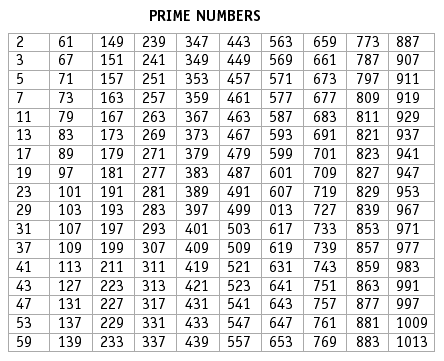
The following is a list of prime numbers to a thousand or so. You may find this list useful.

You may now attempt to find the next ten prime numbers after 1013.

Here are some videos from Khan Academy on this subject.

Prime Numbers

Greatest Common Divisor

.