Author Archives: vinaire

I am originally from India. I am settled in United States since 1969. I love mathematics, philosophy and clarity in thinking.

TAOISM: Augmented Power: Taoist Hygiene and Yoga

Reference: Taoism

[NOTE: In color are Vinaire’s comments.]

Selflessness, cleanliness, and emotional calm are the preliminaries to arriving at full self-knowledge, but they must be climaxed by deep meditation. The result will be a condition of alert waiting known as “sitting with a blank mind.”

Taoist “adepts”—as we shall call the practitioners of this second kind of Taoism because all were engaged in training programs of some sort, many of them demanding—were not willing to settle for the philosophers’ goal of managing their allotments of the Tao efficiently. They wanted to go beyond conserving to increasing the quota of the Tao they had to work with. In accounting terms we can say that if Philosophical Taoists worked at increasing net profits by cutting costs (reducing needless energy expenditures), Taoist adepts wanted to increase gross income. 

Taoist “adepts” want to go beyond conserving to increasing the quota of the Tao they have to work with. 

The word ch’i cries out to be recognized as the rightful entry to this second school, for though it literally means breath, it actually means vital energy. The Taoists used it to refer to the power of the Tao that they experienced coursing through them—or not coursing because it was blocked—and their main object was to further its flow. Ch’i fascinated these Taoists. Blake registered their feelings precisely when he exclaimed, “Energy is delight,” for energy is the life force and the Taoists loved life. To be alive is good; to be more alive is better; to be always alive is best, hence the Taoist immortality cults. 

The word ch’i though it literally means breath, it actually means vital energy. The Taoists use it to refer to the power of the Tao that they experience coursing through them.

To accomplish their end of maximizing ch’i, these Taoists worked with three things: matter, movement, and their minds. Respecting matter, they tried eating things—virtually everything, it would seem—to see if ch’i could be augmented nutritionally. In the course of this experimentation, they developed a remarkable pharmacopia of medicinal herbs, but in a way this was incidental. What they really wanted was not cure but increase—increase and extension of the life force, the ultimate guarantor of which would be the much-sought elixir of life that would insure physical immortality. Sexual experiments were also performed. In one such experiment men hypothesized that if they retained their semen during intercourse by pressing the ball of the thumb against the base of the penis at the moment of ejaculation, thereby diverting the semen into their own bodies, they would absorb the yin of their female partners without dissipating their own yang energy. Breathing exercises were also developed. Working with air, the subtlest form of matter, they sought to draw ch’i from the atmosphere. 

To accomplish their end of maximizing ch’i, these Taoists worked with three things: matter, movement, and their minds. Respecting matter, they tried eating things to see if ch’i could be augmented nutritionally.

These efforts to extract ch’i from matter in its solid, liquid, and gaseous forms were supplemented by programs of bodily movement such as t’ai chi chuan, which gathers calisthenics, dance, meditation, yin/yang philosophy, and martial art into a synthesis that in this case was designed to draw ch’i from the cosmos and dislodge blocks to its internal flow. This last was the object of acupuncture as well.

These efforts to extract ch’i were supplemented by programs of bodily movement such as t’ai chi chuan.

Finally, turning to the mind itself, contemplatives, many of them hermits, developed Taoist meditation. This practice involved shutting out distractions and emptying the mind to the point where the power of the Tao might bypass bodily filters and enter the self directly. 

This third way of increasing ch’i is more abstract than the others, so more needs to be said about it. For the reader who has read this book’s chapter on Hinduism, the quickest gateway to meditational Taoism is to recollect what was said there about raja yoga, the way to God through psychophysical exercises. Whether or not China borrowed from India on this score, the physical postures and concentration techniques of Taoist meditation are so reminiscent of raja yoga that sinologists import the Sanskrit term and call it Taoist yoga. Still, the Chinese gave their yoga a distinctive twist. Their ubiquitous social concern led them to press the possibility that the ch’i that yogis accumulated through meditation could be transmitted psychically to the community to enhance its vitality and harmonize its affairs. Side by side with the Confucianists, who were working on the socializing te of moral example and ritualized etiquette, Taoist yogis sought to harness the Tao directly, drawing it first into their own heart-minds and then beaming it to others. Yogis who managed this feat would for the most part be unnoticed, but their life-giving enterprise did more for the community than the works of other benefactors. 

Turning to the mind itself, many of the Taoists developed Taoist meditation, very similar to the raja yoga of Hinduism. Chinese give their yoga a distinctive twist of transmitting the ch’i accumulated through meditation, psychically, to the community to enhance its vitality.

We border on Philosophical Taoism here because animating this yogic Taoism was a dawning fascination in China with the inner as opposed to the outer self. Children do not separate these two sides of their being, and neither did early peoples. Yogic or meditational Taoism arose as the advancing self-consciousness of the Chinese brought subjective experience to full view. Novel, momentous, exciting, this world of the inner self invited exploration. So enthralling did it appear to its early explorers that matter suffered by comparison; it was mere shell and accretion. Still, the inner world housed a problem. Successive deposits of worry and distraction so silted the soul that their deposits had to be removed until “the self as it was meant to be” could surface. Pure consciousness would then appear, and the individual would see not merely “things perceived” but “that by which we perceive.” 

This yogic Taoism was a dawning fascination in China with the inner as opposed to the outer self. Children do not separate these two sides of their being, and neither did early peoples. 

To arrive at this inwardness it was necessary to reverse all self-seeking and cultivate perfect cleanliness of thought and body. Pure spirit can be known only in a life that is “garnished and swept.” Only where all is clean will it reveal itself; therefore “put self aside.” Perturbing emotions must likewise be quelled. Ruffling the surface of the mind, they prevent introspection from seeing past them to the springs of consciousness beneath. (The proximity to Philosophical Taoism is becoming strong.) Desire and revulsion, grief and joy, delight and annoyance—each must subside if the mind is to return to its original purity, for in the end only peace and stillness are good for it. Let anxiety be dispelled and harmony between the mind and its cosmic source will come unsought.

It is close at hand, stands indeed at our very side; yet is intangible, a thing that by reaching for cannot be got. Remote it seems as the furthest limit of the Infinite. Yet it is not far off; every day we use its power. For the Way of the Vital Spirit fills our whole frames, yet man cannot keep track of it. It goes, yet has not departed. It comes, yet is not here. It is muted, makes no note that can be heard, yet of a sudden we find that it is there in the mind. It is dim and dark, showing no outward form, yet in a great stream it flowed into us at our birth.

To arrive at this inwardness it was necessary to reverse all self-seeking and cultivate perfect cleanliness of thought and body. Pure spirit can be known only in a life that is “garnished and swept.” This approach is very similar to Buddhism.

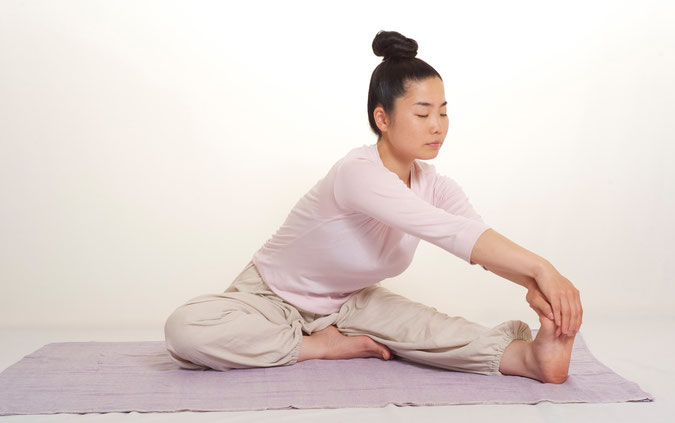
Selflessness, cleanliness, and emotional calm are the preliminaries to arriving at full self-knowledge, but they must be climaxed by deep meditation. “Bide in silence, and the radiance of the spirit shall come in and make its home.” For this to happen all outward impressions must be stilled and the senses withdrawn to a completely interior point of focus. Postures paralleling the Indian asanas were recommended, and the breath must be similarly controlled; it must be as soft and light as that of an infant, or even an embryo in the womb. The result will be a condition of alert waiting known as “sitting with a blank mind.”

Selflessness, cleanliness, and emotional calm are the preliminaries to arriving at full self-knowledge, but they must be climaxed by deep meditation. The result will be a condition of alert waiting known as “sitting with a blank mind.”

And when the realization arrives, what then? With it come truth, joy, and power. The climactic insight of meditational Taoism came with the impact of finality, everything at last having fallen into place. The condition could not be described as merely pleasurable. The direct perception of the source of one’s awareness as “serene and immovable, like a monarch on a throne,” brought joy unlike any hitherto known. The social utility of the condition, however, lay in the extraordinary power it provided over people and things, a power in fact which “could shift Heaven and Earth.” “To the mind that is still, the whole universe surrenders.” We have spoken of India in connection with this psychic power, but St. John of the Cross offers an identical promise: “Without labor you shall subject the peoples, and things shall be subject to you.” Without lifting a finger overtly, a ruler who was adept in “stillness” could order a whole people with his mystical-moral power. A ruler who is desireless himself and has this much psychic power automatically turns his subjects from their unruly desires. He rules without even being known to rule.

The sage relies on actionless activity;
Puts himself in the background; but is always to the fore.
Remains outside; but is always there.
Is it not just because he does not strive for any personal end
That all his personal ends are fulfilled?

The climactic insight of meditational Taoism came with the impact of finality, everything at last having fallen into place. The social utility of the condition, however, lay in the extraordinary power it provided over people and things.

The Taoist yogis recognized that they could not hope for much understanding from the masses, and they made no attempt to publicize their position. When they did write their words tended to be veiled and cryptic, open to one interpretation by initiates and another by the general public. Part of the reason they wrote this way doubtless stemmed from their sensitivity to the lampooning that mysticism attracts from the uncongenial. We find even Chuang Tzu burlesquing their breathing exercises, reporting that these people “expel the used air with great energy and inhale the fresh air. Like bears, they climb trees in order to breathe with greater ease.” Mencius joined in the fun. He likened those who sought psychic shortcuts to social harmony to impatient farmers who tug gently on their crops each night to speed their growth. Despite such satire Taoist yoga had an appreciable core of practitioners. Some sinologists consider it the basic perspective from which the Tao Te Ching was written. If this is true it is a testament to the veiled language of the book, for it is usually read in the philosophical way we shall come to. Before we turn to that way, however, we must introduce the third major branch of Taoism, which is religious.

Taoist Yoga was lampooned by critics. The Taoist yogis recognized that they could not hope for much understanding from the masses, and they made no attempt to publicize their position. 

.
TAOISM: Efficient Power: Philosophical Taoism

Reference: Taoism

[NOTE: In color are Vinaire’s comments.]

To live wisely is to live in a way that conserves life’s vitality by not expending it in useless, draining ways. “Wu wei” is a phrase that translates literally as inaction but in Taoism means pure effectiveness. 

Unlike Religious Taoism, which became a full-fledged church, Philosophical Taoism and the “vitalizing Taoisms,” as we shall clumsily refer to the second group, remain relatively unorganized. Philosophical Taoism is reflective and the vitalizing programs active, but no more than the Transcendentalist movement in New England or contemporary physical fitness programs are they formally institutionalized. They share a second similarity in that both are self-help programs. Teachers are involved, but they are better thought of as coaches who train their students—guiding them in what they should understand, in the case of Philosophical Taoism, and in what they should do in the vitalizing regimens. In decided contrast to Religious Taoists, those in these first two camps work primarily on themselves. 

Philosophical Taoism is reflective and relatively unorganized. Its nature is self-help and people work primarily on themselves. Coaches are involved who guide their students.

The differences between them have to do with their respective stances toward the power of the Tao on which life feeds. To put the difference pointedly, Philosophical Taoists try to conserve their te by expending it efficiently, whereas “vitality” Taoists work to increase its available supply. 

Life feeds on the power of the Tao. Philosophical Taoists try to conserve their te (power) by expending it efficiently.

Because Philosophical Taoism is essentially an attitude toward life, it is the most “exportable” Taoism of the three, the one that has the most to say to the world at large, and as such will receive the longest treatment—not until the second half of this chapter, however. Here we shall only identify it to place it in its logical position before proceeding with its two sister Taoisms. 

Because Philosophical Taoism is essentially an attitude toward life, it is the most “exportable” Taoism of the three, the one that has the most to say to the world at large.

Called School Taoism in China, Philosophical Taoism is associated with the names of Lao Tzu, Chuang Tzu, and the Tao Te Ching. We can connect it with power by remembering that philosophy seeks knowledge and, as Bacon told the world pointedly, “knowledge is power”; to know how to repair a car is to have power over it. Obviously, the Taoists’ eyes were not on machines; it was life that they wanted to repair. Knowledge that empowers life we call wisdom; and to live wisely, the Taoist philosophers argued, is to live in a way that conserves life’s vitality by not expending it in useless, draining ways, the chief of which are friction and conflict. We shall examine Lao Tzu and Chuang Tzu’s prescriptions for avoiding such dissipations in the second half of this chapter, but we can anticipate a single point here. Their recommendations revolve around the concept of wu wei, a phrase that translates literally as inaction but in Taoism means pure effectiveness. Action in the mode of wu wei is action in which friction—in interpersonal relationships, in intrapsychic conflict, and in relation to nature—is reduced to the minimum. 

To live wisely is to live in a way that conserves life’s vitality by not expending it in useless, draining ways. “Wu wei” is a phrase that translates literally as inaction but in Taoism means pure effectiveness. 

We turn now to the vitality cults as our second species of Taoism.

.

TAOISM: Three Approaches to Power and the Taoisms That Follow

Reference: Taoism

[NOTE: In color are Vinaire’s comments.]

We have seen that the first of these substantive terms, the Way, can be taken in three senses. Now we must add that this is also true of the second substantive term, power. 

Tao Te Ching, the title of Taoism’s basic text, has been translated The Way and Its Power. We have seen that the first of these substantive terms, the Way, can be taken in three senses. Now we must add that this is also true of the second substantive term, power. 

Corresponding to the three ways te or power can be approached, there have arisen in China three species of Taoism so dissimilar that initially they seem to have no more in common than homonyms, like blew/blue or sun/son, that sound alike but have different meanings. We shall find that this is not the case, but first the three species must be distinguished. 

Two have standard designations, Philosophical Taoism and Religious Taoism respectively; and because many more people were involved with Religious Taoism it is often called Popular Taoism as well. 

The third school (which will come second in our order of presentation) is too heterogeneous to have acquired a single title. Its population constitutes an identifiable cluster, however, by virtue of sharing a common objective. All were engaged in vitalizing programs that were intended to facilitate Tao’s power, its te, as it flows through human beings.

.

TAOISM: The Three Meanings of Tao

Reference: Taoism

[NOTE: In color are Vinaire’s comments.]

This ineffable and transcendent Tao is the ground of all that follows. It pervades everything, yet itself it cannot be described. It is the way to human life, the universe, and ultimate reality.

On opening Taoism’s bible, the Tao Te Ching, we sense at once that everything revolves around the pivotal concept of Tao itself. Literally, this word means path, or way. There are three senses, however, in which this “way” can be understood. 

The pivotal concept is Tao, which means path, or way.

First, Tao is the way of ultimate reality. This Tao cannot be perceived or even clearly conceived, for it is too vast for human rationality to fathom. The Tao Te Ching announces in its opening line that words are not equal to it: “The Tao that can be spoken is not the true Tao.” Nevertheless, this ineffable and transcendent Tao is the ground of all that follows. Above all, behind all, beneath all is the Womb from which all life springs and to which it returns. Awed by the thought of it, the author/editor of the Tao Te Ching bursts recurrently into praise, for this primal Tao confronts him with life’s basic mystery, the mystery of all mysteries. “How clear it is! How quiet it is! It must be something eternally existing!” “Of all great things, surely Tao is the greatest.” But its ineffability cannot be denied, so we are taunted, time and again, by Taoism’s teasing epigram: “Those who know don’t say. Those who say don’t know.”

First, Tao is the way of ultimate reality. This Tao cannot be perceived or even clearly conceived, for it is too vast for human rationality to fathom. 

Though Tao is ultimately transcendent, it is also immanent. In this secondary sense it is the way of the universe, the norm, the rhythm, the driving power in all nature, the ordering principle behind all life. Behind, but also in the midst of all life, for when Tao enters this second mode it “assumes flesh” and informs all things. It “adapts its vivid essence, clarifies its manifold fullness, subdues its resplendent luster, and assumes the likeness of dust.” Basically spirit rather than matter, it cannot be exhausted; the more it is drawn upon, the more it flows, for it is “that fountain ever on,” as Plotinus said of his counterpart to the Tao, his One. There are about it marks of inevitability, for when autumn comes “no leaf is spared because of its beauty, no flower because of its fragrance.” Yet, ultimately, it is benign. Graceful instead of abrupt, flowing rather than hesitant, it is infinitely generous. Giving life to all things, it may be called “the Mother of the World.” As nature’s agent Tao in this second form resembles Bergson’s elan vital; as nature’s orderer, it resembles the lex aeterna of the Classical West, the eternal law that structures the world. Charles Darwin’s colleague, George Romanes, could have been speaking of it when he referred to “the integrating principle of the whole—the Spirit, as it were, of the universe—instinct without contrivance, which flows with purpose.” 

In this secondary sense it is the way of the universe, the norm, the rhythm, the driving power in all nature, the ordering principle behind all life.

In its third sense Tao refers to the way of human life when it meshes with the Tao of the universe as just described. Most of what follows in this chapter will detail what the Taoists propose that this way of life should be. First, however, it is necessary to point out that there have been in China not one but three Taoisms.

In its third sense Tao refers to the way of human life when it meshes with the Tao of the universe as just described. 

.

TAOISM: The Old Master

Reference: Taoism

[NOTE: In color are Vinaire’s comments.]

The Old Boy didn’t preach. He didn’t organize or promote. He wrote a few pages on request, rode off on a water buffalo, and that was it as far as he was concerned. And yet, whether the story of his life is fact or fiction, it is so true to Taoist attitudes that it will remain a part of Taoism forever.

No civilization is monochrome. In China the classical tones of Confucianism have been balanced not only by the spiritual shades of Buddhism but also by the romantic hues of Taoism.

The Old Master

According to tradition Taoism (pronounced Dowism) originated with a man named Lao Tzu, said to have been born about 604 B.C. He is a shadowy figure. We know nothing for certain about him and scholars wonder if there ever was such a man. We do not even know his name, for Lao Tzu—which can be translated “the Old Boy,” “the Old Fellow,” or “the Grand Old Master”—is obviously a title of endearment and respect. All we really have is a mosaic of legends. Some of these are fantastic: that he was conceived by a shooting star, carried in his mother’s womb for eighty-two years, and born already a wise old man with white hair. Other parts of the story do not tax our credulity: that he kept the archives in his native western state, and that around this occupation he wove a simple and unassertive life. Inferences concerning his personality derive almost entirely from a single slim volume that is attributed to him. From this some conclude that he was probably a solitary recluse who was absorbed in occult meditations; others picture him as down to earth—a genial neighbor with a lively sense of humor. 

Nothing is known about originator of Taoism, except for the slim volume he wrote and the title “Lao Tzu”—which can be translated as “the Old Fellow.” 

The only purportedly contemporary portrait, reported by China’s first historian, Ssu-ma Ch’ien, speaks only of the enigmatic impression he left—the sense that he possessed depths of understanding that defied ready comprehension. According to this account Confucius, intrigued by what he had heard of Lao Tzu, once visited him. His description suggests that the strange man baffled him while leaving him respectful. “I know a bird can fly; I know a fish can swim; I know animals can run. Creatures that run can be caught in nets; those that swim can be caught in wicker traps; those that fly can be hit by arrows. But the dragon is beyond my knowledge; it ascends into heaven on the clouds and the wind. Today I have seen Lao Tzu, and he is like the dragon!” 

The only account available of Lao Tzu leaves an enigmatic impression that he possessed depths of understanding that defied ready comprehension. 

The traditional portrait concludes with the report that Lao Tzu, saddened by his people’s disinclination to cultivate the natural goodness he advocated and seeking greater personal solitude for his closing years, climbed on a water buffalo and rode westward toward what is now Tibet. At the Hankao Pass a gatekeeper, sensing the unusual character of the truant, tried to persuade him to turn back. Failing this, he asked if the “Old Boy” would not at least leave a record of his beliefs to the civilization he was abandoning. This Lao Tzu consented to do. He retired for three days and returned with a slim volume of five thousand characters titled Tao Te Ching, or The Way and Its Power. A testament to humanity’s at-home-ness in the universe, it can be read in half an hour or a lifetime, and remains to this day the basic text of Taoist thought. 

As he was leaving to seek greater personal solitude for his closing years, at the request of the gate keeper, he wrote  a slim volume of five thousand characters titled Tao Te Ching, or The Way and Its Power.

What a curious portrait this is for the supposed founder of a religion. The Old Boy didn’t preach. He didn’t organize or promote. He wrote a few pages on request, rode off on a water buffalo, and that was it as far as he was concerned. How unlike the Buddha, who trudged the dusty roads of India for forty-five years to make his point. How unlike Confucius, who pestered dukes and princes, trying to gain an administrative foothold (or at least a hearing) for his ideas. Here was a man so little concerned with the success of his surmises, to say nothing of fame and fortune, that he didn’t even stay around to answer questions. And yet, whether the story of his life is fact or fiction, it is so true to Taoist attitudes that it will remain a part of Taoism forever. Emperors would claim this shadowy figure as their ancestor, and even scholars—though they do not see the Tao Te Ching as having been written by a single hand and do not think it attained the form in which we have it until the second half of the third century B.C.—concede that its ideas cohere to the point where we must posit the existence of someone under whose influence the book took shape, and have no objection to our calling him Lao Tzu.

The Old Boy didn’t preach. He didn’t organize or promote. He wrote a few pages on request, rode off on a water buffalo, and that was it as far as he was concerned. And yet, whether the story of his life is fact or fiction, it is so true to Taoist attitudes that it will remain a part of Taoism forever.

.