Author Archives: vinaire

I am originally from India. I am settled in United States since 1969. I love mathematics, philosophy and clarity in thinking.

MILESTONE 8: Factors & Primes

The following lessons provide some basic understanding of factors and prime numbers.

MATH MILESTONE #B3: FACTORS

The use of FACTORS and PRIME NUMBERS has declined in the world of calculators today. However, a conceptual understanding of these concepts leads to insights that calculators and computers cannot provide.                       

The factors are obtained from EXACT DIVISION. The divisor and the quotient are the factors of the dividend. When a number cannot be factored into a pair of smaller numbers then it is a prime number.

A composite number has a unique set of prime factors.

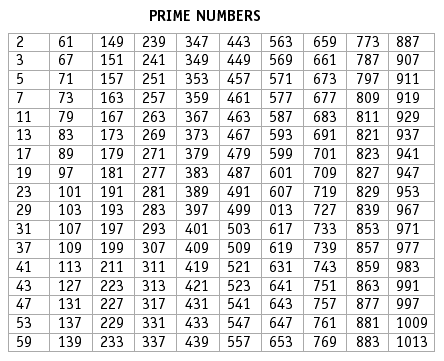
The following is a list of prime numbers to a thousand or so. You may find this list useful.

You may now attempt to find the next ten prime numbers after 1013.

Here are some videos from Khan Academy on this subject.

Prime Numbers

Greatest Common Divisor

.

MILESTONE 7: Integers

The following lessons provide some basic understanding of Integers.

MATH MILESTONE #B2: INTEGERS

Mathematics of integers appears to be quite troublesome to most students. But when we look at it as arithmetic with increase and decrease from zero, it becomes easy to grasp.

Confusion takes place because “plus” and “minus,” which represent operations between two numbers, are also used to show a number as “positive” or ‘”negative.” This becomes clear when integers are defined as being referenced from zero.

–1   =    0 – 1

+1   =    0 + 1

This allows us to convert “positive” or ‘”negative” signs into “plus” and “minus” operations, and vice versa.

Furthermore, confusion arises when “plus” and “minus” operate on “positive” and “negative” numbers, giving consecutive signs. However, once we understand that LIKE consecutive signs produce a positive number…

– (–1)      =     +1

+ (+1)      =     +1

…and UNLIKE consecutive signs produce a negative number, the operations are greatly simplified.

– (+1)      =     –1

+ (–1)      =     –1

Here are some videos from Khan Academy on the subject of Integers.

Negative Numbers Introduction

Adding/Subtracting negative numbers

Multiplying and dividing negative numbers

.

Some Directed Processes

These are some directed processes, in the sense that one may look as directed by these processes. These processes may be done in conjunction with 12 STEPS OF MINDFULNESS. They may go to conclusion quite fast.

Please keep in mind that, in looking, one simply recognizes what is there. If nothing is there then one recognizes that nothing is there.

.

KHTK Process #1

“Look around in your mind and spot something that is trying to grab your attention.”

“Accept it non-judgmentally, and experience it without resisting.”

Repeat these steps until there is nothing new that is trying to grab your attention.

.

KHTK Process #2

“Look around in your mind and spot something there.”

“Accept it non-judgmentally, and experience it without resisting.”

Repeat these steps until there is nothing new to spot.

.

KHTK Process #3

“Look around in your mind and spot unfinished communication that is hanging around.”

“Accept it non-judgmentally, and experience it without resisting.”

Repeat these steps until no unfinished communication is hanging around.

.

KHTK Process #4

“Spot something that another may not want to look at.”

“Accept it non-judgmentally, and experience it without resisting.”

Repeat these steps until nothing new is coming up.

“Spot something that others may not want to look at.”

“Accept it non-judgmentally, and experience it without resisting.”

Repeat these steps until nothing new is coming up.

“Spot something that you may rather not look at.”

“Accept it non-judgmentally, and experience it without resisting.”

Repeat these steps until nothing new is coming up.

.

KHTK Process #5

“Spot something in your mind that is exhausting to look at.”

“Accept it non-judgmentally, and experience it without resisting.”

Repeat these steps until nothing new is coming up.

.

KHTK Process #6

“Spot something in your mind that you are willing to re-experience.”

“Accept it non-judgmentally, and experience it without resisting.”

Repeat these steps until nothing new is coming up.

“Spot a postulate you made for future that you would be willing to experience.”

“Accept it non-judgmentally, and experience it without resisting.”

Repeat these steps until nothing new is coming up.

.

KHTK Process #7

“Spot something that you or somebody wouldn’t mind forgetting.”

“Accept it non-judgmentally, and experience it without resisting.”

Repeat these steps until nothing new is coming up.

.

KHTK Process #8

“Spot something that you or somebody would permit to have happen again.”

“Accept it non-judgmentally, and experience it without resisting.”

Repeat these steps until nothing new is coming up.

.

Glossary

Directed Process
A directed process simply provides some assistance to a person in looking, with the proviso that the process does not imply that there must be something to be found in that direction.

.

MILESTONE 6: Mixed Operations

To practice Mixed Operations, go to the link

MATH MILESTONE # B1: MIXED OPERATIONS

When the various operations of addition, subtraction, multiplication and division are present together in an arithmetic expression we have mixed operations.

Counting is the beginning of computation.

Addition is “counting together,” and therefore, it is an operation of first order. Subtraction, being opposite, or inverse, of addition, is also an operation of first order.

When addition and subtraction are present together they may be carried out from left to right in that sequence. An operation on the right may be carried out first only when there is addition to its left.

Multiplication consists of repeated additions. Therefore, multiplication is an operation of second order. Division, being opposite, or inverse, of multiplication is also an operation of second order.

When multiplication and division are present together they may be carried out from left to right in that sequence.

In mixed operations, second order operations always take priority over first order operations.

Multiplication, division, and parentheses (which group operations) make up the individual terms. “Plus” and “minus” separate the individual terms from each other in an arithmetic expression.

Always compute the individual terms first before you compute the arithmetic expression completely.

Thus, the concept of terms automatically enforces the precedence of second order operations over first order operations.

Understanding this logic involved in reducing mixed operations is very important. Only when you understand this logic, do the various “formulas” about the precedence of operations make sense.

Here are some videos on this subject from Khan Academy.

Introduction to Order of Operations

More Complicated Order of Operations Example

 .

MILESTONE 5: Division

To practice division mentally, go to

MATH MILESTONES #A5: DIVISION

Division is the opposite of multiplication. If you already know the various techniques of multiplication, you can learn to divide easily.

Suppose there are 30 pennies on the table. How many times can you take 6 pennies out? Picture yourself taking out 6-pennies at a time. You can do so 5 times only before no pennies are left on the table. You may also observe that 6 pennies multiplied 5 times results in 30 pennies

Now tell me rapidly: Out of 30 pennies, how many times can you take out

  • 5 pennies ?
  • 30 pennies ?
  • 1 penny ?
  • 0 pennies ?

If you thought of 30 divided by 0 to be “30” or “0” then you need to review the definition of Division. Once again imagine that there are 30 pennies on the table. Now take out 0 pennies. How many are left? 30 pennies are left, correct? Now take out 0 again, and again, and again. You may do so hundreds of times, and still there will be 30 pennies left on the table. Can you see that you may take 0 out of 30 an unlimited number of times? In other words, 30 divided by 0 is infinity.

The operation of division computes how many times a quantity (divisor) can be taken out of another quantity (dividend). That result is called the quotient.

When the division is exact, that is to say, the divisor can be taken out of the dividend an exact number of times, the divisor is called a factor of the dividend.

When the division is not exact, a remainder is left after division. When the remainder is further divided by the divisor into portions less than a unit, then we get fractions.

Both factors and fractions are taken up in subsequent milestones.

A proper understanding of division helps one round up all the earlier concepts in math. By the time one completes the Elementary School, one should have developed the ability of divide mentally with single digit numbers. This understanding then forms the basis of middle school math.

Here are some videos from the Khan Academy that explain division:

Division 1

Division 2

Division 3: More long division and remainder examples

Level 4 division

Partial Quotient Division

Partial Quotient Method of Division 2

.