
-
Pages
-
Categories
-
Posts by Month
-
Recent Comments
- vinaire on PM Chapter 20: The Factors
- egonegator on PM Chapter 20: The Factors
- vinaire on SCN 8-8008: Postulate Processing
- Anonymous on SCN 8-8008: Postulate Processing
- vinaire on SCN 8-8008: Postulate Processing
- Anonymous on SCN 8-8008: Postulate Processing
- Anonymous on SCN 8-8008: Postulate Processing
- vinaire on Introduction to Looking
- vinaire on Introduction to Looking
- Anonymous on Introduction to Looking
- Follow Vinaire's Blog on WordPress.com
-
Top Posts & Pages
-
Administration
Author Archives: vinaire
Speed of Light (old)

Reference: Speed of Light Essays
The speed of light seems to be a property of space, but then space itself is not absolute. It appears that the constancy of speed of light is only a working assumption at the moment. This assumption may be improved in the future.
Here are some arguments:
(1) When we are moving in space we measure our velocity with respect to some fix coordinates of space. We then measure the velocity of another body with respect to the same fixed coordinates of space. These two objects, when they approach each other.with the same velocity, have a relative velocity of twice that value.
(2) When we measure the velocity of light it is always at a constant rate, regardless of how fast we move towards or away from a source of light. This means that light is not something that is moving with respect to some fixed coordinates of space. Light itself is a property of space, just as those fixed coordinates are.
(3) Thus, electromagnetic energy seems to be a phenomenon of space. Looking at the wave/particle properties being demonstrated by most things, particles may then be considered to be a phenomenon of space as well. Particles popping out of space and then disappearing back would then make sense. Mass being formed out of space would also make sense.
(4) In short, we may be looking at a phenomenon of which space, energy, and mass are simply different aspects. The transitions among space-energy-mass seem to be accounted by the aspect of time.
(5) Thus, space, energy, mass and time are all interrelated. The dimensions of space and time are not independent of energy and mass.
(6) Light energy is represented by a transverse wave having the properties of wavelength, period and frequency. Wavelength and period are defined by the dimensions of space and time respectively. Space and time are related to energy through the wave function.
(7) The characteristic of light is best described by its frequency. The frequency spectrum extends to all types of electromagnetic radiation. Using de Broglie’s hypothesis we may extend this spectrum to mass particles as well.
(8) The frequency of gamma rays appears at the upper end of the electromagnetic spectrum, and it is of the order of 10^19 (or 2^64.7) Hz. The de Broglie frequency of 220,000 eV electron moving at 0.9c is 2^65.4 Hz. NOTE: It is convenient to express frequency on a logarithmic scale as a power of 2, and prefix it with DL (disturbance level). On this logarithmic scale, the frequency of gamma ray and electron will appear at DL64.7 and DL65.4 respectively.
(9) We are making our observations of light from a frame of reference defined by earth. The frequency of visible light is at about DL49, whereas the de Broglie “frequency” associated with earth is at about DL182. These two frequency levels are so far apart that if there are any variations in the speed of light due to its frequency, it would be practically imperceptible in the frame of reference of earth.
(10) The wavelength and period of light may appear different in different frames of reference. The time-space-energy-mass phenomenon may best be described by frequency on the DL scale.
Hopefully these ideas provide a new basis from which to look at the phenomena of Space, Time, Energy and Mass.
.
The Boundary of the Universe
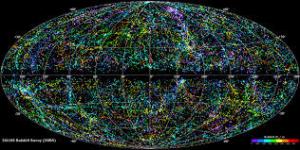
The universe seems to have a boundary even when it is considered to be infinite. This is because there is a limit to what one can be aware of. Thus one’s awareness seems to establish a boundary beyond which there is non-awareness.
This boundary is very likely made up of decreasing awareness of what is there. These gradients of decreasing awareness ultimately disappear into non-awareness.
We may assume the shape of this boundary of awareness to be spherical or close to being spherical. As the outer form of awareness is light, we may assume this outer boundary to be made up of light, which encloses the universe.
In any case, the surface of the universe, thus created by awareness and light, is most likely to be curved and having a convex appearance. This means that light or EMR at the boundary must curve onto itself. We suppose that light travels in straight lines, but it seems possible that light has a curvature even when it is imperceptible.
It is conjectured that as the frequency of EMR increases, its curves upon itself more sharply. Thus, it may be postulated that the volume enclosed by EMR decreases, and the density increases, with increasing frequency.
The electronic shells in an atom and its nucleus may ultimately be the result of this condensation of EMR.
When the EMR curves upon itself it also seems to lock up as a “standing wave.” This gives rise to quantum levels, as visible in the electronic shells of an atom.
.
The KHTK Factors (old)
Please see A Course on Hubbard’s Factors

Scn Factor 1: Before the beginning was a Cause and the entire purpose of the Cause was the creation of effect.
KHTK Factor 1: At the bottom of all existence is a disturbance oscillating between awareness and non-awareness.
NOTE: Cause and effect form a dichotomy that is a part of awareness. Awareness itself is a part of a deeper dichotomy of awareness and non-awareness.
.
Scn Factor 2: In the beginning and forever is the decision and the decision is TO BE.
KHTK Factor 2: The interchanges between non-awareness and awareness give rise to dynamic beingness comprising existence.
NOTE: A transition from non-awareness to awareness appears as creation. Similarly, a transition from awareness to non-awareness appears as destruction. Such transitions give the appearance of awareness changing from one form to another. This is also called survival. Here beingness has the sense of “existingness.”
.
Scn Factor 3: The first action of beingness is to assume a viewpoint.
KHTK Factor 3: The dynamic beingness intrinsically consists of motion and awareness.
NOTE: All motion and awareness are part of the universal beingness. Motion and awareness are two sides of the same coin. When there is motion there is also awareness, and when there is awareness there is also motion. A viewpoint is the narrowing down of awareness, and may be looked upon as a unit of awareness of motion.
.
Scn Factor 4: The second action of beingness is to extend from the viewpoint, points to view, which are dimension points.
KHTK Factor 4: The beingness perceives its form as energy and matter.
NOTE: The beingness has a form made up of energy and matter, where matter is condensation of energy. The beingness is aware of its form.
.
Scn Factor 5: Thus there is space created, for the definition of space is: viewpoint of dimension. And the purpose of a dimension point is space and a point of view.
KHTK Factor 5: Perception separates beingness observed from beingness as observer. This brings about the phenomenon of SPACE.
NOTE: The perception, and the space across which perception takes place, is contained withing the beingness. Using Hubbard’s terminology, the dimension point, viewpoint and space shall all be part of beingness.
.
Scn Factor 6: The action of a dimension point is reaching and withdrawing.
KHTK Factor 6: The beingness changes by the time it perceives itself. This brings about the phenomenon of TIME.
NOTE: Beingness is dynamic so it changes while it perceives itself. Considering the beingness to be a wave of awareness, its wavelength may be looked upon as space and its period as time.
.
Scn Factor 7: And from the viewpoint to the dimension points there are connection and interchange. Thus new dimension points are made. Thus there is communication.
KHTK Factor 7: Space and Time are not absolute but transformable into each other. Thus the motion of the dynamic beingness is denoted by its frequency.
.
Scn Factor 8: And thus there is light.
KHTK Factor 8: The perception across space is denoted by light.
NOTE: The phenomena of perception and space appear to be closely related.
.
Scn Factor 9: And thus there is energy.
KHTK Factor 9: The frequency of beingness expresses energy.
NOTE: Here beingness means “existingness” that is composed of inherent recurring awareness.
.
Scn Factor 10: And thus there is life.
KHTK Factor 10: And thus there is life.
.
Scn Factor 11: But there are other viewpoints and these viewpoints outthrust points to view. And there comes about an interchange amongst viewpoints; but the interchange is never otherwise than in terms of exchanging dimension points.
KHTK Factor 11: Motion and awareness condense to gain individualized forms and qualities, which then combine to generate objects and identities. Motion condenses into atoms that combine to generate objects. Awareness condenses into viewpoints that combine to generate identities.
.
Scn Factor 12: The dimension point can be moved by the viewpoint, for the viewpoint, in addition to creative ability and consideration, possesses volition and potential independence of action; and the viewpoint, viewing dimension points, can change in relation to its own or other dimension points or viewpoints. Thus comes about all the fundamentals there are to motion.
KHTK Factor 12: Objects and identities develop capabilities to interact in complex ways. Objects, such as, cells, are capable of complex interactions. Identities, such as, self of organisms, are capable of complex computations.
.
Scn Factor 13: The dimension points are each and every one, whether large or small, solid. And they are solid solely because the viewpoints say they are solid.
KHTK Factor 13: Solidity of objects and identities, and of the complex interactions among them, comes from increasingly condensing patterns of motion and awareness.
.
Scn Factor 14: Many dimension points combine into larger gases, fluids or solids. Thus there is matter. But the most valued point is admiration, and admiration is so strong its absence alone permits persistence.
KHTK Factor 14: Patterns of motion combine to form the gaseous, fluid and solid states of matter. Patterns of awareness combine to form the various characteristics and abilities. The most important factor is consistency, for the absence of consistency alone brings about unwanted conditions.
.
Scn Factor 15: The dimension point can be different from other dimension points and thus can possess an individual quality. And many dimension points can possess a similar quality, and others can possess a similar quality unto themselves. Thus comes about the quality of classes of matter.
KHTK Factor 15: It is the differences and similarities among the characteristics of matter, and the abilities of organisms, that bring about the classes of beingness.
.
Scn Factor 16: The viewpoint can combine dimension points into forms and the forms can be simple or complex and can be at different distances from the viewpoints and so there can be combinations of form. And the forms are capable of motion and the viewpoints are capable of motion and so there can be motion of forms.
KHTK Factor 16: The patterns of motion and awareness become increasingly complex through interactions; and so we have atoms, cell structures, higher organisms, their characteristics and capabilities.
Note: The viewpoints are a reflection of what is being viewed.
.
Scn Factor 17: And the opinion of the viewpoint regulates the consideration of the forms, their stillness or their motion, and these considerations consist of assignment of beauty or ugliness to the forms and these considerations alone are art.
KHTK Factor 17: All considerations, such as, stillness and motion, beauty and ugliness, are patterns of awareness built into the patterns of motions, and their interactions. They develop into a sense of “I” and opinions.
.
Scn Factor 18: It is the opinions of the viewpoints that some of these forms should endure. Thus there is survival.
KHTK Factor 18: There is a continual change of beingness in its patterns of motion and awareness; but as some of these patterns endure in their forms and opinions there is survival.
.
Scn Factor 19: And the viewpoint can never perish; but the form can perish.
KHTK Factor 19: But even the patterns that endure in their forms and opinions, are bound to change eventually, as there is no underlying permanence.
NOTE: The form and viewpoint are reflection of each other. There is no absolute form or viewpoint independent of each other that can endure forever.
.
Scn Factor 20: And the many viewpoints, interacting, become dependent upon one another’s forms and do not choose to distinguish completely the ownership of dimension points and so comes about a dependency upon the dimension points and upon the other viewpoints.
KHTK Factor 20: All motion and awareness is interconnected. There is no absolute separation. Any sense of “I” and “ownership” is part of the manifestation of the complex patterns of motion and awareness.
NOTE: Viewpoints are not “senior” or “junior” to the forms being viewed. Such opinions are simply a part of what is.
.
Scn Factor 21: From this comes a consistency of viewpoint of the interaction of dimension points and this, regulated, is TIME.
KHTK Factor 21: There is an inherent consistency in all motion and awareness.
NOTE: Any inconsistency in motion and awareness simply stands out. It fixes or disperses the attention.
.
Scn Factor 22: And there are universes.
KHTK Factor 22: The whole system of motion and awareness is the UNIVERSE.
NOTE: In a literal sense, the word UNIVERSE means, “turned into one”. Thus multiple universes are simply subsets of an overall UNIVERSE.
.
Scn Factor 23: The universes, then, are three in number: the universe created by one viewpoint, the universe created by every other viewpoint, the universe created by the mutual action of viewpoints which is agreed to be upheld—the physical universe.
KHTK Factor 23: Separate universes may congeal within the UNIVERSE as the sense of “I” and ownership emerges; but they are still interconnected and never separate.
.
Scn Factor 24: And the viewpoints are never seen. And the viewpoints consider more and more that the dimension points are valuable. And the viewpoints try to become the anchor points and forget that they can create more points and space and forms. Thus comes about scarcity. And the dimension points can perish and so the viewpoints assume that they, too, can perish.
KHTK Factor 24: The sense of “I” and ownership brings about attachments, which create a sense of scarcity and potential loss.
.
Scn Factor 25: Thus comes about death.
KHTK Factor 25: Thus comes about death.
.
Scn Factor 26: The manifestations of pleasure and pain, of thought, emotion and effort, of thinking, of sensation, of affinity, reality, communication, of behavior and being are thus derived and the riddles of our universe are apparently contained and answered herein.
KHTK Factor 26: Pleasure and pain, thought, emotion, effort, thinking, sensation, affinity, reality, communication, behavior and being are all manifestations of these factors.
.
Scn Factor 27: There is beingness, but man believes there is only becomingness.
KHTK Factor 27: Fundamentally, all these manifestations are a continual interplay of awareness and non-awareness; but the attachments to them brings about a desire for permanency where there can be no permanency.
.
Scn Factor 28: The resolution of any problem posed hereby is the establishment of viewpoints and dimension points, the betterment of condition and concourse amongst dimension points, and, thereby, viewpoints, and the remedy of abundance or scarcity in all things, pleasant or ugly, by the rehabilitation of the ability of the viewpoint to assume points of view and create and uncreate, neglect, start, change and stop dimension points of any kind at the determinism of the viewpoint. Certainty in all three universes must be regained, for certainty, not data, is knowledge.
KHTK Factor 28: The resolution of any problem posed hereby lies in seeing things as they are, spotting of the inconsistencies as they present themselves, and resolving them through the practice of mindfulness.
.
Scn Factor 29: In the opinion of the viewpoint, any beingness, any thing, is better than no thing, any effect is better than no effect, any universe better than no universe, any particle better than no particle, but the particle of admiration is best of all.
KHTK Factor 29: There is inherently a relative consistency in all manifestations arising from the continual interplay of awareness and non-awareness; and nothing is ever absolute.
.
Scn Factor 30: And above these things there might be speculation only. And below these things there is the playing of the game. But these things which are written here man can experience and know. And some may care to teach these things and some may care to use them to assist those in distress and some may desire to employ them to make individuals and organizations more able and so give to Earth a culture of which we can be proud.
KHTK Factor 30: Thus we have an eternal stage that stages its own plays eternally.
.
