Author Archives: vinaire

I am originally from India. I am settled in United States since 1969. I love mathematics, philosophy and clarity in thinking.

The Photon

Light theory

Reference: Spacetime 5: A New Model of Atom

Light (electromagnetic radiation) is a disturbance in space. Light spreads uniformly in space in all directions as it moves away from its source. The intensity of light decreases with distance, but the frequency remains the same. Frequency is the only discrete aspect of light. Each cycle of light represents an energy equal to the Planck’s constant ‘h’.

In 1905, Einstein wrote in his paper “On a heuristic point of view concerning production and transformation of light”:

“It seems to me that the observations associated with blackbody radiation, fluorescence, the production of cathode ray by ultraviolet light, and other related phenomena connected with the emission and transformation of light are more readily understood if one assumes that the energy of light is discontinuously distributed in space. In accordance with the assumption to be considered here, the energy of light ray spreading out from a point source is not continuously distributed over an increasing space but consists of a finite number of energy quanta which are localized at points in space, which move without dividing, and which can only be produced and absorbed as complete units.”

Why did Einstein assume light to be discontinuously distributed in space even when this idea was contradictory to the known wave nature of light?

.

The key reason was that Einstein wanted to explain how light of low intensity could still eject electrons instantaneously when shined over some metals. The energy of the electron followed the equation,

V0.e       =       hf  –  φ0

Where 

V0.e represents maximum kinetic energy of electron

hf represents energy supplied by the photon of light

φ0 represents energy consumed in ejecting an electron

This relationship was accurately verified by Robert Millikan in 1914 with great precision.

.

Einstein formulated the idea of light quantum (photon) based on the idea of ‘energy quantum’ suggested by Max Planck five years earlier to explain the blackbody radiation.

When heated, a blackbody radiated light at all frequencies. But the frequency distribution of that radiation could not be explained using the principles of classical physics. Max Planck used the “mathematical idea” of energy quantum to resolve the difficulty.

‘hf’ was the energy quantum suggested by Max Planck that was required to activate an “atomic oscillator” of frequency ‘f’, which then radiated light at that frequency.

.

In photoelectric effect, frequency was involved in ejecting the electron and not the intensity of light. Electron could not be ejected by light below a threshold frequency. Energy of the ejected electron then increased only with increasing frequency. An increasing intensity of light did not eject electrons below the threshold frequency. Above that frequency, the increasing intensity simply increased the number of electrons ejected.

At the threshold frequency f0, light supplied the energy hf0 to the atomic oscillator to release the electron. This energy had to be supplied as a bundle to activate the oscillator. So, the energy supplied by light had to be bundled in space.

.

Robert Millikan, who didn’t agree with Einstein’s particle theory of light, analyzed the absorption of light in photoelectric emission (see Section 9, Theories of Photo Emission, of Millikan’s paper). He noted that his experiments showed exact proportionality between the field strength and the force acting on the electron, which contradicted any kind of discontinuous structure in space. This leaves the only alternative that the energy supplied by light must bundle up within the metal.

Frequency triggers resonance in an oscillator of the atom. The initial amplitude of incident light determines how many of those resonances build up and discharge an electron. The amplitude has decreased as the wave front has spread. But it builds up very quickly in a resonating oscillator. The electron discharges at a certain amplitude of oscillator. Energy imparted to an oscillator per cycle of incident light is ‘h’. The more oscillators are exposed to light, the more energy per cycle is imparted. The oscillator discharges at energy ‘hf’.

If we assume that all oscillators in an area can pool their energy to one central oscillator, and that there is one oscillator per atom, then ‘f’ atoms shall be pooling their energy to eject an electron instantly.

With this assumption we can calculate the amount of potassium required to instantly generate a photo electron. For potassium the threshold frequency is 5.537 x 10¹⁴ Hertz. One mole of potassium is 39 gram, which consists of 6.022 x 10²³ atoms. 5.537 x 10¹⁴ atoms of potassium would weigh 3.59 x 10⁻⁸ gram. This is an extremely small amount.

Thus, when a very weak star light of threshold frequency falls on a very small area on film of potassium, it can easily eject electrons. We may thus assume that photons are generated upon the interaction of light with the photoelectric material, instead of assuming that photon must already exist in space.

The metallic surface must act as an energy lens to the light shining upon it. The energy carried by the wave front of light is then concentrated at the atomic oscillators within the surface as a photon.

We do not really need to postulate a particle theory of light to explain the photoelectric effect. We may simply postulate that the photon is created as part of the energy interaction.

.

Mindfulness 03: Suppression, Interference and Resistance

suppression_by_dyler_turden-d93xypc

ReferenceMindfulness Exercises

Mindfulness is “seeing things as they are.”

It is difficult to see things as they are when there is suppression. Suppression occurs when one is not allowed to be one’s natural self. The natural self is logical and sensible. An illogical person has been suppressed to become that way.

Suppression may come about when a person is too young to understand the situation and he is badly controlled; or when the person finds that there is no recourse available to some obvious and continuing injustice. There can be suppression also when one is continually being harassed and attacked overtly or covertly.

Suppression may get absorbed into one’s thinking. This is the case when one finds one can’t think without interfering with it, or when there is too much resistance involved in one’s thinking.

When one starts to contemplate on suppression in one’s life and in the society around one, the suppression seems to come off in layers. As these layers come off, there comes about increasing understanding and feelings of peace within oneself.

.

MINDFULNESS # 03: Observe suppression, interference and resistance.

Establish the students in mindfulness meditation by calling out the instructions of Mindfulness 0: See Things as They areThen call out the following instructions.

Give out the instructions “one per minute” slowly and clearly. This will give the student some time to settle down with it.

  1. Become aware of any feeling of suppression that might be there.

  2. Observe nonjudgmentally. It is neither good nor bad. It is what it is.

  3. Do not resist anything. Do not suppress anything. Do not interfere with what is there.

  4. Simply become aware of the feeling of suppression and move on.

  5. When it is difficult to move on, simply observe that feeling of suppression more closely. Let further details appear as they may.

  6. Let the realizations come as they may, and move on.

  7. Become aware of any feeling of interference that might be there. Trace it back to underlying suppression. Simply become aware and move on.

  8. Become aware of any feeling of resistance that might be there. Trace it back to underlying suppression. Simply become aware and move on.

  9. Expand your span of attention to your whole life as far back as possible. Let the perceptions pour in.

  10. Become aware of the feelings of suppression, interference and resistance present during various stage of your life.

  11. Expand your span of attention to other people whom you have come across in your life. Let the perceptions pour in.

  12. Become aware of the suppression, interference and resistance that you saw happening with others.

  13. Observe nonjudgmentally. It is neither good nor bad. It is what it is.

  14. Do not resist anything. Do not suppress anything. Do not interfere with what is there.

  15. Simply become aware of the underlying suppression and move on.

  16. When it is difficult to move on, simply observe the suppression more closely. Let further details appear as they may.

  17. Let the realizations come as they may, and move on.

  18. Continue contemplating on suppression, interference and resistance till the end of the meditation session.

.

Science and Matter-centrism

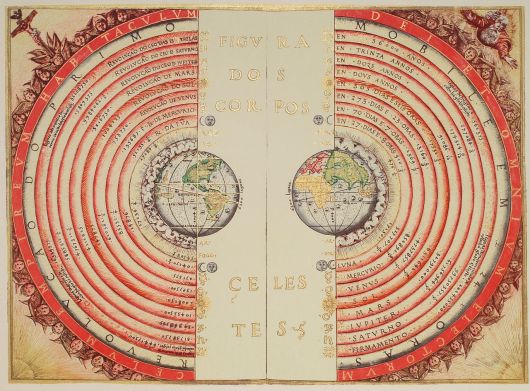
1280px-Bartolomeu_Velho_1568

From Wikipedia article on Copernican heliocentrism:

“Copernican heliocentrism is the name given to the astronomical model developed by Nicolaus Copernicus and published in 1543. It positioned the Sun near the center of the Universe, motionless, with Earth and the other planets rotating around it in circular paths modified by epicycles and at uniform speeds. The Copernican model departed from the Ptolemaic system that prevailed in Western culture for centuries, placing Earth at the center of the Universe, and is often regarded as the launching point to modern astronomy and the Scientific Revolution.”

From Wikipedia article on Galileo Galilei:

“Galileo’s championing of heliocentrism and Copernicanism was controversial within his lifetime, when most subscribed to either geocentrism or the Tychonic system. He met with opposition from astronomers, who doubted heliocentrism due to the absence of an observed stellar parallax. The matter was investigated by the Roman Inquisition in 1615, and they concluded that it could only be supported as a possibility, not as an established fact. Galileo later defended his views in Dialogue Concerning the Two Chief World Systems, which appeared to attack Pope Urban VIII and thus alienated him and the Jesuits, who had both supported Galileo up until this point. He was tried by the Inquisition, found “vehemently suspect of heresy”, forced to recant, and spent the rest of his life under house arrest.”

The geocentric viewpoint was so embedded in the minds of the 17th century scientists that the heliocentric viewpoint took a long time to be accepted. But when finally that happened it created a scientific revolution.

The prevailing viewpoint in science today can aptly be described as matter-centrism. Current science looks at space and energy through the filter of matter. The Theory of Relativity looks at light travelling relative to matter. Quantum Mechanics looks at energy as discrete “particles” in the fashion of matter.

Recently I asked the following question on Quora,

Relative to light, all objects are moving at the “speed of light”. So what is the big deal about a spaceship moving at the speed of light?

This question innocently reversed the prevailing viewpoint on relativity. It looked at matter moving relative to light instead of light moving relative to matter. Nothing else was changed. The “speed of light” remained a universal constant as before.

But the protests were immediate. “Your opening assumption is not consistent with the known physics.” “There is no such thing as the frame of reference of light.” “To say we’re traveling at the speed of light relative to a light ray is superficially true, but irrelevant.” “None of what you said makes sense. That is not how speed of light is defined.” etc.

Why can’t we consider matter moving relative to light? Did Einstein provide a reason against it? Or, did he simply never consider it?

This question put on Quora was definitely jarring, but it was not out of line. Maybe it will improve known physics if we consider matter moving relative to light. There is no reason why light cannot be used as a reference. Our minds are conditioned to using matter as the basis. But we can certainly turn that around and pursue new paths.

If we take the viewpoint that all matter is already traveling at ‘c’ relative to light, then the motion among material objects seems to occur on a different plane. It is as if light forms the bottom of a lake, matter floats on the surface of the lake relative to other matter.

The theory of relativity correctly points out that there is no material aether. That makes space itself a medium in which light appears as a disturbance. This brings about a new concept of “undisturbed space”, which replaces the concept of “void”. The universe is now seen as a disturbance spreading out into undisturbed space.

The undisturbed space appears at the lower end of the light spectrum as frequency approaches zero. Matter then appears at the higher end of the light spectrum where increasing frequency finally collapses.

This Disturbance theory presents a “light-centric” approach, which is no less valid than the “matter-centric” approach. It opens the door to a whole lot of new possibilities. It does not change the “speed of light” as a fundamental constant. That constant can now be seen as the wavelength to period ratio that does not change while frequency changes.

There is nothing unscientific or illogical about the postulates of the Disturbance theory. Its basis rests in the recognition of an assumption that current science makes unwittingly. Recognition of this matter-centric assumption opens the door to a myriads of new possibilities.

This is good for science.

.

Relative Speed of Objects

albert einstein

This undated file photo shows famed physicist Albert Einstein.

Reference: Spacetime 1: Speed and Frequency

We note that the units of space and time are fixed only for matter and not for light. Therefore, the concept of speed does not really apply to light.

Michelson–Morley experiment actually determines the speed of earth relative to light.

The Dutch astronomer De Sitter showed that the “speed of light” does not depend on the speed of the source of light. In this case the speed of the source of light is determined relative to earth. Light seems to serve as the ultimate reference point for speed of stars.

All stars and planet are traveling at the “speed of light” relative to light.

Light seems to have sort of an independent and absolute existence. All objects seems to behave the same way relative to it. The universal constant of “speed of light” needs to be reinterpreted as follows.

The speed of all mass objects relative to light is the constant ‘c’.

This gives us a new perspective on the speed of objects relative to each other.

.

We can no longer dream of objects moving at the speed of light, because they already are doing that. That dream had actually to do with our desire to travel to distant corners of this universe that are light years away.

Can a rocket travel at the “speed of light” relative to earth? This question suddenly acquires very different implications. Speed ‘c’ comes about in reference to light that has zero inertia.

What limiting speed comes about when an object with considerable inertia is used for reference?

The concept of inertia is associated with the resistance that mass puts up to being moved or disturbed. Gravity seems to be a reaction to disturbance that has already taken place.

All mass with inertia seems to be fighting to come back together as a single entity.

Einstein’s General Relativity models mass, momentum, pressure and stress as curvatures within a space measured by meter rods.

This may put a limit to the speed that two mass objects may attain relative to each other.

An understanding of that limit would require a better understanding of inertia, and how it relates to curvature of space.

.

Spacetime without Matter

3047944-poster-p-1-mastering-the-extremely-difficult-art-of-letting-go

We view space from a matter-centric viewpoint. For us space is the distance between two material points. It seems that when there are no material points the concept of space will be entirely different. Without matter, space feels like some sort of vague awareness.

Maybe it is awareness itself that appears as space through the filter of matter.

.

It is the disturbance in space that spreads with alternating electric and magnetic characteristics. It brings about consciousness of what is there by appearing as light.

Maybe it is pure consciousness itself that appears as light through the filter of matter.

.

The electromagnetic characteristics come together as a field. The interplay among frequencies produces various gradients within that field.  Here we see electromagnetic characteristics being knitted together into various shapes.

Maybe it is consciousness shaping itself that appears as electromagnetic field  through the filter of matter.

.

That makes awareness compare to undisturbed space, and consciousness compare to electromagnetic field (disturbed space). Time enters into the picture when space is disturbed. We may compare time to the desire that disturbs awareness to generate consciousness.

The disturbed space spreads out as electromagnetic wave. It may be said that light is simply the spreading of pure consciousness at a universal level.

.

Space may then be viewed as the “fabric” of this universe. The essence of space is awareness.

Time then shapes the universe out of the “fabric” of space. The essence of time is desire.

.