Author Archives: vinaire

I am originally from India. I am settled in United States since 1969. I love mathematics, philosophy and clarity in thinking.

Michelson-Morley’s Null Result (old)

maxresdefault
Reference: Disturbance Theory

Please see Michelson-Morley’s Null Result

“The situation grows more and more serious. Two assumptions have been tried. The first, that moving bodies carry ether along. The fact that the velocity of light does not depend on the motion of the source contradicts this assumption. The second, that there exists one distinguished coordinate system and that moving bodies do not carry the ether but travel through an ever calm ether-sea. If this is so, then the Galilean relativity principle is not valid and the speed of light cannot be the same in every coordinate system. Again we are in contradiction with experiment.”

~ Albert Einstein, Evolution of Physics by Einstein

.

The null results from Michelson-Morley’s experiment in 1887 initiated a line of research that eventually led to Einstein’s theory of Special Relativity. The expected difference between the speed of light in the direction of movement through the presumed aether, and the speed at right angles, was found not to exist. The special relativity then ruled out a stationary aether.

Light seems to have both wave and particle characteristics. As a wave, light requires a medium; and as particles, light requires some system of coordination among particles. In either case, light requires some relationship within its background, which is space, even when there is no aether.

There seems to be an assumption that moving bodies travel through space without resistance. We do not see space. We can only see a body moving relative to another body. How do we know that a body is moving relative to space?

We all know about inertia. Newton defined it as follows:

“The vis insita, or innate force of matter, is a power of resisting by which every body, as much as in it lies, endeavours to preserve its present state, whether it be of rest or of moving uniformly forward in a straight line.”

If we postulate that inertia is the resistance of space to a moving body then a lot of observations fall into place.

  1. When there is acceleration then we know that a body is definitely moving relative to space.

  2. When there is no acceleration then a body’s acceleration is balanced by inertia.

  3. Light has a finite and constant speed because its acceleration is balanced by inertia.

  4. A body has a constant drift speed in space when its acceleration is balanced by its inertia.

  5. The drift speed of any object shall depend on its inertia.

We may then postulate space to be the background of no inertia in which bodies with inertia are drifting at speeds that depend on their inertia.

The difference between the speeds of light and the earth shall be constant because the difference between their inertia is constant. This explains the null result of Michelson-Morley’s experiment.

One may object to the above by saying, “The earth is orbiting the sun. Therefore, it is constantly accelerating in the radial direction towards the sun, but not in the tangential direction. So, there must be a slight difference in speed relative to light in the two directions.”

We may calculate the order of this difference as follows:

  1. The difference between the disturbance levels of the earth and light is roughly 186 (235 – 49). Therefore, the ratio of their frequencies is 2186.

  2. The ratio of their drift speed shall then be 293 or 1028.

  3. The drift speed of the earth shall then be (3 x 10⁸ meters/sec) (10-28) = 3 x 10-20 m/s.

  4. The Michelson-Morley’s experiment is then required to detect a velocity difference of 6 x 10-20 m/s.

So far there has been no Michelson-Morley or another type of experiment that has the level of accuracy to detect the speed of the earth relative to “aether”, which, in this case, is space.

.

Conclusion

Thus, the null result from Michelson-Morley’s experiment is questionable when we consider space to be that elusive aether.

This then also makes the postulates of special relativity questionable when we consider inertia to be the resistance of space to a moving body.

This then limits the validity of the theory of special relativity to the explanation of phenomena where speeds involved are much smaller compared to the speed of light.

.

Comment (1/5/2019):

Moving bodies do not carry aether along because there is no aether. There cannot be stationary aether because only a system of infinite inertia can be stationary.

There is only a very ephemeral form of substance with inertia less than that of light. Light has its own inertia, which determines its velocity. Similarly, the source of light also has inertia that determines its velocity. Each velocity is constant in the coordinate system based on a scale of inertia.

.
Self-Learning Diagnostic #2

Mathblanls
Reference: Critical Thinking in Education

.

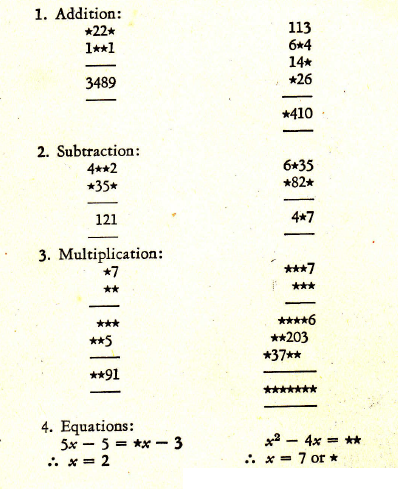
The above is the second “Self-Learning” Diagnostic Test for students in middle school and above

Can you find the illegible numbers represented by the *’s?

The purpose of this diagnostics is to assess the following:

  • Is the student able to move beyond patterned thinking?
  • Can the student think in novel ways to resolve problems?
  • Is the student’s mental math techniques up to par?

Calculators are very useful. They speed up the ability to calculate. But they should augment and not replace a person’s ability to calculate mentally and on paper with pencil. The person should not get so addicted to calculators that he loses his number sense and the gut feeling when computation go wrong.

This exercise may be timed. If the student can do this exercise rapidly and accurately then his attention and self-learning potential are in good shape. No remedy is needed at this level.

If the student is unable to move beyond patterned thinking then he should review the following documents to learn that different ways of thinking are possible.

Mental Math Techniques for Subtraction

Mental Math Techniques for Multiplication

This diagnostic helps locate and fill some of the early holes in the understanding of math. Filling of such holes in a subject restores student’s eagerness to learn.

With eagerness comes the ability to self-learn.


Self-Learning Diagnostic #1

This exercise develops the fundamental thinking skill on which subsequent math skills are built. It fills an early hole in the understanding of math.

It is the first “Self-Learning” Diagnostic Test for students in middle school and above.

Can you compute these three addition problems on paper with pencil?

The purpose of this diagnostics is to assess the following:

  • Is the student’s attention well focused?
  • Is the student confident of his/her answer?
  • Is the student’s mental addition techniques up to par?

In this diagnostics, the student

  1. Adds the numbers from top to bottom to get the sum.
  2. Adds the numbers from bottom to top to verify the sum.
  3. Checks his answers against those provided on the right.
Diagnostic1

This exercise may be timed. If the student can do this exercise rapidly and accurately then his attention and self-learning potential are in good shape. No remedy is needed at this level.

If the student’s focus and confidence in math needs improvement then he should practice mental addition on a gradient as follows.

  1. Practice adding two single-digit numbers.
  2. Practice adding a single-digit number to a double-digit number.
  3. Practice adding two double-digit numbers

It all boils down to knowing the sum of two single-digit numbers. And, for that, there are limited numbers of combinations. The rest is attention and technique.

The techniques for mental addition help develop basic number sense. The student is then able to rapidly add two numbers, while also verifying the sum at the same time. This skill is then carried forward to the rest of the basic math operations. This builds up a confidence that is hard to shake.

The following document provides basic mental addition techniques and exercises. After learning these techniques, the student may develop his own techniques.

Mental Math Techniques for Addition

This diagnostic helps locate and fill one of the early holes in the understanding of math. Filling of such holes in a subject restores student’s eagerness to learn.

With eagerness comes the ability to self-learn.

.

Lorentz transformation

lorentz

Reference: Disturbance Theory

.

From Wikipedia,

“In physics, the Lorentz transformations are coordinate transformations between two coordinate frames that move at constant velocity relative to each other. The transformations are named after the Dutch physicist Hendrik Lorentz.

“Frames of reference can be divided into two groups: inertial (relative motion with constant velocity) and non-inertial (accelerating in curved paths, rotational motion with constant angular velocity, etc.). The term “Lorentz transformations” only refers to transformations between inertial frames, usually in the context of special relativity.”

“Historically, the transformations were the result of attempts by Lorentz and others to explain how the speed of light was observed to be independent of the reference frame.”

Thus, the earth provides one reference frame, and the Sun provides another. Since the earth is moving relative to the sun, one would expect the velocity of light to be slightly different in the two reference frames. However, this difference is practically undetectable from the experiments conducted so far. This resulted in the assumption that speed of light is independent of the reference frame.

Is the assumption that the speed of light is independent of the reference frame, correct?

This assumption will definitely be correct if the speed of light is infinite. But the measurements show that the speed of light is 3 x 10⁸ meters /second. It takes sunlight an average of 8 minutes and 20 seconds to travel from the Sun to the Earth. Why is the speed of light finite?

From the essay, The Inertial Frame and Space,

“The truth seems to be that matter cannot move freely through space.  Matter encounters resistance when pushed through space. This resistance is INERTIA.”

The speed of light is finite because its propagation through space is not without resistance. Light has a limiting speed because its acceleration is balanced by inertia.

The speed ‘c’ of light is the result of a balance of forces.

We know that the earth is always accelerating toward the sun; but it has hit a limiting speed because this acceleration is balanced by its inertia. This may be the case with the speed of all heavenly bodies.

A heavenly body has a limiting speed because its acceleration is balanced by its inertia.

It is the resistance between space and the moving object that limits the speed; therefore, we may use space as the common reference frame for both matter and energy.  This is the SRF (space reference frame) mentioned in The Inertial Frame and Space.

In SRF, the naturally balanced speeds of objects and radiation shall depend on their inertia. Light has a very high speed because its inertia is very small. The speed of the earth is likely to be very small because its inertia is very large. The speed of the sun shall be smaller still because its inertia is much larger than that of the earth.

This means that the speed of light shall be different relative to the earth and the sun.

The speed of light ‘c’ remains a universal constant in SRF. But it is not a constant in the reference frames of material origin.

The assumption that the speed of light is independent of the reference frame (of material origin) is theoretically incorrect.

This brings into question the usefulness of Lorenz transformations that are based on this assumption. This also brings into question those aspects of the Theory of Relativity that utilize Lorentz transformations.

Lorentz transformations have only a limited application.

There cannot be matter traveling at speeds that are significant fractions of the speed of light. Only sub-atomic particles with very small inertia can have speeds anywhere near the speed of light. But in that range more useful than velocities are frequencies, where the ratio of wavelength to period is ‘c’.

In Cosmology, Lorentz transformations may provide good approximations only for relative speeds that are very small compared to the speed of light. That happens to be the case in explaining the aberration of light.

In my opinion, the Theory of Relativity only resolves those difficult problems in physics, where the speeds are relatively very small compared to the speed of light. For larger relative speeds in the material realm, the speed of light cannot be held as a constant.

Lorentz transformations may provide good approximations only for relative speeds that are very small compared to the speed of light.

.


The Problem of Aether

Stellar_aberration_versus_the_dragged_aether
Reference: Disturbance Theory

.

James Bradley’s (1729) explanation for aberration of light became unacceptable in 1804 because light was established to be a wave. It was no longer looked upon as corpuscular, which was assumed earlier by Newton. So, the medium of light (aether) became an issue.

The aberration of light is an astronomical phenomenon which produces an apparent motion of celestial objects about their true positions, dependent on the velocity of the observer.

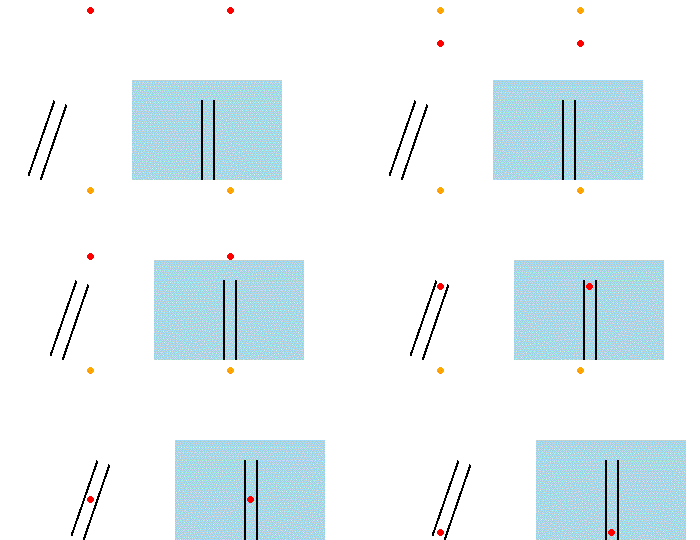
Pre-1800 Corpuscular theory of light – Light was considered to be made up of particles that had inertia and they traveled in straight lines. Aberration of light was explained very simply by James Bradley using this model for light. It was shown that the telescope had to be tilted to capture a vertically descending light particle because earth moved. This created the angle of aberration.

1804 Thomas Young – He proved the wave nature of light through the famous double-slit experiment. This revived investigation into the nature of the medium through which light moved. This medium was viewed as aether that filled all space. It was completely elastic as it could transmit light over infinite distances.

1810 François Arago – He expected the speed of light to be different as corpuscles of light were supposed to be affected differently by the gravity of different stars. But light from different stars produced the same refractive index, and, therefore, had the same velocity. This negated Newton’s corpuscular theory of light, and supported a uniform medium of aether.

1816 Augustin-Jean Fresnel – Since the speed of light was constant in aether, he expected it to have different values relative to earth as earth changed its directions. However, Arago’s results negated that. Therefore, Fresnel postulated that earth’s velocity did account for the aberration of light, but aether was partially dragged at the point of measurement to maintain a constant velocity of light. Fresnel calculated an aether drag coefficient based on the refractive index that seemed to explain the inconsistency.

1887 Michelson & Morley – Earth was expected to have a velocity relative to aether in order to explain the aberration of light. However, the velocity of light was found to be constant regardless of the direction in which earth moved. This created the same inconsistency as the Arago’s experiment, but on a much larger scale.  This could not be explained by Fresnel’s partial ether drag hypothesis.

1905 Albert Einstein – He explained the inconsistency by dropping the aether model and returning to the corpuscular theory of light. This generates questions about the very nature of light. Light cannot be a wave. It cannot be a particle with significant inertia either. The questions now become,

  1. If light is made up of particles that do not require a medium to travel, then how do these particles coordinate their motion?

  2. Matter has relative speeds. Light seems to adjust its speed to ‘c’ relative to any matter. So, how does light and matter coordinate their motion?

  3. Are light particles made up of electromagnetic fields? Do they exist within larger fields? If not, then what do we have?

The theory of relativity is too mathematical and does not seem to answer these questions

.