This paper presents Chapter
1 from the book DIANETICS: THE ORIGINAL THESIS by L. RON HUBBARD.
The contents are from the original publication of this book by The
Hubbard Dianetic Foundation, Inc. (1948).
The paragraphs of the original
material (in black) are accompanied by brief comments (in color) based on the present
understanding. Feedback on these comments is appreciated.
The heading below is linked to
the original materials.
In nineteen thirty-two an investigation was undertaken to
determine the dynamic principle of existence in a workable form which might
lead to the resolution of some of the problems of mankind. A long research in
ancient and modern philosophy culminated, in nineteen thirty-eight, in the
heuristically discovered primary law. A work was written at that time which
embraced man and his activities. In the following years further research was
undertaken in order to prove or disprove the axioms so established.
Certain experiences during the war made it necessary for the
writer to resolve the work into applicable equations and an intensive program
was begun in nineteen forty-five toward this end.
A year later many techniques had been discovered or evolved and a
nebulous form of the present work was formulated. Financed chiefly by a lump
sum disability compensation, that form of Dianetics was intensively applied to
volunteer subjects, and the work gradually developed to its present form.
Dianetics has been under test by the writer, as here delineated,
for the past three years. The last series of random volunteers, numbering
twenty, were rehabilitated, twenty out of twenty, with an average number of
work hours of 151.2 per subject. Dianetics offers the first anatomy of the
human mind and techniques for handling the hitherto unknown reactive mind,
which causes irrational and psychosomatic behavior. It has successfully removed
any compulsions, repressions, neuroses and psychoses to which it has been
applied.
L. R. H. January, 1948
.
.
Final Comments
KEY WORDS: Human Condition, Dianetics, Investigate
When investigating a pervasive condition, one starts as broadly as possible, and establishes certain axioms. These axioms are then resolved into applicable equations and workable techniques. One then tests these techniques and refines them.
In this case that pervasive condition being investigated is the irrational behaviorand psychosomatic condition originating from the mind.
This paper presents Chapter
III, section 4 from the book THE EVOLUTION
OF PHYSICS by A. EINSTEIN and L. INFELD. The contents are from the original
publication of this book by Simon and Schuster, New York (1942).
The paragraphs of the original
material (in black) are accompanied by brief comments (in color) based on the present
understanding. Feedback on these comments is appreciated.
The heading below is linked to
the original materials.
The
electromagnetic wave is a transverse one and is propagated with the velocity of
light in empty space. The fact that their velocities are the same suggests a close
relationship between optical and electromagnetic phenomena.
The electromagnetic wave may appear as “transverse” as it propagates in its domain marked as “spherical surface.” Light may be described as an electromagnetic wave.
When
we had to choose between the corpuscular and the wave theory, we decided in
favour of the wave theory. The diffraction of light was the strongest argument
influencing our decision. But we shall not contradict any of the explanations
of the optical facts by also assuming that the light wave is an electromagnetic one. On the contrary, still other
conclusions can be drawn. If this is really so, then there must exist some connection
between the optical and electrical properties of matter that can be deduced
from the theory. The fact that conclusions of this kind can really be drawn and
that they stand the test of experiment is an essential argument in favour of
the electromagnetic theory of light.
Diffraction of light is an optical property. But, if light is an electromagnetic wave, diffraction may also have an explanation as an electromagnetic property.
This
great result is due to the field theory. Two apparently unrelated branches of
science are covered by the same theory. The same Maxwell’s equations describe
both electric induction and optical refraction. If it is our aim to describe
everything that ever happened or may happen with the help of one theory, then
the union of optics and electricity is, undoubtedly, a very great step forward.
From the physical point of view, the only difference between an ordinary
electromagnetic wave and a light wave is the wave-length: this is very small
for light waves, detected by the human eye, and great for ordinary
electromagnetic waves, detected by a radio receiver.
From the physical point of view, the only difference between an ordinary electromagnetic wave and a light wave is the wave-length: this is very small for light waves, detected by the human eye, and great for ordinary electromagnetic waves, detected by a radio receiver.
The
old mechanical view attempted to reduce all events in nature to forces acting
between material particles. Upon this mechanical view was based the first naive
theory of the electric fluids. The field did not exist for the physicist of the
early years of the nineteenth century. For him only substance and its changes were
real. He tried to describe the action of two electric charges only by concepts
referring directly to the two charges.
In
the beginning, the field concept was no more than a means of facilitating the
understanding of phenomena from the mechanical point of view. In the new field language
it is the description of the field between the two charges, and not the charges
themselves, which is essential for an understanding of their action. The
recognition of the new concepts grew steadily, until substance was overshadowed
by the field. It was realized that something of great importance had happened
in physics. A new reality was created, a new concept for which there was no
place in the mechanical description. Slowly and by a struggle the field concept
established for itself a leading place in physics and has remained one of the
basic physical concepts. The electromagnetic field is, for the modern
physicist, as real as the chair on which he sits.
In the new field language it is the description of the field between the two charges, and not the charges themselves, which is essential for an understanding of their action.
But
it would be unjust to consider that the new field view freed science from the
errors of the old theory of electric fluids or that the new theory destroys the
achievements of the old. The new theory shows the merits as well as the
limitations of the old theory and allows us to regain our old concepts from a
higher level. This is true not only for the theories of electric fluids and
field, but for all changes in physical theories, however revolutionary they may
seem. In our case, we still find, for example, the concept of the electric charge
in Maxwell’s theory, though the charge is understood only as a source of the
electric field. Coulomb’s law is still valid and is contained in Maxwell’s equations
from which it can be deduced as one of the many consequences. We can still
apply the old theory, whenever facts within the region of its validity are
investigated. But we may as well apply the new theory, since all the known
facts are contained in the realm of its validity.
The new theory shows the merits as well as the limitations of the old theory and allows us to regain our old concepts from a higher level. The concept of the electric charge is understood only as a source of the electric field in Maxwell’s theory.
To
use a comparison, we could say that creating a new theory is not like
destroying an old barn and erecting a skyscraper in its place. It is rather
like climbing a mountain, gaining new and wider views, discovering unexpected
connections between our starting-point and its rich environment. But the point
from which we started out still exists and can be seen, although it appears
smaller and forms a tiny part of our broad view gained by the mastery of the
obstacles on our adventurous way up.
It
was, indeed, a long time before the full content of Maxwell’s theory was
recognized. The field was at first considered as something which might later be
interpreted mechanically with the help of ether. By the time it was realized
that this programme could not be carried out, the achievements of the field
theory had already become too striking and important for it to be exchanged for
a mechanical dogma. On the other hand, the problem of devising the mechanical
model of ether seemed to become less and less interesting and the result, in
view of the forced and artificial character of the assumptions, more and more
discouraging.
Our
only way out seems to be to take for granted the fact that space has the
physical property of transmitting electromagnetic waves, and not to bother too much
about the meaning of this statement. We may still use the word ether, but only
to express some physical property of space. This word ether has changed its meaning
many times in the development of science. At the moment it no longer stands for
a medium built up of particles. Its story, by no means finished, is continued by
the relativity theory.
A new theory provides new and wider view that helps discover unexpected connections. The old view of aether has been a medium built up of particles. Maxwell’s theory now provides a new view of aether as the physical property of transmitting electromagnetic waves in space.
.
Final Comment
In the model of an atom, the field may best describe the electronic region of very low mass and the radiation envelope of no mass. At the extreme outer boundary of the radiation envelope shall lie the layer of substance of the least density. This layer may be referred to as aether. This aether would act as the background for spherical surfaces of all different densities. In other words, this aether will be able to contain all possible fields, and transmit electromagnetic waves of all energy densities.
This paper presents Chapter
III, section 3 from the book THE EVOLUTION
OF PHYSICS by A. EINSTEIN and L. INFELD. The contents are from the original
publication of this book by Simon and Schuster, New York (1942).
The paragraphs of the original
material (in black) are accompanied by brief comments (in color) based on the present
understanding. Feedback on these comments is appreciated.
The heading below is linked to
the original materials.
The
quantitative, mathematical description of the laws of the field is summed up in
what are called Maxwell’s equations. The facts mentioned so far led to the
formulation of these equations, but their content is much richer than we have
been able to indicate. Their simple form conceals a depth revealed only by
careful study.
The
formulation of these equations is the most important event in physics since
Newton’s time, not only because of their wealth of content, but also because they
form a pattern for a new type of law.
The
characteristic features of Maxwell’s equations, appearing in all other
equations of modern physics, are summarized in one sentence. Maxwell’s
equations are laws representing the structure
of the field.
Maxwell’s equations are laws representing the structure of the
field.
Why do Maxwell’s equations differ in form and character from the equations of classical mechanics? What does it mean that these equations describe the structure of the field? How is it possible that, from the results of Oersted’s and Faraday’s experiments, we can form a new type of law, which proves so important for the further development of physics?
We
have already seen, from Oersted’s experiment, how a magnetic field coils itself
around a changing electric field. We have seen, from Faraday’s experiment, how
an electric field coils itself around a changing magnetic field. To outline
some of the characteristic features of Maxwell’s theory, let us, for the
moment, focus all our attention on one of these experiments, say, on that of
Faraday. We repeat the drawing in which an electric current is induced by a
changing magnetic field. We already know that an induced current appears if the
number of lines of force, passing the surface bounded by the wire, changes.
Then the current will appear if the magnetic field changes or the circuit is
deformed or moved: if the number of magnetic lines passing through the surface
is changed, no matter how this change is caused. To take into account all these
various possibilities, to discuss their particular influences, would necessarily
lead to a very complicated theory. But can we not simplify our problem? Let us try
to eliminate from our considerations everything which refers to the shape of
the circuit, to its length, to the surface enclosed by the wire. Let us imagine
that the circuit in our last drawing becomes smaller and smaller, shrinking
gradually to a very small circuit enclosing a certain point in space. Then
everything concerning shape and size is quite irrelevant. In this limiting
process where the closed curve shrinks to a point, size and shape automatically
vanish from our considerations and we obtain laws connecting changes of
magnetic and electric field at an arbitrary point in space at an arbitrary
instant.
Thus,
this is one of the principal steps leading to Maxwell’s equations. It is again
an idealized experiment performed in imagination by repeating Faraday’s
experiment with a circuit shrinking to a point.
We
should really call it half a step rather than a whole one. So far our attention
has been focused on Faraday’s experiment. But the other pillar of the field theory,
based on Oersted’s experiment, must be considered just as carefully and in a similar
manner. In this experiment the magnetic lines of force coil themselves around
the current. By shrinking the circular magnetic lines of force to a point, the
second half-step is performed and the whole step yields a connection between the
changes of the magnetic and electric fields at an arbitrary point in space and
at an arbitrary instant.
The Maxwell equations are obtained by shrinking Oersted’s and Faraday’s circuits to an idealized point, such that everything concerning shape and size of the circuits become quite irrelevant. We then obtain laws connecting the changes of the magnetic and electric fields at an arbitrary point in space and at an arbitrary instant.
But
still another essential step is necessary. According to Faraday’s experiment,
there must be a wire testing the existence of the electric field, just as there
must be a magnetic pole, or needle, testing the existence of a magnetic field
in Oersted’s experiment. But Maxwell’s new theoretical idea goes beyond these
experimental facts. The electric and magnetic field or, in short, the electromagnetic field is, in Maxwell’s
theory, something real. The electric field is produced by a changing magnetic
field, quite independently, whether or not there is a wire to test its existence;
a magnetic field is produced by a changing electric field, whether or not there
is a magnetic pole to test its existence.
Maxwell’s theoretical ideas goes beyond the experimental fact that there must be a wire testing the existence of the electric field, just as there must be a magnetic pole, or needle, testing the existence of a magnetic field. The electromagnetic field is something quite independently real.
Thus
two essential steps led to Maxwell’s equations. The first: in considering
Oersted’s and Rowland’s experiments, the circular line of the magnetic field
coiling itself around the current and the changing electric field had to be
shrunk to a point; in considering Faraday’s experiment, the circular line of
the electric field coiling itself around the changing magnetic field had to be shrunk
to a point. The second step consists of the realization of the field as
something real; the electromagnetic field once created exists, acts, and changes
according to Maxwell’s laws.
Maxwell’s
equations describe the structure of the electromagnetic field. All space is the
scene of these laws and not, as for mechanical laws, only points in which
matter or charges are present.
According to Maxwell, all space is the scene of these laws and not only the points in which matter or charges are present. Therefore, the duality of matter and void, as in the mechanical view, is eliminated.
We
remember how it was in mechanics. By knowing the position and velocity of a
particle at one single instant, by knowing the acting forces, the whole future path
of the particle could be foreseen. In Maxwell’s theory, if we know the field at
one instant only, we can deduce from the equations of the theory how the whole
field will change in space and time. Maxwell’s equations enable us to follow
the history of the field, just as the mechanical equations enabled us to follow
the history of material particles.
Maxwell’s equations enable us to follow the history of the
field, just as the mechanical equations enabled us to follow the history of
material particles.
But
there is still one essential difference between mechanical laws and Maxwell’s
laws. A comparison of Newton’s gravitational laws and Maxwell’s field laws will
emphasize some of the characteristic features expressed by these equations.
With
the help of Newton’s laws we can deduce the motion of the earth from the force
acting between the sun and the earth. The laws connect the motion of the earth
with the action of the far-off sun. The earth and the sun, though so far apart,
are both actors in the play of forces.
In
Maxwell’s theory there are no material actors. The mathematical equations of
this theory express the laws governing the electromagnetic field. They do not, as
in Newton’s laws, connect two widely separated events; they do not connect the
happenings here with the conditions there.
The field here and now depends on the field in the immediate neighbourhood at a time just past. The equations allow us to
predict what will happen a little farther in space and a little later in time, if
we know what happens here and now. They allow us to increase our knowledge of
the field by small steps. We can deduce what happens here from that which happened
far away by the summation of these very small steps. In Newton’s theory, on the
contrary, only big steps connecting distant events are permissible. The experiments
of Oersted and Faraday can be regained from Maxwell’s theory, but only by the
summation of small steps each of which is governed by Maxwell’s equations.
In Newton’s theory only big steps connecting distant events are permissible. In Maxwell’s theory, the field here and now depends on the field in the immediate neighborhood at a time just past. We can deduce what happens here from that which happened far away by the summation of these very small steps.
A
more thorough mathematical study of Maxwell’s equations shows that new and
really unexpected conclusions can be drawn and the whole theory submitted to a
test on a much higher level, because the theoretical consequences are now of a
quantitative character and are revealed by a whole chain of logical arguments.
Let
us again imagine an idealized experiment. A small sphere with an electric
charge is forced, by some external influence, to oscillate rapidly and in a
rhythmical way, like a pendulum. With the knowledge we already have of the
changes of the field, how shall we describe everything that is going on here,
in the field language?
The
oscillation of the charge produces a changing electric field. This is always
accompanied by a changing magnetic field. If a wire forming a closed circuit is
placed in the vicinity, then again the changing magnetic field will be
accompanied by an electric current in the circuit. All this is merely a
repetition of known facts, but the study of Maxwell’s equations gives a much
deeper insight into the problem of the oscillating electric charge. By
mathematical deduction from Maxwell’s equations we can detect the character of
the field surrounding an oscillating charge, its structure near and far from
the source and its change with time. The outcome of such deduction is the electromagnetic wave. Energy radiates
from the oscillating charge travelling with a definite speed through space; but
a transference of energy, the motion of a state, is characteristic of all wave
phenomena.
The Maxwell’s equations provide the insight that energy radiates from the oscillating charge, traveling with a definite speed through space; but a transference of energy, the motion of a state, is characteristic of all wave phenomena.
Different
types of waves have already been considered. There was the longitudinal wave
caused by the pulsating sphere, where the changes of density were propagated
through the medium. There was the jellylike medium in which the transverse wave
spread. A deformation of the jelly, caused by the rotation of the sphere, moved
through the medium. What kind of changes are now spreading in the case of an
electromagnetic wave? Just the changes of an electromagnetic field! Every
change of an electric field produces a magnetic field; every change of this
magnetic field produces an electric field; every change of…, and so on. As
field represents energy, all these changes spreading out in space, with a
definite velocity, produce a wave. The electric and magnetic lines of force
always lie, as deduced from the theory, on planes perpendicular to the
direction of propagation. The wave produced is, therefore, transverse. The
original features of the picture of the field we formed from Oersted’s and
Faraday’s experiments are still preserved, but we now recognize that it has a
deeper meaning.
Energy is diluted substance—force that is spread out in space. This is field, which is maintaining a balance between motion and inertia dynamically at every point. This balance gives it a certain density and velocity.
The
electromagnetic wave spreads in empty space. This, again, is a consequence of
the theory. If the oscillating charge suddenly ceases to move, then its field becomes
electrostatic. But the series of waves created by the oscillation continues to
spread. The waves lead an independent existence and the history of their changes
can be followed just as that of any other material object.
There are electromagnetic waves of different densities (frequencies). Those densities are maintained. Therefore, we have many different densities spreading through the same region independent of each other. But they may mix in some manner without losing individual identities.
We
understand that our picture of an electromagnetic wave, spreading with a
certain velocity in space and changing in time, follows from Maxwell’s
equations only because they describe the structure of the electromagnetic field
at any point in space and for any instant.
There
is another very important question. With what speed does the electromagnetic
wave spread in empty space? The theory, with the support of some data from simple
experiments having nothing to do with the actual propagation of waves, gives a
clear answer: the velocity of an
electromagnetic wave is equal to the velocity of light.
There are two distinct velocities: The velocity in material
domain, and the velocity in radiation domain. The inertia of these two domains
is very far apart, and so are their velocities. All the velocities in the radiation
domain appear to be the same from the perspective of material domain. So, it is
no surprise that the velocity of electromagnetic wave is same as the velocity
of light.
Oersted’s
and Faraday’s experiments formed the basis on which Maxwell’s laws were built.
All our results so far have come from a careful study of these laws, expressed
in the field language. The theoretical discovery of an electromagnetic wave
spreading with the speed of light is one of the greatest achievements in the
history of science.
Experiment has confirmed the prediction of theory. Fifty years ago, Hertz proved, for the first time, the existence of electromagnetic waves and confirmed experimentally that their velocity is equal to that of light. Nowadays, millions of people demonstrate that electromagnetic waves are sent and received. Their apparatus is far more complicated than that used by Hertz and detects the presence of waves thousands of miles from their sources instead of only a few yards.
The electromagnetic wave produced by an oscillating charge is of
a different substantiality then that of the electromagnetic field existing among
the nuclei of the atoms.
.
Final Comment
Maxwell’s equations provide laws for the structure of the electromagnetic field. At every point in this field there is a magnetic (spinning) component that contributes to its inertia, and an electrical (linear) component that contributes to its motion. These two components maintain a balance. The electromagnetic field related to a certain frequency of spin seems to confine itself to the surface of a sphere of certain radius. This field is continuous throughout the spherical surface.
Different frequencies have different spherical surfaces that share the same center, and are stacked on top of each other. Frequency increases and velocity decreases as the radius of the surface decreases. There is a constant relationship among the frequency, wavelength (radius) and the velocity (motion on the spherical surface). This can be worked out mathematically from this model.
The surface of the sphere represents a merging of force and distance, which is energy. The frequency represents the density of this energy layer. The wavelength represents the radius of the spherical surface. These spherical surfaces seems to stack up on top of the spherical atom. We may visualize the atom consisting of a “solid” nucleus, a “liquid” electronic region, and a “gaseous” envelop of radiation.
Newton’s laws of motion seem to address the “solid” core of the atom. Maxwell’s equations seem to address the “liquid” region of the atom; and Einstein’s equation may address the “gaseous” envelop of the atom.
Thus, the “thickness” of substance decreases from the center of the atom towards its periphery.
This paper presents Chapter
III, section 2 from the book THE EVOLUTION
OF PHYSICS by A. EINSTEIN and L. INFELD. The contents are from the original
publication of this book by Simon and Schuster, New York (1942).
The paragraphs of the original
material (in black) are accompanied by brief comments (in color) based on the present
understanding. Feedback on these comments is appreciated.
The heading below is linked to
the original materials.
“The
change of an electric field is accompanied by a magnetic field.” If we
interchange the words “magnetic” and “electric”, our
sentence reads: “The change of a magnetic field is accompanied by an
electric field.” Only an experiment can decide whether or not this statement
is true. But the idea of formulating this problem is suggested by the use of
the field language.
Just over a hundred years ago, Faraday performed an experiment which led to the great discovery of induced currents.
The
demonstration is very simple. We need only a solenoid or some other circuit, a
bar magnet, and one of the many types of apparatus for detecting the existence of
an electric current. To begin with, a bar magnet is kept at rest near a
solenoid which forms a closed circuit. No current flows through the wire, for
no source is present. There is only the magnetostatic field of the bar magnet
which does not change with time. Now, we quickly change the position of the
magnet either by removing it or by bringing it nearer the solenoid, whichever
we prefer. At this moment, a current will appear for a very short time and then
vanish. Whenever the position of the magnet is changed, the current reappears,
and can be detected by a sufficiently sensitive apparatus. But a current—from
the point of view of the field theory—means the existence of an electric field
forcing the flow of the electric fluids through the wire. The current, and
therefore the electric field, too, vanishes when the magnet is again at rest.
Not only the change of an electric field is accompanied by a magnetic field; but the change of a magnetic field is alsoaccompanied by an electric field.
Imagine
for a moment that the field language is unknown and the results of this
experiment have to be described, qualitatively and quantitatively, in the language
of old mechanical concepts. Our experiment then shows: by the motion of a
magnetic dipole a new force was created, moving the electric fluid in the wire.
The next question would be: upon what does this force depend? This would be
very difficult to answer. We should have to investigate the dependence of the force
upon the velocity of the magnet, upon its shape, and upon the shape of the
circuit. Furthermore, this experiment, if interpreted in the old language,
gives us no hint at all as to whether an induced current can be excited by the
motion of another circuit carrying a current, instead of by motion of a bar
magnet.
The field language describes the phenomenon of induced current much more clearly by including what is going on in the space around a magnet.
It
is quite a different matter if we use the field language and again trust our
principle that the action is determined by the field. We see at once that a
solenoid through which a current flows would serve as well as a bar magnet. The
drawing shows two solenoids: one, small, through which a current flows, and the
other, in which the induced current is detected, larger. We could move the
small solenoid, as we previously moved the bar magnet, creating an induced
current in the larger solenoid. Furthermore, instead of moving the small
solenoid, we could create and destroy a magnetic field by creating and
destroying the current, that is, by opening and closing the circuit. Once
again, new facts suggested by the field theory are confirmed by experiment!
The key Principle is that the action is determined by the field. The bar magnet can be replaced by a solenoid through which a current flows, without changing the results.
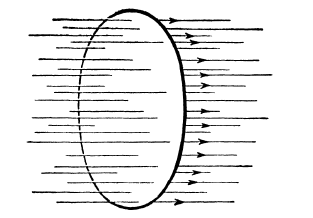
Let us take a simpler example. We have a closed wire without any source of current. Somewhere in the vicinity is a magnetic field. It means nothing to us whether the source of this magnetic field is another circuit through which an electric current flows, or a bar magnet. Our drawing shows the closed circuit and the magnetic lines of force. The qualitative and quantitative description of the induction phenomena is very simple in terms of the field language. As marked on the drawing, some lines of force go through the surface bounded by the wire. We have to consider the lines of force cutting that part of the plane which has the wire for a rim. No electric current is present so long as the field does not change, no matter how great its strength. But a current begins to flow through the rim-wire as soon as the number of lines passing through the surface surrounded by wire changes. The current is determined by the change, however it may be caused, of the number of lines passing the surface. “The number of lines changes” means that the density of the lines changes and this, we remember, means that the field strength changes.
A current begins to flow through the rim-wire as soon as the number of lines passing through the surface surrounded by wire changes. This means that the field strength changes.
These then are the essential points in our chain of reasoning: change of magnetic field → induced current → motion of charge → existence of an electric field.
Therefore:
a changing magnetic field is accompanied
by an electric field.
Thus
we have found the two most important pillars of support for the theory of the
electric and magnetic field. The first is the connection between the changing electric
field and the magnetic field. It arose from Oersted’s experiment on the
deflection of a magnetic needle and led to the conclusion: a changing electric field is accompanied by a magnetic field.
The
second connects the changing magnetic field with the induced current and arose
from Faraday’s experiment. Both formed a basis for quantitative description.
Thus we have found the two most important pillars of support for the theory of the electric and magnetic field. A changing electric field is accompanied by a magnetic field. A changing magnetic field is accompanied by an electric field.
Again
the electric field accompanying the changing magnetic field appears as
something real. We had to imagine, previously, the magnetic field of a current existing
without the testing pole. Similarly, we must claim here that the electric field
exists without the wire testing the presence of an induced current.
In
fact, our two-pillar structure could be reduced to only one, namely, to that
based on Oersted’s experiment. The result of Faraday’s experiment could be deduced
from this with the law of conservation of energy. We used the two-pillared
structure only for the sake of clearness and economy.
The result of Faraday’s experiment could be deduced from Oersted’s experiment, with the law of conservation of energy.
One
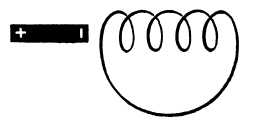
more consequence of the field description should be mentioned. There is a
circuit through which a current flows, with, for instance, a voltaic battery as
the source of the current. The connection between the wire and the source of
the current is suddenly broken. There is, of course, no current now! But during
this short interruption an intricate process takes place, a process which could
again have been foreseen by the field theory. Before the interruption of the
current, there was a magnetic field surrounding the wire. This ceased to exist
the moment the current was interrupted. Therefore, through the interruption of
a current, a magnetic field disappeared. The number of lines of force passing through
the surface surrounded by the wire changed very rapidly. But such a rapid
change, however it is produced, must create an induced current. What really
matters is the change of the magnetic field making the induced current stronger
if the change is greater. This consequence is another test for the theory. The
disconnection of a current must be accompanied by the appearance of a strong,
momentary induced current. Experiment again confirms the prediction. Anyone who
has ever disconnected a current must have noticed that a spark appears. This
spark reveals the strong potential differences caused by the rapid change of
the magnetic field.
The theory predicts that the disconnection of a current must be accompanied by the appearance of a strong, momentary induced current. Experiment confirms the prediction.
The
same process can be looked at from a different point of view, that of energy. A
magnetic field disappeared and a spark was created. A spark represents energy,
therefore so also must the magnetic field. To use the field concept and its
language consistently, we must regard the magnetic field as a store of energy. Only
in this way shall we be able to describe the electric and magnetic phenomena in
accordance with the law of conservation of energy.
To use the field concept and its language consistently, we must regard the magnetic field as a store of energy, in order to be consistent with the law of conservation of energy.
Starting
as a helpful model, the field became more and more real. It helped us to
understand old facts and led us to new ones. The attribution of energy to the field
is one step farther in the development in which the field concept was stressed
more and more, and the concepts of substances, so essential to the mechanical point
of view, were more and more suppressed.
The development of the field view stresses the concept of energy more; whereas, the mechanical view stressed the concept of substance.
.
Final Comment
The Two Pillars of the Field Theory are: A changing electric field is accompanied by a magnetic field. A changing magnetic field is accompanied by an electric field.
The core characteristic of matter is force. As matter is diluted it becomes more dynamic. We may refer to this more dynamic form as energy. Thus, we may describe force and energy as the static and dynamic forms of substance respectively. Within a field the concepts of force and distance become inseparable.
This may help clear up the use of the terms force and energy in the field view, as compared to their use in the mechanical view.