
Author Archives: vinaire

I am originally from India. I am settled in United States since 1969. I love mathematics, philosophy and clarity in thinking.

Gains on OT Levels

Reference: Scientology OT Levels

William Chad Holland is a good friend of mine. He s a retired psychotherapist with Scientology experience. He did OT levels in the seventies and trained up to Class VIII and C/Sed at the San Francisco Org. 

When I asked Chad about his experience on OTII, his response was as follows:

My experience on OT II, as well the Clearing Course and other OT levels, was profound. When I realized that the focus of the Clearing Course and many of the OT levels was working to diffuse polarities, and blow charge on dichotomies, I was intrigued and ready to audit the processes. I thought I knew from exposure to Eastern thought that any work toward wholeness, inclusiveness, and oneness, was a good thing.

My end phenomena from these Scientology processes were a sense of peace, compassion, and expanded consciousness. However, even though i tried to imagine Hubbard’s whole track bank incidents as literal and my personal facsimiles, I couldn’t. But rather, I saw the LRH content as suggestive and archetypical. Still, I was willing to run each and every process and drill on the content that LRH presented. I ran most OT processes several times, and I realized that in many cases I might be “mocking up” incidents or pulling together fragments of memories, thoughts, and assumptions—from who knows where. I remember letting go of judgement, not caring whether I was actually contacting an historical Hubbard track event presented in the data or engaging in the power to create and then explode my own mocked up facsimiles and narratives. My only gauge of success was whether or not a particular OT exercise provided the end point of catharsis, insight, and or expanded consciousness.

Although Scientology processing was a boon for me, maintaining those early gains is most always a work in progress, but it is usually an enjoyable exercise. I thank LRH for triggering in me an incipient realization and joy of connectedness; a new dimension of understanding that I was something beyond the confines of my own skin. Ironically, Hubbard seemingly couldn’t give himself the gift of his own transformative teaching. I remember reading a confidential note on one of the higher OT levels. Paraphrasing Hubbard’s arcane message, it read something like this: The big lie is that We Are All One. This assumption seems contrary to my understanding that the intent of processing at advanced levels is to create a sense of inclusion and oneness with all of existence. So I was left with one more dichotomy. But what do I really know?

Chad

This response resonated with me. It is a beautiful response stated in a very simple and sincere manner. I believe that what one gets out from OT Levels depends on the way one approaches them. Simplicity, sincerity and honesty with oneself are the key factors.

.
First postulate of Relativity

Reference: Essays on Substance

First postulate of Relativity

The mathematics of a physicist is self-consistent logic that he has applied to his starting postulates to arrive at certain approximate conclusions. Mathematics being a tool may be left to mathematicians to sharpen. Where physics is concerned, one should examine the starting postulates and conclusions that are arrived at by a physicist against the continuity, consistency and harmony of reality.

Let’s look at the first postulate underlying relativity.

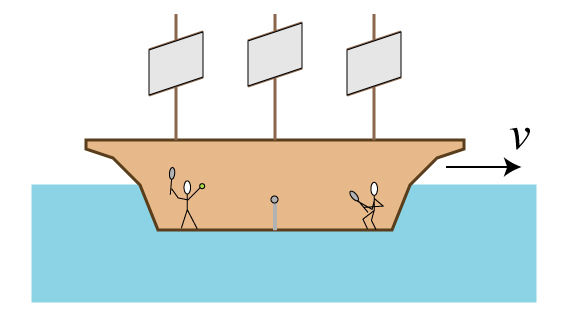
(1) The laws of physics are the same in all inertial frames of reference.

An inertial frame of reference is a fundamental concept in classical physics and special relativity. It is defined as a reference frame in which objects not subjected to external forces either remain at rest or move with constant velocity in a straight line. This definition is closely tied to Newton’s first law of motion, also known as the law of inertia.

Key characteristics of an inertial frame of reference include:

  1. No acceleration: The frame itself is not undergoing any acceleration.
  2. Uniform motion: Any frame moving at a constant velocity relative to an inertial frame is also an inertial frame.
  3. Consistency of physical laws: The laws of physics, particularly Newton’s laws of motion, hold true and have the same form in all inertial frames.

In practical terms, an inertial frame of reference can be understood through examples:

  • A stationary train platform
  • A car traveling at constant speed on a straight road
  • A motionless ramp down which objects can roll

It’s important to note that the concept of an inertial frame is an idealization. In reality, truly inertial frames are rare due to the presence of gravitational fields and other forces. However, many situations can be approximated as inertial frames for practical purposes.

The concept of inertial frames is crucial in physics because it provides a foundation for describing motion and applying the laws of mechanics consistently. It also plays a significant role in the development of more advanced theories, such as special relativity, which generalizes the notion of inertial frames to include all physical laws, not just Newton’s first law.

In general relativity, the concept of inertial frames is only applicable locally. This means that inertial frames are well-defined in infinitesimal neighborhoods of spacetime points. In curved spacetime, there are no global inertial frames that extend throughout all of space and time.

General relativity incorporates Einstein’s equivalence principle, which states that no experiment can distinguish between a frame in gravitational free-fall and an inertial frame. This principle effectively extends the notion of inertial frames to include freely falling reference frames in gravitational fields.

In general relativity, the laws of physics are expressed in a way that is covariant under all coordinate transformations, not just the Lorentz transformations of special relativity. This means that the form of physical laws remains invariant under any smooth change of coordinates, reflecting the principle that the laws of physics should be the same for all observers, regardless of their state of motion or choice of coordinate system.

Free particles in general relativity follow geodesics, which are the curved spacetime equivalent of straight lines in flat spacetime. The principle that free particles follow geodesics replaces the notion of uniform motion in straight lines from special relativity.

In sufficiently small regions of spacetime, the effects of curvature become negligible, and the laws of physics reduce to those of special relativity. This is known as the principle of local flatness, which allows for the local application of special relativistic concepts in general relativity.

By generalizing the concept of inertial frames and incorporating the effects of gravity into the structure of spacetime itself, general relativity maintains the spirit of the original postulate while adapting it to a more comprehensive understanding of the universe.

CRITICISM

  1. Einstein applies the inertial frames of reference to matter only and not to all substance. His viewpoint is matter-centric. Please see: The Matter-Centric Fixation
  2. Einstein ignores inertia when considering relative speeds. In reality, light can be considered to travel at speed ‘c’ relative to matter; but matter cannot be considered to travel at speed ‘c’ relative to light.

.

Testing a Theory

Reference: Essays on Substance

Testing a Theory

A theory is as sound as the postulates it stands on. The postulates underlying the theory of relativity are:

  1. The laws of physics are the same in all inertial frames of reference.
  2. The speed of light in a vacuum is the same for all observers, regardless of the motion of the light source or the observer.

The soundness of the theory of relativity depends on the soundness of these two postulates.

Similarly, the postulates underlying quantum mechanics (its key principles) are:

  1. Wave Function Postulate: The state of a quantum system is completely described by a wave function Ψ(r,t), which contains all accessible physical information about the system.
  2. Observables and Operators: Every observable quantity in quantum mechanics is represented by a linear, Hermitian operator.
  3. Measurement Postulate: When measuring an observable associated with operator A, only the eigenvalues that satisfy the eigenvalue equation will be observed.
  4. Expectation Values: The average value of an observable for a system in a normalized state Ψ is given by the expectation value of the corresponding operator.
  5. Time Evolution: The wave function of a system evolves in time according to the time-dependent Schrödinger equation.
  6. Pauli Exclusion Principle: The total wave function of a system with N spin-1/2 particles (fermions) must be antisymmetric with respect to the interchange of all coordinates of one particle with those of another.
  7. Superposition Principle: Quantum systems can exist in a superposition of states, exhibiting wave-particle duality.

The soundness of quantum mechanics depends on the soundness of these postulates.

I have examined the soundness of the above postulates to some degree in layman terms. We can evaluate their soundness in mathematical terms too.

I have no quarrel with mathematics. The mathematics is a system of very specialized self-consistent logic. The trouble comes when mathematics is interfaced with reality. The mathematics should be applied to physics in a way that it is consistent with reality. That is the principle of the Scientific Method. The scientific method views reality as continuous, consistent and harmonious.

.

Non-Locality & Oneness of Reality

Reference: Essays on Substance

Non-Locality & Oneness of Reality

Non-locality, particularly in quantum mechanics, refers to phenomena that appear to violate the principle of locality. The principle of locality states that an object is influenced directly only by its immediate surroundings.

Oneness of Reality states that all reality is continuous, consistent and harmonious. Therefore, space is continuous. Space denotes dimensions of substance. If there is space, there must be substance filling it. Hence, there is no such thing as void. Non-locality implies that there are voids, and the space is discontinuous.

The quantum theory supports voids, but defines it as a field filled with fluctuating energy and activity. This is a self contradiction. It also contradicts the very idea of non-locality. In some quantum field theories, the vacuum can have non-vanishing expectation values of field operators, known as condensates. So, here we have mathematics defining reality, and that too in a contradicting manner.

The actual reality of Casimir effect is explained by means of virtual particles of quantum vacuum. Newton will be shocked at this explanation of “action at a distance.” It reminds one of Alice in Wonderland.

We have already discovered misconceptions in quantum mechanics about quanta having point positions. Entanglement can be explained by defining the position of a quantum particle by its wavelength. What is viewed as two entangled particles is actually the same particle occupying a very large position in space.

By looking at the Casimir effect more closely, more real explanations can be arrived at. One must not accept the twisted “reality” of contradictions that exist in abundance in quantum mechanics.

.

Logic, Reality and Oneness

Reference: Essays on Substance

Logic, Reality and Oneness

Reality is the ultimate logic. It is defined by the continuity, consistency and harmony of ONENESS. The ultimate rule in the perception of reality is:

Garbage IN = Garbage OUT

When you start to examine a subject, start with the postulates or principles it is based on. If the basics violate the ONENESS of reality, the rest of the subject will be flawed. A subject may appear to be brilliant, as in the case of quantum mechanics, but that brilliance would be spotty and not consistent.

The concept of ONENESS has been applied even to God. But it should be understood properly as follows:

Oneness does not imply sameness.

Oneness means that all that is known is continuous, consistent and harmonious.

Oneness lies in the continuity of dimensions.

Oneness lies in the consistency of realities.

Oneness lies in the harmony of relations.

This Principle of Oneness underlies the very concept of the Universe.

It also underlies the scientific method.

Oneness gives us the ideal scene for logic, and its violation gives us anomalies, such as, discontinuity (missing data), inconsistency (contradictory data), and disharmony (arbitrary data).

Oneness also provides the criterion for truth. The relative truth depends on the absence of anomalies.

Oneness is erroneously identified with sameness. Oneness is not a monotone canvas; but a beautiful painting full of colors and forms that are continuous, consistent and harmonious. Oneness appears equally from the universal scale down to the minutest detail.

.