Author Archives: vinaire

I am originally from India. I am settled in United States since 1969. I love mathematics, philosophy and clarity in thinking.

ARISTOTLE: Ethics and the Nature of Happiness

Reference: The Story of Philosophy

This paper presents Chapter II, Section 7 from the book THE STORY OF PHILOSOPHY by WILL DURANT. The contents are from the 1933 reprint of this book by TIME INCORPORATED by arrangement with Simon and Schuster, Inc.

The paragraphs of the original material (in black) are accompanied by brief comments (in color) based on the present understanding.  Feedback on these comments is appreciated.

The heading below is linked to the original materials.

.

VII. Ethics and the Nature of Happiness

And yet, as Aristotle developed, and young men crowded about him to be taught and formed, more and more his mind turned from the details of science to the larger and vaguer problems of conduct and character. It came to him more clearly that above all questions of the physical world there loomed the question of questions-what is the best life?- what is life’s supreme good?-what is virtue?-how shall we find happiness and fulfillment?

In eastern philosophy, the goal of human life has been the attainment of Static viewpoint, which is detached from all worldly phenomena, and can look at everything with equanimity.

He is realistically simple in his ethics. His scientific training keeps him from the preachment of superhuman ideals and empty counsels of perfection. “In Aristotle,” says Santayana, “the conception of human nature is perfectly sound; every ideal has a natural basis, and everything natural has an ideal development.” Aristotle begins by frankly recognizing that the aim of life is not goodness for its own sake, but happiness. “For we choose happiness for itself, and never with a view to anything further; whereas we choose honor, pleasure, intellect … because we believe that through them we shall be made happy.” But he realizes that to call happiness the supreme good is a mere truism; what is wanted is some clearer account of the nature of happiness, and the way to it. He hopes to find this way by asking wherein man differs from other beings; and by presuming that man’s happiness will lie in the full functioning of this specifically human quality. Now the peculiar excellence of man is his power of thought; it is by this that he surpasses and rules all other forms of life; and as the growth of this faculty has given him his supremacy, so, we may presume, its development will give him fulfillment and happiness. 

In my opinion, Aristotle correctly assumes that the development of the power of thought will give man fulfillment and happiness. 

The chief condition of happiness, then, barring certain physical pre-requisites, is the life of reason—the specific glory and power of man. Virtue, or rather excellence,* will depend on clear judgment, self-control, symmetry of desire, artistry of means; it is not the possession of the simple man, nor the gift of innocent intent, but the achievement of experience in the fully developed man. Yet there is a road to it, a guide to excellence, which may save many detours and delays: it is the middle way, the golden mean. The qualities of character can be arranged in triads, in each of which the first and last qualities will be extremes and vices, and the middle quality a virtue or an excellence. So between cowardice and rashness is courage; between stinginess and extravagance is liberality; between sloth and greed is ambition; between humility and pride is modesty; between secrecy and loquacity, honesty; between moroseness and buffoonery, good humor; between quarrelsomeness and flattery, friendship; between Hamlet’s indecisiveness and Quixote’s impulsiveness is self-control. “Right,” then, in ethics or conduct, is not different from “right” in mathematics or engineering; it means correct, fit, what works best to the best result.

*[The word excellence is probably the fittest translation of the Greek arete, usually mistranslated virtue. The reader will avoid misunderstanding Plato and Aristotle if, where translators write virtue, he will substitute excellence, ability, or capacity. The Greek arete is the Roman virtus; both imply a masculine sort of excellence (Ares, god of war; vir, a male). Classical antiquity conceived virtue in terms of man, just as medieval Christianity conceived it in terms of woman.]

It is true that virtue, or excellence, is the achievement of experience in the fully developed man. Such experience consists of assimilation of all perceptions such that no anomalies are left unresolved.

The golden mean, however, is not, like the mathematical mean, an exact average of two precisely calculable extremes; it fluctuates with the collateral circumstances of each situation, and discovers itself only to mature and flexible reason. Excellence is an art won by training and habituation: we do not act rightly because we have virtue or excellence, but we rather have these because we have acted rightly; “these virtues are formed in man by his doing the actions”; we are what we repeatedly do. Excellence, then, is not an act but a habit: “the good of man is a working of the soul in the way of excellence in a complete life; … for as it is not one swallow or one fine day that makes a spring, so it is not one day or a short time that makes a man blessed and happy.”

Excellence is learned from the experience that comes from resolving anomalies.

Youth is the age of extremes: “if the young commit a fault it is always on the side of excess and exaggeration.” The great difficulty of youth (and of many of youth’s elders) is to get out of one extreme without falling into its opposite. For one extreme easily passes into the other, whether through “over-correction” or elsewise: insincerity doth protest too much, and humility hovers on the precipice of conceit.* Those who are consciously at one extreme will give the name of virtue not to the mean but to the opposite extreme. Sometimes this is well; for if we are conscious of erring in one extreme “we should aim at the other, and so we may reach the middle position, … as men do in straightening bent timber.” . But unconscious extremists look upon the golden mean as the greatest vice; they “expel towards each other the man in the middle position; the brave man is called rash by the coward, and cowardly by the rash man, and in other cases accordingly”; so in modern politics the “liberal” is called “conservative” and ”radical” by the radical and the conservative.

*[“The vanity of Antisthenes” the Cynic, said Plato, “peeps out through the holes in his cloak.”] 

The golden mean is the best position. Unfortunately, the extreme viewpoint misconstrues the middle position as the other extreme.

It is obvious that this doctrine of the mean is the formulation of a characteristic attitude which appears in almost every system of Greek philosophy. Plato had had it in mind when he called virtue harmonious action; Socrates when he identified virtue with knowledge. The Seven Wise Men had established the tradition by engraving, on the temple of Apollo at Delphi, the motto meden agan,—nothing in excess. Perhaps, as Nietzsche claims all these were attempts of the Greeks to check their own violence and impulsiveness of character; more truly, they reflected the Greek feeling that passions are not of themselves vices, but the raw material of both vice and virtue, according as they function in excess and disproportion, or in measure and harmony.*

*[Cf. a sociological formulation of the same idea: “Values are never absolute, but only relative… A certain quality in human nature is deemed to be less abundant than it ought to be; therefore we place a value upon it, and … encourage and cultivate it. As a result of this valuation we call it a virtue; but if the same quality should become superabundant we should call it a vice and try to repress it.”—Carver, Essays in Social Justice.]

The golden mean lies in assuming that position which brings harmony, consistency and continuity to a situation.

But the golden mean, says our matter-of-fact philosopher, is not all of the secret of happiness. We must have, too, a fair degree of worldly goods: poverty makes one stingy and grasping; while possessions give one that freedom from care and greed which is the source of aristocratic ease and charm. The noblest of these external aids to happiness is friendship. Indeed, friendship is more necessary to the happy than to the unhappy; for happiness is multiplied by being shared. It is more important than justice: for “when men are friends, justice is unnecessary; but when men are just, friendship is still a boon.” “A friend is one soul in two bodies.” Yet friendship implies few friends rather than many; “he who has many friends has no friend”; and “to be a friend to many people in the way of perfect friendship is impossible.” Fine friendship requires duration rather than fitful intensity; and this implies stability of character; it is to altered character that we must attribute the dissolving kaleidoscope of friendship. And friendship requires equality; for gratitude gives it at best a slippery basis. “Benefactors are commonly held to have more friendship for the objects of their kindness than these for them. The account of the matter which satisfies most persons is that the one are debtors and the others creditors, … and that the debtors wish their creditors out of the way, while the creditors are anxious that their debtors should be preserved.” Aristotle rejects this interpretation; he prefers to believe that the greater tenderness of the benefactor is to be explained on the analogy of the artist’s affection for his work, or the mother’s for her child. We love that which we have made.

The golden mean lies in the balance, not just in thoughts and character, but also in acquiring the means of living satisfactorily.

And yet, though external goods and relationships are necessary to happiness, its essence remains within us, in rounded knowledge and clarity of soul. Surely sense pleasure is not the way: that road is a circle: as Socrates phrased the coarser Epicurean idea, we scratch that we may itch, and itch that we may scratch. Nor can a political career be the way; for therein we walk subject to the whims of the people; and nothing is so fickle as the crowd. No, happiness must be a pleasure of the mind; and we may trust it only when it comes from the pursuit or the capture of truth. “The operation of the intellect … aims at no end beyond itself, and finds in itself the pleasure which stimulates it to further operation; and since the attributes of self-sufficiency, unweariedness, and capacity for rest, … plainly belong to this occupation, in it must lie perfect happiness.” 

The essence of happiness remains within us, in rounded knowledge and clarity of soul; and, not in the pleasure of senses.

Aristotle’s ideal man, however, is no mere metaphysician. 

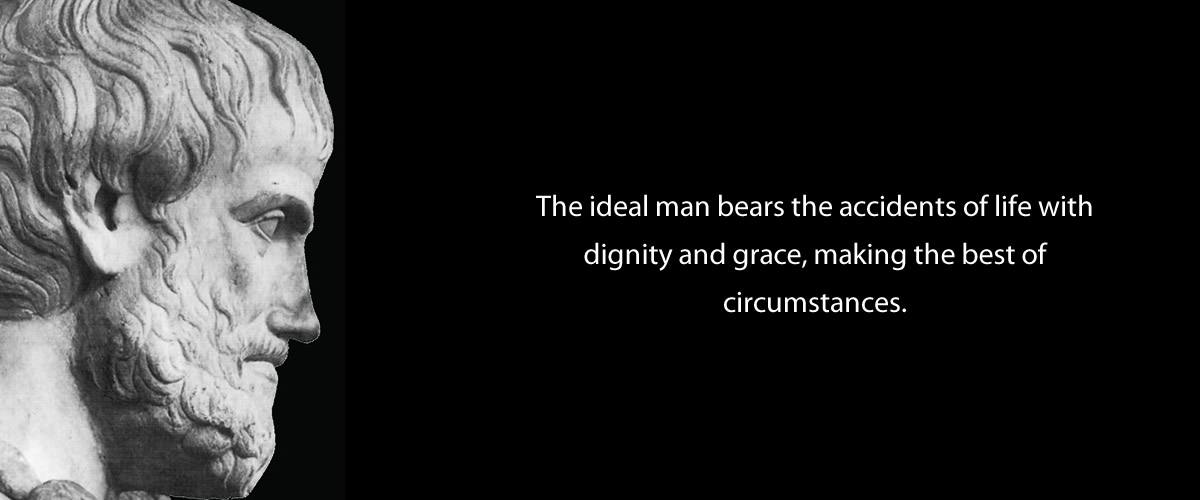
He does not expose himself needlessly to danger, since there are few things for which he cares sufficiently; but he is willing, in great crises, to give even his life,—knowing that under certain conditions it is not worth while to live. He is of a disposition to do men service, though he is ashamed to have a service done to him. To confer a kindness is a mark of superiority; to receive one is a mark of subordination… He does not take part in public displays… He is open in his dislikes and preferences; he talks and acts frankly, because of his contempt for men and things… He is never fired with admiration, since there is nothing great in his eyes. He cannot live in complaisance with others, except it be a friend; complaisance is the characteristic of a slave…. He never feels malice, and always forgets and passes over injuries… He is not fond of talking… It is no concern of his that he should be praised, or that others should be blamed. He does not speak evil of others, even of his enemies, unless it be to themselves. His carriage is sedate, his voice deep, his speech measured; he is not given to hurry, for he is concerned about only a few things; he is not prone to vehemence, for he thinks nothing very important. A shrill voice and hasty steps come to a man through care… He bears the accidents of life with dignity and grace, making the best of his circumstances, like a skillful general who marshals his limited forces with all the strategy of war… He is his own best friend, and takes delight in privacy whereas the man of no virtue or ability is his own worst enemy, and is afraid of solitude.

Such is the Superman of Aristotle. 

Aristotle’s ideal man is quite balanced and measured.

.
DIANETICS: The “Demons”

Reference: Hubbard 1950: Dianetics TMSMH

These are some comments on Book Two, Chapter 4, “The ‘Demons’” from  DIANETICS: THE MODERN SCIENCE OF MENTAL HEALTH.

.

Comments on
The “Demons”

KEY WORDS: Demon, Demon circuit

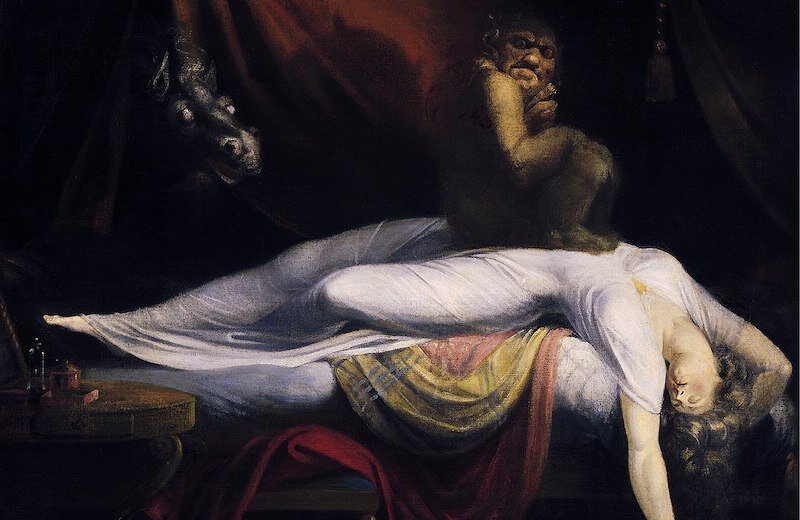
A bona-fide demon is one who gives thoughts voice, or echoes the spoken word interiorly, or who gives all sorts of complicated advice like a real, live voice exteriorly. Such “demons” appeared in Dianetics research. This was a strange phenomenon, which Hubbard found to be pretty common among people. He found that a dianetic demon is a parasitic mental circuit that is derived entirely from words contained in engrams. 

What appears as a demon possessing a person is actually an engram of that person dramatizing itself.

Many people, when they look inward for some answer, hear a voice inside their head that seem to answer their question. This is an engram (unassimilated trauma) demanding the person to listen and obey its orders. Such “listen to me” demon is common in the society, which is to say this, engram circulates widely. After it is keyed-in, the individual thinks “out loud,” which is to say, he puts his thoughts into language. Some people find a voice inside their head criticizing them all the time. 

All the chatter going inside one’s head is the result of mental circuits set up by the engrams.

These circuits are formed when the engram compartments off part of the mental matrix. The engram reduces the intellect of the person. When a person resists the actions of the engram, it eventually makes him ill one way or another. 

According to Hubbard, there is another class of demons that don’t permit certain things to be said or done. These are parasitic circuits that are created from phrases contained in engrams, such as, “Never say can’t!” “Never talk back to your elders,” or “You can’t talk here. Who said you could talk?” 

Any of these engramic phrases that create “demons” (parasitic circuits) might produce a stammerer.

There are thousands of cliches in any language which, when literally taken, mean quite the opposite from what the speaker intends. Such cliches can enter engrams and enforce themselves on the behavior of the person with moronic literalness under the threat of pain, emotion, and “unconsciousness.” Phrases in engrams, such as, “you can’t see,” “you can’t hear,” can inhibit or obstruct that ability. Any perception can be occluded in recall by engrams. 

According to Hubbard, any disability can be traced back to phrases in the engrams.

This is the dianetic theory of Hubbard. This theory is found to be limited when applied. However, there is no doubt that there are unassimilated perceptions that can corrupt the circuits of the mental matrix, and seriously affect a person’s thinking, behavior and well-beingness. When such perceptions are finally assimilated, miraculous improvements can occur in a person’s condition.

.

The World of Atom (Part XV)

Reference: Boorse 1966: The World of Atom

PART XV –NUCLEAR REACTIONS AND NUCLEAR ENERGY

THE WORLD OF ATOM by Boorse

Chapter 89: Nuclear Theory (Werner K. Heisenberg 1901 – 1976)

The Normal States of Atomic Nuclei. Many properties of the nucleus can be discussed and understood without making specific assumptions about nucleons. The binding energy per nucleon remains the same as we go to heavier nuclei; that means nucleons inside the nucleus interact only with their nearest neighbors. The volume of the nucleus is proportional to the number of nucleons; that means nucleons are spread out uniformly throughout the nucleus.

Chapter 90: Energy Production in Stars (Hans A. Bethe 1906 – 2005)

Energy Production in Stars. Bethe set forth the law: As long as the neutron and the proton are separated by more than a critical distance (of the order of 10-13 cm) they have no influence on each other; if they are closer, there is a constant but very large pull between them. His work led to the discovery of the nuclear reactions that generate the radiation of stars. Bethe’s pioneering work with the proton-proton chain and the carbon cycle laid the foundation for the great advances that have occurred in our knowledge of the structure and the evolution of stars.

Chapter 91: Fission (Lise Meitner 1878 – 1968, Otto R. Frisch 1904 – 1968, Niels Bohr 1885 – 1962)

Disintegration of Uranium by Neutrons. The more neutrons we add to the nucleus, the more protons we must add. The bottom gets filled up with 2 protons and 2 neutrons. As more protons and neutrons are added they get stacked up getting closer to the “top of the crater.” Thus, a great deal more energy can be obtained from a fission process than is supplied to the nucleus to induce the fission. Lise Meitner and O. R. Frisch used the liquid-drop model of Bohr to point out how a splitting of uranium can occur under the appropriate conditions. They were among the first to analyze the experimental data correctly and originate the idea of nuclear fission in 1939. 

Chapter 92: Chain-Reacting Pile (Enrico Fermi 1901 – 1954)

Experimental Production of a Divergent Chain Reaction. The first chain reaction was obtained on December 2, 1942 with a “pile” constructed and successfully operated at the University of Chicago. Fermi and his co-workers achieved this by clever geometry and a proper distribution of the uranium atoms relative to carbon atoms. To produce a chain reaction or a self-sustaining pile a game of slowing down and catching neutrons must be played. Fermi showed that a chain reaction is possible only if at least 1.22 of the original 2 neutrons become thermal neutrons and give rise to fission.

Chapter 93: Power from Fusion (Ernest W. Titterton 1914 – 1990)

Power from Fusion? Long lasting radioactive byproducts from fission process make it an untenable power source. The possibility of producing power without such hazard exists through the use of nuclear fusion. This is the natural process of “thermonuclear” reactions occurring in our sun and all the stars. Unfortunately, to produce fusion artificially is a difficult task. An account of the way in which fusion comes about and how this process proceeds naturally in the stars is lucidly explained in E. W. Titterton’s book ‘Facing the Atomic Future’.

.

MAIN POINTS

  1. The binding energy per nucleon remains the same as we go to heavier nuclei.
  2. That means nucleons inside the nucleus interact only with their nearest neighbors. 
  3. The volume of the nucleus is proportional to the number of nucleons.
  4. That means nucleons are spread out uniformly throughout the nucleus.
  5. The neutron and the proton have no influence on each other, as long as they are separated by 10-13 cm or more.
  6. If they are closer, there is a constant but very large pull between them. 
  7. Nuclear reactions generate the radiation of stars similar to the sun.
  8. Both the carbon cycle and the proton-proton chain operate simultaneously in stellar interiors.
  9. The more neutrons we add to the nucleus, the more protons we must add.
  10. A great deal more energy can be obtained from a fission process than is supplied to the nucleus to induce the fission.
  11. A chain reaction is possible only if at least 1.22 of the original 2 neutrons become thermal neutrons and give rise to fission.
  12. Long lasting radioactive byproducts from fission process make it an untenable power source. 
  13. The possibility of producing power without such hazard exists through the use of nuclear fusion. 

THEORY
Nuclear reactions generate the radiation of stars similar to the sun. Future research on nucleus requires closer study of the stars.

.

ARISTOTLE: Psychology and the Nature of Art

Reference: The Story of Philosophy

This paper presents Chapter II, Section 6 from the book THE STORY OF PHILOSOPHY by WILL DURANT. The contents are from the 1933 reprint of this book by TIME INCORPORATED by arrangement with Simon and Schuster, Inc.

The paragraphs of the original material (in black) are accompanied by brief comments (in color) based on the present understanding.  Feedback on these comments is appreciated.

The heading below is linked to the original materials.

.

VI. Psychology and the Nature of Art 

Aristotle’s psychology is marred with similar obscurity and vacillation. There are many interesting passages: the power of habit is emphasized, and is for the first time called “second nature”; and the laws of association, though not developed, find here a definite formulation. But both the crucial problems of philosophical psychology—the freedom of the will and the immortality of the soul—are left in haze and doubt. Aristotle talks at times like a determinist— “We cannot directly will to be different from what we are”; but he goes on to argue, against determinism, that we can choose what we shall be, by choosing now the environment that shall mould us; so we are free in the sense that we mould our own characters by our choice of friends, books, occupations, and amusements. He does not anticipate the determinist’s ready reply that these formative choices are themselves determined by our antecedent character, and this at last by unchosen heredity and early environment. He presses the point that our persistent use of praise and blame presupposes moral responsibility and free will; it does not occur to him that the determinist might reach from the same premisses a precisely opposite conclusion—that praise and blame are given that they may be part of the factors determining subsequent action. 

In my opinion, we are what we are, and we can improve ourselves through our own efforts. Improvement consists of being increasingly consistent and harmonious.

Aristotle’s theory of the soul begins with an interesting definition. The soul is the entire vital principle of any organism, the sum of its powers and processes. In plants the soul is merely a nutritive and reproductive power; in animals it is also a sensitive and locomotor power; in man it is as well the power of reason and thought. The soul, as the sum of the powers of the body, cannot exist without it; the two are as form and wax, separable only in thought, but in reality one organic whole; the soul is not put into the body like the quick-silver inserted by Daedalus into the images of Venus to make “stand-ups” of them. A personal and particular soul can exist only in its own body. Nevertheless the soul is not material, as Democritus would have it; nor does it all die. Part of the rational power of the human soul is passive: it is bound up with memory, and dies with the body that bore the memory; but the “active reason,” the pure power of thought, is independent of memory and is untouched with decay. The active reason is the universal as distinguished from the individual element in man; what survives is not the personality, with its transitory affections and desires, but mind in its most abstract and impersonal form. In short, Aristotle destroys the soul in order to give it immortality; the immortal soul is “pure thought,” undefiled with reality, just as Aristotle’s God is pure activity, undefiled with action. Let him who can, be comforted with this theology. One wonders sometimes whether this metaphysical eating of one’s cake and keeping it is not Aristotle’s subtle way of saving himself from anti-Macedonian hemlock? 

Aristotle’s description of soul is brilliant. There is a personal soul but that “soul” is not immortal; it dies with the body.

In a safer field of psychology he writes more originally and to the point, and almost creates the study of esthetics, the theory of beauty and art. Artistic creation, says Aristotle, springs from the formative impulse and the craving for emotional expression. Essentially the form of art is an imitation of reality; it holds the mirror up to nature. There is in man a pleasure in imitation, apparently missing in lower animals. Yet the aim of art is to represent not the outward appearance of things, but their inward significance; for this, and not the external mannerism and detail, is their reality. There may be more human verity in the sternly classic moderation of the Oedipus Rex than in all the realistic tears of the Trojan Women. 

In my opinion, at the very depth of artistic creation is the impulse to understand (intellect) and express (feelings) itself.

The noblest art appeals to the intellect as well as to the feelings (as a symphony appeals to us not only by its. harmonies and sequences but by its structure and development); and this intellectual pleasure is the highest form of joy to which a man can rise. Hence a work of art should aim at form, and above all at unity, which is the backbone of structure and the focus of form. A drama, e. g., should have unity of action: there should be no confusing sub-plots, nor any digressive episodes.* But above all, the function of art is catharsis, purification: emotions accumulated in us under the pressure of social restraints, and liable to sudden issue in unsocial and destructive action, are touched off and sluiced away in the harmless form of theatrical excitement; so tragedy, “through pity and fear, effects the proper purgation of these emotions.” Aristotle misses certain features of tragedy (e. g., the conflict of principles and personalities); but in this theory of catharsis he has made a suggestion endlessly fertile in the understanding of the almost mystic power of art. It is an illuminating instance of his ability to enter every field of speculation, and to adorn whatever he touches. 

*[Aristotle gives only one sentence to unity of time; and does not mention unity of place; so that the “three unities” commonly foisted upon him are later inventions.]

The work of art is pleasing when it is continuous, consistent and harmonious in its form. It brings to fore the anomalies of life that have been suppressed and need resolution.

.

DIANETICS: The Cell and the Organism

Reference: Hubbard 1950: Dianetics TMSMH

These are some comments on Book Two, Chapter 3, “The Cell and the Organism” from  DIANETICS: THE MODERN SCIENCE OF MENTAL HEALTH.

.

Comments on
The Cell and the Organism

KEY WORDS: Sentient, Unconsciousness, lock, Justification, Dramatization, Valences

Hubbard postulates that humans are sentient because each individual cell of the body is sentient. This sentience enters the body when a human soul enters the sperm and ovum at conception. 

According to Hubbard, the source of sentience is the human soul.

Hubbard postulates that the cell being sentient retains imprints (engrams) of painful events. The reactive mind is the combined cellular intelligence. The primitive intelligence of the reactive mind takes over when the analytical mind fails. It uses pain to whip the body into performing the most basic survival actions.

According to Hubbard, the primitive sentience is devoted to ensuring the survival of the cells and the body.

But human soul is a mystical concept. Sentience can be explained in terms of greater sophistication of the human organism. The body is an electro-chemical system. There is an inherent impulse unique to the electromagnetic field that surrounds the body of the person. This is the soul. The mind is a phenomenon of this electromagnetic field. It controls the activity of the body by manipulating its chemistry through electrical signals.  

The human soul is the inherent impulse unique to the electromagnetic field of the sperm and ovum at conception. 

Perceptions are continually reaching the mind as electromagnetic signals originating from the sense organs. The cells, of course, have their role to play. These perceptions get differentiated into fine perceptual elements and get assimilated into the mental matrix. The organism does not become aware of these perceptions until they are assimilated. 

Ideally all incoming perceptions get assimilated in the mental matrix at which point the organism becomes aware of them.

Assimilation means differentiating perceptions into fine perceptual elements and associating them so they are continuous, consistent and harmonious throughout the mental matrix. When the incoming perceptions cannot be assimilated they are queued in a holding area for gradient assimilation. 

When a perception cannot be assimilated it is queued in a holding area for later gradient assimilation.

A person experiences shock and pain, because the perceptions pack too much information in too little time and space to be differentiated. There are simply too many moving pieces to differentiate. This is called high RANDOMITY. As a result the assimilation of such perception (and its awareness) suffers.

When the randomness is so high that the assimilation stops, we have UNCONSCIOUSNESS

These unassimilated perceptions appear as literal recordings. The organism is not conscious of these recordings because they are unassimilated. In Hubbard’s terminology, these unassimilated perceptions are ENGRAMS, and their holding area is REACTIVE BANK. 

Engram and the Reactive mind are most likely situated in the body’s electromagnetic field (aura).

When the person experiences something similar to the engram its perceptions get associated with those of the engram. When this experience is mild it gets assimilated, but then it forms a bridge to the engram. This gives the engram access to the mental circuits. The mild incident that helps the engram this way, is called a LOCK.  The person is aware of the lock, but he is not aware of the engram.

A LOCK is a mild incident that serves to hook the engram to the circuits of the mental matrix.

A RESTIMULATOR is something in the environment, which is similar to the recording of the engram. When a restimulator is present, the engram gets KEYED IN the mental circuit. This makes the body act out the recording of the engram. The person does not know why he is acting that way. He feels stupid.

When the engram keys in, the person acts out the engram without knowing why he is acting that way.

People who make us feel stupid are in some manner using words, voice tones, music, etc. that “restimulate” our engrams. An engram, even when slightly restimulated, reduces our ability to discriminate and makes us feel stupid. This is the reason why many young boys get very confused in the presence of a beautiful girl. 

When a person does not know why he is acting the way he is, he makes up some explanation. This is called a JUSTIFICATION. 

Hubbard refers to the acting out of an engram as DRAMATIZATION. In a dramatization a person may do and say exactly the same things done and said to him or her. 

Usually there are multiple dramatic personnel in an engram. Hubbard refers to such “personalities” as VALENCES. When the engram is keyed in the person dramatizes one of these valences. Usually, he dramatizes the winning valence. If the winning valence cannot be dramatized then he may dramatize another valence, which could be his own losing valence in the engram.

Hubbard says, “If one set out to resolve the problem of aberration by a system of cataloguing everything he observed and were unaware of the basic source, he would end up with as many separate insanities, neuroses, psychoses, compulsions, repressions, obsessions and disabilities as there are combinations of words in the English language.”

The natural solution is, of course, doing what was missed—the assimilation of the engram into the mental matrix.

Hubbard says, “The cells evolved into an organism and in the evolution created what was once a necessary condition of mind. Man has grown up to a point where he creates now the means of overcoming that evolutionary blunder.”

This is not an evolutionary blunder. Man has gained sentience only because of the evolution of a very fine mental matrix. Now he must learn how to assimilate painful traumas.

Hubbard’s technique of auditing requires dependence on another person.

It is now possible for an individual to assimilate his engrams (traumas) all by himself.

This is covered in later chapters.

.