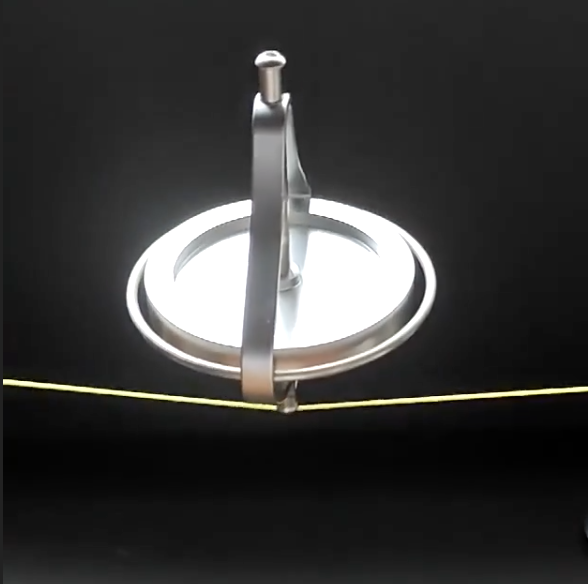
Reference: A Conceptual Model of Inertia, Mass & Location
The inconsistency I am faced with is “a continuous space being defined as a set of discrete points.” Mathematics fails to define the relationship between point and space properly. It seems that there is a better explanation underlying this inconsistency.
Science has progressed to a point where it is looking at the process of observation itself. It is difficult to come up with some absolute reference point, from which to look at the rest of existence. God seems to be a placeholder for what we do not understand. The only possible avenue to take is to take one inconsistency at a time and resolve it as best as one can, keeping in mind that one may have to come back to it later to resolve it further.
The universe is obviously finite in terms of what one is actually able to observe. We may postulate the universe to be infinite but that does not add anything more to our actual awareness or understanding. The idea of location is limited to the mechanical universe that we actually observe, independent of what one might postulate mathematically or otherwise.
We are now confronted with the idea of motion that goes beyond the classical concept of a physical body moving in space and time. A physical body consists of motion within itself at atomic levels. We cannot say if there is a point within the atom that is absolutely still. The stillness may be computed only in relative terms as difficulty involved in shifting a point. This is where the concept of inertia springs from. Thus, the idea of a location in space is intimately tied with the idea of inertia. This is what I meant by the concept of “centeredness” of CoM. I do not know if there is any limit to ideal centeredness. That is subject to observation.
An electromagnetic wave does not have its momentum concentrated at a point; rather it is evenly spread throughout. So, it has a physical presence that cannot be described as located at a point, as it can be done with mass. A photon may be described as having a physical presence as a wave packet, the size of which depends on its frequency. The higher is the frequency, the smaller is the region that describes its presence. One may say the location of a photon is spread-out in space, as opposed to being concentrated at a point as in case of mass. There is continuity that seems to exist within that “spread-out location”.
As frequency of the photon decreases, its location seems to “spread-out” further as proportional to its wavelength. This is looking at location in terms of inertia. The inertia lessens as frequency decreases. This spread may assume infinite proportions as frequency approaches zero. Here we achieve an approximation of space as a primitive concept that does not depend on the concept of point. In fact, space and point seem to appear at the opposite ends of a scale of inertia. The picture that I get is shown above.
So, an absence of “point location” does not mean “absence of location”. It means a location spread out in a manner of continuity that is very different from a “set of points.”
The statement, “A physical point location in space depends on the distribution of mass around it” means that there is the continuity of space corresponding to “zero inertia” that acts as the background. In this background exist point locations as “concentrated inertia.” I shall explain this as further questions arise.
Basically, I believe that physical space and location can be described more coherently in terms of inertia. This description bypasses the contradiction posed by a mathematical description of space as a set of points.
.