
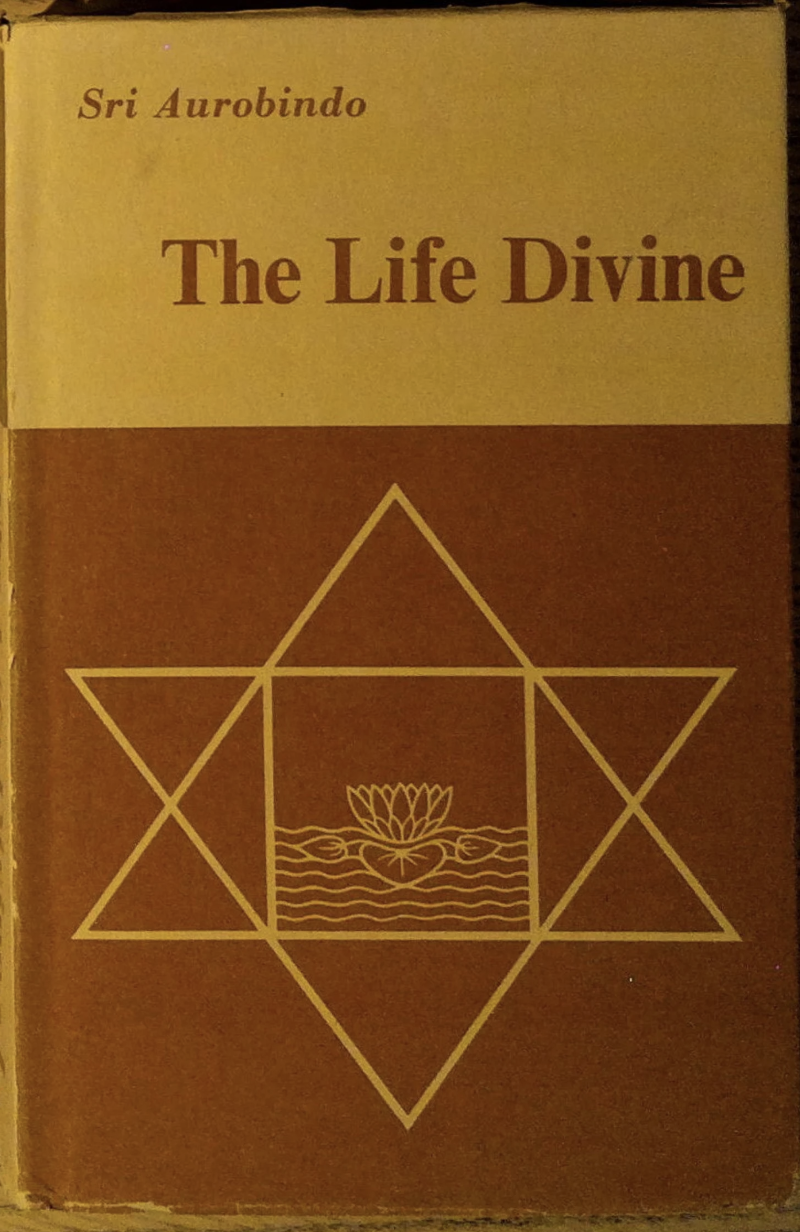
THE LIFE DIVINE by Sri Aurobindo was first written and published serially in the monthly review Arya between August 1914 and January 1919. The original language of composition was English.
1. The Life Divine Book I
2. The Life Divine Book II
BOOK 1 – OMNIPRESENT REALITY AND THE UNIVERSE
- The Human Aspiration
Impulse toward perfection. - The Two Negations: The Materialist Denial
The materialist negation denies spirit, and affirms that only matter or force is real. - The Two Negations: The Refusal of the Ascetic
The ascetic insists on pure spirit as the sole reality, free from change, death. - Reality Omnipresent
World and non-being are affirmations of omnipresent Reality. - The Destiny of the Individual
Liberation of the individual is the keynote of the definitive divine action. - Man in the Universe
Universe and individual are necessary to each other, and the conditions of the universe provide the means for our progress. - The Ego and the Dualities
Dualities (pain, etc.) are the first inevitable outcome of the attempt to realize unity through the self-limitation of the ego. [Dualities are two ends of a dimension. Ego-spirit is a dimension of the mind.] - The Methods of Vedantic Knowledge
Vedanta starts from reason but uses intuition as the final authority, in order to know truths that are beyond ordinary experience. [What is being referred to as intuition here are actually postulates.] - The Pure Existent
The pure existence can be known by identity, intuition, but not by thought. [Identity and intuition are postulates; but thought is reason.] - Conscious Force
The existent is also a self-aware force of consciousness, Chit. [Consciousness grows out of the assimilation of postulates.] - Delight of Existence: The Problem
If delight is the nature of existence, how can pain exist?… [Pain-delight is a dimension. Pain is force that indicates a lack of assimilation.] - Delight of Existence: The Solution
Delight is at the root of all experiences, hidden behind our superficial responses… [Delight is an outcome of assimilation] - The Divine Maya
The power of the self-existence to measure out and order itself is the higher Maya. At the level of mind, this is seen as a lower Maya… [Higher Maya points to greater assimilation. Mind, as lower Maya, is struggling to assimilate anomalies.] - The Supermind as Creator
Supermind is the intermediary creatrix between the one and the divided many. It puts forth forms out of its own substance. [Supermind is doing real-time assimilation.] - The Supreme Truth-Consciousness
The supermind is a cosmic vision and a power of projecting concentration, everywhere present as an ordering self-knowledge. [Supermind is focused on real-time assimilation.] - The Triple Status of Supermind
Supermind takes a triple status in its role as the intermediary between the absolute Sacchidananda and the separate mind. The triple status is: 1) equal self-extension, 2) individual divine, Jivatman, 3) divine projected into existence, the psychic. [The supermind is boring into the Unknowable by postulating and assimilating. 1) It is doing so evenly and impartially wherever anomalies appear. 2) This function is the constant of Individual divine. 3) The psychic being is the continual progress.] - The Divine Soul
The divine soul in itself, not descended into the ignorance. [It is real-time resolution of anomalies.] - Mind and Supermind
The fundamental error, Avidya, of mind lies in conceiving of things as separate. This is the final stage of the apprehending movement, Prajnana, of the supermind. [Avidya lies in the inability to spot anomalies.] - Life
Life is a universal operation of conscious-force, acting to create, maintain, and destroy forms. [Life is a universal operation of assimilation.] - Death, Desire and Incapacity
Death, desire, and incapacity are necessary processes of life as it is in a limited form. [Assimilation results in evolution of forms.] - The Ascent of Life
Life ascends through four statuses: physical matter; vitality; mind; and spirit. It has different expressions at each stage. - The Problem of Life
The problem of life is that it is an infinite force in a divided action, which results in the clash of forces. [As the violations of oneness among postulates are approached, a tremendous inertia towards assimilation is encountered. This is the inertia of fixed ideas.] - The Double Soul in Man
Like all principles, the soul has a surface form and a true form. The surface is the desire-soul, whereas the true form is the psychic being, the caitya purusha. [Here we have an anomaly inherent to the postulate. To solve it requires a technique like Subject Clearing.] - Matter
Matter is the result of the dividing action of cosmic mind, causing extreme fragmentation as the basis of evolution. In reality it is a form of conscious-force, but we know it only as the senses contact it. [Matter is in extreme violation of oneness, because it is closest to the raw postulates; and, therefore, it requires the most unpacking.] - The Knot of Matter
Matter presents a practical difficulty, due to three characteristics: its self-lost inconscience; its bondage to material law; and the principle of division and struggle. [Matter is utterly unconscious of its own source and unity, it is split into multiplicity of forms and opposing forces, and has become totally mechanical.] - The Ascending Series of Substance
Substance itself has an ascending series from matter to the spirit, and in each level there is less bondage to form, greater force, flexibility, and power of transmutation. [Substance has an ascending series from matter to radiation to thought in terms of increasing motion and flexibility.] - The Sevenfold Chord of Being
Mind, life, matter, supermind, sat-chit-ananda is the sevenfold chord. The nodus of the psyche adds an eighth. [This is mapping of the Divine Being into a graded hierarchy from pure Spirit down to physical existence.] - Supermind, Mind and the Overmind Maya
Overmind is the link between supermind and mind, and has ranges (higher mind, etc.). Overmind itself is still a realm of knowledge, the higher Maya. [There are many gradations of mind from ego to spirit.]
BOOK 2 – THE KNOWLEDGE AND THE IGNORANCE
- Indeterminates, Cosmic Determinations and the Indeterminable
Specific things (determinates) arise in the infinite (indeterminable) because a secret involved consciousness is behind the material universe. The freedom of the infinite from specific form is positive, not negative. [The “secret involved consciousness” is the Unknowable.] - Brahman, Purusha, Ishwara—Maya, Prakriti, Shakti
In each status of being, the spirit takes a poise proper to that level. Brahman meets us in three general modes of self (Brahman, Purusha, Ishwara) and power of self (Maya, Prakriti, Shakti). The Reality can simultaneously inhabit the individual and the cosmic, time and timelessness, etc. - The Eternal and the Individual
The question of the individual comes from the reason thinking of the temporary ego as the individual. In reality there is a Person (purusha) behind the individual, which has a spiritual unity with other selves and the world. All particulars have the absolute behind them, and the presence of the human individual is the key to the divine unfolding. - The Divine and the Undivine
The experience of what is undivine (suffering, limitation, etc.) is because consciousness is limited, not the divine being. It is a necessary consequence of the divine limiting itself, and of a progressive evolution. Even so, our revolt against them is necessary, and part of the adventure of the soul in self-concealing and self-finding. - The Cosmic Illusion: Mind, Dream and Hallucination
Dreams and hallucinations do not provide a valid analogy for the world, since they are themselves based on realities. Dreams are a transcript or symbol of reality, but so is the surface consciousness. It appears that mind is not an original creator, but rather an instrument of ignorance of a truth-consciousness. [The reality is an outcome of postulates and not an illusion by itself unless it is distorted.] - Reality and the Cosmic Illusion
Classical theory of illusion is that there is a sole reality, and the phenomenal world is an illusion. But the premises for this do not hold up. The true premise is that an eternal oneness supports an eternal dynamism, and there are multiple real statuses of being and consciousness. So the real question is how these statuses (knowledge and ignorance) arose, and what is the relation between them. [Natural laws are an outcome of oneness of postulates. They are not an illusion in themselves; but an ignorance of these laws may lead to illusion.] - The Knowledge and the Ignorance
If mind were the original form of consciousness, then illusion might be the source of the world. But the integral view (from the Vedas), is that ignorance is a limited form of knowledge. [The source of illusion is the ignorance of anomalies, that have remained unresolved.] - Memory, Self-Consciousness and the Ignorance
A consideration of memory leads us to see an eternal conscious being who supports the action of mind in time on a basis of stable consciousness free from time. Our surface being is really our deeper self adventuring through time, using memory as coin of experience. - Memory, Ego and Self-Experience
Memory and ego are devices used by the mental being; they do not constitute direct or continuous experience of past, present, future. There is in fact one being, but the immutable self is not experienced by the surface mental consciousness. - Knowledge by Identity and Separative Knowledge
Knowledge goes from identity in the absolute to separative ignorance on the surface. Opening to the subliminal is the critical movement in developing knowledge by direct contact, and the cosmic being. - The Boundaries of the Ignorance
In our surface mentality we are ignorant of our own inner being, of the world around, and of our superconscient being. The world currents run in us, but we think that these things take place separately. - The Origin of the Ignorance
Being is unitary, so ignorance must be a movement of the one conscious reality. Just as the experience of passive and active Brahman must be a seeming alternation, not a fundamental one, so the ignorance cannot be primal and original – it must be a partial and relative movement of the reality. - Exclusive Concentration of Consciousness-Force and the Ignorance
Ignorance is really a positive power of the infinite for exclusive concentration. It is required for the individual to exist and evolve in the cosmos. The ignorance of inconscient matter is complete, but superficial, and underneath it is the awareness of the eternal. - The Origin and Remedy of Falsehood, Error, Wrong and Evil
Origin of falsehood and evil is a limited consciousness growing out of nescience, personal attachment to the limitation, a consciousness governed by the life-ego. The true solution is to find the soul, become one with all beings, realize the divine, and heal the division between nature and supernature. - Reality and the Integral Knowledge
Integral conception sees finite/infinite, many/one, etc. as complementary. Both the subjective and the objective must be known, in their entirety, and we must have freedom in our methods. The sevenfold ignorance must be replaced by a sevenfold knowledge. - The Integral Knowledge and the Aim of Life: Four Theories of Existence
The four theories are the supracosmic; terrestrial; other-worldly; integral. Taking into account the absolute as the origin, and involution/evolution, the only sense of life must be that of an evolution in consciousness towards a perfect expression of the spirit here and elsewhere. - The Progress to Knowledge—God, Man and Nature
God, individual, nature are the three categories, approaches in our search for knowledge. In the conscious unity, all three are realized and harmonized. - The Evolutionary Process—Ascent and Integration
Evolution has the triple character of development of forms, progress of consciousness, and integration of previous elements. In each, a latent power of consciousness emerges. Human development so far has been on the surface; the next stage is the conscious and inner development. - Out of the Sevenfold Ignorance Towards the Sevenfold Knowledge
The method and result of a conscious spiritual evolution is a transformation of the ignorant mental life into the divine life of the truth-conscious spirit, a self-expansion. It is a heightening and a greatening of consciousness. - The Philosophy of Rebirth
If there is an evolution of consciousness in a body, and an individual soul inhabiting the body, then rebirth is a necessary machinery for progressive experience. - The Order of the Worlds
Inner experience indicates that there are other worlds, independent of the physical, which communicate with the physical and have influences here. They are based on the seven principles of the spirit (sat-chit-ananda-supermind-mind-life). - Rebirth and Other Worlds; Karma, the Soul and Immortality
The nature of evolution and other worlds necessitates an internatal period, and ultimately the soul goes to its own plane for assimilation of experiences. The processes of reincarnation involve all our energies and bodies, as well as the conscious will of the soul. What continues is the spiritual person, not the outer personality. - Man and the Evolution
The true meaning of evolution is the evolution of consciousness in matter. It has produced change in outward forms and in principles of consciousness. At the human level, change through consciousness becomes primary, instead of change of form. Human is an intermediate term, with a future supramental level yet to emerge. - The Evolution of the Spiritual Man
Spiritual first emerges in common activities, through the mind or emotions. Has been through religion, occultism, spiritual thought, and finally realization. Spiritual realization so far has not been transformative, but still it is to prepare the being. Though the lines are general, there must be a great variety. - The Triple Transformation
The first transformation comes by the emergence of the psychic being, which uses and then purifies our current instruments through the contact with the divine. It results in a guidance, and a free inflow of all kinds of spiritual experience. The second transformation is the descent from and ascent to the infinity and eternal spiritual consciousness above. The higher ranges of mind begin to form, but its work is still hampered by the disabilities of the lower consciousness. These are preparatory to the supramental transformation. - The Ascent towards Supermind
Inner awareness and a breaking down of the barrier between inner and outer are the first conditions of this transition. The psychic and spiritual transformations are crucial and prepare the being. The four main stages are higher, illumined, intuitive, and overmind. Each has its own substance, power. The actuality is more complex, owing to the necessity of integration, gradations, interpenetration of degrees, and the necessity to transform the outer, dynamic side of our nature. - The Gnostic Being
The emergence of the gnostic being will be gradual, and it will be continue to evolve, with a great diversity. It will be the consummation of the spiritual life, always having the experience of the divine, acting from the divine will, in perfect harmony with all forces and beings. Discovery (mind), growth (life), and the body will continue, but based on a divine identity. The person will not be a fixed set of qualities, but rather an index of the infinite behind. Standards of conduct will not be necessary, because the gnostic will automatically obey the inherent law in each instance. - The Divine Life
Consciousness and life are the keywords of evolution, but they are still imperfect. The foundation of the spiritual and divine life must be an inner growth; the outer is then transformed by that inner reality. A gnostic collectivity is held together by the same principle of oneness, mutuality, harmony as the gnostic individual. The supernature that we have to evolve includes new powers of consciousness, which are natural to it. The perfection of society comes by the perfection of the individuals within it. The gnostic collectivity will harmonize with the life of the ignorance around it, and will be the unfolding of a constant, creative miracle, not a monotone.
.

Comments
Thank you for this.