
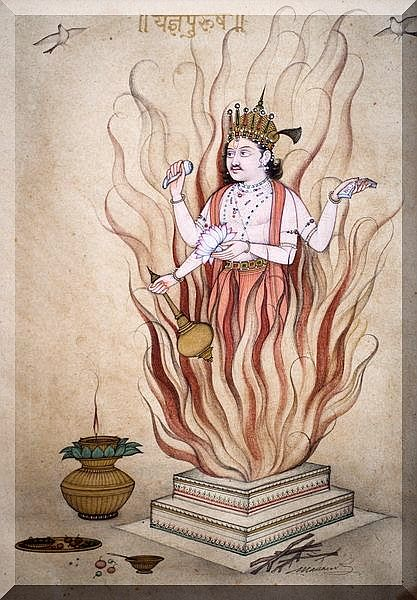
Reference: Subject: The Vedas
AGNI
Agni represents divine illumination. It is the excitement of discovery, and the key to all knowledge. Agni is the active power of looking and attaining insight through meditation.
.
Agni in Mandala 1, Sukta 1
(From Perplexity AI)
The main themes and symbols in Rig Veda Mandala 1, Sukta 1 center on the spiritual, psychological, and cosmic attributes of Agni, moving far beyond ritual fire and touching on the foundational ideas of Vedic thought.
Main Themes
- Agni as Power of Will: Agni represents willpower and direction, the force that introduces all other powers within the human soul to aid spiritual evolution and fulfillment.
- Collaboration of Divinity and Humanity: A recurring Vedic idea is that humans and devas (gods) are co-creators, collaborating in realizing higher truths and spiritual progress.
- Spiritual Progress and Plenitude: Agni is seen not just as a bestower of material wealth, but as the conduit for “inner plentitude,” inspiring and guiding seekers toward heroism, knowledge, and the fullness of being.
- Truth and Illumination: Agni is the “guardian of Truth”, symbolizing psychological illumination and the protection of divine order, rather than mere ritualistic functionality.
- Fatherly Guidance: Agni is invoked as a father figure, approachable and benevolent, reflecting seeds of later Bhakti traditions of emotional devotion and surrender.
Key Symbols
- Agni (Fire): Symbolizes both actual sacrificial fire and the internal spark of inspiration, consciousness, and transformation.
- Hota, Ritvik, Purohita: Agni embodies multiple priestly roles—invoker, knower of truth, and foremost guide in the ritual—which are metaphorical for guidance of thought and aspiration.
- Wealth (Ratna, Rayi): These terms represent not only material prosperity, but spiritual abundance, divine joy, and the richness of higher consciousness.
- Day and Night: Serve as symbols for the alternation of ignorance and illumination within the aspirant, underpinning the path to enlightenment.
Symbolic Interpretation
The language and imagery of Sukta 1 suggest that rituals themselves are metaphors for internal spiritual practices: kindling Agni inside oneself means awakening the will, aspiration, and the power to access higher consciousness and truth.
.
Evolution of Agni’ symbolism across Mandala 1
(From Perplexity AI)
Agni’s symbolism in Mandala 1 of the Rig Veda evolves from being the ritual fire and cosmic medium to embodying deeper spiritual, psychological, and metaphysical principles. Across the Mandala, Agni is described and invoked in several overlapping yet expanding roles that chart a journey from external ritual to inner realization and cosmic consciousness.
Early Hymns: Ritual and Spiritual Will
- In Sukta 1, Agni represents the presiding priest (purohita) and the Hotar, bridging humans and gods—a channel for offerings and blessings.
- He emerges as the psychological power of will—the force of aspiration and inspiration vital for spiritual progress, not merely a ritual symbol.
- Agni is the guardian of Truth (ṛta), simultaneously instilling order and illumination within the seeker.
Expansion of Symbolism: Cosmic and Psychological
- As the Mandala progresses, Agni’s symbolism deepens:
- Agni is described as present in three realms: earthly fire, lightning in the atmosphere, and the sun in the heavens—a messenger uniting all worlds.
- He is invoked as Jātaveda (“knower of all births and forms”), being the divine witness, carrier of wisdom, and guardian—connecting fire, knowledge, and divine order.
- Agni as Kravyād (the funeral fire) symbolizes transition, creative/destructive power, and purification—marking existence, transformation, and rebirth.
- Agni comes to represent consciousness, discernment, life force, and the mind’s swiftness—as well as the principle of tapas (spiritual heat/energy).
Internalization and Mystical Symbolism
- Later in Mandala 1, Agni is less an external force and more an internal principle—the spiritual fire kindled by the gods within the soul, not by human hands.
- There is frequent invocation of Agni as father, friend, and guide, with increasing emotional (Bhakti) resonance, encouraging surrender and inner union.
- Agni’s iconography and mythology expand; he is depicted with both beneficent and destructive aspects, reborn daily, yet immortal—pervasive in all forms of existence.
Agni evolves from external sacrificial fire to internalized divine principle—the transformative force uniting the ritual, the cosmos, and the inner journey of the seeker towards illumination and truth.
.
