
Reference: Postulate Mechanics
This glossary is a compilation of definitions in Hinduism that are applied in Postulate Mechanics .
.
Glossary
—A—
ADVAITA AND DVAITA
In Hindu philosophy, Advaita emphasizes non-duality, meaning that the ultimate reality (Brahman) and the individual soul (Atman) are one and the same. Dvaita, on the other hand, asserts a dualistic view where the supreme being (Brahman) and individual souls (jivas) are eternally distinct realities. Philosophically, non-duality is looking at the whole dimension; for example, the dimension of temperature. Whereas, duality is looking at the two ends of the dimension, such as hot-cold, while ignoring all the gradients in between. The gradient between Brahman and Atman is the gradient of unresolved anomalies. The lesser are the anomalies left to be resolved the closer one is to realizing Brahman.
ANOMALY
Anomaly is something that does not make sense because it is inconsistent, discontinuous or disharmonious. It generates doubts, perplexities and problems. Also consult PM: Glossary.
ĀTMAN (Self)
In Bhagavad Gita, ĀTMAN (Self) is used in the sense of universal divine essence, or pure consciousness. Atman (pure consciousness) may reside in a body, and take care of that body. But it is not identified with anything in the universe; and so, it has no individuality. Atman has the same sense as Sākār Brahman. It is realized when all unsettled karma has been resolved.
—B—
BHAKTI AND JNANA
Bhakti takes the “heart” approach. The “heart” in spiritual discourse typically refers to the source of emotions, intuition, and inner wisdom. Heart-centered approaches foster emotional intelligence, self-awareness, compassion, and a direct connection with a deeper sense of meaning or higher purpose. Bhakti Yoga centers on loving devotion to God, emphasizing emotional connection, surrender, and worship. Practices include prayer, singing hymns (bhajans), puja (rituals), pilgrimage, and developing a personal relationship with a chosen deity (Ishta Devata).
Jnana takes the “mind” approach. The “mind” represents the faculties of understanding, discernment, and critical thinking. Jnana Yoga focuses on intellectual inquiry and self-knowledge, seeking direct realization of the Self (Atman) as one with Brahman through wisdom and discrimination. Mind-centered spirituality might focus on studying, meditating on, or intellectually understanding spiritual teachings, and is crucial for discerning truth and applying knowledge wisely.
Most contemporary spiritual teachers and philosophies suggest a holistic approach: true spiritual maturity arises when one allows the mind and heart to inform and balance each other in all aspects of life. Regular spiritual practices such as meditation, prayer, contemplation, and self-reflection can help cultivate this integration, leading to greater peace, resilience, and fulfillment.
BRAHMAN
Brahman encapsulates the sense of pure consciousness of everything. This is considered to be Brahman that is Sākār (With Form). The realization of Sākār Brahman occurs as one is able to see things as they are without assumptions and misconceptions. This is essentially becoming conscious of the knowable Universe in its purity.
Brahman also encapsulates the sense of the all-inclusive source of everything, transcending all dualities and limitations. This is considered to be Brahman that is Nirākār (Formless). The realization of Nirākār Brahman occurs as one follows the process of “neti, neti” (not this, not that). This is essentially the realization that the ultimate source of everything is “Unknowable.”
—C—
CHANTING
A chant is the iterative speaking or singing of words or sounds. Chanting may also be done mentally in a meditative mode, where a person is looking closely at postulates associated with the word or sound. A chant has an effect of calming the mind. Regular chanting can enhance focus, improve memory, and foster feelings of connection and well-being. Chanting does not erase karma absolutely, but transforms it or lessens its effects through spiritual purification and divine grace. In scientific terms, chanting brings some assimilation of thought, but complete assimilation requires the resolving of anomalies through the practice of meditation.
—D—
DEATH AND BIRTH CYCLE
Death is the total and permanent cessation of all vital functions of a person. When the person dies, the consciousness of what he was while alive also disintegrates. But the contents of the mind continue as atman. That aspect of atman, which is assimilated thought, gets stored as knowledge in the society, culture and the universe. The other aspect, which is unassimilated thought, gets stored in the DNA of those subsequently born. This DNA storage is called KARMA because it influences the tendencies and actions of the person. The awareness of such tendencies and actions alert the person to the need of assimilation of karma.
DEITY
A deity is the symbolic representation of a postulate or a system of postulates. For example, Hindu trinity of Brahma, Vishnu, Mahesh is a symbolic representation of the principle of Create, Survive, Destroy. This is a cycle that applies to the fundamentals of life. Through the “worship” of deities a person evolves to new levels of consciousness. The Bhagavad Gita visualizes Krishna as the God teaching Jnana, Karma and Bhakti yoga. The Bhagavata Purana focuses on the worship of Krishna as the cosmic deity of Bhakti yoga.
DIVINE
The root meaning of the word DIVINE is ‘to shine’ from the observation that sun, moon and stars shine in the heavens. Divine is associated with phenomena that is amazing, inspired or prophetic. Divine attributes are those, which are “excellent in the highest degree.” Divine refers to higher ideals or spiritual qualities, such as, love, inspiration, excellence, selflessness, and the ability to resolve difficulties.
DVAITA
Please see ADVAITA AND DVAITA.
—E—
EVOLUTION
Human evolution occurs in infinitesimal steps. The source of this evolution is resolution of karma. Such a resolution not only straightens out the earlier DNA programming; but it also updates that programming, which adds new capabilities.
—F—
—G—
GOD
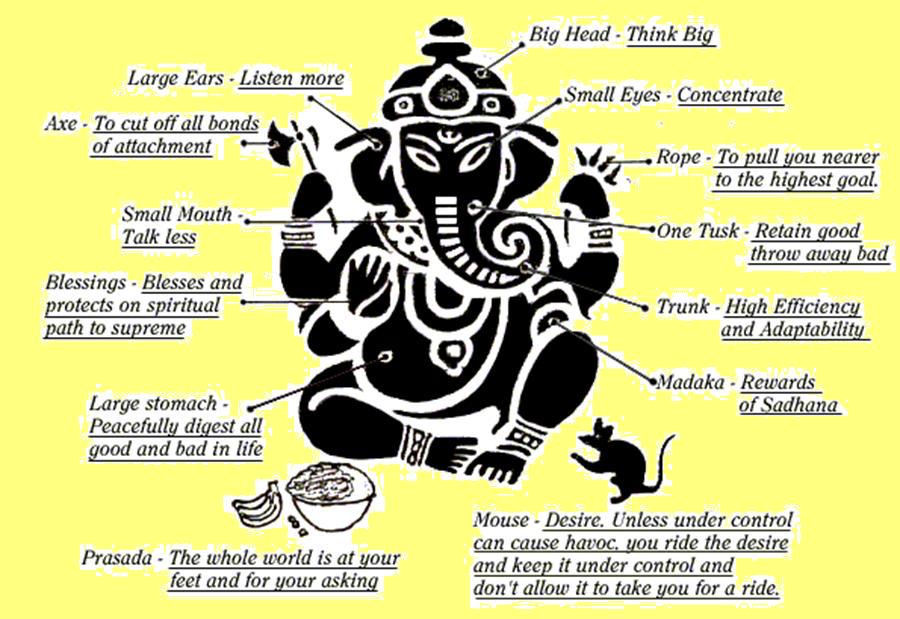
God is visualized as a being that has divine attributes. In Hinduism, different gods and deities emphasize different divine attributes or principles. For example, Ganesha is a god in Hinduism, who is viewed as the remover of obstacles. Such a visualization of a god helps the devotee absorb god’s spiritual attributes both intuitively and descriptively. It is intuitively felt that all spiritual attributes integrate into a oneness. Thus, Hindus may worship different gods on different occasions, and even worship the gods of other religions.
—H—
HINDUISM AND KARMA
Brahma of the Trinity “Brahma-Vishnu-Mahesh” is a symbolic representation of the concept of Creation. Māyā that forms the bridge between Brahman and Reality also represents the creative process. Brahma and Māyā are quite similar in this respect. They are from two different periods and from two different philosphies during the evolution of Hinduism over the centuries. The profusion of such terminology and their representation by different deities in Hinduism makes this religion to appear very complex. But all this complexity disappears when we assimilate myriads of such representations in our understanding for the purpose of dissolving Karma.
—I—
—J—
JIVĀTMAN
The divine core (consciousness) of a person is the individual self, or JIVATMAN. Jivatman makes a person unique and different from others around him. Jivatman is essentially a bundle of karma (identifications) activated by atman. As a person dissolves his unsettled karma, he rises in his consciousness from Jivatman to Atman (Sākār Brahman). He loses all identifications and individuality. Upon death of an individual, the bundle of his unresolved karma continues in the form of genetic programming in his descendants; and also as the unresolved effects of his actions in the society.
—K—
KARMA
Karma is action that is committed out of ignorance. When a person is dissolving his “karma,” he is basically dissolving his ignorance, which led to that action. Karma is stored in the form of “mental impressions”. Such impressions are carried forward genetically.
Kriyamana karma = Current actions being generated by one’s ignorance
Prarabdha Karma = Stored actions generated by individual ignorance
Sanchita Karma = Stored actions generated by universal ignorance
—L—
—M—
MĀYĀ
Māyā is the process by which Nirākār (Formless) arises to be Sākār (With Form); or, in modern terms, the Unknowable becomes knowable. Māyā has been described as the cosmic illusion or creative potential; but, in modern terms, it is best described as the process of ‘postulation.’ Dictionaries define a ‘postulate’ as a creative thought that is claimed to be true, and which is then used as the starting point for reasoning. So, matter, energy, space and time are postulates, and so are Krishna, Shiva and Kali. Thus, the knowable universe is manifested through the process of postulation. The source of the postulates is Unknowable.
MEDITATION
The purpose of meditation is to assimilate the unassimilated content of the mind and to look beyond. Meditation has a precise technology based on the understanding of the nature of the mind. The first description of meditation is found in the ancient Rig Veda. Meditation is all about looking and investigating. It has little to do with thinking and trying to empty the mind. A person first acquires the spiritual discipline of seeing things as they are. He then practices Karma yoga, acting for the benefit of all, so as not to keep adding to his karma. He then starts practicing meditation to start reducing his accumulated karma. As he assimilates karma he acquires many insights.
MOKSHA AND NIRVANA
In Hinduism, Moksha is the realization that Atman and Brahman are one and the same. Atman is the universal divine essence that is loaded with karma. As this karma is dissolved, the state of Atman approaches the state of Brahman. Moksha comes about when a person attains the state of pure consciousness of Sākār Brahman. Nirvana occurs when the person overcomes even the māyā of pure consciousness and realizes the unknowable state of Nirākār Brahman.
MYSTERY
A mystery is a lower harmonic of Unknowable. Calling something a mystery draws people’s attention to it because the most basic impulse of a person is to know. The natural action to know is to make a postulate. The lower harmonic of a postulate is an assumption. So, it is natural for the person to make an assumption when he is faced with a mystery. There is nothing wrong with making assumptions. But if that assumption generates an anomaly, then he must resolve that anomaly to know the truth. People in this world want to improve their condition, and they are searching for truth. They are already sitting with many assumptions to their credit. These assumptions are the things they have taken for granted without examining them closely. The only way for them to discover truth is to look at their assumptions, spot the related anomalies and resolve them. So, a person who finds himself in a mystery of not knowing how to go about improving his condition, must start with something that he has taken for granted to explain his condition and examine it closely. This is the only way out of the mystery.
—N—
NIRVANA
Nirvāṇa literally means, “blown out”, as in an oil lamp. It represents the blowing out of Self, as in the realization that even Self is a product of maya, or postulate. Nirvana is the ultimate release from dukkha and saṃsāra. Also see MOKSHA AND NIRVANA.
—O—
ONENESS
Liberation (Moksha), in Hinduism, is experiencing oneness with all reality. It is like one has become the whole reality. It is not sameness; but a feeling of continuity, consistency and harmony everywhere. There is continuity of dimensions, consistency of realities, and harmony of relations. It is not a monotone canvas; but a beautiful painting full of colors and forms that are in perfect alignment with each other. Also consult PM: Glossary.
—P—
PARAMĀTMAN (Ultimate Self)
Paramatman is the ultimate state of pure consciousness. Paramatman has the same sense as Sākār Brahman. As the awareness of a person rises, it converges to this state. Selflessness is the attribute of Paramatman, where all personality/individuality vanishes.
POSTULATE
Māyā is viewed as illusion but it is really a creative postulate. When all the postulates are consistent there exists a solid reality. That solid reality is our universe. Also consult PM: Glossary.
—Q—
—R—
REBIRTH
For a specie to continue, the DNA passes from a life organism to its progeny. Birth and death of a life organism are a part of this continuation of the specie and its evolution. This applies to humans also. Rebirth is the concept of a human being carrying forth the karma of the specie. This determines certain attributes of the person existing from birth that are unique to him, but which he shares with his ancestors. Part of such attributes are memories, which are not from the current life of the person. This makes the person believe that he has lived before.
—S—
SACRIFICE (YAJNA)
Sacrifice means that our actions should be in harmony with the physical and spiritual laws of nature, and not just fixated on ourselves. The nature provides us with everything to sustain ourselves; and we must do everything to sustain the nature back. A community is part of that nature. Yajna (sacrifice) means the performance of one’s duty to foster and nourish others in their advancement in accordance with the laws of nature. Such karma is naturally assimilated.
—T—
TANTRA
The term “Tantra” is derived from the Sanskrit root “tan” (to expand) and “tra” (instrument), signifies the use of various techniques to transcend ordinary consciousness and achieve a higher state of awareness. The ultimate goal of Tantra is liberation (moksha) or enlightenment. Tantra views the universe as a web where everything is interrelated and interconnected. Unlike some other spiritual traditions that view the body and the material world as obstacles, Tantra sees them as potential tools and manifestations of the divine. Tantra involves various meditation practices, rituals, and visualizations, often centered on deities and mandalas. Mantras (sacred sounds or words) and yantras (geometric diagrams) are used to invoke specific energies and states of consciousness. Tantric practices can involve working with the subtle body, including the chakras, nadis (energy channels), and vital winds (prana).
THOUGHT
Thought is a substance where substance is anything substantial enough to be sensed. Awareness always requires a substance, or a form made of substance, to be aware of; otherwise, awareness cannot exist. This is a basic postulate.
—U—
—V—
—W—
—X—
—Y—
YAJNA
Yajna means selfless action done for the welfare of the world. For example, Jnana yajna is performed to spread jnana for larger benefit of community. The ritual of yajna is a symbol for such action. Please see SACRIFICE.
