
Reference: Essays on Substance
Inertia and Absolute Motion
Newton saw the planets moving against an unchanging background of star-studded skies, and so he conceived the idea of absolute motion. Absolute motion required a reference to a fixed, unmoving background. Newton conceived this reference as absolute space and gave it an abstract definition. An abstract space cannot be visualized as something real, and that is where Newton’s definition of absolute motion fell apart.
But Newton was not too far from the truth. What made star-studded skies a fixed, unmoving background was not space but the stars that maintained unchanging configurations. The unchanging configuration came about because stars had a high inertia (both linear and rotational) that kept them pinned to a location in space.
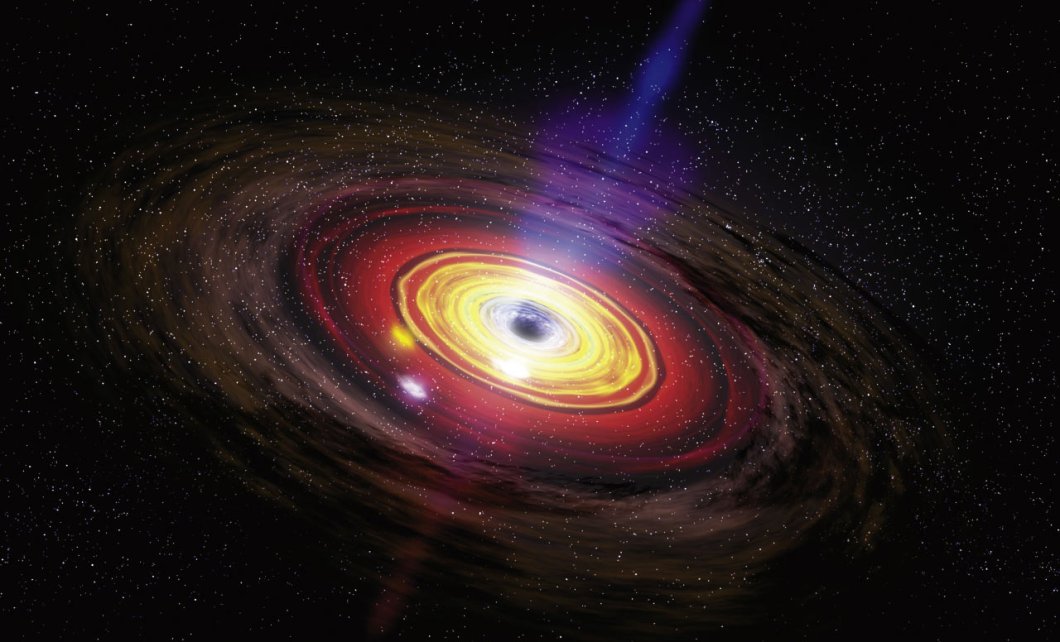
We can easily visualize an object of infinite inertia to provide a fixed, unmoving reference point. For example, the back hole at the center of a galaxy has higher inertia than any other individual star in the galaxy. It, therefore, provides a fixed, unmoving reference point for rest of the galaxy. The motion of a body with respect to such a fixed, unmoving reference point, may then be plotted on an absolute scale of motion.
The inertia of Earth is much less than the inertia of the black hole at the center of galaxy. Therefore, Earth will have a measure of absolute motion with respect to the center of galaxy. Similarly, light will have absolute motion with respect to the center of galaxy; but this motion will be very large because light hardly has any inertia. Thus, it is possible to have a scale of absolute motion, which would be inverse of the scale of inertia.
In the post, Michelson-Morley’s Null Result, we made a rough calculation of the drift speed of Earth based on its estimated inertia. That drift speed was found to be much smaller than the speed of Earth relative to the Sun. This was because the calculated drift speed of Earth represented the absolute motion of Earth in space. By conceiving motion as inverse of inertia, and taking into account the gravitational effects, we can find the absolute motion of particles in space.
The above reasoning also provides an insight into why light has extremely large but finite speed. It is because light has a very small but finite inertia. This gives rise to the following postulate of the Theory of Substance:
The velocity of a particle in free space is constant because its motion is balanced by the inertia of its mass, or consistency. The motion increases as the mass, or consistency, decreases.
.
